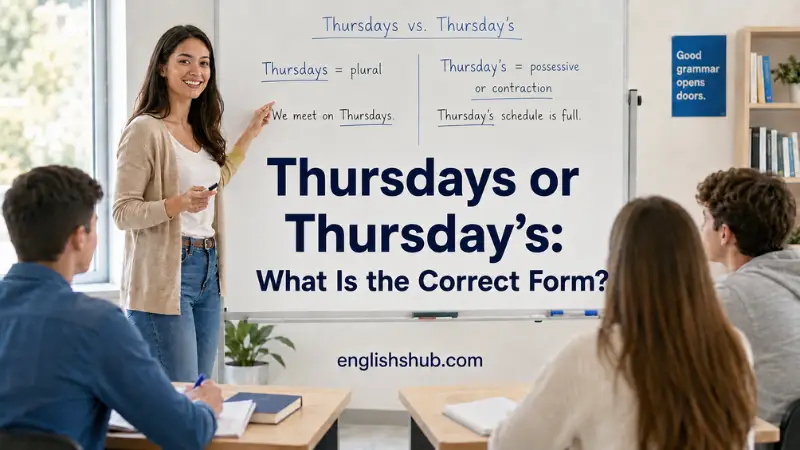
Choosing between Thursdays or Thursday’s depends on the job the word performs. Use Thursdays for more than one Thursday or a weekly routine. Use Thursday’s when something relates to one Thursday or when the form shortens Thursday is or Thursday has.
The apostrophe may be small, but it changes the sentence’s grammar. Knowing whether you need a plural, possessive, or contraction will help you write clearer schedules, emails, invitations, and announcements.
Quick Answer
Both Thursdays or Thursday’s can be correct, but they are not interchangeable. Use Thursdays for several Thursdays or recurring activities: “We meet on Thursdays.” Use Thursday’s for something associated with one Thursday, as in “Thursday’s meeting,” or as a contraction of Thursday is or Thursday has.
Key Takeaways
- Use Thursdays for multiple Thursdays or a recurring weekly schedule.
- Use Thursday’s to connect something with one Thursday.
- Thursday’s can also mean Thursday is or Thursday has.
- Write every Thursday, never every Thursdays.
- Use Thursdays’ only for possession involving multiple Thursdays.
Thursdays or Thursday’s at a Glance
| Form | Grammatical Role | Meaning | Example |
|---|---|---|---|
| Thursday | Singular proper noun | One specific day | The appointment is Thursday. |
| Thursdays | Plural or adverbial use | Multiple Thursdays or every Thursday | We work late on Thursdays. |
| Thursday’s | Singular possessive | Associated with one Thursday | Thursday’s deadline was extended. |
| Thursday’s | Contraction | Thursday is or Thursday has | Thursday’s been unusually busy. |
| Thursdays’ | Plural possessive | Associated with several Thursdays | Those Thursdays’ sales were strong. |
The Core Rule for Thursdays or Thursday’s

Use Thursdays when the final s makes the word plural. Use Thursday’s when the apostrophe shows possession or replaces missing letters in a contraction.
The Purdue Online Writing Lab’s apostrophe guidance
confirms the general pattern: add ’s to a singular noun for possession, but add only s to form most ordinary plurals. Therefore, an apostrophe does not belong in a simple plural such as Thursdays.
Ask these three questions:
- Do I mean several Thursdays or a weekly habit? Use Thursdays.
- Does another word relate to one Thursday? Use Thursday’s.
- Can I expand the form to Thursday is or Thursday has? Use Thursday’s.
These checks solve nearly every everyday case.
When to Use Thursdays
Thursdays is the regular plural form of Thursday. It can refer to several separate dates or to something that happens regularly on that weekday.
Correct examples include:
- There are five Thursdays in October.
- Our office closes at 6 p.m. on Thursdays.
- She attends evening classes Tuesdays and Thursdays.
- Thursdays are usually quieter than Fridays.
- The museum offers free admission Thursdays.
The last example uses Thursdays to mean “on Thursdays.” This adverbial use is standard.
The Dictionary.com entry for Thursdays
recognizes both the ordinary plural and the meaning “every Thursday” or “on Thursdays.”
Do not insert an apostrophe merely because the word ends in s. Nothing in these examples belongs to one Thursday, and no letters have been omitted.
When Thursday’s Shows Possession
Thursday’s is the singular possessive form when a meeting, deadline, event, forecast, or other detail relates to one Thursday. The relationship does not need to involve literal ownership.
For example:
- Thursday’s meeting starts at 10 a.m.
- We changed Thursday’s lunch menu.
- Thursday’s weather forecast calls for rain.
- Please send me Thursday’s sales report.
- The team discussed Thursday’s disappointing result.
In “Thursday’s meeting,” the phrase means “the meeting associated with Thursday.” This construction is shorter and more natural than “the meeting of Thursday.”
The MLA Style Center’s apostrophe rules
support this formation: a singular possessive noun normally takes an apostrophe followed by s. Because Thursday is singular, its possessive form becomes Thursday’s.
Thursday’s Can Mean Thursday Is or Thursday Has
Thursday’s is not always possessive. It can also be a contraction of Thursday is or Thursday has. The words following it reveal the intended meaning.
Thursday’s meaning Thursday is
- Thursday’s our final day to register.
- Thursday’s usually the busiest day.
- Thursday’s not convenient for the interview.
Expand the first sentence to “Thursday is our final day to register.” Because it still makes sense, the apostrophe marks omitted letters.
Thursday’s meaning Thursday has
- Thursday’s been reserved for staff training.
- Thursday’s already brought several surprises.
- Thursday’s become our preferred meeting day.
Here, Thursday’s been expands to Thursday has been. This contraction sounds natural in speech and informal writing. However, spelling out the full form may improve clarity in formal business documents.
What Does Thursdays’ Mean?
Thursdays’ is the plural possessive form. It describes something associated with multiple Thursdays rather than one Thursday.
For example:
- The last three Thursdays’ attendance figures were unusually high.
- Those Thursdays’ schedules included additional training.
- Both Thursdays’ events ended early.
The construction is grammatical, but it can look awkward. Often, rewriting produces a clearer sentence:
- Attendance was unusually high on the last three Thursdays.
- The schedules for those Thursdays included additional training.
- The events on both Thursdays ended early.
The rule follows the standard pattern for plural nouns ending in s: make the plural first and then place the apostrophe after the final s. Use Thursdays’ only when the sentence truly needs plural possession.
Every Thursday or on Thursdays?
Both every Thursday and on Thursdays describe recurring activities. However, the grammar differs.
Use the singular after every:
- We publish a newsletter every Thursday.
- The bus arrives early every Thursday.
- Every Thursday brings a new assignment.
Use the plural in the phrase on Thursdays:
- We publish our newsletter on Thursdays.
- The clinic stays open late on Thursdays.
- I work from home on Thursdays.
Do not write every Thursdays or every Thursday’s when you mean a weekly routine. The determiner every treats each occurrence separately, so it takes the singular form Thursday. Meanwhile, on Thursdays groups repeated Thursdays into a recurring schedule.
For one particular date, write on Thursday: “The clinic will close early on Thursday.”
Thursday Meeting vs Thursday’s Meeting
Both Thursday meeting and Thursday’s meeting can be correct, but their emphasis may differ.
In Thursday meeting, the singular noun Thursday works as a noun adjunct. It identifies the type or scheduled day of the meeting:
- Our Thursday meeting happens every week.
- The Thursday meeting has moved online.
- We canceled all Thursday meetings this month.
Thursday’s meeting usually points to the meeting associated with a particular Thursday:
- Thursday’s meeting was canceled because of the storm.
- I prepared the slides for Thursday’s meeting.
The distinction is flexible. Speakers may use either phrase for an upcoming meeting. Still, Thursday meetings sounds especially natural for a recurring category, while Thursday’s meeting often identifies one occasion.
Capitalization and Style Rules
Always capitalize Thursday because names of weekdays are proper nouns. Capitalize every grammatical form:
- Thursday
- Thursdays
- Thursday’s
- Thursdays’
Write “We meet on Thursdays,” not “We meet on thursdays.” The same rule applies in sentences, schedules, calendar labels, email subject lines, and titles.
An apostrophe should be curly or straight according to your publication’s typography, but its grammatical position must remain correct. In plain text, Thursday’s is acceptable. In typeset content, Thursday’s usually looks more polished.
Also avoid changing the rule for headlines. “Thursday’s Schedule” needs an apostrophe if it means the schedule for Thursday. “Open Thursdays” needs none because it describes recurring business hours.
Common Mistakes and Corrections
Most mistakes happen when writers use an apostrophe to create an ordinary plural.
Incorrect: We have soccer practice on Thursday’s.
Correct: We have soccer practice on Thursdays.
Reason: The practice recurs on multiple Thursdays.
Incorrect: Every Thursdays, the store closes early.
Correct: Every Thursday, the store closes early.
Reason: Every takes a singular countable noun.
Incorrect: Thursdays meeting begins at noon.
Correct: Thursday’s meeting begins at noon.
Reason: The meeting relates to one Thursday.
Incorrect: Thursday’s are difficult for me.
Correct: Thursdays are difficult for me.
Reason: The sentence refers to Thursdays in general.
Incorrect: Thursday’s been busy means possession.
Correct explanation: Here, Thursday’s means Thursday has.
Reason: The phrase expands to “Thursday has been busy.”
According to Purdue OWL’s proofreading advice,
writers should check whether a final s marks possession, plurality, or a contraction.
A Three-Step Editing Test
Use this quick process whenever the forms look confusing:
- Check for recurrence or quantity.
If the sentence means several Thursdays or every Thursday, write Thursdays. - Look for a related noun.
If a meeting, deadline, forecast, or event relates to one Thursday, write Thursday’s. - Expand the possible contraction.
Replace Thursday’s with Thursday is or Thursday has. If the expanded sentence works, keep the apostrophe.
For instance, “Thursday’s our deadline” passes step three because “Thursday is our deadline” makes sense. By contrast, “We meet on Thursday’s” passes none of the apostrophe tests. It requires the ordinary plural: “We meet on Thursdays.”
FAQs
Yes. On Thursdays describes an activity that occurs regularly on that day, as in “We hold staff meetings on Thursdays.” Use on Thursday when referring to one particular Thursday, usually understood from the surrounding context.
Use Thursdays when listing recurring business hours: “Open late Thursdays” or “Open 9–6 on Thursdays.” Use Thursday’s when discussing one day’s hours: “Thursday’s opening hours have changed because of the holiday.”
Yes. Thursday’s meeting is a correct singular possessive construction meaning the meeting associated with Thursday. You may also write the Thursday meeting, especially when describing a regular type of meeting rather than emphasizing one specific occasion.
Yes. It can mean Thursday is in “Thursday’s the deadline” or Thursday has in “Thursday’s been exhausting.” Expand the expression to determine whether it functions as a contraction rather than a possessive noun.
The plural is Thursdays, without an apostrophe. For example, “The month contains five Thursdays.” Names of weekdays form their regular plurals by adding s, just like many other English nouns.
Yes. Thursdays’ is the plural possessive form, as in “Those Thursdays’ schedules were full.” Although it is grammatically valid, it is uncommon. A rewrite such as “the schedules for those Thursdays” often reads more clearly.
Conclusion
The choice between Thursdays or Thursday’s becomes easy once you identify the word’s purpose. Use Thursdays for multiple days or a recurring weekly activity. Use Thursday’s for something associated with one Thursday or for the contractions Thursday is and Thursday has.
If several Thursdays possess something, Thursdays’ is possible, though rewriting may improve clarity. Before adding an apostrophe, check whether the sentence expresses possession or omits letters. If neither applies, the ordinary plural is probably correct.