
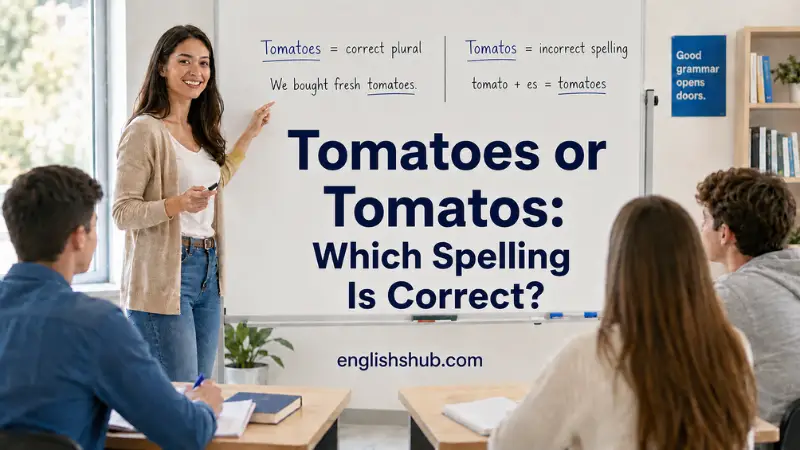
When choosing between tomatoes or tomatos, write tomatoes. It is the only standard plural of tomato, while tomatos is a misspelling. You add -es when referring to two or more of these fruits or plants: “We picked six tomatoes.”
The confusion is understandable because some nouns ending in o, including photos and pianos, take only -s. However, English does not apply one universal plural pattern to every such word. You must use the established form for the specific noun.
Quick Answer
Tomatoes is the correct plural of tomato. Tomatos is incorrect in standard American and British English. Write “one tomato” for the singular form and “two tomatoes” for the plural. The added e belongs only to the plural ending -es; it does not change the singular spelling to tomatoe.
Key Takeaways
- Tomatoes is the only standard plural spelling.
- Tomatos is a spelling error, not an accepted variant.
- The singular word remains tomato without a final e.
- Some other nouns ending in o take only -s.
- Apostrophes indicate possession, not an ordinary plural.
- American and British dictionaries both use tomatoes.
Tomatoes or Tomatos at a Glance
| Form | Correct Spelling | Purpose | Example |
|---|---|---|---|
| Singular | tomato | Refers to one | I sliced a tomato. |
| Plural | tomatoes | Refers to more than one | She bought four tomatoes. |
| Singular possessive | tomato’s | Something belongs to one tomato | The tomato’s skin split. |
| Plural possessive | tomatoes’ | Something belongs to several | The tomatoes’ color changed. |
| Misspelling | tomatos | Not standard English | Avoid this form. |
| Misspelling | tomatoe | Not the singular form | Write tomato instead. |
Is Tomatoes or Tomatos Correct?
Tomatoes is correct; tomatos is not an accepted plural in standard English.
The Merriam-Webster entry for tomato
lists its plural as tomatoes.
Likewise, the Cambridge Essential American Dictionary gives the same form.
A plural noun refers to more than one person, place, object, or idea. Therefore, use tomatoes whenever the quantity is two or more:
- One tomato was left in the basket.
- Three tomatoes were left in the basket.
- These tomatoes are ready to eat.
Although people sometimes type tomatos, frequent use does not make it a standard variant. Correct it in school assignments, recipes, menus, business materials, and other edited writing.
Why Tomato Becomes Tomatoes
The plural of tomato is formed by attaching the suffix -es: tomato + es = tomatoes. The original o remains, and the ending adds the letters e and s. Nothing is removed from the base word.
Many traditional English spelling lessons teach that nouns ending in a consonant followed by o often take -es. This pattern works for familiar words such as:
- tomato → tomatoes
- potato → potatoes
- hero → heroes
- echo → echoes
However, treat this pattern as helpful guidance rather than a universal law. English has borrowed words from many languages, and its plural forms developed in different ways. As a result, several consonant-plus-o nouns take only -s, while others accept either ending.
For tomato, no choice is necessary. Standard dictionaries consistently record tomatoes.
Why Tomatos Looks Correct but Is Not
Tomatos may look reasonable because the usual English spelling rule forms a plural by adding -s. Writers use that simple pattern in words such as books, cars, and apples. It also works with several words ending in o, including radios, videos, and photos.
That similarity causes the mistake:
- photo → photos
- radio → radios
- tomato → tomatoes, not tomatos
Spell-checking software may catch the error, but understanding the form is more reliable. If a program flags tomatos, replace it with tomatoes. Do not add an apostrophe, and do not change the word to tomato’s unless the sentence shows possession.
The extra e does not change the meaning. It is simply part of the established plural ending.
Tomato, Tomatoes, Tomato’s, and Tomatoes’
The four forms differ in number and possession. Tomato and tomatoes tell readers how many are involved. By contrast, tomato’s and tomatoes’ show ownership or association.
Tomato
Use tomato for one fruit or plant:
- A tomato rolled off the counter.
- The farmer examined each tomato plant.
A noun can also modify another noun. In “tomato sauce,” for example, tomato describes the type of sauce. English usually keeps this attributive noun singular even if the sauce contains several tomatoes.
Tomatoes
Use tomatoes for more than one:
- The recipe requires five tomatoes.
- Tomatoes grow well in sunny locations.
Tomato’s
Use tomato’s when something belongs to or concerns one tomato:
- The tomato’s skin was unusually thick.
- The tomato’s weight was recorded.
The apostrophe can also mark the contraction tomato is, although that construction is uncommon: “The tomato’s ready” means “The tomato is ready.”
Tomatoes’
Use tomatoes’ for possession involving multiple tomatoes:
- The tomatoes’ skins began to wrinkle.
- The tomatoes’ total weight was ten pounds.
Never use tomato’s merely to create an ordinary plural.
Examples of Tomatoes in Sentences
Correct examples help establish the spelling more effectively than repeating the rule alone. In each sentence below, tomatoes refers to multiple fruits or plants.
- We bought tomatoes, onions, and peppers for the salsa.
- The gardener protected the tomatoes from the first frost.
- Add the chopped tomatoes after the garlic begins to soften.
- Several tomatoes fell from the vine during the storm.
- Our science class compared tomatoes grown under different lights.
- The restaurant receives fresh tomatoes from a nearby farm.
- Red and yellow tomatoes made the salad more colorful.
- Please check whether we need tomatoes before visiting the store.
- These tomatoes are ripe, but those still need another day.
- Maya packed two tomatoes in a separate container.
Here are two incorrect sentences with their corrections:
- Incorrect: The soup contains roasted tomatos.
Correct: The soup contains roasted tomatoes. - Incorrect: We planted six tomato’s.
Correct: We planted six tomatoes.
In the second example, the apostrophe does not belong because the sentence expresses quantity, not possession.
Nouns Ending in O Do Not Share One Rule
Nouns ending in o fall into several spelling groups. That is why guessing based on the final letter can produce errors.
| Add -es | Add -s | Either Form May Be Accepted |
|---|---|---|
| tomatoes | photos | volcanoes or volcanos |
| potatoes | pianos | tornadoes or tornados |
| heroes | radios | halos or haloes |
| echoes | studios | zeros or zeroes |
Dictionary preferences can vary for words in the third group. Therefore, consult a current dictionary when you are unsure. Still, this variation does not apply to tomato: its standard plural is always tomatoes.
Some explanations claim that every consonant-plus-o noun takes -es or that every recently borrowed word takes -s. Neither claim works in all cases. English spelling contains established patterns, exceptions, and forms that changed over time. A dictionary provides a safer answer than an overly broad shortcut.
Tomatoes or Tomatos in American and British English
American English and British English both spell the plural tomatoes. There is no standard regional distinction in which Americans use one form and British writers use the other.
You may notice a difference in how speakers pronounce tomato. Many Americans say a version resembling “tuh-MAY-toh,” while many British speakers use a vowel resembling “tuh-MAH-toh.” However, both groups retain the same written plural:
- American English: tomatoes
- British English: tomatoes
The spelling also remains the same in formal and informal contexts. Text messages may contain shortened or mistaken forms, but tomatos does not become correct because the setting is casual.
How to Pronounce Tomato and Tomatoes
In common American pronunciation, tomato sounds approximately like “tuh-MAY-toh,” and tomatoes sounds like “tuh-MAY-tohz.” The plural ending is usually pronounced like a z sound, even though it is written with an s.
Pronunciation does not determine whether you insert the e. The ending may sound like a simple final syllable, so a writer cannot always recover the correct spelling from speech alone.
Merriam-Webster recognizes more than one standard pronunciation of tomato. Therefore, accent differences are not spelling errors. A person may pronounce the central vowel differently while still writing tomatoes. Keep the pronunciation issue separate from the plural spelling decision.
How to Remember the Correct Spelling
The easiest reminder is to connect tomatoes with potatoes. Both singular nouns end in -ato, and both form their standard plurals with -atoes:
- tomato → tomatoes
- potato → potatoes
You can also divide the plural visually:
tomato + es = tomatoes
This method shows that you are not inserting a random letter inside the noun. Instead, you are adding the complete plural ending -es.
A third memory aid is the phrase “Tomatoes take ES.” The words tomatoes and take begin with t, while ES identifies the required ending. A useful mnemonic should lead to the correct form without pretending that every word ending in o follows the same rule.
How to Correct Tomatos in Your Writing
Correcting the error takes three quick steps:
- Search for the exact misspelling. Use your editor’s Find command to locate every instance of tomatos.
- Check the sentence’s meaning. If it refers to more than one tomato, replace the word with tomatoes.
- Review nearby apostrophes. Change tomato’s to tomatoes when the sentence expresses only a plural quantity.
For example, “The farm sells tomato’s” should become “The farm sells tomatoes.” However, “The tomato’s stem broke” is correct because the stem belongs to one tomato.
Finally, run a spelling checker, then proofread the sentence yourself. Automated tools help find mistakes, but they may not always determine whether you intended a plural or a possessive form.
FAQs
The plural of tomato is tomatoes. Add -es to the singular word without removing its final o: tomato + es = tomatoes. This is the standard form in American and British English.
No, tomatos is not a standard English spelling. It usually appears because a writer applies the common add-s plural pattern. In edited writing, replace it with tomatoes whenever you mean more than one tomato.
No, the singular form is tomato, without a final e. The letter e appears when the plural ending -es is added. Write “one tomato” but “two tomatoes.”
Write tomatoes for more than one and tomato’s to show possession by one tomato. For example, “I washed the tomatoes” is plural, while “The tomato’s skin split” uses the singular possessive form.
English nouns ending in o do not follow one universal pattern. Tomato takes -es, while photo takes only -s. Because both patterns contain exceptions, checking an established dictionary is safer than applying one rule to every word.
Yes. The singular noun often acts as a modifier in phrases such as “tomato plants,” “tomato slices,” and “tomato recipes.” The following noun carries the plural ending, so “tomatoes plants” would normally be incorrect.
No. Both American and British English use tomatoes. Their pronunciation of tomato may differ, particularly in the stressed vowel, but the singular and plural spellings remain the same.
Conclusion
When deciding between tomatoes or tomatos, choose tomatoes. It is the recognized plural of tomato in both American and British English, while tomatos is a spelling mistake. Remember the construction tomato + es, or pair the word with potatoes as a quick reminder.
However, do not extend this pattern to every noun ending in o. Words such as photos take only -s, and some nouns accept two plural forms. When another word causes doubt, confirm its spelling in a current dictionary.