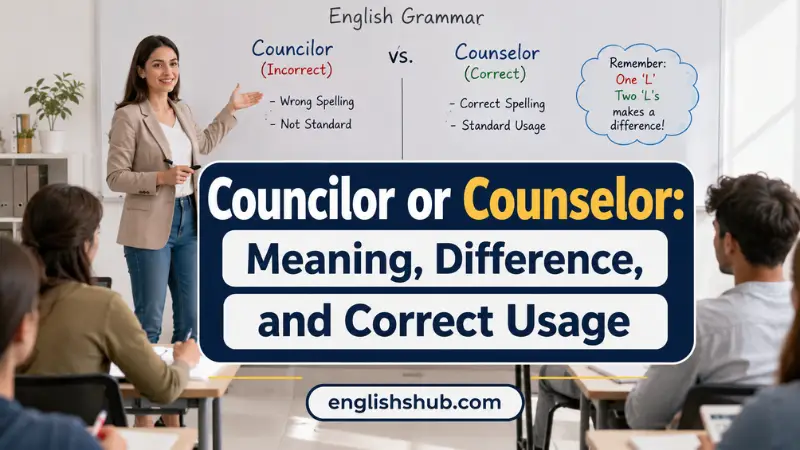
If you are deciding between councilor or counselor, the correct choice depends on the person’s role. A councilor is a member of a council, especially a local government body, while a counselor is someone who provides advice, guidance, or counseling. The words sound alike, but their meanings are different. In American English, the spelling also matters because councilor and counselor belong to different word families. Understanding that distinction helps you write accurately in government, education, legal, and personal contexts.
Quick Answer
Councilor means a member of a council, while counselor means someone who gives advice, guidance, or counseling. In U.S. English, use councilor for a local government role and counselor for an adviser or counseling professional. British English commonly uses councillor and counsellor for the corresponding forms.
Key Takeaways
- Use councilor for a member of a council.
- Use counselor for someone who provides advice or counseling.
- American English usually uses single-l spellings.
- British English commonly uses councillor and counsellor.
- Context determines which word belongs in your sentence.
Councilor or Counselor at a Glance
| Word | Meaning | Common Context | U.S. Spelling | Example |
|---|---|---|---|---|
| Councilor | Member of a council | Local government | Councilor | The councilor proposed a new ordinance. |
| Counselor | Person who provides advice | Counseling, education, law | Counselor | The counselor helped the student plan for college. |
| Councillor | Member of a council | British/Commonwealth English | Less common U.S. form | The councillor attended the council meeting. |
| Counsellor | Person who gives advice | British/Commonwealth English | Less common U.S. form | The counsellor spoke with the student. |
What Does a Councilor Mean in American English?
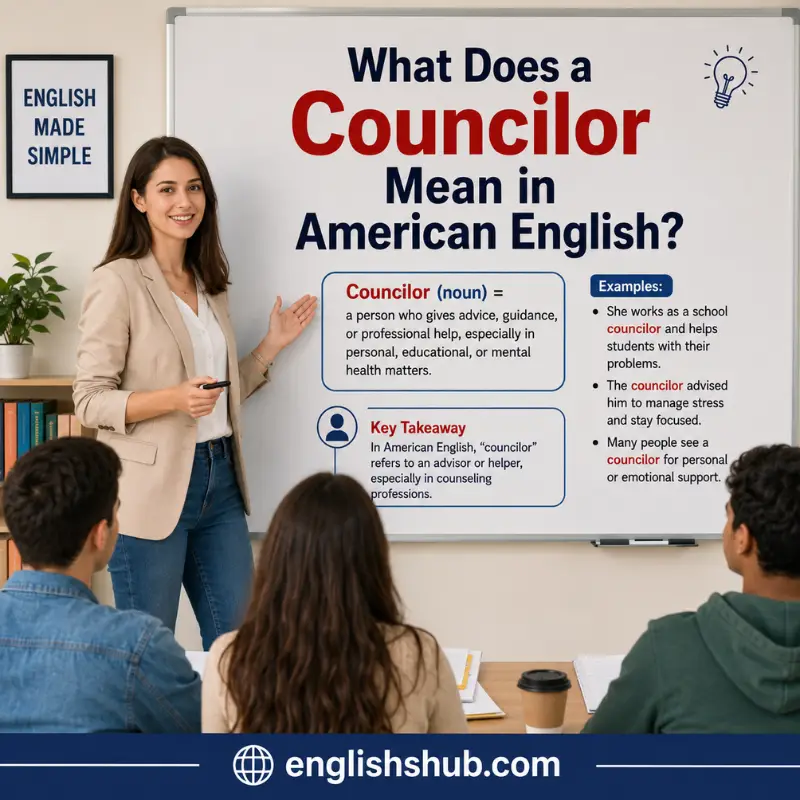
A councilor is a member of a council. In the United States, the word commonly refers to someone serving on a city or other municipal council, although local titles vary by jurisdiction.
The National League of Cities explains that city councils act as the legislative bodies of municipalities. Their responsibilities can include budgets, public services, local priorities, taxes, and other matters established by local law.
National League of Cities: City Councils and Council Powers
This matters because councilor describes a civic role, not a counseling profession. A councilor may represent residents, participate in meetings, vote on proposals, or help shape local policy.
For example:
- The councilor voted on the proposed housing ordinance.
- Residents contacted their councilor about road repairs.
- The councilor attended the municipal budget meeting.
The exact duties of a council member can vary because municipal government structures differ among states and cities. Therefore, “councilor” identifies the person’s relationship to a council rather than a single nationally standardized job description.
What Does a Counselor Mean?
A counselor is a person who provides advice, guidance, or counseling. The term can apply to several professional settings, including education, mental health, law, and summer camps.
Merriam-Webster lists several meanings for counselor, including a person who gives advice or counseling, a lawyer, and someone with supervisory duties at a summer camp.
Merriam-Webster: Counselor Definition
The American Counseling Association also describes professional counselors as people who help clients gain insight, develop strategies, and address challenges. Its professional material shows that counseling can involve different areas of personal and professional life.
American Counseling Association: What Is Counseling?
Common examples include:
- Guidance counselor: helps students with academic or personal decisions.
- School counselor: supports students with educational, career, and personal concerns.
- Marriage counselor: works with couples on relationship concerns.
- Mental health counselor: provides professional counseling for mental and emotional concerns.
- Legal counselor: an adviser or lawyer providing legal guidance.
The important point is that counselor is connected with counsel, or advice and guidance, rather than membership in a council.
Councilor or Counselor: What Is the Main Difference?
The simplest difference is council versus counsel. A council is a group or governing body, while counsel relates to advice, guidance, or legal representation.
A useful test is to replace the person with a more descriptive phrase:
- If you mean “member of a council,” choose councilor.
- If you mean “person who gives advice,” choose counselor.
- If you mean “person providing counseling,” choose counselor.
- If you mean “local government representative,” choose councilor.
Consider these examples:
The councilor discussed the new parking regulations.
The person is participating in local government, so councilor is correct.
The counselor helped the student choose a college.
The person is providing guidance, so counselor is correct.
This distinction remains useful even when both people are involved in advising others. A councilor may advise residents or colleagues as part of public service, but the title still comes from council.
How British English and American English Spell These Words
American English and British English use different spelling conventions for these related words. In U.S. writing, councilor and counselor are the standard forms for the two different roles.
British English commonly uses councillor for a council member and counsellor for someone who provides advice or counseling. Merriam-Webster lists councillor as a variant of councilor and counsellor as a variant of counselor.
| Meaning | American English | British English |
|---|---|---|
| Member of a council | councilor | councillor |
| Person who gives advice | counselor | counsellor |
Cambridge likewise identifies counselor as the American form and notes that counsellor is used in British English.
Cambridge Dictionary: Counselor
The easiest way to avoid mistakes is to keep the two questions separate:
First: What does the person do?
Second: Which regional spelling does your audience expect?
That prevents a common error where writers treat all four spellings as interchangeable.
When to Use Councilor or Counselor in Real Sentences
Context usually makes the correct choice obvious. Look at the setting before choosing the spelling.
Government and civic settings
Use councilor for a person serving on a council.
- The city councilor met with neighborhood leaders.
- The councilor introduced a proposal at the meeting.
- Residents emailed their councilor about the traffic problem.
Education
Use counselor when the person provides student guidance.
- The school counselor helped her select classes.
- A guidance counselor discussed college options with the student.
- The counselor helped students prepare for career decisions.
The American Psychological Association explains that school counseling can address students’ academic, personal, social, and career development.
APA Dictionary: School Counseling
Personal and mental health contexts
Use counselor for a professional who provides counseling.
- She spoke with a counselor about relationship problems.
- The counselor helped the client develop coping strategies.
- He scheduled an appointment with a mental health counselor.
Legal contexts
Counselor can also refer to a lawyer or legal adviser.
- The defendant spoke with legal counselor.
- Her counselor reviewed the agreement.
- The attorney served as legal counsel for the company.
Here, the word is connected with professional advice, not membership in a government council.
Why These Homophones Are So Easy to Confuse
Councilor and counselor are easy to confuse because they are pronounced alike or nearly alike in standard English. Their spellings, however, point to different roots and meanings.
The first connects with council, a body that meets or makes decisions. The second connects with counsel, meaning advice or guidance.
That creates a useful visual distinction:
council → councilor → governing body
counsel → counselor → advice or guidance
The pronunciation alone cannot tell you which word is correct. Instead, identify the person’s role.
This is especially useful when editing spoken language into written form. If you hear someone say “counselor,” the sentence may require councilor once you see that the person is a city official.
Common Mistakes and How to Fix Them
The most common errors happen when writers choose a word based on sound rather than meaning.
| Incorrect Choice | Better Choice | Why |
|---|---|---|
| The city counselor voted on the ordinance. | The city councilor voted on the ordinance. | The person serves on a council. |
| I met with a school councilor. | I met with a school counselor. | The person provides student guidance. |
| The counselor proposed the city budget. | The councilor proposed the city budget. | The civic role requires councilor. |
| She became a marriage councilor. | She became a marriage counselor. | Marriage counseling involves advice and support. |
Another mistake is treating councillor and counsellor as interchangeable simply because both contain two Ls. They are not. One refers to a council member; the other refers to an adviser or counseling professional.
For American writing, the cleanest rule is:
councilor = council
counselor = counsel
A Simple Memory Trick for Choosing the Right Word
Use the word after the first part as your memory clue.
Councilor has “council” inside it. Think of city hall, public meetings, and local government.
Counselor has “counsel” inside it. Think of advice, guidance, therapy, or legal counsel.
You can also use this three-second editing test:
- Is the person a member of a council? → Councilor
- Is the person giving advice or counseling? → Counselor
- Are you writing for a British audience? → Consider councillor/counsellor according to the role.
This test works better than memorizing isolated spellings because it connects each word to its meaning.
If you are writing for a U.S. audience, use the American spellings consistently. If you are quoting an official title or writing about another country, preserve the spelling used in that regional context.
FAQs
No. A councilor is a member of a council, usually in a civic or governing context, while a counselor provides advice or counseling. The two words can sound alike, but they describe different roles.
Yes. Councilor is the standard American spelling for a member of a council. British English commonly uses councillor with two Ls.
Yes. Counselor is the standard American spelling for a person who gives advice or counseling. British English commonly uses counsellor with two Ls.
Yes. A person can hold both roles if they are a council member and also have a separate counseling or advisory profession. The words still retain different meanings.
School counselor is correct when you mean a professional who supports students with academic, career, or personal matters. School councilor would mean a member of a school council.
Connect councilor with council, a governing group. Connect counselor with counsel, meaning advice or guidance. That distinction usually makes the correct spelling easy to choose.
Conclusion
Councilor or counselor is not simply a spelling choice. A councilor is a member of a council, while a counselor provides advice, guidance, or counseling. In American English, those roles are normally written with single-l spellings.
The quickest way to choose correctly is to identify the person’s role first. Think council → councilor for government and counsel → counselor for advice. For British English, the corresponding spellings are commonly councillor and counsellor.