
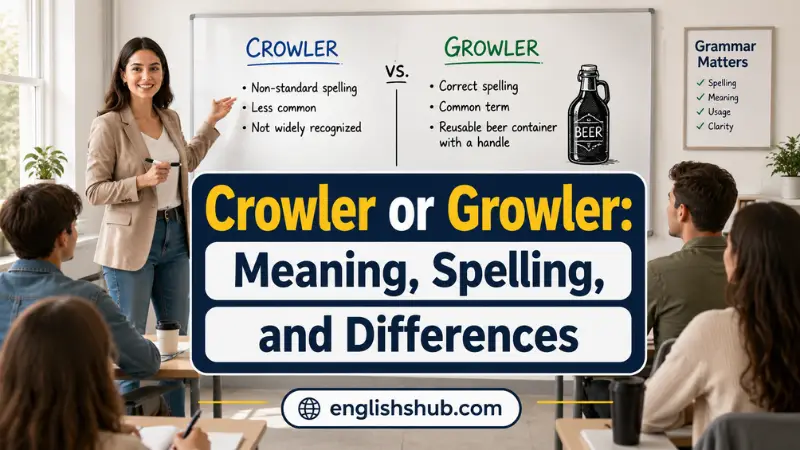
The terms crowler or growler refer to two legitimate beer-container terms, not two competing spellings of the same word. A growler is traditionally a reusable jug or large bottle for draft beer, while a crowler is a larger metal beer can filled and sealed at the brewery.
The difference matters because the words describe different formats, even though they are closely related. If you are writing a menu, ordering beer, or learning American English, using the right term makes your meaning clear.
Quick Answer
Crowler and growler are both correct words, but they describe different beer containers. A growler is usually a reusable jug, often holding 64 fluid ounces, while a crowler is commonly a machine-sealed 32-ounce metal can. The right term depends on the container you mean, not on a spelling preference.
Key Takeaways
- Growler usually means a reusable beer jug or large bottle.
- Crowler usually means a machine-sealed beer can.
- A traditional growler commonly holds 64 fluid ounces.
- A crowler commonly holds 32 fluid ounces.
- Neither word is simply a misspelling of the other.
- Your best choice depends on portability, reuse, and storage needs.
Crowler vs. Growler at a Glance
| Feature | Crowler | Growler |
|---|---|---|
| Basic format | Large beer can | Large beer jug or bottle |
| Common material | Aluminum | Glass, stainless steel, or ceramic |
| Common capacity | 32 fl oz | 64 fl oz, with other sizes available |
| Reusable | Usually no | Yes |
| Sealing | Machine-sealed lid | Cap, stopper, or other closure |
| Filling | Usually filled from draft and sealed | Filled from a draft system |
| Main advantage | Portable and easy to transport | Reusable for future refills |
| Best fit | Shorter-term takeaway | Repeated local use |
Are “Crowler” and “Growler” Both Correct Words?
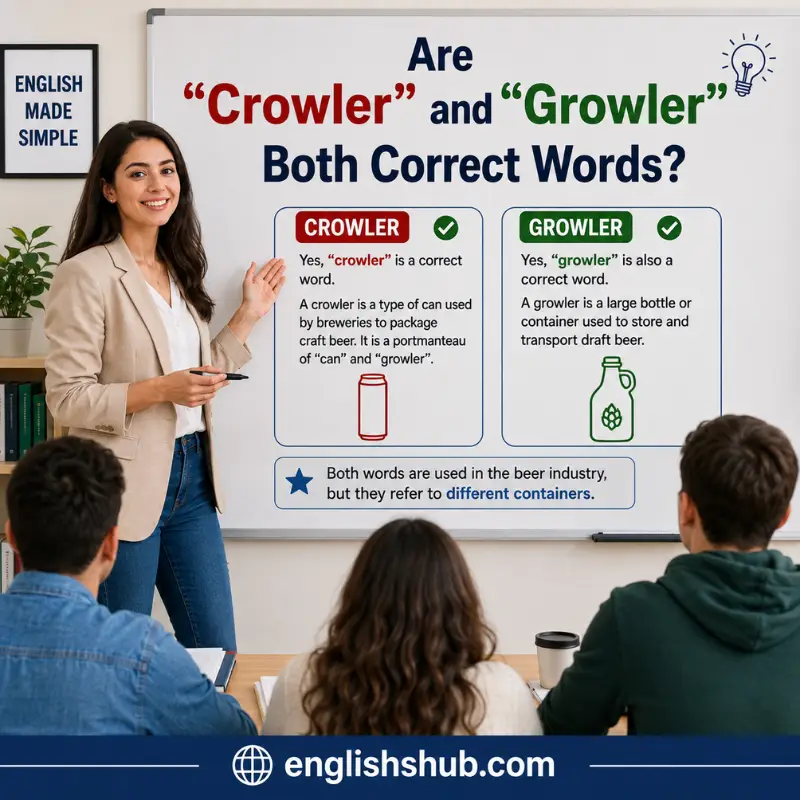
Yes. Crowler and growler are both established English words, but they do not mean exactly the same thing. Cambridge defines a crowler as a large metal beer container, usually around 32 fluid ounces, that can be filled and machine-sealed.
Merriam-Webster gives growler several meanings. In the beer sense, it is a container such as a can, jug, or pitcher used for beer purchased by measure. That means growler is the broader and older beer-container term, while crowler identifies a particular can-based format.
So, if you are wondering which spelling is “correct,” the answer is not one or the other. Both are correct when used for their intended meanings.
Correct examples
- “I brought a growler to the brewery for a refill.”
- “The taproom filled a crowler with the seasonal IPA.”
- “Should we take home a growler or a crowler?”
- “The brewery offers both 32-ounce crowlers and larger growlers.”
The key is context. Calling a sealed aluminum can a growler may be understood, but crowler gives the reader more precise information.
What Does “Growler” Mean?
A growler is a beer container used to transport draft beer from a brewery, taproom, or filling station. Cambridge describes the typical growler as a jug or large bottle, especially one filled at a brewery, and notes that a common size is 64 fluid ounces.
Modern growlers can be made from several materials. Glass remains a familiar choice, while stainless-steel and ceramic versions also exist. Their defining feature is not simply the material or exact size. Instead, the important idea is that a growler is designed as a refillable container for beer.
The word also has a history that goes beyond modern craft beer. Merriam-Webster records its beer-container sense alongside other meanings and traces the word’s use back centuries.
Why is it called a growler?
The exact origin of the beer sense is uncertain. Merriam-Webster discusses several historical explanations, including stories involving the sound of beer or impatient people waiting for their drink. However, the dictionary notes that there is no definitive evidence proving one popular explanation.
That uncertainty is worth remembering. A popular story can be interesting without being established etymological fact.
What Does “Crowler” Mean?
A crowler is a large metal beer can that is filled with draft beer and sealed with a can-seaming machine. Cambridge identifies it as a U.S. noun and gives approximately 32 fluid ounces as the usual capacity.
The word is commonly understood as a blend of can and growler. That construction makes sense because the crowler combines the takeaway purpose of a growler with the format of an aluminum can.
The modern crowler became closely associated with Oskar Blues Brewery and Ball Corporation. VinePair reports that the first crowler was developed through their partnership and identifies 2013 as the introduction period.
Read Cambridge’s definition of “crowler”
Cambridge is useful here because it confirms that crowler is an established English noun rather than an informal typo. Its entry also gives the pronunciation and explains the machine-sealed beer-container meaning. That makes it a useful reference when the question is about correct word usage.
Crowler or Growler: What Is the Difference?
The main difference is format and reusability. A crowler is generally a single-use, machine-sealed can, while a growler is generally a reusable jug or bottle designed to be filled again.
Capacity also helps distinguish the two. A crowler is commonly 32 fluid ounces. A traditional growler is commonly 64 fluid ounces, although growlers can be sold in smaller and larger sizes.
There are several practical differences:
- Material: Crowlers are commonly aluminum; growlers may use glass, steel, or ceramic.
- Portability: Crowlers are lighter and less fragile than glass growlers.
- Reuse: Growlers are designed for repeated use; crowlers are commonly discarded or recycled after use.
- Quantity: A standard crowler commonly holds half as much as a traditional 64-ounce growler.
- Sealing: Crowlers require specialized sealing equipment, while growlers use a closure designed for the vessel.
- Handling: A sealed crowler is convenient for travel, while a glass growler requires more care.
CraftBeer.com similarly describes growlers as refillable containers and explains that a crowler is a can filled in a manner similar to a growler.
See the CraftBeer.com beer packaging guidance
That resource is especially useful because it places growlers and crowlers within the wider context of beer presentation and packaging. It also shows why “growler” and “crowler” should be treated as related formats rather than alternate spellings.
How Size and Packaging Affect the Choice
Size matters because a container changes how much beer you take home and how quickly you may want to consume it. A 32-ounce crowler holds two standard 16-ounce pints, while a 64-ounce growler holds twice that amount.
However, capacity alone should not determine the choice. The packaging format also changes portability, storage, cleaning, and reuse.
For example, a crowler can make sense when you want a limited amount of a draft-only beer and do not want to carry a large glass vessel. A growler can make more sense if you regularly visit the same brewery and want to reuse your container.
The phrase beer packaging covers much more than these two formats. Bottles, standard cans, draft systems, growlers, and crowlers each solve different transportation and serving needs.
Which Container Keeps Beer Fresher?
Neither container has one universal freshness deadline. Beer quality depends on how it was filled, how much oxygen entered the container, how it was sealed, storage temperature, light exposure, the beer itself, and whether the container has been opened.
A well-sealed crowler has one major packaging advantage: its aluminum body blocks light, and its machine-sealed lid creates a closed package. That can make it convenient for transporting draft beer.
Growlers can also work well, particularly when they are filled and handled correctly. However, the reusable nature of the container means cleanliness matters. Craft beer guidance specifically emphasizes proper handling of refillable growlers.
Read Merriam-Webster’s explanation of growler history and usage
This source is valuable for a different reason: it separates documented dictionary information from popular explanations about the word’s origin. That distinction matters when writing accurately about terminology.
For either format, refrigeration and careful handling are sensible practices. Follow the brewery’s instructions because filling methods and recommended consumption windows can vary.
When Should You Choose a Growler?
Choose a growler when reuse, larger capacity, or repeated brewery visits matter most. Its traditional 64-ounce format is useful when you are sharing beer with several people or want a larger quantity for home consumption.
A growler is particularly practical when:
- You regularly buy draft beer from the same brewery.
- You want to reuse the container.
- You need around 64 ounces rather than 32.
- You prefer glass, stainless steel, or another reusable vessel.
- You can transport and store a larger container safely.
A clean growler is essential for repeated refills. Residue or poor cleaning can affect the beer and create an unpleasant experience.
For casual buyers, however, a large growler may be more beer than they need. That is one reason a smaller takeaway format can be attractive.
When Should You Choose a Crowler?
Choose a crowler when portability, convenience, and a sealed can format are more important than reuse. Its common 32-ounce size gives you a moderate amount of draft beer without requiring a reusable jug.
A crowler is a practical choice when:
- You are taking beer on a trip.
- You want a smaller quantity than a traditional growler.
- You do not want to carry a glass container.
- You want a machine-sealed aluminum package.
- You are trying a beer that you may not buy again.
The format became popular partly because it combines features associated with cans and growlers. Food Republic describes 32-ounce crowlers as an alternative to the larger, more cumbersome glass growler.
That does not make a crowler automatically superior. A reusable growler may be the better environmental or practical choice for someone who frequently refills it and already has a suitable cleaning routine.
Common Mistakes With Crowler and Growler
The most common mistake is treating crowler as a misspelling of growler. It is not. The two words refer to related but distinct beer-container formats.
Another mistake is assuming every growler is exactly 64 ounces. That is a common traditional size, but other capacities exist. Likewise, a crowler is commonly 32 ounces, but the term should not be treated as a universal capacity rule.
A third mistake is claiming that a crowler always keeps beer fresh for a fixed number of weeks. Packaging and filling conditions vary, so a precise universal deadline can be misleading.
Quick usage test
If you mean a reusable beer jug, write growler.
If you mean a large beer can filled and sealed at the brewery, write crowler.
If you are discussing both, write crowler and growler or crowler vs. growler, depending on the sentence.
FAQs
Yes. Crowler is an established English noun for a large metal beer container that is typically filled and machine-sealed. Cambridge lists it as a U.S. term and commonly associates it with a 32-fluid-ounce container.
The beer-container word is growler, with a “g.” Crowler, with a “c,” is a different term for a can-based beer container. Neither spelling is simply a variation of the other.
Usually, no. A common crowler holds 32 fluid ounces, while a traditional growler commonly holds 64 fluid ounces. However, growlers are available in multiple sizes, so capacity alone does not define the word.
The name is commonly explained as a combination of can and growler. The format essentially adapts the growler concept into a large, sealable can, which explains the unusual word.
A traditional crowler is generally intended as a single-use container. Once opened, it is normally recycled rather than cleaned and refilled like a reusable growler. Specialized resealable can formats exist, but they are different from the standard crowler concept.
Neither is universally better. A crowler is usually more convenient for portability and smaller quantities, while a growler is useful for repeated refills and larger amounts. Your choice should depend on how much beer you need and how you plan to transport and store it.
There is no single reliable timeframe for every container. Filling technique, oxygen exposure, sealing, refrigeration, beer style, and opening all affect quality. For the best result, keep the beer cold and follow the brewery’s handling or consumption guidance.
Conclusion
Crowler and growler are both correct terms, but they are not interchangeable spellings. A growler usually refers to a reusable beer jug or bottle, while a crowler usually means a machine-sealed metal can, commonly holding 32 fluid ounces.
If you are choosing between them, consider capacity, portability, reuse, and storage rather than assuming one format is always better. For writing, the rule is simple: use growler for the reusable beer container and crowler for the can-based format.