
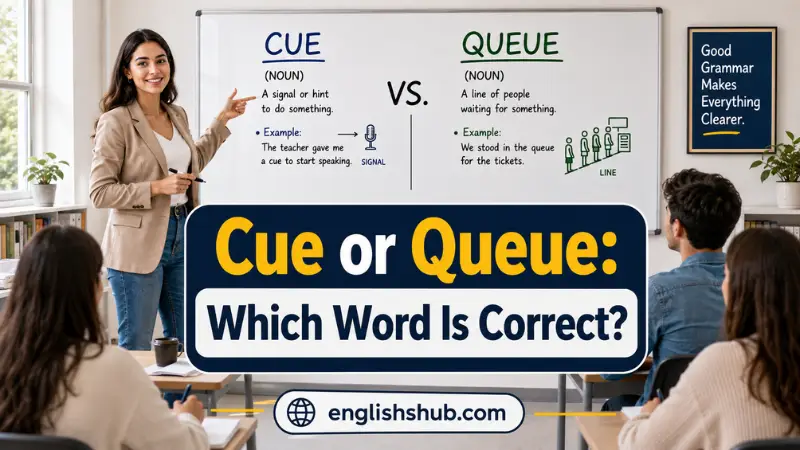
The words cue or queue sound exactly alike, but they have different meanings and spellings. Cue usually means a signal, hint, or prompt that tells someone to act, while queue usually means a line or an ordered group waiting for its turn. The distinction is simple once you connect each spelling to its context.
For American readers, there is one useful extra point: line is more common than queue for people waiting somewhere. Still, queue is standard English and is especially common in British English and technology.
Quick Answer
Use cue for a signal, hint, or prompt, and use queue for a line, sequence, or waiting list. For example, “That was my cue to leave” means a signal told you to go, while “We waited in a queue” means you waited in line. Both words are pronounced /kjuː/.
Key Takeaways
- Cue means a signal, hint, or prompt.
- Queue means a line or waiting sequence.
- Both words have the same pronunciation.
- American English usually favors line for people waiting.
- Cue up and queue up have different meanings.
- Que is usually not the spelling you want.
Cue or Queue at a Glance
The fastest way to distinguish these words is to identify what the sentence describes. If something signals an action, choose cue. If people, objects, messages, or tasks are waiting in an order, choose queue.
| Word | Main Meaning | Common Role | Example |
|---|---|---|---|
| cue | Signal or prompt | Noun | That was my cue to speak. |
| cue | Give a signal | Verb | The director cued the actor. |
| queue | Waiting line or sequence | Noun | We stood in a queue. |
| queue | Form or enter a line | Verb | Customers queued outside. |
| queue | Waiting digital tasks | Computing noun | The document is in the print queue. |
| cue up | Prepare something for playback | Verb phrase | Cue up the next song. |
| queue up | Put things into a waiting order | Verb phrase | Queue up the files for processing. |
The distinction also works outside physical situations. A cue can be a facial expression, sound, event, or piece of information that prompts a response. A queue can be digital, such as a list of jobs waiting for a computer system.
What Does “Cue” Mean?

Cue is a noun or verb connected to a signal, prompt, or indication. In theater, a cue tells a performer when to speak or perform an action. In everyday English, the word can describe anything that gives someone a reason or signal to act.
For example:
- “The bell was my cue to leave.”
- “She gave me a cue to start talking.”
- “The actor missed his cue.”
- “His tired expression was a cue that he needed a break.”
As a verb, cue means to give someone a signal or prepare something at the appropriate moment. Cambridge Dictionary also lists cue as the name of the long stick used in pool or billiards.
The word also appears in expressions such as on cue and take your cue from someone. “On cue” means something happens at the expected moment, while taking your cue from someone means using that person’s behavior or words as guidance.
What Does “Queue” Mean?
Queue means a line or an ordered sequence of people or things waiting for their turn. It can be a physical waiting line, such as customers outside a store, or a digital sequence of tasks waiting for processing.
For example:
- “There was a long queue at the ticket counter.”
- “Several customers joined the queue.”
- “Your request is waiting in the queue.”
- “The files are in the processing queue.”
In American English, line is usually the more natural everyday word for a physical waiting line. However, queue remains correct English and is especially familiar in British usage. In computing, the word is common in both American and British English because it describes an ordered set of waiting tasks or data.
Microsoft provides a useful real-world example. Windows has a print queue containing pending print jobs, so “queue” describes documents waiting to be printed rather than people standing somewhere.
Microsoft’s explanation of the Windows print queue
Cue or Queue: Which One Fits Your Sentence?
Choose cue when the sentence involves a signal or prompt. Choose queue when it involves waiting, ordering, or a sequence.
A simple test is to replace the word mentally:
- If signal, hint, or prompt fits, use cue.
- If line, waiting list, or ordered sequence fits, use queue.
Consider these examples:
Correct: “The teacher’s nod was my cue to begin.”
The nod gave a signal, so cue is correct.
Correct: “The students formed a queue outside the office.”
The students formed a waiting line, so queue works.
Correct: “The files are in the queue.”
The files are waiting to be processed, so queue is correct.
Correct: “That message was my cue to call her.”
The message prompted an action, so cue is correct.
This test is more reliable than trying to remember the spelling by sound because the two words are homophones. Their pronunciation cannot tell you which spelling to use.
Cue or Queue in American English
For U.S. readers, queue deserves special attention because Americans usually say line for a physical waiting line. For example, “I stood in line at the bank” sounds more natural in everyday American conversation than “I stood in a queue at the bank.”
That does not make queue incorrect in American English. It remains a standard word, especially for ordered groups in computing and other technical settings. Merriam-Webster defines a queue as a sequence of items waiting for processing, while Microsoft uses print queue for pending documents.
Merriam-Webster’s current queue definition
The regional distinction is therefore about frequency and context, not correctness:
- American everyday speech: “Wait in line.”
- British everyday speech: “Wait in a queue.”
- Technology: “The request is in the queue.”
- Signal or prompt: “That was my cue.”
Cue Up vs. Queue Up
Cue up means to prepare something so it is ready to play or happen at the appropriate time. Queue up means to place something into a line or waiting sequence.
For example:
- “Cue up the next video.”
→ Prepare the video for playback. - “Queue up the videos for the presentation.”
→ Put the videos into an ordered waiting list.
The difference becomes especially clear with music. A DJ might cue up a track, meaning prepare it for playback. A streaming system might queue up several tracks, meaning place them in an order to play later.
Both expressions are legitimate, but they emphasize different actions. The first focuses on timing and readiness. The second focuses on order and waiting. Grammarist also notes that “cue the music” is the conventional expression when the meaning is to signal or prepare music for performance.
Common Cue and Queue Mistakes
The most common mistakes happen when writers choose a spelling based only on pronunciation. Since both words sound like /kjuː/, listening is not enough.
Mistake 1: Using “cue” for a waiting line
Incorrect: “We stood in a long cue at the airport.”
Correct: “We stood in a long queue at the airport.”
For U.S. readers, an even more natural version is:
“We stood in a long line at the airport.”
Mistake 2: Using “queue” for a signal
Incorrect: “That was my queue to leave.”
Correct: “That was my cue to leave.”
The event gave you a signal, so cue is the right word.
Mistake 3: Confusing “cue up” with “queue up”
“Cue up the recording” means prepare the recording for playback.
“Queue up the recordings” means place multiple recordings into a waiting sequence.
Mistake 4: Writing “que”
“Que” is generally not the English spelling for either meaning. If you mean a signal, write cue. If you mean a line or waiting sequence, write queue.
Merriam-Webster specifically identifies queue and cue as words people may be seeking when they type or hear “que.”
How to Remember Cue vs. Queue
The easiest memory trick is to connect each word with its action.
Cue = a signal to act.
Think of a performer receiving a cue before speaking or moving. The word is short because the signal is usually quick.
Queue = a line or waiting order.
The spelling is much longer, just as a queue can contain many people or items waiting their turn. This is only a memory aid, not the word’s actual linguistic origin.
Another useful trick is the letter Q. Imagine the tail on a capital Q as part of a line. Then associate queue with a line or sequence.
The important point is to remember the meaning, not the trick. If the sentence describes a prompt, choose cue. If it describes waiting or ordering, choose queue.
Is “Que” Correct?
“Que” is usually not the English word you want when choosing between cue and queue. It commonly appears because the three spellings can sound similar when spoken or typed from memory.
Use cue for a signal:
“The director gave me a cue to enter.”
Use queue for a waiting line or sequence:
“My request is in the queue.”
If you are writing in English and mean either of those concepts, que should normally be replaced with one of the two standard spellings. Merriam-Webster notes the same confusion among people searching for the correct spelling of these homophones.
FAQs
Yes. Cue and queue are pronounced /kjuː/, so they are homophones. Their meanings and spellings differ even though they sound identical. Context determines which word belongs in a sentence.
Queue is correct when you mean a waiting line or ordered sequence. In everyday American English, however, line is usually more natural for a physical line of people. For example, “We waited in line” is typical U.S. usage.
Both are correct, but they have different meanings. Cue up means prepare something for playback or action, while queue up means place something into a waiting order. The context tells you which expression to use.
Yes. “My cue to leave” means that something gave you a signal or indication that it was time to leave. For example, “The lights going out were my cue to leave” uses cue correctly.
Yes. Americans use queue, particularly for computing and ordered processes. For a physical waiting line, however, line is usually more common in American English. Technical phrases such as print queue are standard U.S. usage.
Remember cue = signal and queue = line. If something tells you to act, use cue. If people, objects, messages, or tasks are waiting in order, use queue.
Usually no. When you mean a signal or prompt, use cue. When you mean a waiting line or sequence, use queue. The spelling “que” is a common mistake or a word from another language rather than the standard English spelling for these meanings.
Conclusion
The choice between cue or queue becomes easy when you focus on meaning rather than pronunciation. Use cue for a signal, hint, or prompt, and use queue for a line or ordered group waiting for its turn. In American English, line is often more natural for people waiting, while queue remains common in technology and other formal contexts.
When you see cue up or queue up, check whether the emphasis is on preparation or waiting order. That small context check will usually give you the correct spelling immediately.