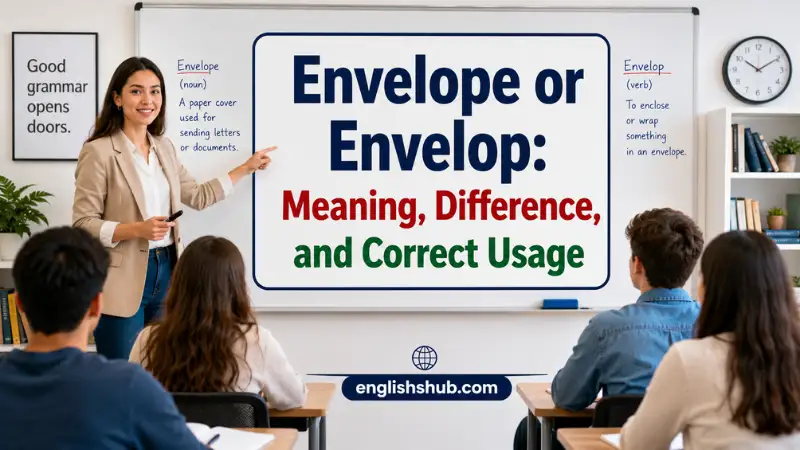
If you are unsure about envelope or envelop, the correct choice depends on what the word is doing in the sentence. Envelope is mainly a noun for a paper container, while envelop is a verb meaning to surround, cover, or enclose something completely.
The final e is therefore more than a spelling detail. It separates an object from an action, and the two words can also sound different when spoken. Once you connect the spelling with the grammar, the distinction becomes much easier to remember.
Quick Answer
Envelope is the noun for a paper container used to hold a letter or document. Envelop is a verb meaning to surround or cover something completely. For example, you seal a letter in an envelope, but fog can envelop a valley. The words are related, but they are not interchangeable.
TL;DR
- Envelope is a noun for a paper container or surrounding boundary.
- Envelop is a verb meaning to surround, cover, or enclose.
- The final e belongs to the noun envelope.
- Envelop has its main stress on the second syllable.
- Enveloped is the correct past-tense form of the verb.
- Push the envelope means to go beyond usual limits.
Envelope vs. Envelop at a Glance
| Word | Part of Speech | Main Meaning | Example | Easy Test |
|---|---|---|---|---|
| envelope | Noun | Paper container for mail | Put the card in the envelope. | Can you say “the envelope”? |
| envelop | Verb | Surround or cover completely | Fog may envelop the town. | Can you replace it with “surround”? |
| envelops | Verb | Surrounds or covers | Darkness envelops the street. | Is it an action? |
| enveloped | Verb | Surrounded or covered | Smoke enveloped the building. | Is it past action? |
| enveloping | Verb form | Surrounding or covering | An enveloping mist filled the valley. | Is it describing an ongoing action? |
| envelope | Noun | Limit or boundary | The test pushed the aircraft’s envelope. | Does it mean a range or limit? |
What Does “Envelope” Mean?
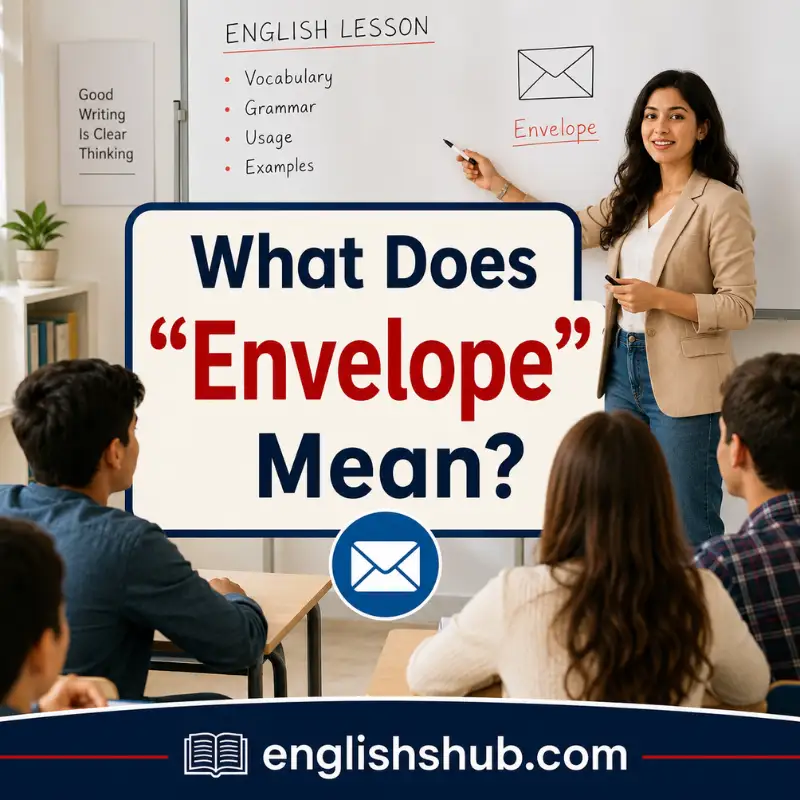
Envelope is primarily a noun. In everyday American English, it usually means a flat paper container that holds a letter, card, check, or other document. Cambridge gives the standard definition as a usually rectangular paper container for a letter.
For example:
- Please write the address on the envelope.
- She placed the invitation inside an envelope.
- The check arrived in a sealed envelope.
- He opened the envelope carefully.
The word can also describe a broader covering or boundary. In technical contexts, an envelope may describe the limits within which a system operates. That is why expressions such as flight envelope and operating envelope can appear in specialized writing.
So, do not assume that envelope always means mail. Its core idea is a covering or boundary, although the paper container is by far the most familiar everyday use.
What Does “Envelop” Mean as a Verb?
Envelop is a verb meaning to surround, cover, or enclose something completely. Merriam-Webster defines it as enclosing or enfolding completely, and it also records a specialized military meaning involving an attack on an enemy’s flank.
The word often appears when something spreads around another thing:
- Fog began to envelop the hills.
- Darkness enveloped the room.
- Warm sunlight enveloped the garden.
- A strong feeling of calm enveloped her.
The verb is especially useful when the surrounding action feels complete or widespread. It can describe physical things such as fog, smoke, darkness, or fabric. It can also describe abstract things such as silence, fear, warmth, or calm.
Its common forms are envelop, envelops, enveloped, and enveloping.
How Do You Pronounce Envelope and Envelop?
Pronunciation provides another useful clue because the two words commonly have different stress patterns.
In American English, envelope is commonly pronounced with stress toward the beginning, while envelop places the main stress on the second syllable. Cambridge lists American pronunciations for envelope, and Merriam-Webster gives envelop as in-VEL-əp.
Think of the contrast this way:
- EN-velope → noun
- en-VEL-op → verb
The exact vowel sounds can vary among speakers and dialects. Therefore, pronunciation should be a helpful clue rather than your only test.
When writing, grammar is more reliable. If the word names a thing, use envelope. If it describes an action of surrounding or covering, use envelop.
Why Does the Final E Matter?
The final e matters because it marks two different words with different grammatical jobs.
Envelope is a noun. It names something:
I bought a new envelope.
Envelop is a verb. It describes an action:
Thick fog may envelop the road.
A useful memory rule is simple:
Envelope = object.
Envelop = action.
You can test the sentence by replacing the word. If surround, cover, or enclose fits as an action, you probably need envelop. If you can put a, an, or the before the word because it names an object, envelope is usually correct.
For example:
Put the document in the envelope.
Here, the comes before the noun.
Darkness will envelop the building.
Here, the word follows will and expresses an action.
This simple grammar test is often more reliable than trying to remember the spelling by sight alone.
When Should You Use Each Word?
Use envelope when you are talking about a physical container, a surrounding layer, or a limit or range.
For mailing:
Please place the letter in an envelope.
For a broader covering:
The spacecraft has a protective outer envelope.
For a technical boundary:
The aircraft must remain within its operating envelope.
Use envelop when something actively surrounds or covers something else:
Clouds began to envelop the mountain.
Silence enveloped the theater.
A warm blanket enveloped the child.
A useful sentence test is to look at the word immediately before the blank. After a, an, or the, you will often need the noun envelope. After modal verbs such as will, can, or may, you will often need the base verb envelop.
This is not a rule based on those words alone, but it is a helpful practical check.
Common Mistakes With Envelope and Envelop
The most common error is using envelop when the sentence needs the paper container.
Incorrect:
Please put the check in the envelop.
Correct:
Please put the check in the envelope.
The reverse mistake also occurs:
Incorrect:
Thick fog will envelope the valley.
Correct:
Thick fog will envelop the valley.
The reason is grammatical. Fog performs the action, so the sentence needs the verb.
Past tense can create another trap. The correct form is enveloped, not envelopeed:
Smoke enveloped the building.
Likewise, the present participle is enveloping:
An enveloping mist covered the road.
The spelling may look unusual because the base verb ends in p, but the normal forms follow the standard pattern: envelops, enveloped, and enveloping. Merriam-Webster lists these forms with the verb.
What Does “Push the Envelope” Mean?
Push the envelope is an idiom meaning to go beyond the usual limits or accepted boundaries. Cambridge gives this sense as going further than normal limits by doing something new, dangerous, or unconventional.
For example:
The engineers are pushing the envelope with the new design.
Here, envelope does not mean a paper container. Instead, it refers to a limit or boundary.
The expression has an aviation connection. In aviation, an aircraft’s flight envelope describes the range of conditions in which it can safely operate. The idiom developed from the idea of testing or extending those boundaries. GrammarBook also explains this connection when discussing the phrase.
Today, however, you can use push the envelope in many fields:
- Technology
- Engineering
- Science
- Sports
- Art
- Business
- Design
So, envelope has a wider life beyond mail. The common thread is still the idea of a surrounding limit or boundary.
Where Did Envelope and Envelop Come From?
The two words are closely related because they developed from older French forms associated with wrapping or covering. However, English did not simply create one word with two spellings.
The verb envelop entered English earlier. Grammarphobia traces it to Middle English and Anglo-French forms associated with wrapping. The noun envelope appeared later and developed into the familiar word for a paper covering used with letters.
That shared history helps explain why the words look so similar today.
The distinction became clearer in modern English:
- envelop → an action of surrounding or covering
- envelope → a noun for a covering, container, or boundary
This history is useful because it shows that the final e is not a random spelling difference. The two words developed into separate grammatical forms with related meanings.
You do not need to memorize the history to use them correctly. Still, understanding the connection can make the spelling easier to remember.
FAQs
Yes. Envelop is a standard English verb meaning to surround, cover, or enclose completely. It is less common in everyday conversation than envelope, but it is completely correct when the sentence describes an action.
In modern standard usage, envelope is chiefly used as a noun. It can mean a paper container, a surrounding covering, or a boundary or operating range. For the verb meaning “surround,” use envelop instead.
No. When you mean the paper container for a letter or document, the correct word is envelope. For example, write “Put the check in an envelope,” not “Put the check in an envelop.”
They are commonly pronounced differently. Envelop has its main stress on the second syllable, while envelope commonly has stress toward the beginning in American English. Regional pronunciation can vary, so spelling and grammar remain useful clues.
The past tense is enveloped. The same form can function as a past participle: “The valley was enveloped in fog.” The present forms include envelop, envelops, and enveloping.
They share a historical connection with words meaning to wrap or cover. English developed them into separate forms: envelop became the verb, while envelope became the noun. Their related meanings explain the similar spelling.
Conclusion
The easiest way to remember envelope or envelop is to focus on grammar. Envelope is the noun for a paper container, a covering, or sometimes a boundary or operating range. Envelop is the verb meaning to surround, cover, or enclose completely.
If you can replace the word with surround or cover, choose envelop. If you are naming the object that holds a letter, choose envelope. Remembering “envelope = object, envelop = action” will prevent most mistakes.