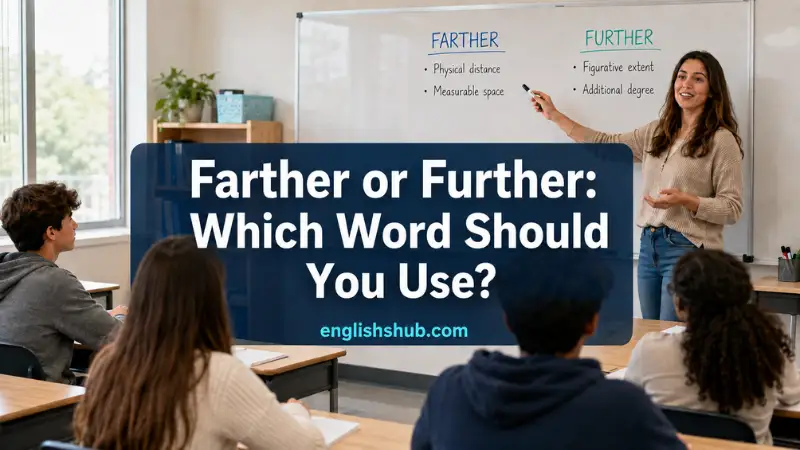
Choosing farther or further becomes easier when you know what kind of distance the sentence describes. In careful American English, use farther for real, measurable space and further for figurative distance, added detail, or progress.
However, the boundary is not absolute. Standard English often allows either word for distance, especially when the meaning could be physical or metaphorical. The safest strategy is simple: keep the traditional distinction in edited US writing, but never replace further when it means “additional,” “moreover,” or “advance.”
Quick Answer
Use farther for physical distance: “We drove farther than expected.” Use further for figurative distance, degree, added information, or advancement: “We need further discussion.” When choosing farther or further for literal distance, both may be acceptable, but farther is usually the clearest choice for American readers.
TL;DR
- Choose farther for miles, feet, roads, and other measurable space.
- Choose further for ideas, progress, degree, or added detail.
- Only further can mean “additional” or “moreover.”
- Only further works as a verb meaning “advance.”
- Either word may describe distance, but US editors often preserve the distinction.
Farther vs. Further at a Glance
| Context or Meaning | Best Choice | Grammar Role | Example |
| Greater physical distance | Farther | Adverb | Maya walked farther than Ben. |
| A more distant place or object | Farther | Adjective | We chose the farther entrance. |
| Greater figurative extent | Further | Adverb | Let’s examine the claim further. |
| More or additional | Further | Adjective | Please send further information. |
| Moreover or additionally | Further | Conjunctive adverb | Further, the plan would reduce delays. |
| Help something advance | Further | Verb | The course may further her career. |
| Literal distance in general usage | Either may occur | Adjective or adverb | Their house is farther/further away. |
What Is the Difference Between Farther and Further?
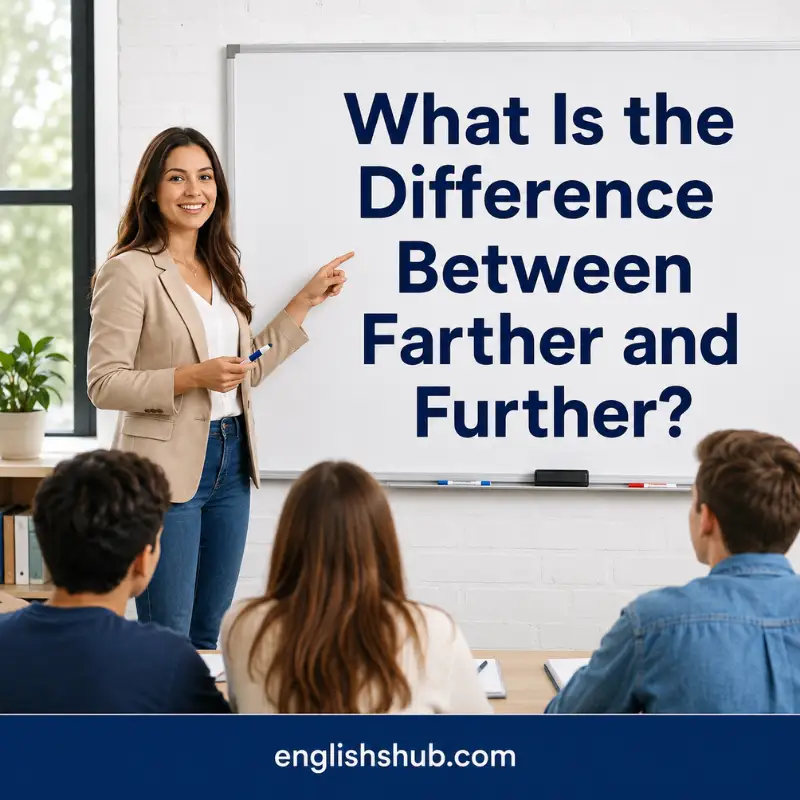
The practical difference between farther or further is meaning. Farther usually points to a physical distance that someone could measure. By contrast, further usually describes figurative distance, a greater degree, extra information, or progress.
That rule improves clarity, yet it does not tell the whole story.
The Merriam-Webster usage guide
explains that the two words have long overlapped when they refer to distance. It also notes that further is the older form and farther developed as a Middle English variant.
Therefore, three labels are more accurate than simply “right” and “wrong”:
- Preferred: farther for literal space in edited US English.
- Acceptable: further for distance, especially in common or British usage.
- Incorrect: farther when the intended meaning is “additional,” “moreover,” or “advance.”
Use Farther for Physical and Measurable Distance
Choose farther when the sentence describes real space between people, places, or objects. Miles, feet, yards, blocks, and steps all signal measurable distance. Even when the sentence gives no number, the space could still be measured.
For example:
- The grocery store is farther from our apartment than the pharmacy.
- Jordan threw the ball farther during the second practice.
- We hiked two miles farther before stopping for lunch.
- The farther shore was hidden by fog.
Use a quick measurement test. If you could answer “How far?” with a unit or point to the gap on a map, farther will usually sound most precise. Thus, “The hotel is farther away” is the safest form for polished American writing.
Use Further for Figurative Distance and Additional Meaning
Choose further when no literal space separates two points. It can describe an abstract distance, a deeper stage of thought, or a greater degree of action. For instance, a team may move further toward its goal, or a researcher may investigate a question further.
In addition, further can mean “more” or “additional” before a noun:
- We need further information before approving the request.
- The teacher offered further explanation after class.
- No further changes are required.
- The office will remain closed until further notice.
In these sentences, farther cannot replace further. “Farther information” and “farther notice” do not express standard English meanings. When “additional” fits naturally as a substitute, choose further every time.
How Farther and Further Work as Adjectives and Adverbs
Both words can function as adjectives or adverbs. A comparative adjective modifies a noun, while a comparative adverb modifies a verb, adjective, or another adverb. The labels matter less than the word each form describes.
As adjectives:
- The farther trail leads to the lake. (Farther modifies trail.)
- We need further evidence. (Further modifies evidence.)
As adverbs:
- The cyclist traveled farther today. (Farther modifies traveled.)
- Please explain the last point further. (Further modifies explain.)
Notice that grammar role alone does not determine the choice. Meaning does. First identify whether the sentence concerns literal space, nonphysical extent, or something additional. Then select the form that expresses that idea clearly.
Further as a Verb and a Conjunctive Adverb
Only further works as a verb. In that role, it means to advance, promote, or help something develop. You can further a career, goal, cause, education, or understanding.
- The internship helped further Ana’s career.
- The grant will further medical research.
- Reading widely can further your understanding of history.
Further can also act as a conjunctive adverb meaning moreover or “in addition.” When it opens a sentence in that sense, place a comma after it:
- Further, the revised plan costs less.
- Further, every applicant must provide identification.
This sentence-opening use sounds formal. In everyday prose, also, in addition, or furthermore may feel smoother. Still, farther never carries this meaning and cannot replace it.
Can Further Also Describe Physical Distance?
Yes. Further can describe physical distance, and reputable dictionaries do not treat that use as a basic grammar error. You may hear “We walked further down the road” or read that one city lies further north than another.
However, many American editors keep the traditional distinction because it gives each word a clear job. In school assignments, business documents, and formal US publications, farther remains the low-risk choice for literal space.
The Chicago Manual of Style Q&A
also recognizes that writers have long used further for greater distance.
Use this practical rule: accept further for distance when reading, but prefer farther when editing your own US prose. If a teacher, publisher, or organization follows a house style, follow that guide consistently.
American English vs. British English
American English tends to maintain the literal-versus-figurative distinction more strongly. As a result, US writers often choose farther for a road, trip, throw, or location and further for thought, degree, or progress.
British English uses further more freely for both kinds of distance.
states that both forms discuss distance and that further is more common. Therefore, “London is further away” sounds entirely natural in British writing.
Regional preferences also affect pairs such as afterward and afterwards and among and amongst.
In each case, correctness, frequency, and audience are separate questions. For a US audience, choose the familiar American form and remain consistent.
Common Phrases With Farther and Further
Fixed and familiar phrases become easier when you identify their meaning:
- Farther away: preferred in US editing for a greater physical distance.
- Further away: also standard, especially in British or general usage.
- Further from the truth: preferred because the distance from truth is figurative.
- Until further notice: means until more information or a later announcement arrives.
- No further questions: means no additional questions.
- Further education: education beyond a current level; never farther education.
- Further your career: help your career advance.
- Go any farther: usually concerns movement through physical space.
- Go any further: usually concerns continuing an action, discussion, or relationship.
Some phrases allow both forms because the context supports two readings. “I cannot go any farther” may describe tired feet on a trail. “I cannot go any further” may mean the speaker refuses to continue a plan.
Common Mistakes and Corrections
The most serious errors occur when writers use farther for one of the meanings unique to further.
- Incorrect: We need farther details.
Correct: We need further details. - Incorrect: The course will farther her career.
Correct: The course will further her career. - Incorrect: Farther, the proposal lacks a budget.
Correct: Further, the proposal lacks a budget.
Another mistake is overcorrecting every use of further that refers to space. Although “The cabin is farther north” follows the common US rule, “The cabin is further north” is also established English. Edit for audience and consistency rather than labeling every variation wrong.
Finally, avoid switching forms randomly within the same context. Consistent wording helps readers follow the intended distinction.
This principle also improves choices involving
where formality and standard usage affect the best option.
Correct Examples for Everyday, School, and Workplace Writing
Everyday conversations often involve travel, plans, and progress:
- Is the gas station much farther?
- I do not want to discuss the issue any further tonight.
- Their new house is farther away from downtown.
School and academic writing often use further for added study or analysis:
- The second experiment requires further testing.
- Mia ran farther than the other students during practice.
- The evidence moves the argument further from the original claim.
Workplace writing follows the same meaning-based pattern:
- Please contact us if you need further assistance.
- The new warehouse is farther from the airport.
- This training may further your professional goals.
These examples show why context matters more than sound. Both words compare something with a more distant or advanced point, but only further covers added material and advancement.
A Five-Second Farther or Further Test
Use this short process whenever the choice interrupts your writing:
- Look for real space. If the sentence concerns miles, steps, roads, or locations, choose farther.
- Try “additional.” If that replacement works, choose further.
- Try “advance.” If the word describes helping progress, only further works.
- Try “moreover.” If the word adds another point, choose further and check punctuation.
- Check the audience. For an unclear distance in edited US English, prefer farther; otherwise, either form may be acceptable.
A memory trick can make the first step faster: farther contains far, which points toward physical space. Still, do not let the trick erase the accepted overlap between the two words.
FAQs
Yes, further than is grammatically correct. It often compares progress, degree, or figurative extent, as in “The project went further than expected.” It may also describe literal distance, although American editors often prefer farther than for measurable space.
Farther is most strongly associated with physical distance, especially in edited American English. However, historical and modern examples sometimes use it for figurative extent. The physical-distance rule remains a helpful style choice, not an unbreakable law of grammar.
Further from the truth is the usual choice because the phrase describes figurative distance from accuracy. “Nothing could be further from the truth” means a statement is completely false. Farther appears occasionally, but further is clearer and more widely expected.
Write no further questions. Here, further means “additional,” so the phrase says that no more questions remain. Because farther does not mean “additional,” “no farther questions” is incorrect in standard usage.
Both forms can be correct, but the meaning changes. Use go any farther for continued physical movement: “The car cannot go any farther.” Use go any further for continuing an action or process: “We cannot go any further with the deal.”
Yes. As a verb, further means to promote, advance, or help something develop. For example, “She took the course to further her career.” Farther does not function as a verb, so it cannot replace further in that sentence.
Conclusion
The safest way to choose farther or further in American English is to separate physical space from other meanings. Use farther for a distance you could measure, and use further for degree, progress, added information, or advancement. Still, remember that both forms have long appeared in distance expressions, so further is not automatically wrong there. When the boundary feels unclear, follow your audience’s style guide and stay consistent. Above all, never use farther when you mean “additional,” “moreover,” or “advance.”