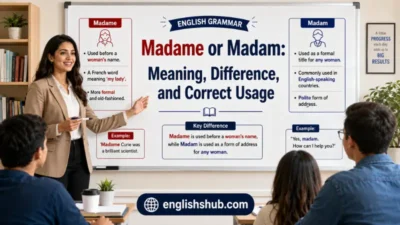
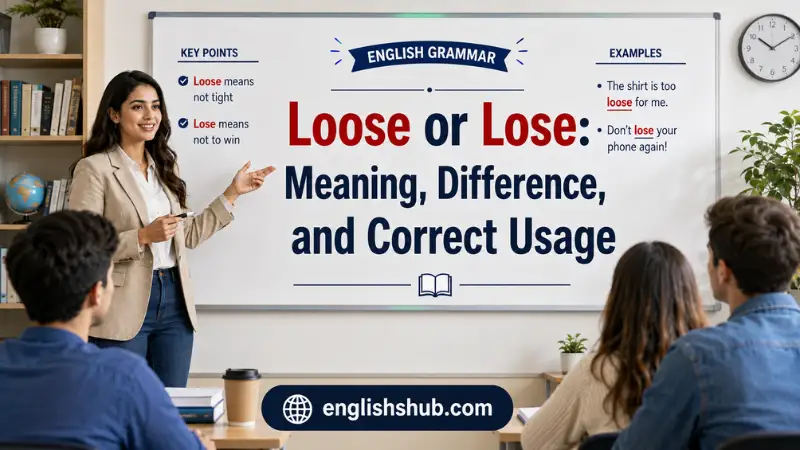
The difference between loose or lose is easy to understand once you focus on meaning and grammar. Loose usually describes something that is not tight, firmly attached, or confined. Lose is usually a verb meaning to misplace something, stop having something, fail to win, or suffer a loss. Merriam-Webster confirms that the two words have distinct meanings and grammatical roles.
The extra o in loose makes the spelling look simple to remember, but these words are often confused in emails, school assignments, social media posts, and everyday writing. Knowing their pronunciation, word class, and common sentence patterns will help you choose the correct form every time.
Quick Answer
Use loose when something is not tight, securely attached, or confined: “My shoes are loose.” Use lose when you mean to misplace something, fail to win, or no longer have something: “I don’t want to lose my keys.” The words are pronounced differently: loose ends with an /s/ sound, while lose ends with a /z/ sound.
Key Takeaways
- Loose usually means not tight, fixed, or confined.
- Lose is usually a verb meaning misplace, fail, or stop having something.
- Loose has two o’s; lose has one.
- Loose rhymes with moose; lose rhymes with choose.
- “Don’t lose your keys” is correct.
- “My shoes are too loose” is correct.
Loose or Lose at a Glance
| Word | Part of Speech | Main Meaning | Pronunciation | Example |
|---|---|---|---|---|
| loose | Adjective | Not tight or securely fixed | /luːs/ | My shirt is loose. |
| loose | Verb | To release or set free | /luːs/ | They loosed the animal. |
| lose | Verb | Misplace, fail, or no longer have | /luːz/ | Don’t lose your phone. |
| lose | Verb | Fail to win | /luːz/ | Our team may lose. |
| loose | Adverb | In a loose manner | /luːs/ | The papers were loosely arranged. |
What Does Loose Mean?
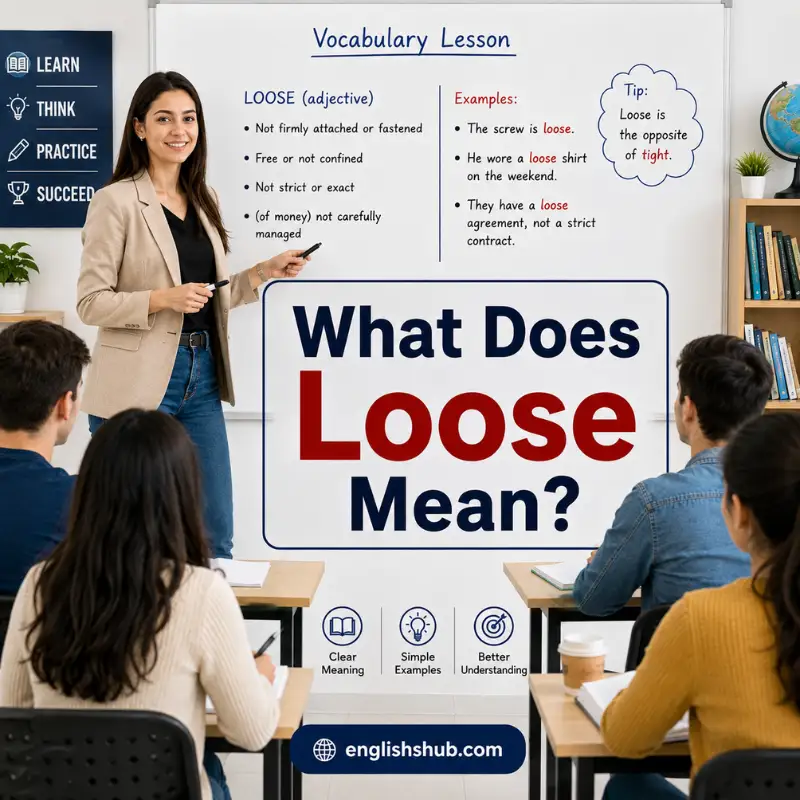
Loose usually means not tight, not firmly attached, or free from restraint. It can describe clothing, ropes, screws, teeth, objects, animals, and many other things. Merriam-Webster lists meanings including “not rigidly fastened,” “not tight-fitting,” and “free from confinement.”
Examples include:
- “My jacket is loose.”
- “The screw is loose.”
- “One of the dog’s teeth is loose.”
- “The rope became loose.”
- “The dog got loose from the yard.”
The word can also describe something that is not closely organized or compact:
- “The papers were in a loose pile.”
- “They formed a loose group.”
- “The story is based on a loose interpretation of the facts.”
In these examples, loose describes a condition rather than an action of misplacing something.
Loose as a Verb
Although less common in everyday writing, loose can also be a verb meaning to release or set free. Merriam-Webster lists this use as well.
For example:
- “The soldiers loosed a volley of arrows.”
- “The ropes were cut and the animals were loosed.”
Do not confuse loose with loosen. Loosen means to make something less tight:
“Please loosen the knot.”
What Does Lose Mean?
Lose is usually a verb. It can mean to misplace something, stop having something, fail to win, or suffer a reduction or loss. Merriam-Webster gives several related meanings, including no longer having something and undergoing defeat.
Examples:
- “I don’t want to lose my wallet.”
- “Be careful not to lose your passport.”
- “Our team might lose the game.”
- “She doesn’t want to lose her job.”
- “He hopes to lose weight.”
- “We could lose money on the deal.”
The word often describes something that happens to possession, success, control, or an amount.
For example:
“I lost my keys.”
The keys are no longer in your possession.
“We lost the match.”
Your team failed to win.
“She lost five pounds.”
Her weight decreased.
These meanings are different, but they all involve the idea of no longer having, keeping, winning, or retaining something.
What Is the Main Difference Between Loose and Lose?
The simplest distinction is:
Loose = not tight or free.
Lose = misplace, fail, or no longer have.
Compare:
“My shoelaces are loose.”
The shoelaces are not tight.
“I might lose my shoes.”
You might no longer have your shoes.
The words can even appear in the same sentence:
“Don’t lose the dog because its collar is loose.”
Here, lose describes the possibility of no longer having control of the dog, while loose describes the condition of the collar.
Another useful comparison is:
“If you lose weight, your clothes may become loose.”
The first word describes an action or change. The second describes a condition.
That difference between action and condition is one of the easiest ways to remember which spelling you need.
Why Do People Confuse Loose and Lose?
The main problem is their similar spelling. Both words begin with loo-, and the only spelling difference is the extra o in loose. However, they also have different pronunciations. Scribbr gives loose as /luːs/ and lose as /luːz/.
Think of the sounds this way:
- loose → rhymes with moose
- lose → rhymes with choose
The final consonant is different:
- loose ends with an s sound.
- lose ends with a z sound.
This pronunciation difference can help when speaking, but spelling requires a meaning check.
If you mean not tight, write loose.
If you mean misplace, fail, or no longer have, write lose.
This is especially important when typing quickly because the incorrect form can look surprisingly natural.
When Should You Use Loose?
Use loose when you are describing something that is not tight, securely attached, or confined.
Loose clothing
“These pants are too loose.”
The pants do not fit tightly.
A loose screw
“The screw is loose.”
The screw is not firmly attached.
A loose tooth
“The child’s tooth is loose.”
The tooth is not firmly fixed in place.
A loose rope
“The rope is loose.”
The rope is not pulled tight.
An animal that is loose
“The dog is loose in the neighborhood.”
The dog is free rather than securely contained.
You can also use loose in common expressions:
- loose change
- loose clothing
- loose connection
- loose tooth
- loose knot
- loose grip
- loose end
- loose cannon
The central idea remains the same: something is not tightly fixed, held, or controlled.
When Should You Use Lose?
Use lose when you are describing an action or situation involving something no longer being possessed, retained, or won.
Losing an object
“Don’t lose your keys.”
Losing a game
“Our team cannot afford to lose this match.”
Losing a job
“He was afraid he might lose his job.”
Losing weight
“She wants to lose ten pounds.”
Losing time
“We cannot lose any more time.”
Losing control
“Try not to lose your temper.”
Merriam-Webster lists many common expressions with lose, including lose one’s temper, lose one’s way, lose heart, lose one’s nerve, lose count, and lose face.
A helpful question is:
Am I talking about something becoming missing, failing, or no longer being kept?
If yes, lose is probably the word you need.
Loose vs. Lose in Common Sentences
| Meaning | Correct Sentence |
|---|---|
| Not tight | My shoes are loose. |
| Misplace something | Don’t lose your phone. |
| Not firmly attached | The handle is loose. |
| Fail to win | We don’t want to lose the game. |
| Free from restraint | The dog got loose. |
| No longer possess | She may lose her wallet. |
| Clothing with extra room | He prefers loose shirts. |
| Reduce weight | I want to lose weight. |
| Not tightly secured | The bolt is loose. |
| Stop having something | They could lose their opportunity. |
The pattern is consistent: loose describes a state or condition, while lose normally describes an action or change.
What Is the Difference Between Loose, Loosen, and Lose?
These three words are related in appearance but have different jobs.
Loose
Usually an adjective meaning not tight.
“The knot is loose.”
Loosen
A verb meaning to make something less tight.
“Please loosen the knot.”
Lose
A verb meaning to misplace, fail, or stop having something.
“Don’t lose the key.”
Compare all three:
“The knot is loose, so loosen it carefully—but don’t lose the key.”
This distinction is useful because writers sometimes accidentally use loose or loosen when they actually mean lose.
For example:
❌ “I don’t want to loose my job.”
✅ “I don’t want to lose my job.”
And:
❌ “Please lose the rope.”
✅ “Please loosen the rope.”
The intended action determines the correct word.
What Are the Most Common Loose-or-Lose Mistakes?
Mistake 1: “Loose” when you mean “lose”
❌ “I don’t want to loose my phone.”
✅ “I don’t want to lose my phone.”
You are talking about misplacing the phone, so lose is correct.
Mistake 2: “Lose” when you mean “loose”
❌ “My jeans are too lose.”
✅ “My jeans are too loose.”
You are describing the fit of the jeans, so loose is correct.
Mistake 3: “Loose weight”
❌ “I need to loose weight.”
✅ “I need to lose weight.”
Weight can be lost, not “loosed.”
Mistake 4: “Lose” when something is not tight
❌ “The screw is lose.”
✅ “The screw is loose.”
The screw is not securely attached.
Mistake 5: “Loose the game”
❌ “Our team might loose.”
✅ “Our team might lose.”
A team can lose a game but cannot “loose” it.
These errors are common enough that major English-language usage guides specifically address the confusion.
How Do You Remember Loose or Lose?
The easiest memory trick is:
Loose has an extra O = extra room.
Think:
loose → two O’s → more room → not tight
For example:
“My shirt is loose.”
The shirt has extra space.
Then remember:
Lose has one O = something is gone.
“I don’t want to lose my shirt.”
Another useful trick is to connect the pronunciation:
Loose → moose → /s/
Lose → choose → /z/
If you remember both the meaning and the sound, the spelling becomes much easier.
How Do You Choose Between Loose or Lose Quickly?
Use this three-question test.
1. Is something not tight?
Use loose.
“The lid is loose.”
2. Are you talking about misplacing, failing, or no longer having something?
Use lose.
“Don’t lose the lid.”
3. Are you making something less tight?
Use loosen.
“Loosen the lid.”
So the quickest rule is:
Loose = not tight.
Lose = misplace or fail.
Loosen = make less tight.
Once you identify the meaning, the spelling becomes straightforward.
Loose or Lose in American and British English
The distinction between loose and lose is the same in American and British English. This is not a regional spelling difference. Both varieties use loose for meanings such as “not tight” and lose for meanings such as “misplace” or “fail to win.” Scribbr confirms the separate grammatical roles and meanings, while Merriam-Webster gives the standard American English definitions.
For example, both American and British writers use:
- “Don’t lose your passport.”
- “My shoes are loose.”
- “We might lose the game.”
- “The screw is loose.”
Therefore, you do not need to choose one spelling based on whether you are writing for a U.S. or U.K. audience.
FAQs
The correct phrase is lose weight. Lose is the verb used when someone’s weight decreases. “Loose weight” is incorrect in standard English. For example: “She wants to lose weight before the competition.”
Use loose when describing clothing that is not tight. For example, “I prefer loose clothing.” You could use lose in a different sentence, such as “Don’t lose your clothing,” but that would mean misplacing it.
Usually, no. If you mean “I don’t want to misplace or no longer have something,” use lose: “I don’t want to lose my keys.” Loose generally means not tight or free from restraint.
No. Loose normally ends with an /s/ sound and rhymes with moose. Lose ends with a /z/ sound and rhymes with choose. Their similar spelling is one reason writers often confuse them.
Remember: loose has an extra O, like extra space. If something is not tight, use loose. If you mean misplace, fail, or no longer have something, use lose.
Yes. Although it is most commonly an adjective, loose can also be a verb meaning to release or set free. For example, “The soldiers loosed a volley.” This use is less common in everyday writing.
Not exactly. Loose and lose are different words, not opposites. Loose describes something that is not tight or restrained, while lose describes an action or state involving no longer having, keeping, or winning something
Conclusion
When choosing between loose or lose, focus on the meaning. Use loose when something is not tight, securely attached, or confined. Use lose when you mean to misplace something, fail to win, or stop having something. The words also have different pronunciations: loose ends in an /s/ sound, while lose ends in a /z/ sound.
The easiest memory trick is “loose has extra O’s and extra space.” So you wear loose clothes, but you lose your keys.