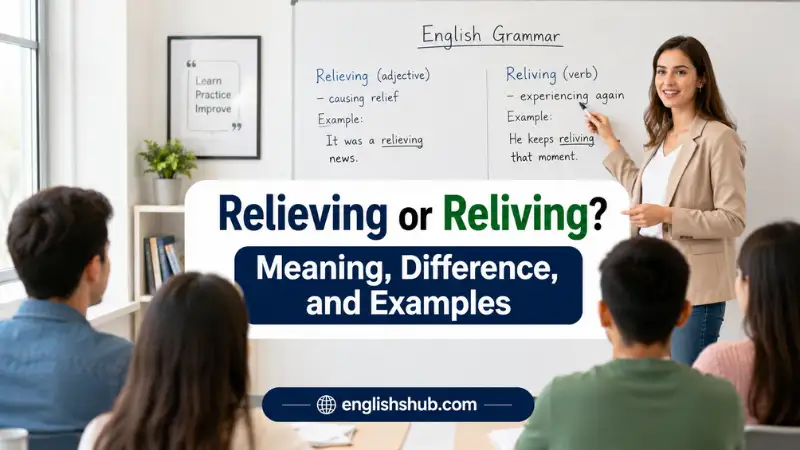
Choosing between relieving or reliving depends on the action you mean. Relieving comes from relieve and describes reducing pain, stress, pressure, or another burden. It can also mean replacing someone who is on duty. Reliving comes from relive and means experiencing a past event again, usually through memory or imagination.
Although only one letter separates these forms, they are not interchangeable. A treatment may be relieving pressure, while old photographs may leave someone reliving a vacation. In addition, the words have different pronunciations and connect to different word families. Once you identify whether the sentence concerns relief, replacement, or a replay of the past, the correct spelling becomes much easier.
Quick Answer
Use relieving when something reduces discomfort, removes a burden, or replaces someone on duty. Use reliving when someone experiences a previous event again through memory, imagination, or a vivid emotional response. Therefore, when choosing relieving or reliving, connect relieving with relief and reliving with living again.
TL;DR
- Relieving means easing pain, stress, pressure, or another burden.
- Reliving means experiencing a past event again.
- Relieving comes from relieve; reliving comes from relive.
- Use reliving with memories, moments, events, and past experiences.
- Relieved often sounds more natural than adjective-like relieving.
Relieving vs. Reliving at a Glance
| Feature | Relieving | Reliving |
|---|---|---|
| Base verb | Relieve | Relive |
| Main meaning | Reducing or removing discomfort | Experiencing something again |
| Common objects | pain, stress, pressure, burden | moment, event, experience, past |
| Secondary meaning | Replacing someone on duty | Literally living again in rare contexts |
| Pronunciation | ri-LEE-ving | ree-LIV-ing |
| Progressive example | The treatment is relieving pressure. | She is reliving the final game. |
| Gerund example | Relieving congestion is the goal. | Reliving the trip made us smile. |
| Memory cue | Relieving brings relief. | Reliving means living again. |
Relieving or Reliving: The Core Difference
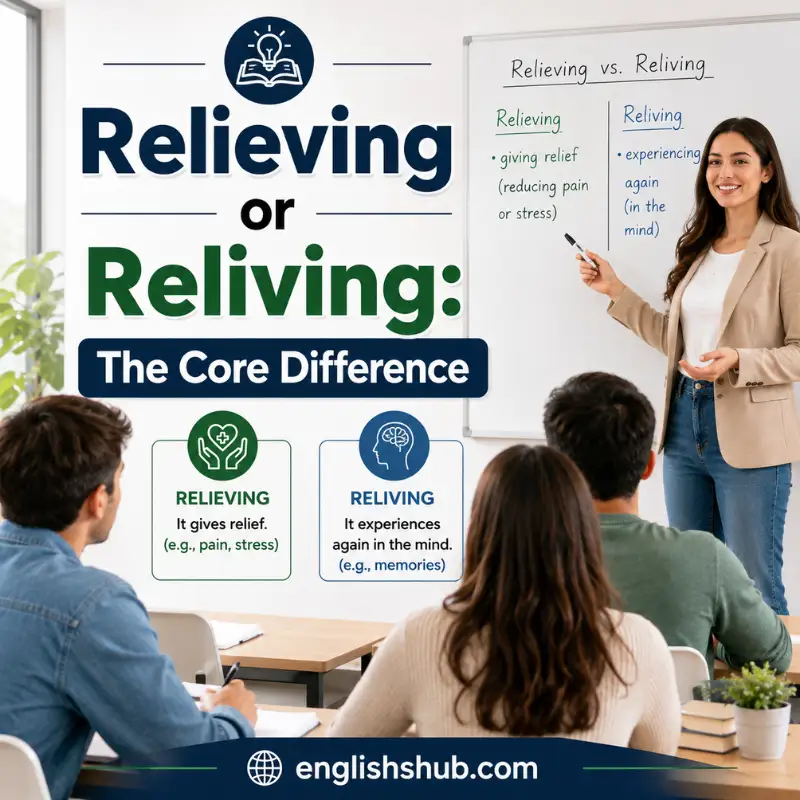
The core difference concerns what happens to an experience. Relieving makes an unwanted condition weaker, lighter, or easier to manage. By contrast, reliving brings an earlier experience back into someone’s thoughts or emotions.
Compare these sentences:
- The new schedule is relieving pressure on the staff.
- The reunion has everyone reliving old school days.
In the first sentence, the pressure decreases. In the second, people mentally return to earlier events.
However, the two ideas are not true opposites. Someone might relive a pleasant memory, so reliving does not always create distress. Likewise, relieving describes an action rather than a permanent result. The safest rule is meaning-based: use relieving for reduction or replacement and reliving for experiencing something again.
What Does Relieving Mean?
Relieving is the -ing form of relieve.
According to the Merriam-Webster definition of relieve,
the verb can mean reducing a burden, easing discomfort, releasing someone from duty, or taking another person’s place.
Its most common pattern is:
relieving + discomfort, burden, or pressure
- The repair crew is relieving pressure on the damaged pipe.
- Extra volunteers are relieving the workload for the small team.
- Opening the window is relieving some of the heat.
- Her honest response was relieving my worry.
The word also appears in workplace settings:
- Jordan is relieving the front-desk employee at noon.
- The night crew will begin relieving the day crew at six.
Another structure is relieve someone of something:
- The assistant is relieving Maya of several routine tasks.
Here, Maya no longer has to complete those tasks. In a disciplinary context, however, relieve someone of duty can mean removing that person from a position.
What Does Reliving Mean?
Reliving is the -ing form of relive.
The Merriam-Webster entry for relive
defines the verb as living something over, especially by experiencing it again in the imagination.
Common patterns include:
- reliving a memory
- reliving an experience
- reliving a moment
- reliving the past
- reliving an event
- reliving one’s childhood
For example:
- The former players spent dinner reliving the championship game.
- Old home videos had Elena reliving her first day of school.
- He kept reliving the awkward conversation.
- The exhibit lets visitors imagine reliving an earlier period.
Reliving often suggests more intensity than remembering. You can remember a date without feeling connected to it. However, when you relive an event, you mentally replay it and may experience some of its sights, thoughts, or emotions again.
The word can describe joyful, embarrassing, neutral, or painful experiences. Therefore, it does not carry one fixed emotional tone.
How Both Words Work Grammatically
Both terms are -ing forms, traditionally called present participles. They can join a form of be to create a progressive verb phrase:
- The new process is relieving pressure.
- She is reliving the moment.
They can also function as gerunds, meaning that the -ing form heads a phrase that performs a noun-like job:
- Relieving traffic congestion will require several changes.
- Reliving the trip brought back happy memories.
In addition, relieving sometimes works as a participial modifier:
- a pressure-relieving valve
- a stress-relieving activity
Still, the intended meaning and natural sentence pattern matter more than the label. This approach also helps with
similar-looking words that perform different grammatical jobs.
Neither form represents an alternative spelling of the other. Instead, each belongs to a separate verb and word family.
Spelling and Pronunciation
The spelling difference comes from the base verbs:
- relieve → relieving
- relive → reliving
In both cases, English drops the final silent e before adding -ing. However, relieve retains the letter sequence liev, while relive becomes reliv.
Standard American pronunciations also differ:
- relieving: /rɪˈliːvɪŋ/ — ri-LEEV-ing
- reliving: /ˌriːˈlɪvɪŋ/ — ree-LIV-ing
Therefore, the words are not exact homophones in standard American English. Relieving contains the vowel sound in leave, while reliving contains the vowel in live. The first syllable also commonly sounds shorter in relieving.
By contrast, true
homophone pairs such as herd and heard
cannot be separated through pronunciation alone.
How to Choose Relieving or Reliving
Use this three-step decision rule.
- Is something becoming less painful, stressful, heavy, or difficult?
Choose relieving. - Is someone taking over another person’s duty or burden?
Choose relieving. - Is someone mentally experiencing a previous event again?
Choose reliving.
For example:
- The update is ___ our worries.
Relieving is correct because the worries are decreasing. - We spent the evening ___ our college adventures.
Reliving is correct because the speakers are revisiting past experiences. - The second guard is ___ the first guard.
Relieving is correct because one worker is replacing another.
As with ensure and insure,
looking at the intended action gives a more reliable answer than looking only at spelling.
A short memory aid also works:
RelIEVing → relIEF
RelIVing → lIVE again
Tricky Contexts That Can Express Either Idea
Some subjects can connect with either word. However, the meaning changes.
Pain
- The treatment is relieving her pain.
The pain is becoming weaker. - She is reliving the pain of that loss.
She is experiencing the earlier emotional pain again.
Stress
- Taking two tasks off his schedule is relieving stress.
- Thinking about the event keeps him reliving a stressful moment.
Experience
- Discussing the problem was relieving some of her concern.
- Discussing the vacation meant reliving the experience.
The past
- Solving the problem is relieving a burden from the past.
- Watching the recording is like reliving the past.
Therefore, a noun such as pain cannot decide the answer by itself. Ask what the verb does to that pain. If it reduces the pain, use relieving. If it brings the earlier pain back as an experience, use reliving.
Relieving vs. Relieved vs. Relief
Writers sometimes choose relieving when relieved or relief would sound more natural.
Use relieving for something that actively reduces a burden:
- The changes are relieving pressure on teachers.
Use relieved for a person who feels less worried or distressed:
- The teachers felt relieved after receiving more help.
Use relief as a noun for the welcome reduction itself:
- The additional help was a relief.
Consequently, this sentence can sound awkward in everyday American English:
- Awkward: Finishing the exam was very relieving.
More natural choices include:
- Finishing the exam was a relief.
- I felt relieved when I finished the exam.
The original sentence is understandable, but natural English often describes the person as relieved or the situation as a relief.
Synonyms, Near-Synonyms, and Contextual Opposites
Several verbs can replace relieving in particular contexts:
| Alternative | Tone or Nuance | Example |
|---|---|---|
| easing | Neutral and common | The changes are easing pressure. |
| reducing | Precise and neutral | The barrier is reducing noise. |
| alleviating | More formal; often partial relief | The program is alleviating hardship. |
| soothing | Calming pain, feelings, or irritation | The music is soothing her nerves. |
| mitigating | Formal; reducing severity or harm | The design is mitigating flood risk. |
| lightening | Making a burden feel less heavy | Extra help is lightening the workload. |
These words are not always interchangeable. Soothe fits feelings or irritation, but it does not normally mean replacing a worker. Likewise, mitigate reduces severity but rarely describes taking over a shift.
Near-synonyms for reliving include re-experiencing, revisiting, replaying, and recalling. However, recalling and remembering may describe simple memory without the vivid emotional quality of reliving.
Contextual opposites of relieving include worsening, aggravating, intensifying, and increasing. Possible contrasts for reliving include forgetting, leaving behind, and moving on from. Still, English has no single antonym that fits every use of reliving.
Common Mistakes and Corrections
Using reliving for reduced discomfort
Incorrect: The medication is reliving the pressure.
Correct: The medication is relieving the pressure.
The sentence describes a reduction, not a replayed event.
Using relieving for a memory
Incorrect: We were relieving our graduation day.
Correct: We were reliving our graduation day.
The speakers are experiencing a past event again.
Describing a person as relieving
Awkward: I felt relieving when the email arrived.
Correct: I felt relieved when the email arrived.
Relieved describes the person’s emotional state.
Adding an unnecessary again
Wordy: She was reliving the concert again.
Better: She was reliving the concert.
The prefix re- already carries the idea of repetition. However, speakers may add again for emphasis in casual conversation.
Using the wrong structure after make
Incorrect: The song made me reliving my childhood.
Correct: The song made me relive my childhood.
After active make + object, use the base verb: made me relive. Similar structural attention helps readers distinguish
other easily confused verb pairs.
American and British English
American and British English use the same spellings for relieving and reliving. Their core meanings also remain consistent across the two varieties.
Accents can change the exact sound slightly, but the main contrast remains: relieving connects with relieve, while reliving connects with relive. Therefore, this is not a regional spelling choice like color versus colour.
The same meaning-first method applies to other US and UK word-choice questions, including
A writer should choose according to the intended idea, not the reader’s country.
FAQs
Yes. Reliving is the correct present participle and gerund form of relive. It usually describes experiencing a previous event again through memory or imagination. For example, “They spent the evening reliving their first concert” is standard English.
Use reliving memories when you mean experiencing past moments again. However, reliving an experience or reliving the moment may sound more precise because a memory already refers to the past. Relieving memories would suggest reducing their burden, which requires more context.
Yes. Someone can relive a wedding, vacation, achievement, funny conversation, or favorite game. The word describes experiencing something again, not whether the original event was positive or negative. Context supplies the emotional tone.
Yes. Relieving someone can mean taking that person’s place during a shift or duty period. For example, “The evening supervisor is relieving Marco at six” means the evening supervisor will replace Marco.
The past tense of relieve is relieved, while the past tense of relive is relived. For example, “The change relieved pressure” and “The documentary relived the expedition” use two different verbs and meanings.
No. Relieve is a verb, while relief is normally a noun. An action may relieve stress, and the resulting comfort is relief. Meanwhile, relieved can function as a past-tense verb or an adjective describing someone’s emotional state.
Test Your Understanding
- Which sentence correctly describes reducing a burden? A. The new assistant is reliving my workload.
B. The new assistant is relieving my workload.
C. The new assistant is relieved my workload.
D. The new assistant is relief my workload. - Which word completes this sentence: “During the reunion, we were ___ our school days”? A. relieving
B. relieved
C. reliving
D. relief - Which sentence uses relieving in its workplace sense? A. The photos are relieving our vacation.
B. The guard is relieving Nina at midnight.
C. Nina felt relieving after work.
D. The guard is reliving Nina at midnight. - Which revision sounds most natural in American English? A. Receiving the approval was very reliving.
B. Receiving the approval made me relief.
C. Receiving the approval was a relief.
D. Receiving the approval was a relive. - Which sentence uses the correct verb form after made me? A. The video made me reliving the celebration.
B. The video made me relived the celebration.
C. The video made me relieve the celebration.
D. The video made me relive the celebration.
Answer Key
- B. Relieving is correct because the assistant reduces the speaker’s workload.
- C. The speakers are mentally experiencing their school days again.
- B. Here, relieving means replacing a person who is on duty.
- C. A relief is the natural noun phrase for a welcome result.
- D. The structure made me takes the base verb relive.
Conclusion
Choosing relieving or reliving becomes simple when you identify the action. Use relieving when pain, stress, pressure, or another burden becomes lighter. The same form can also describe taking over someone’s work or duty. By contrast, use reliving when a person mentally experiences an earlier event again.
Remember the built-in spelling clues: relieving connects with relief, while reliving contains living. Finally, check the full sentence rather than one nearby noun. Pain can be relieved or relived, but each verb creates a completely different meaning.
More Discover Related to: englishshub.com
https://englishshub.com/loose-or-lose/
https://englishshub.com/herd-or-heard/
https://englishshub.com/ensure-or-insure/
https://englishshub.com/elude-or-allude/
https://englishshub.com/fourth-or-forth/