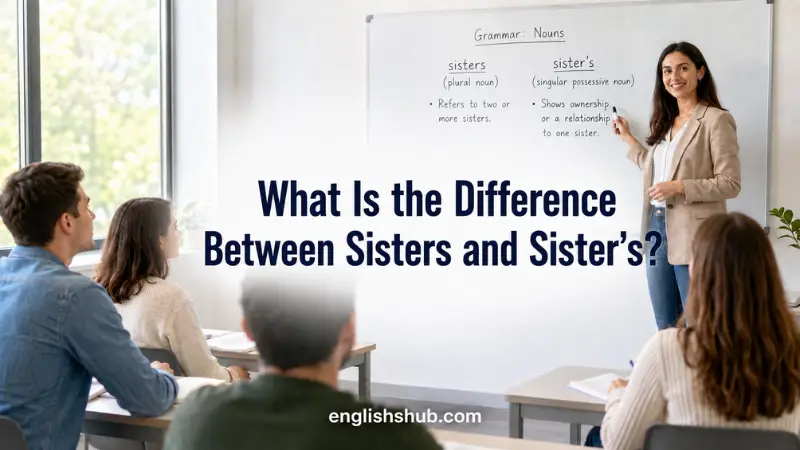
Choosing between sisters or sister’s depends on meaning, not writing style. Sisters is the plural form of sister, so it refers to two or more female siblings. Sister’s usually shows that something belongs or relates to one sister, although it can also shorten sister is or sister has.
A third form, sisters’, matters when something belongs or relates to multiple sisters. Therefore, the apostrophe’s presence and position tell readers whether the sentence expresses number, possession, or a contraction.
Quick Answer
Use sisters for two or more sisters: “My sisters live nearby.” Use sister’s for something connected to one sister or as a contraction of sister is or sister has: “My sister’s car” or “My sister’s arrived.” Choose sisters’ when the possessive meaning involves multiple sisters: “My sisters’ apartment.”
Key Takeaways
- Sisters is the regular plural of sister.
- Sister’s shows possession or connection involving one sister.
- Sister’s can mean sister is or sister has.
- Sisters’ is the plural possessive form.
- An apostrophe does not make a regular noun plural.
- Context determines the correct spelling.
Sisters or Sister’s at a Glance
| Form | Grammar Function | Meaning | Quick Test | Example |
|---|---|---|---|---|
| sister | Singular noun | One sister | Can you count one? | My sister called. |
| sisters | Plural noun | Two or more sisters | Can you add a number? | My two sisters called. |
| sister’s | Singular possessive | Connected to one sister | Can you say “of my sister”? | My sister’s coat is blue. |
| sister’s | Contraction | Sister is or sister has | Can you expand it? | My sister’s already eaten. |
| sisters’ | Plural possessive | Connected to multiple sisters | Are several sisters involved? | My sisters’ room is upstairs. |
What Is the Difference Between Sisters and Sister’s?
The main difference is that sisters expresses number, while sister’s expresses possession, association, or a contraction. Adding an apostrophe does not create the plural form.
Consider these sentences:
- My sisters work at the same hospital.
- My sister’s office is near the hospital.
- My sister’s working at the hospital today.
In the first sentence, sisters names more than one person. In the second, the office relates to one sister. Finally, the third sentence uses sister’s as a shortened form of sister is.
confirms the general rule: ordinary plural nouns do not take apostrophes. Meanwhile, a singular possessive noun normally takes an apostrophe followed by s.
When to Use Sisters as a Plural Noun
Use sisters whenever you mean two or more sisters without making the noun possessive. Because sister is a regular countable noun, its plural requires only the ending -s.
Correct examples include:
- Maya has three sisters.
- Both sisters joined us for dinner.
- Her older sisters live in Arizona.
- The sisters opened a small bakery.
- I sent invitations to my sisters.
A number or plural determiner often confirms the choice. Words such as two, three, both, several, and many normally require sisters.
You can also check the verb. In “My sisters are visiting,” the plural subject agrees with are. Therefore, “My sister’s are visiting” is incorrect because an apostrophe cannot replace the plural ending.
When to Use Sister’s for Singular Possession
Use sister’s when something belongs, relates, or connects to one sister. Form the singular possessive by adding an apostrophe and s to the singular noun: sister + ’s.
For example:
- My sister’s laptop is on the desk.
- Her sister’s wedding takes place in June.
- I value my sister’s opinion.
- The sister’s patience helped the child.
- We visited my sister’s school.
Possession does not always mean legal ownership. A sister does not “own” a wedding, opinion, school, or birthday in the usual sense. Instead, the possessive noun marks a relationship or association.
A useful rephrasing test is to substitute an of phrase. “My sister’s opinion” becomes “the opinion of my sister.” If the meaning remains clear and only one sister is involved, sister’s is likely correct.
When Sister’s Means Sister Is or Sister Has
Sister’s can also function as a contraction. In that case, the apostrophe represents omitted letters rather than possession.
It may mean sister is:
- My sister’s waiting outside.
- Your sister’s very thoughtful.
- His sister’s the new team captain.
It may also mean sister has when has acts as a helping verb:
- My sister’s finished her assignment.
- Her sister’s already left.
- My sister’s been busy all week.
Expand the expression to test it. If sister is or sister has fits naturally, you have a contraction.
However, sister’s does not replace sister has when has means ownership. Write “My sister has a new car,” not “My sister’s a new car.” The shortened version would be misread as my sister is a new car.
When to Use Sisters’ for Multiple Sisters
Use sisters’ when something belongs or relates to two or more sisters. First form the regular plural sisters, then place the apostrophe after its final s.
- My sisters’ apartment is downtown.
- The sisters’ parents attended the event.
- My sisters’ schedules are very different.
- We listened to the sisters’ presentation.
- Both sisters’ names appeared on the form.
The University of North Texas at Dallas apostrophe guidance
follows this standard process: form the plural first, then add an apostrophe to a plural noun that already ends in s.
Context must establish that several sisters are involved. Compare:
- My sister’s room is upstairs. One sister uses the room.
- My sisters’ room is upstairs. Multiple sisters share or use it.
- My sisters’ rooms are upstairs. Multiple sisters have more than one room.
The noun following the possessive may be singular or plural. Its number depends on the intended meaning.
A Three-Step Test for Choosing the Correct Form
Choose the right spelling by checking number, possession, and contraction in that order.
- Are you simply naming two or more sisters?
Use sisters: “My sisters are teachers.” - Does the sentence connect something with one or more sisters?
Use sister’s for one sister and sisters’ for multiple sisters. - Can the word expand to sister is or sister has?
Use sister’s as a contraction.
Here is the process in action:
“Both of my ___ cars are outside.”
The word both may initially look like a clue about the cars. However, you must identify the owners. If two sisters own the cars, write “Both of my sisters’ cars are outside.” If one sister owns two cars, write “Both of my sister’s cars are outside.”
Common Errors and Their Corrections
The most common error is using an apostrophe to create a regular plural.
Incorrect: I have two sister’s.
Correct: I have two sisters.
Another mistake is omitting the apostrophe from a possessive noun.
Incorrect: My sisters phone rang.
Correct: My sister’s phone rang.
Writers also place the apostrophe before the final s when several sisters possess something.
Incorrect: My sister’s shared apartment is nearby.
Correct: My sisters’ shared apartment is nearby.
Finally, some sentences remain grammatically possible but unclear:
Unclear: My sisters’ birthday is Saturday.
This sentence could describe twins or sisters who share a birthday. If their birthdays differ, write “My sisters’ birthdays are in May and July.” Adding precise context prevents readers from guessing.
Difficult Real-Life Examples
Some constructions require more than a simple ownership test. In “one of my sister’s dogs,” one sister owns several dogs, and the sentence refers to one dog. By contrast, “one of my sisters’ dogs” indicates that multiple sisters own or care for the relevant dogs.
Joint possession can also cause trouble:
- My sister and brother’s house means they share one house.
- My sister’s and brother’s houses usually means each person has a separate house.
Although both structures can be grammatical, clarity matters more than preserving a complicated possessive. You can rewrite the second example as “the separate houses owned by my sister and brother.”
Nested possessives become especially difficult to scan. For instance, “my sisters’ friend’s car” refers to one friend associated with multiple sisters. If readers may hesitate, recast the sentence: “the car belonging to a friend of my sisters.”
Do Sister’s and Sisters’ Sound Different?
Sister’s and sisters’ usually sound the same in ordinary speech. Both commonly end with a /z/ sound, so listeners rely on surrounding words and context.
Compare:
- My sister’s room is small.
- My sisters’ room is small.
The apostrophe cannot be heard as a separate sound. As a result, the difference becomes visible mainly in writing. This similarity helps explain why writers sometimes place the mark incorrectly.
Sisters, without an apostrophe, may also sound identical to the other forms when it appears by itself. However, sentence structure normally reveals its role: “My sisters arrived” uses a plural subject, while “My sister’s arrived” expands to “My sister has arrived.”
Formal Writing and American English Usage
The same central rules apply in formal and informal American English. Use sisters as the plural, sister’s as the singular possessive or contraction, and sisters’ as the plural possessive.
Contractions are acceptable in most everyday messages, personal writing, and conversational business communication. However, an academic or highly formal document may prefer “my sister is” over “my sister’s” if the full form improves tone or prevents ambiguity.
Automated spelling tools may not catch every mistake because all three spellings are valid words. A checker must interpret the complete sentence to identify the intended function. Therefore, manual proofreading remains useful. Ask how many sisters the sentence names and whether the following idea belongs or relates to them.
Applying the Rule to Other Family Nouns
The same apostrophe rule works with most regular family nouns. Once you understand the pattern, you do not need to memorize each word separately.
| Singular | Plural | Singular Possessive | Plural Possessive |
|---|---|---|---|
| brother | brothers | brother’s | brothers’ |
| parent | parents | parent’s | parents’ |
| cousin | cousins | cousin’s | cousins’ |
| aunt | aunts | aunt’s | aunts’ |
| uncle | uncles | uncle’s | uncles’ |
For example, “my parents live nearby” simply uses a plural noun. “My parent’s car” connects the car with one parent, while “my parents’ car” connects it with both parents.
Irregular plurals follow a different pattern. Because children does not end in s, its possessive form is children’s, not childrens’.
The Pasco-Hernando State College apostrophe guide
explains this distinction between regular and irregular plural possessives.
FAQs
Both forms are correct, but they perform different jobs. Sisters refers to two or more sisters, while sister’s shows a connection with one sister or shortens sister is or sister has. The intended sentence determines the choice.
The plural of sister is sisters. Add -s without an apostrophe because sister is a regular noun: “She has four sisters.” Apostrophes do not normally form English plurals.
No. Write “My sisters are coming” if you mean that multiple sisters will arrive. If only one sister is coming, write “My sister is coming” or use the conversational contraction “My sister’s coming.”
Sister’s connects something with one sister, as in “my sister’s coat.” Sisters’ connects something with multiple sisters, as in “my sisters’ coats.” The apostrophe appears after the plural ending in the second form.
Write my sister’s house when the house relates to one sister. Use my sisters’ house if two or more sisters share or occupy it. “My sisters house” is incorrect when you intend a possessive meaning.
Yes, sister’s can mean sister has when has helps form a perfect verb: “My sister’s finished dinner.” Do not use this contraction when has means possession; write “My sister has a bicycle.”
Conclusion
The choice between sisters or sister’s becomes clear once you identify the word’s function. Use sisters for two or more female siblings. Choose sister’s for a relationship involving one sister or when the term expands to sister is or sister has. When multiple sisters share the possessive connection, place the apostrophe after the plural ending: sisters’.
Before publishing, check how many sisters the sentence involves and whether it expresses number, possession, or a contraction. That brief test prevents nearly every error.