
When choosing between theirself or themself, use themself for one person referred to by the singular pronoun they. Theirself exists in some regional dialects, but most edited American English treats it as a nonstandard form.
Another choice, themselves, can also refer to one person and remains more common in many contexts. Therefore, the best word depends partly on whether you want to emphasize that the antecedent is singular. A person’s stated pronoun preference can also guide your choice.
Quick Answer
Between theirself or themself, themself is the better choice in standard American English when singular they refers to one person. Theirself is chiefly dialectal and should usually be avoided in formal writing. However, themselves is also correct for singular they and remains the more common reflexive form.
Key Takeaways
- Use themself when singular they clearly refers to one person.
- Use themselves for multiple people.
- Singular themselves is also widely accepted.
- Treat theirself as a regional or nonstandard form.
- Follow a known person’s stated pronoun preference.
- Keep the antecedent clear throughout the sentence.
Theirself or Themself at a Glance
| Form | Typical Reference | Status in American English | Example |
|---|---|---|---|
| Themself | One person using singular they | Accepted, though less common than themselves | Taylor introduced themself. |
| Themselves | Two or more people | Fully standard | The players introduced themselves. |
| Themselves | One person using singular they | Widely accepted and more common | Each applicant should identify themselves. |
| Theirself | Usually one person | Chiefly dialectal | The form may appear in regional speech. |
| Theirselves | Two or more people | Nonstandard in edited English | Use themselves instead. |
Which Is Correct: Theirself or Themself?
Themself is the recommended choice when singular they refers to one person. For example, “Jordan prepared themself for the interview” follows the pattern they–them–their–themself. It also makes the singular reference explicit.
By contrast, theirself is not the usual form in edited American English.
Merriam-Webster defines theirself
as “chiefly dialectal,” which means it occurs in certain regional varieties rather than mainstream formal usage. Calling it completely imaginary would be inaccurate, but it is generally unsuitable for academic, business, and other carefully edited writing.
If your choice is strictly theirself or themself, choose themself:
- Correct: Casey completed the assignment themself.
- Usually avoided: Casey completed the assignment theirself.
- Also correct: Casey completed the assignment themselves.
What Does Themself Mean?
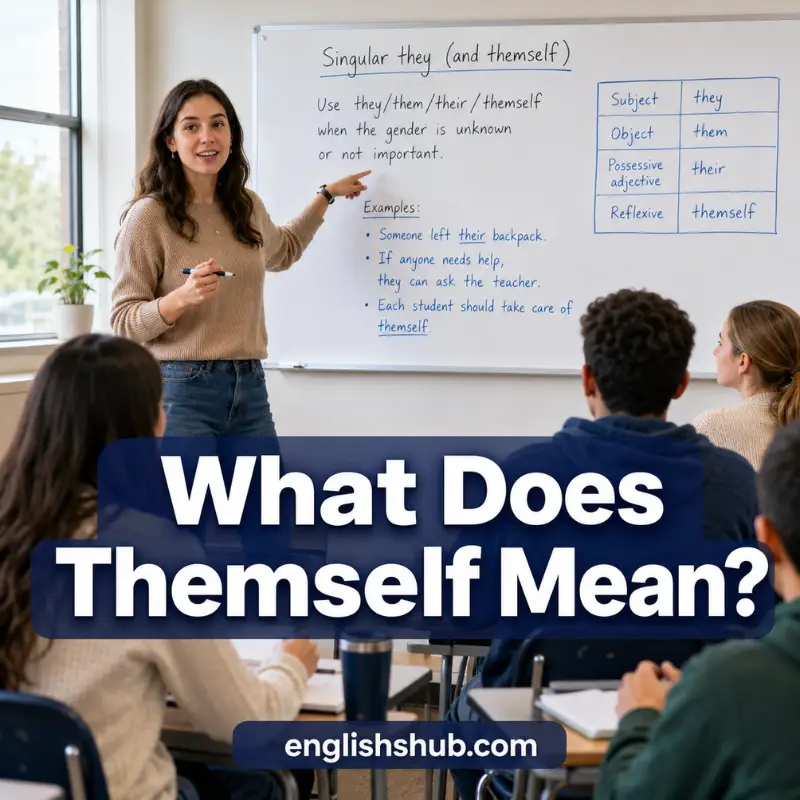
Themself is a singular reflexive pronoun connected to singular they. A reflexive pronoun points back to the subject when the subject and object refer to the same person.
Consider this sentence:
Morgan accidentally locked themself outside.
Morgan performs the action and also experiences its result. Therefore, themself refers back to Morgan. Compare that construction with “Morgan locked them outside,” where them could mean a different person.
Themself can also work as an intensive pronoun. In that role, it adds emphasis instead of serving as the object:
Morgan themself approved the final design.
The sentence remains grammatically complete without the intensive pronoun: “Morgan approved the final design.” Adding themself emphasizes that Morgan personally approved it.
Why Theirself Sounds Logical
Theirself sounds logical to some speakers because English reflexive pronouns do not follow one perfectly consistent pattern. Herself appears to combine the possessive form her with self, while himself combines the object form him with self. Likewise, yourself uses your, but myself uses my.
A speaker may therefore extend the yourself pattern to singular they and create theirself. This process is called analogy: speakers form a word based on an existing grammatical pattern.
Even so, logical structure alone does not determine standard usage. English conventions develop through established use. Current dictionaries recognize theirself as a real dialectal form, but themself has broader acceptance in edited writing. Thus, understanding why theirself exists does not make it the safest formal choice.
Themself or Themselves: What Is the Difference?
Use themself to make it clear that they refers to one person. Use themselves when they refers to multiple people. However, themselves can also agree with singular they, so it is not automatically plural.
Compare these sentences:
- One person: The new student introduced themself.
- One person: The new student introduced themselves.
- Several people: The new students introduced themselves.
Both forms in the first two sentences are acceptable.
According to APA Style’s guidance on singular they,
themself and themselves can both serve as singular reflexive pronouns, although themselves is more common.
Consequently, use themself when singular meaning needs emphasis or when it matches someone’s preference. Use themselves when you want the most familiar choice or when your publication’s style requires it.
Singular They and Pronoun Agreement
Singular they refers to one person whose gender is unknown, irrelevant, or nonbinary. Although its meaning can be singular, it takes the same verb forms as plural they: write “they are,” “they have,” and “they do,” not “they is,” “they has,” or “they does.”
The basic singular pattern is:
| Function | Pronoun | Example |
|---|---|---|
| Subject | they | They are ready. |
| Object | them | I called them. |
| Possessive determiner | their | Their appointment starts soon. |
| Possessive pronoun | theirs | The blue folder is theirs. |
| Reflexive | themself or themselves | They prepared themself/themselves. |
The antecedent—the noun or phrase a pronoun refers to—should remain clear. In “Someone left their phone, but they may return for it,” someone is the singular antecedent of their and they.
Examples of Themself in Sentences
Natural examples make the singular meaning of themself easier to recognize:
- Each student may choose the topic themself.
- Alex taught themself how to play the piano.
- The customer can complete the form themself.
- Riley described themself as a careful listener.
- Someone could hurt themself on the loose step.
- Taylor themself suggested the new schedule.
- A good leader should examine themself honestly.
- The winner asked themself whether the result was final.
The first seven examples use they or an implied singular antecedent. In the eighth, the winner clearly means one person.
However, not every use of themself is necessary:
- Incorrect: The manager spoke to themself.
- Correct if the manager was alone: The manager spoke to themself.
- Correct if another person was addressed: The manager spoke to them.
Context determines whether the object points back to the subject.
Formal, Academic, and Professional Writing
Themself is acceptable in many modern forms of edited English, but publication preferences differ. Some editors choose singular themselves because it is more familiar. Others prefer themself because the ending -self signals one person clearly.
In academic writing, follow the assigned style guide. APA permits both singular forms. Meanwhile, a workplace, school, publisher, or legal organization may maintain its own house style. Consistency matters once a choice has been made.
When writing about a known person who uses they/them pronouns, respect that person’s stated reflexive preference if it is available. Some people prefer themself, while others naturally use themselves. If you cannot confirm a preference, either accepted form works, though themselves may sound more familiar to a broad audience.
You can also rewrite an awkward sentence:
- Original: Every employee must prepare themself.
- Alternative: All employees must prepare themselves.
- Alternative: Every employee must be prepared.
Common Mistakes and How to Correct Them
The most common mistake is choosing a reflexive form simply because it sounds formal. Instead, identify the antecedent and decide whether it represents one person or several.
Using Theirself in Edited English
- Avoid: Pat wrote the report theirself.
- Better: Pat wrote the report themself.
- Also correct: Pat wrote the report themselves.
Using Themself for a Clearly Plural Group
- Incorrect: The children dressed themself.
- Correct: The children dressed themselves.
Using a Reflexive Pronoun Without a Matching Subject
- Incorrect: Please send the document to Sam or themself.
- Correct: Please send the document to Sam or them.
In the incorrect sentence, themself does not point back to the subject. Therefore, the ordinary object pronoun them is required.
Confusing Their and They’re
Their shows possession, while they’re means they are. Neither spelling determines whether the reflexive should be themself or themselves.
History and Modern Acceptance of Themself
Themself is not a recent invention.
Merriam-Webster’s history of themself
records plural use from at least the late 1300s and singular examples from around 1450. Themselves later became the dominant plural form.
Modern visibility has grown alongside wider acceptance of singular they.
Today, Cambridge Dictionary defines themself
for cases involving singular they, including reference to one person who is nonbinary.
Language changes do not make every possible form equally suitable in every context. Themself has substantial historical evidence and current institutional recognition. Theirself also has a long history, but it remains chiefly dialectal rather than the normal edited form.
FAQs
Theirself is a recorded word, but it is chiefly dialectal. People use it in some regional varieties of English, and dictionaries document that usage. However, writers usually choose themself or themselves in standard American academic, professional, and published writing.
Yes, themself is grammatically acceptable when singular they refers to one person. Major dictionaries record it, and APA Style accepts it as an alternative to singular themselves. Nevertheless, some organizations and editors still prefer the more common themselves.
“Everyone should be themselves” is the more common and natural construction. “Everyone should be themself” can emphasize that everyone is grammatically singular, but it may sound unfamiliar to some readers. Both forms can refer back to the singular indefinite pronoun everyone.
Yes. Themselves may refer to one person when it agrees with singular they. For example, “Each applicant should introduce themselves” is standard modern English. The -selves ending does not force a plural meaning in this construction.
Themself does not have a separate possessive form. Use their before a noun, as in “their coat,” and use theirs without a following noun, as in “The coat is theirs.” These forms work with both singular and plural they.
Theirselves occurs in some dialects, but standard edited English uses themselves for multiple people. Write “The players congratulated themselves,” not “The players congratulated theirselves,” in academic, professional, and general published content.
Conclusion
When deciding between theirself or themself, choose themself for one person referred to by singular they. Use themselves for several people and, when preferred, for one person as well. Both singular options have current support, although themselves remains more common.
Theirself is a genuine dialectal form, but it is usually avoided in formal American English. The clearest approach is to identify the antecedent, follow the relevant style guide, and respect a known person’s pronoun preference.