
When choosing between themselves or theirselves, use themselves in Standard American English. It is the accepted reflexive and intensive form connected with the plural pronoun they: “The students introduced themselves.”
Theirselves does appear in some regional dialects, so calling it meaningless or invented would be inaccurate. However, it remains nonstandard. Therefore, replace it with themselves in school assignments, business communication, edited articles, and other formal writing.
Quick Answer
Themselves is the correct choice in standard US English: “They completed the work themselves.” Theirselves is a documented regional or dialectal form, but formal writing generally does not accept it. Therefore, when deciding between themselves or theirselves, choose themselves unless you are deliberately representing a particular dialect or a speaker’s natural voice.
Key Takeaways
- Use themselves in standard written and spoken English.
- Treat theirselves as dialectal, not formal.
- Use reflexive pronouns when the subject and object match.
- Use themselves for emphasis when a plural group acts directly.
- Consider themself when singular they refers to one person.
- Use each other for actions exchanged between people.
Themselves or Theirselves at a Glance
| Feature | Themselves | Theirselves |
|---|---|---|
| Standard US English | Yes | No |
| Grammatical role | Reflexive or intensive pronoun | Dialectal alternative |
| Usual reference | A group, or sometimes singular they | Mostly plural in regional speech |
| Formal writing | Recommended | Avoid |
| Example | They prepared themselves. | They prepared theirselves. |
| Edited correction | No change needed | Change to themselves |
| Dictionary status | Standard entry | Recorded as chiefly dialectal |
| Best general choice | Always preferred | Use only for a deliberate dialect effect |
Is Themselves or Theirselves Correct?
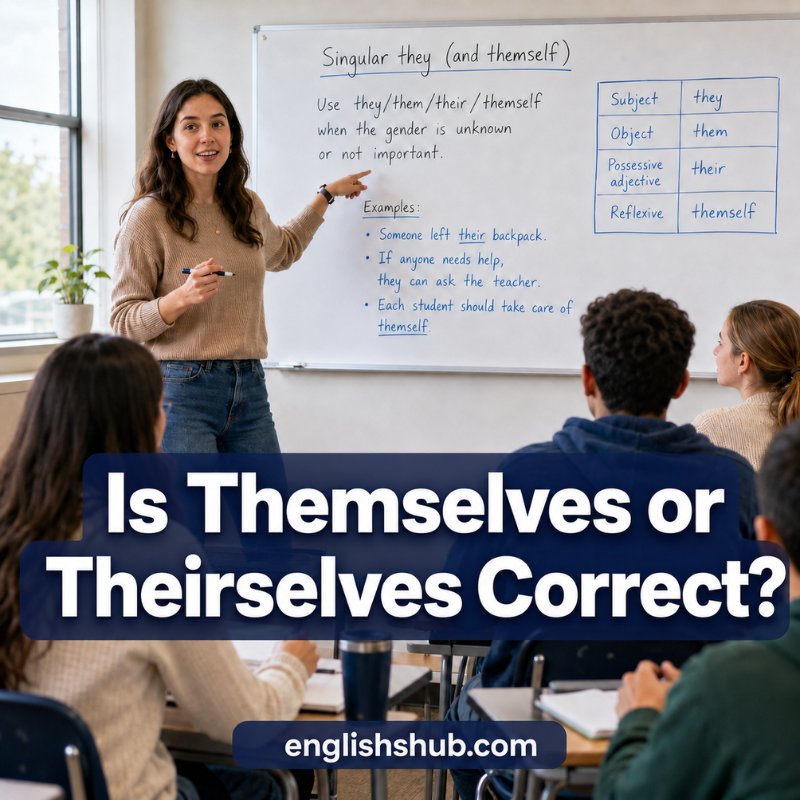
Themselves is correct in Standard American English. It belongs to the standard pronoun pattern they–them–their–theirs–themselves. For example:
- The players congratulated themselves.
- The machines shut themselves off.
- Ava and Mia completed the project themselves.
In each sentence, themselves refers back to a plural antecedent. It can represent people, animals, objects, or other plural nouns.
Although you may hear theirselves in conversation, hearing a form does not automatically make it suitable for every setting. Standard English is the variety normally expected in academic papers, news reports, job applications, and professional messages. In those situations, choose themselves.
What Does Themselves Mean?
Themselves is a third-person reflexive pronoun. It normally refers back to a plural subject when that subject receives or experiences its own action.
Consider this sentence:
The children dressed themselves.
The children performed the action, and the same children received it. Therefore, the subject and object refer to the same group.
The Purdue Online Writing Lab’s reflexive-pronoun guidance
provides a useful general rule: use a reflexive form when a verb’s subject and object refer to the same person or thing.
Without the reflexive pronoun, the meaning can change:
- The children dressed themselves.
The children put on their own clothes. - The children dressed them.
The children dressed other people.
Reflexive and Intensive Uses of Themselves
Themselves has two main grammatical functions: reflexive use and intensive use. The spelling stays the same, but the function changes.
Reflexive use
A reflexive pronoun receives the action performed by its antecedent:
The hikers protected themselves from the rain.
Removing themselves would leave the verb without its necessary object: “The hikers protected from the rain.” The sentence would sound incomplete.
Intensive use
An intensive pronoun adds emphasis:
The hikers themselves designed the route.
Here, themselves emphasizes that the hikers—not another person—designed it. You can remove the pronoun without damaging the basic grammar:
The hikers designed the route.
This removal test is helpful. If the sentence remains complete but loses emphasis, the pronoun is intensive. If removing it changes or breaks the meaning, it is reflexive.
Is Theirselves a Real Word?
Theirselves is a real recorded dialect word, but it is not part of Standard American English.
Merriam-Webster labels theirselves “chiefly dialectal”
and traces its known use to the 14th century.
This distinction matters. Dictionaries record how people use language; they do not include only forms recommended for formal writing. A word can have an established meaning and history while remaining regional or nonstandard.
Therefore, two statements can be true:
- Some English speakers naturally use theirselves.
- Editors generally change theirselves to themselves in standard prose.
Avoid describing dialect users as lazy, careless, or uneducated. Regional language follows its own patterns. Nevertheless, writers must consider audience and context. For broadly accepted US English, themselves remains the safest choice.
Why Do People Say Theirselves?
People often form theirselves by following the pattern of possessive pronouns such as myself, yourself, and ourselves:
- my + self = myself
- your + self = yourself
- our + selves = ourselves
- their + selves = theirselves
That pattern appears logical. However, standard third-person reflexive forms developed differently:
- him + self = himself
- her + self = herself
- them + selves = themselves
English contains many patterns that are not perfectly consistent. As a result, theirselves is understandable even though standard grammar prefers themselves.
The best memory trick is to connect they with its object form them: they did it to them + selves = themselves. The possessive form their belongs in phrases such as their books, their decision, and their own work.
Themselves with Singular They
Themselves can also refer to one person when the writer uses singular they. This happens when someone’s gender is unknown, irrelevant, or represented by they/them pronouns:
Every applicant should prepare themselves for the interview.
Jordan introduced themselves before the presentation.
Some writers prefer themself when the meaning is clearly singular:
Jordan introduced themself before the presentation.
Both options occur in contemporary usage.
The MLA Style Center accepts themselves or themself
with singular they and advises writers to respect an individual’s stated pronouns.
However, theirself is not the usual standard solution. If you are writing about a specific person, follow that person’s preference. Otherwise, use the form required by your organization’s style guide.
Themselves vs. Each Other
Use themselves for a self-directed action, but use each other for an action exchanged between two or more people.
Compare these sentences:
- The twins photographed themselves.
Each twin appeared in a photograph they took, perhaps through a mirror or timer. - The twins photographed each other.
One twin photographed the other.
The same distinction applies in many situations:
- The teammates blamed themselves for their own mistakes.
- The teammates blamed each other for one another’s mistakes.
- The actors introduced themselves to the audience.
- The actors introduced each other to the audience.
Context sometimes permits both forms, but the meanings are different. Ask whether the action returns to the same person or passes between different people.
How to Choose the Correct Form
Use this four-step test whenever you are unsure:
- Identify the subject.
Find who or what performs the action. - Check whether the action returns to that subject.
If a plural subject also receives the action, use themselves. - Check for emphasis.
If the word means “without help” or “those exact people,” themselves can act as an intensive pronoun. - Consider the writing context.
Replace theirselves in academic, professional, and general-audience writing.
For example:
The employees organized the event theirselves.
The plural subject is employees. The final pronoun emphasizes that they worked without outside help. Standard editing therefore produces:
The employees organized the event themselves.
Common Mistakes and Corrections
These corrections show how the rule works in everyday sentences.
Nonstandard: The students should be proud of theirselves.
Standard: The students should be proud of themselves.
The students experience the feeling directed toward the same group, so the reflexive form is required.
Nonstandard: They fixed the computers by theirselves.
Standard: They fixed the computers by themselves.
The phrase by themselves means without help or alone.
Incorrect meaning: The friends gave themselves gifts.
Possible correction: The friends gave each other gifts.
Use each other if every friend gave a gift to another friend. Keep themselves only if each person bought a gift for their own use.
Unnecessary reflexive: The manager spoke to Jamie and themselves.
Correction: The manager spoke to Jamie and them.
A reflexive pronoun normally needs an antecedent in the same clause. Here, them is simply an object.
FAQs
Theirselves is grammatically established in some regional dialects, but it is nonstandard in general American English. Use themselves in schoolwork, professional communication, formal speech, and edited online content.
Not always. Some writers may type it accidentally, but others use it as a regular feature of their regional speech. Dictionaries therefore describe it as dialectal rather than treating every occurrence as a random misspelling.
Yes, when it accurately represents a character’s dialect, identity, period, or speaking style. Use it thoughtfully and consistently; inserting nonstandard grammar merely to make a character appear unintelligent can create an unfair stereotype.
By themselves is the standard expression. It may mean “alone,” “without assistance,” or “without being caused by someone else,” as in “The lights turned off by themselves.”
Either may be appropriate with singular they. Themselves has broad recognition, while themself makes the singular reference explicit. For a known person, respect that person’s usage; otherwise, follow the relevant style guide.
Themselves does not have a separate possessive form. Use their before a noun or theirs independently: “They brought their equipment,” and “The equipment is theirs.”
Themselves is always written as one word when used as a reflexive or intensive pronoun. The separate phrase their selves is rare and has a different meaning, referring to their identities or senses of self.
Conclusion
When choosing between themselves or theirselves, use themselves in Standard American English. It works as a reflexive pronoun when an action returns to a plural subject and as an intensive pronoun when the writer adds emphasis.
Theirselves has a genuine history and remains part of some regional dialects, but that does not make it the usual choice in formal prose. For school, business, publishing, and general communication, remember the standard pattern: they, them, and themselves.