
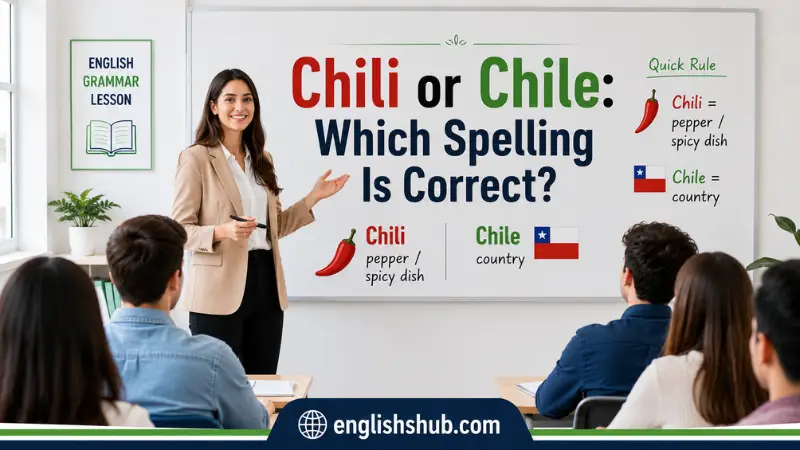
The answer to chili or chile depends on what you mean and, sometimes, where you are writing. In American English, chili can mean the spicy pepper or the dish made with beans, meat, and seasonings. Chile is also an accepted U.S. spelling for the pepper, especially in Southwestern and Mexican culinary contexts.
The key distinction is context. If you mean the country in South America, write Chile with a capital C. If you mean the pepper, chili and chile can both work in U.S. English, while British English normally uses chilli.
Quick Answer
Chili and chile can both be correct for the pepper in American English. Chili is also the common U.S. word for the spicy dish, while chile often appears in culinary and regional contexts for the pepper. British English generally uses chilli. Capitalized Chile means the South American country.
Key Takeaways
- Chili can mean a pepper or a spicy dish.
- Chile can mean a pepper in U.S. English.
- Chilli is the usual British spelling.
- Chile means the country when capitalized.
- Context matters more than a single rigid spelling rule.
At a Glance: Chili vs. Chile vs. Chilli vs. Chile
| Word | Main meaning | Common usage | Example |
| chili | Pepper or spicy dish | American English | “Add two chili peppers.” |
| chile | Pepper | U.S. culinary/regional usage | “Roast the green chile.” |
| chilli | Pepper or spicy dish | British English | “Add a chopped red chilli.” |
| Chile | Country | Geography/proper noun | “Chile is in South America.” |
Cambridge lists chili as a U.S. spelling and recognizes chile as another U.S. form for the pepper. Oxford similarly identifies chili as North American English and chilli as the British form.
Is “Chili” Correct for the Pepper?
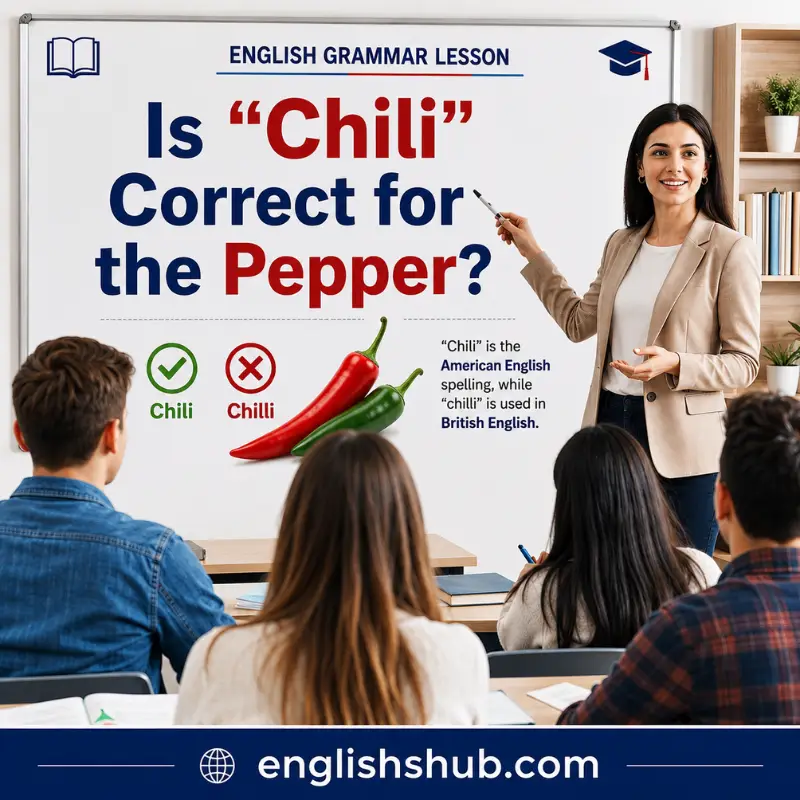
Yes. Chili is a correct American English spelling for the hot pepper. Cambridge defines chili as the small red or green fruit of certain pepper plants and also lists the word as the name of a spicy dish.
For example:
- “Add one red chili to the sauce.”
- “These chilies are very hot.”
- “She grows several types of chili peppers.”
The word is also common in compounds such as chili pepper, chili powder, chili sauce, and chili oil. Oxford lists chili pepper as another name for the hot fruit and also recognizes chili con carne as a dish.
So, if you are writing ordinary American English, chili is a safe and widely recognized choice.
Is “Chile” Correct for the Pepper?
Yes. Chile is also correct when referring to the pepper, especially in U.S. culinary contexts. Cambridge explicitly defines lowercase chile as a U.S. noun for the red or green pepper used to make food spicy.
For example:
- “Add chopped green chile.”
- “The recipe uses roasted red chile.”
- “Serve the enchiladas with chile sauce.”
The spelling chile can be especially useful when discussing particular regional food traditions. In that context, it may appear in names such as green chile or chile sauce.
That does not mean chili is wrong. The two forms overlap, and authoritative dictionaries recognize both. The choice can reflect regional or culinary convention rather than a universal grammar rule.
Chili vs. Chile in American English
American English allows more than one spelling for the pepper. Chili is broadly familiar, while chile is also established, particularly in culinary writing and Southwestern U.S. contexts.
This is why the simple rule “chili means the dish, chile means the pepper” can be useful as a memory aid but should not be treated as an absolute rule. Cambridge gives chili and chile as forms for the pepper, while chili also has the separate meaning of a spicy dish.
Consider these examples:
- “I added chili to the soup.” — correct; the context may mean pepper or chili-based seasoning.
- “I made a pot of chili.” — clearly refers to the dish.
- “I roasted green chile.” — clearly refers to the pepper.
- “I bought chili peppers.” — clearly refers to peppers.
When the meaning could be unclear, adding pepper or naming the dish makes the sentence more precise.
Chili vs. Chilli in British English
Chilli is the standard British English spelling. Oxford labels chilli as British English and chili as the North American form. It also uses chilli for both the pepper and the spicy dish.
Examples include:
- “Add two red chillies.”
- “The sauce contains fresh chilli.”
- “We had chilli con carne for dinner.”
Cambridge likewise identifies chilli as the UK spelling and chili as the U.S. spelling.
Therefore, if your audience follows British English, chilli is usually the most natural choice. For American readers, chili is generally more familiar.
Chile vs. Chile: Why Capitalization Matters
Capitalization creates a completely different distinction.
Chile with a capital C is the name of a country in South America. chile with a lowercase c can refer to a hot pepper. Oxford defines Chile as a country in South America, while Cambridge separately defines lowercase chile as a pepper.
Compare:
- “She added a green chile to the salsa.”
- “She traveled to Chile last summer.”
The pronunciation is essentially the same, but capitalization and context identify the meaning.
This distinction is especially important in writing because “I visited chile” can look like a spelling mistake if you mean the country. Use Chile for the proper noun.
What About “Chili Con Carne” and “Chili Powder”?
The word chili has several food-related uses, which is one reason the spelling can be confusing.
Chili con carne is the spicy dish. In American English, it is commonly shortened to simply chili. Oxford identifies chili con carne as a spicy dish containing ingredients such as beans, chilies, and meat.
Chili powder is different. It generally refers to a powdered seasoning made from dried ground peppers, often combined with other spices depending on the product.
Examples:
- “We made a pot of chili for dinner.”
- “Add one teaspoon of chili powder.”
- “Slice the fresh chili peppers.”
- “Roast the green chile before adding it to the sauce.”
The surrounding noun often makes the intended meaning obvious.
Which Spelling Should You Use?
Use this practical framework:
- Writing for a general American audience?
Use chili as the broad, familiar spelling. - Talking about a specific pepper or regional culinary tradition?
Chile may be the preferred form. - Writing in British English?
Use chilli. - Talking about the South American country?
Always use Chile with a capital C. - Concerned about ambiguity?
Add a clarifying word such as pepper, powder, sauce, or dish.
The best choice is therefore not simply “chili” or “chile.” It depends on the meaning, audience, and regional convention.
Common Mistakes With Chili and Chile
Mistake 1: Treating “chile” as always incorrect
Incorrect assumption: “Chile” is only the country.
Better: Lowercase chile is also an established U.S. word for a hot pepper.
Mistake 2: Saying “chili” only means the dish
Incorrect assumption: “Chili” cannot mean a pepper.
Better: Dictionaries recognize chili as a word for the pepper as well as the spicy dish.
Mistake 3: Using “Chile” for the country without capitalization
Write:
“Chile is a country in South America.”
Not:
“chile is a country in South America.”
Mistake 4: Assuming British English uses “chili”
British English normally uses chilli, with two l’s. American English normally uses chili.
Mistake 5: Applying one rigid rule everywhere
The rule “dish = chili, pepper = chile” can help beginners, but it does not describe every real-world use. American dictionaries recognize overlapping culinary meanings.
FAQs
Both can be correct when referring to the pepper in American English. Chili is also widely used for the spicy dish, while chile is common in certain culinary and regional contexts.
Yes. Lowercase chile is an established U.S. spelling for a hot pepper. It is especially familiar in regional and culinary contexts, but chili is also correct.
Chilli is the standard British English spelling, while chili is the usual North American spelling. British English uses chilli for both the pepper and the spicy dish.
No. Chile with a capital C is the country in South America. Lowercase chile can refer to a hot pepper in U.S. English.
Chilies is a common American plural, although chilis also occurs. For chile, the plural is chiles. British English commonly uses chillies.
Both expressions are used. Chili pepper is broadly familiar in American English, while chile pepper is also established, particularly in culinary contexts. Cambridge lists the pepper under both chili pepper and chile.
Conclusion
Chili and chile are both correct spellings for the pepper in American English, although their usage can reflect context and regional culinary convention. Chili also means the spicy dish, chilli is the usual British spelling, and capitalized Chile names the South American country.
For general U.S. writing, chili is a safe choice. When discussing a particular pepper or Southwestern culinary tradition, chile may be more natural. The most accurate rule is simple: choose the spelling that fits your meaning, audience, and regional context.