
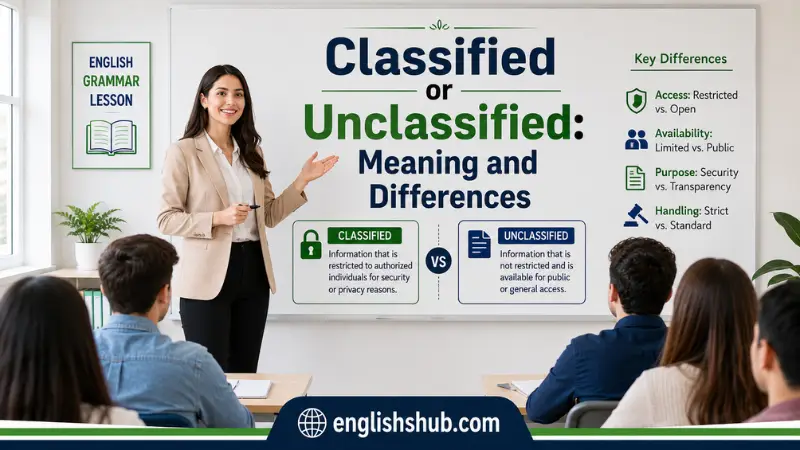
The choice between classified or unclassified depends on context. When talking about information, classified usually means officially secret or restricted, while unclassified means the information does not have that security classification. Oxford lists unclassified as the opposite of classified in this sense.
However, classified has another meaning: arranged into groups according to subject or type. Because of that, unclassified can also mean something that has not been placed into a category. The right word therefore depends on whether you mean security status, categorization, or another specialized context.
Quick Answer
Classified usually describes information that is officially secret or restricted, while unclassified means it is not assigned that security classification. But classified can also mean categorized, so unclassified may mean “not put into a category.” Also, declassified specifically refers to information whose classified status was formally removed.
Key Takeaways
- Classified information is officially secret or restricted.
- Unclassified information lacks that security classification.
- Classified can also mean organized into categories.
- Unclassified does not always mean publicly available.
- Declassified information was classified previously.
- Context determines the correct word.
Classified vs Unclassified at a Glance
| Context | Classified | Unclassified |
| Security | Officially secret or restricted | Not security-classified |
| Documents | Classified documents | Unclassified documents |
| Information | Protected under a classification system | Not assigned that classification |
| Categorization | Put into a class or group | Not put into a class or group |
| Example | “The report contains classified information.” | “The report contains unclassified information.” |
| Related status | May later be declassified | Does not necessarily mean previously classified |
What Does “Classified” Mean?

Classified has two important meanings in modern English. The first is the security meaning: information, documents, or material are officially designated as secret and available only to authorized people. Oxford lists classified information, classified documents, and classified material as standard examples.
Cambridge gives the same core meaning and also shows common expressions such as highly classified information and classified documents. In this context, the word is directly connected to secrecy and restricted access.
For example:
- The agency released an unclassified summary but kept the full report classified.
- The investigator was not authorized to view the classified documents.
- Details of the operation remain classified.
The second meaning is broader. Classified can describe something arranged into groups according to subjects or characteristics. Oxford gives classified catalogue as an example.
So, classified does not automatically mean secret. The noun that follows it usually reveals the intended meaning.
What Does “Unclassified” Mean?
Unclassified is commonly used as the opposite of classified information. Oxford defines it as information or documents that are not officially secret, while Merriam-Webster also gives the broader meaning “not placed or belonging in a class.”
That creates two useful meanings:
- Security meaning: not subject to a security classification.
- Categorization meaning: not placed into a particular class or group.
For example:
- The press received an unclassified report.
- The briefing contains only unclassified information.
- Several records remain unclassified because they have not been assigned to a category.
Collins likewise distinguishes information that is not secret from things that have not been placed into a category.
This is why unclassified should not automatically be interpreted as “unimportant” or “ordinary.” The exact meaning comes from the context.
Classified or Unclassified: Which Should You Use?
Use classified when the subject has been formally assigned a restricted or secret status. Use unclassified when it has not been given that classification.
A simple decision test helps:
Are you talking about secrecy?
- Yes, and the information is restricted → classified
- Yes, and it does not have that classification → unclassified
Are you talking about categories?
- Organized into a class → classified
- Not placed into a class → unclassified
For example, these sentences use the words correctly:
The military document is classified.
The public report is unclassified.
The library keeps a classified catalogue.
The records contain several unclassified entries.
The first two sentences concern security. The last two concern categorization.
This distinction matches the dictionary treatment of both words: classified can describe officially secret information or information arranged by subject, while unclassified can describe information without a security classification or something not placed in a category.
Classified Information vs Unclassified Information
In U.S. government usage, classified information is information that has been assigned a national-security classification. The Department of Commerce explains that the three classification levels are Top Secret, Secret, and Confidential. It also distinguishes unclassified information from Controlled Unclassified Information, or CUI.
The National Institute of Standards and Technology defines unclassified in a specialized federal context as information that does not require the relevant safeguarding or dissemination controls and has not been determined to require protection as classified national-security information.
That distinction matters because unclassified does not always mean unrestricted.
For example, CUI is not classified national-security information, but it can still be subject to safeguarding and dissemination controls. Therefore, writers should avoid assuming that every piece of unclassified government information is automatically intended for unrestricted public release.
For ordinary English, however, the basic contrast remains:
- Classified information = officially assigned a security classification.
- Unclassified information = not assigned that classification.
- Controlled Unclassified Information (CUI) = unclassified information subject to specified controls.
The U.S. Department of Commerce provides an especially useful overview because it places the three concepts within the same classification-management framework.
Classified vs Declassified vs Unclassified
Declassified is not simply a more formal synonym for unclassified. The key difference is the information’s history.
The National Archives defines declassification as the authorized change from classified information to unclassified information. Its training material makes the distinction even more directly: an unclassified document has not contained classified information, while a declassified document originally contained classified information.
Think of the three terms this way:
| Term | What it tells you |
| Classified | The information currently has a classified status |
| Unclassified | The information does not have that classified status |
| Declassified | The information previously had classified status and was formally changed |
For example:
- “The report is unclassified.”
This describes its current status. - “The agency declassified the report.”
This describes a formal change in status. - “The report was declassified last year.”
This tells you it was classified before.
The distinction is especially important in historical and government records. A document can be unclassified without ever having been secret, while a declassified document has a history of classification.
Common Uses and Sentence Examples
The most natural collocations make the difference easier to remember. Classified information, classified documents, and classified material are established expressions in major dictionaries.
Examples with “classified”
- The journalist was denied access to classified information.
- The agency stores classified documents securely.
- The report contains classified material.
- Some details of the investigation remain classified.
- The library uses a classified catalogue.
The final example has the categorization meaning rather than the secrecy meaning.
Examples with “unclassified”
- The agency published an unclassified report.
- The presentation contains only unclassified information.
- Researchers reviewed several unclassified documents.
- The database includes some unclassified records.
- Officials prepared an unclassified version of the report.
The phrase unclassified version is also used in real English-language reporting and institutional contexts. Cambridge records examples in which a classified report can have an unclassified version.
Pronunciation
In U.S. English, classified is pronounced approximately /ˈklæs.ə.faɪd/. Cambridge provides the U.S. pronunciation as well as the British pronunciation.
Unclassified begins with the unstressed un- prefix, followed by the same core sound found in classified.
Common Mistakes to Avoid
1. Assuming “unclassified” always means “public”
That is too broad for specialized government contexts. Some unclassified information can still be subject to handling or dissemination controls, including certain CUI categories.
2. Using “declassified” when you mean “never classified”
If information was never classified, unclassified is the more precise description. Declassified implies a previous classified status.
3. Assuming “classified” always means secret
The word can also mean organized into categories. A classified catalogue is not necessarily secret.
4. Confusing “classified” with “classified ad”
A classified ad is an advertisement, usually for selling something, buying something, or offering or seeking a job. It is a completely different sense of the word.
5. Treating “unclassified” as a synonym for “unimportant”
An unclassified document can still be important, sensitive, or professionally significant. The term primarily describes its classification status or categorization, not its value.
FAQs
Yes. Both classified and unclassified are standard adjectives. In security contexts, they describe opposite classification statuses. In other contexts, they can describe whether something has been placed into a category.
Yes, when discussing security classification. Classified information has an official security classification, while unclassified information does not. However, the broader meanings can involve categorization rather than secrecy.
Not necessarily. In everyday usage, unclassified information may be publicly available, but specialized systems can place controls on certain unclassified information. U.S. CUI is an important example.
Classified describes information that has a classified status. Declassified indicates that information previously had a classified status and was formally changed to unclassified status. The National Archives explicitly defines declassification as this authorized status change.
Yes. Classified can mean arranged or organized according to subjects, types, or characteristics. For example, a library may have a classified catalogue.
Yes, in the expression classified ad, where classified is short for classified advertisement. The plural classifieds refers to these advertisements collectively.
Both phrases are correct. Choose classified information when the information has an applicable security classification and unclassified information when it does not. The governing classification system matters in official contexts.
Conclusion
Classified and unclassified are both correct, but they are not interchangeable when discussing security status. Classified information has an official security classification, while unclassified information does not. The important extra distinction is that declassified describes information that was classified previously and later changed to unclassified status. Also, classified can mean categorized rather than secret. For everyday writing, identify the context first, then choose the term that accurately describes the information or category.