

If you mean “on the way,” the correct phrase is en route. The expression describes a person, vehicle, package, or other subject traveling toward or from a destination. Major dictionaries define en route as “on or along the way” and recognize it as an established English expression borrowed from French.
The phrase in route is usually a mistake when it is intended to mean en route. However, the two words can appear next to each other legitimately when in introduces a separate noun phrase, such as “a change in route planning.” That grammatical difference is the key to choosing the right form.
Quick Answer
Use en route when you mean “on the way,” “along the way,” or “traveling toward a destination.” For example, “The package is en route to Chicago.” In route is not the standard substitute for this meaning, although the separate words can occur in phrases such as “changes in route planning.”
TL;DR
- En route means “on the way” or “along the way.”
- Use en route to when naming a destination.
- Use en route from when identifying a starting point.
- In route is usually incorrect for travel.
- “In route planning” can be correct because in and route have separate jobs.
- Write en route, not enroute, in standard English.
In Route or En Route at a Glance
| Form | Status | Meaning or Function | Example |
| en route | Standard | On the way or along the way | The bus is en route. |
| en route to | Standard | Traveling toward a destination | We are en route to Boston. |
| en route from | Standard | Traveling from a place | She called en route from Denver. |
| in route | Usually incorrect for travel | Not the standard travel expression | ❌ We are in route to Boston. |
| in + route noun | Can be grammatical | In introduces a noun phrase | Changes in route planning |
| enroute | Incorrect standard spelling | Missing the space | ❌ The driver is enroute. |
| en-route | Limited modifier use | Hyphenated modifier in some contexts | An en-route delay |
What Does “En Route” Mean?
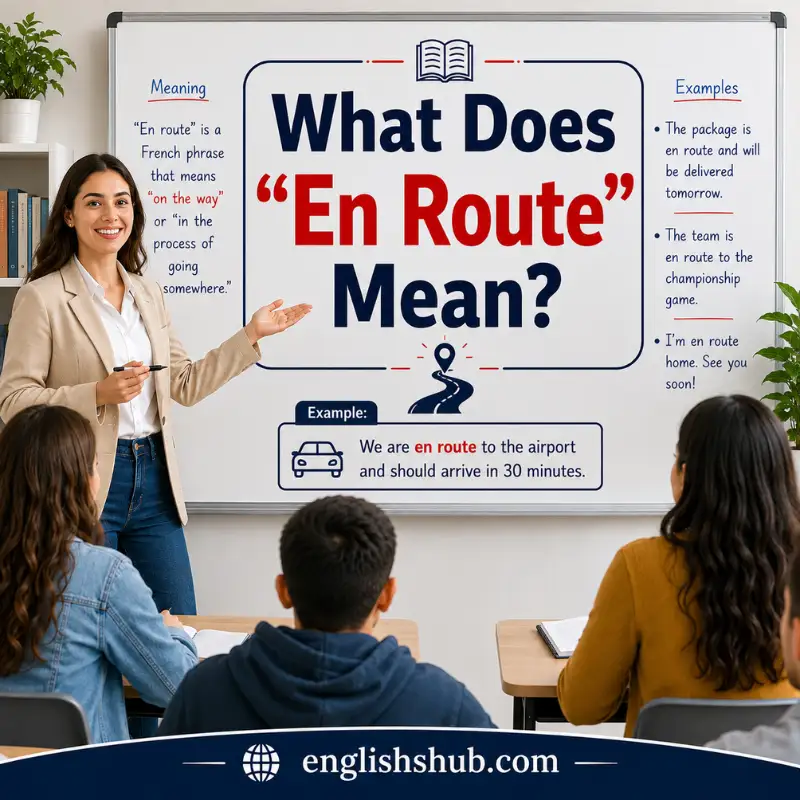
En route means on the way to or from somewhere. Cambridge lists it as an adverb and also recognizes adjectival use in expressions such as en route aircraft and en-route delays.
The phrase can describe people, vehicles, packages, aircraft, emergency crews, or even progress toward an abstract goal. For example:
- The ambulance is en route to the hospital.
- Your order is en route to the warehouse.
- We stopped for lunch en route to the beach.
- The plane was en route from Seattle to Miami.
- She made several discoveries en route to completing the project.
The destination does not always need to appear. If the context already makes it clear, “The technician is en route” is complete and natural.
Merriam-Webster defines en route as an adverb or adjective meaning “on or along the way.” It also records its French origin and gives its first known English use as 1779.
Why Is “In Route” Usually Incorrect?
The main problem is that in route is not the established English expression for being on the way. Writers often choose it because the first syllable of en route can sound like in in American speech.
Compare:
❌ The delivery driver is in route to your house.
✅ The delivery driver is en route to your house.
The second sentence uses the standard travel expression.
However, there is an important exception. The sequence in route can appear when in works as a normal preposition and route begins a larger noun phrase:
The company found an error in route planning.
Here, in does not mean “on the way.” It connects error with the noun phrase route planning. Therefore, deleting or replacing in would change the grammar.
A useful test is simple: Can you replace the phrase with “on the way”? If yes, choose en route. If not, inspect the surrounding words before correcting the sentence.
How the French Expression Entered English
The spelling en route comes from French. Merriam-Webster identifies its etymology as French, while Collins gives its origin as an 18th-century French borrowing meaning “on the way” or “along the way.”
English contains many borrowed expressions that retain forms associated with their source languages. En route is one of them. That history helps explain why en remains part of the standard spelling even though English speakers may hear it differently.
Merriam-Webster also notes that en route has been used in English since at least the 18th century. It has therefore become an established English expression rather than a newly imported phrase.
You do not need to know French to use it correctly. The practical rule is simply to remember the fixed spelling:
en route = on the way
That connection is more useful for everyday writing than trying to translate each French word separately.
How to Use “En Route” in a Sentence
The most common pattern is en route to + destination.
Examples include:
- We are en route to the airport.
- The students were en route to the museum.
- The shipment is en route to its final destination.
- The firefighters were en route to the scene.
You can also use en route from + place when the starting point matters:
- The train was en route from Chicago to Detroit.
- She called me en route from the office.
- The shipment was damaged en route from the warehouse.
Cambridge specifically gives examples of both en route to and en route from … to …, confirming these patterns as standard usage.
You can also place the phrase later in a sentence:
We stopped for coffee en route to the conference.
Or use it alone:
The repair team is en route.
The final version works when the destination is already understood.
For another useful lesson on how small spacing differences can change English grammar, see EnglishShub’s guide to
Pronunciation and American English Usage
Pronunciation is one major reason people write in route instead of en route. Cambridge gives U.S. pronunciations that include forms beginning with sounds represented roughly by “on,” “en,” or the French-style nasal vowel. Merriam-Webster likewise records multiple pronunciations.
That variation does not change the spelling.
In American English, you may hear:
- en route pronounced close to “ahn ROOT”
- en route pronounced closer to “en ROOT”
The exact pronunciation varies among speakers. The written form remains en route.
The phrase works in both formal writing and casual conversation. You might see it in a business email:
The technician is en route and should arrive shortly.
You might also text a friend:
I’m en route now.
It can sound slightly more polished than on the way, but it is not limited to formal writing.
En Route, En-Route, Enroute, and In-Route
Several forms appear online, but they do not have equal status.
En route
This is the normal form when the expression means on the way.
The package is en route.
En-route
A hyphenated form can appear when the expression functions directly as a modifier before a noun, although many writers prefer a clearer rewrite. Merriam-Webster recognizes adjectival use, including examples such as en route delays.
For everyday prose, you can often avoid uncertainty:
En-route delay
or
Delay while traveling
The second version may be easier for a broad audience.
Enroute
Do not normally combine the two words into one:
❌ The shipment is enroute.
✅ The shipment is en route.
The standard phrase is written as two words.
In-route
Do not use in-route as a replacement for en route.
❌ The driver is in-route to Dallas.
✅ The driver is en route to Dallas.
The hyphen does not make the incorrect form standard.
Common Mistakes and a Simple Choice Test
The most common mistake is choosing in route because it sounds natural.
❌ We are in route to the hotel.
✅ We are en route to the hotel.
Another mistake is joining the words:
❌ The plane is enroute to New York.
✅ The plane is en route to New York.
A third mistake is using en route without the required to before a named destination:
❌ We are en route Chicago.
✅ We are en route to Chicago.
When the destination is not stated, however, no to is necessary:
The ambulance is en route.
A three-step choice test
Step 1: Identify the meaning.
Do you mean “on the way” or “traveling”?
If yes, choose en route.
Step 2: Look for the destination.
If you name a destination, use en route to.
Step 3: Check whether “in” has another job.
If in introduces a noun phrase such as route planning, route design, or route selection, it may be perfectly grammatical.
This method works better than memorizing “in route is always wrong,” because the actual sentence structure matters.
Everyday Examples of “En Route”
The phrase appears naturally in many situations.
Travel
We stopped at a gas station en route to the airport.
Deliveries
Your replacement package is en route to your address.
Emergency services
The rescue crew is en route to the scene.
Work
I reviewed the report en route to the meeting.
Public transportation
The train was en route from Boston to New York.
News and sports
Merriam-Webster notes that en route can also describe progress toward an outcome, not only physical travel. For example, a team can score several times en route to a victory.
Legitimate “in route” construction
The engineers found an error in route design.
Here, the sentence is not saying that the engineers were traveling. In introduces the noun phrase route design.
That distinction is small but important. It prevents unnecessary corrections while still keeping the travel expression accurate.
FAQs
Not when you mean that someone or something is traveling toward a destination. In that context, use en route to, as in “The driver is en route to Dallas.” The separate words in route can occur when in introduces a route-related noun phrase, such as “an error in route planning.”
En route is normally written as two words. Writing enroute is not the standard spelling. When the expression functions as a modifier before a noun, a hyphenated form such as en-route delay may appear, although a rewrite can often make the sentence clearer.
En route to is the clearest choice in American English when you identify a destination. For example, “We are en route to the airport.” Dictionaries also record en route for in some varieties and contexts, but en route to is the safest general-purpose pattern for U.S. readers.
Yes. You can say “The package is en route” when the destination is already known from context. Add to + destination when the reader needs to know where the person, vehicle, or item is heading.
You may encounter in route in speech or informal writing, but it is not the standard choice when the intended meaning is “on the way.” For school, professional, public, and edited writing, use en route. This avoids a form that many readers will recognize as a mistake.
Connect en route with on the way. If you can substitute “on the way” without changing the meaning, write en route. If in introduces a noun phrase such as “route planning,” keep the ordinary preposition in because the sentence has a different grammatical structure.
Conclusion
For the meaning “on the way,” use en route. It is the established English expression for travel or progress toward or from a destination, and major dictionaries support its meaning, spelling, pronunciation, and French origin.
Do not replace it with in route, in-route, or enroute. The important exception is when in and route belong to separate grammatical parts of a sentence, as in “changes in route planning.” When in doubt, use the simple test: if you mean “on the way,” write en route.