
The phrase kill or be killed describes an extreme situation in which one side must act to survive, avoid defeat, or prevent the other side from prevailing. It can have a literal meaning involving real danger, but English speakers also use it as figurative language for fierce competition. The phrase therefore carries a strong, dramatic tone. Understanding the difference between literal and figurative use helps you choose it correctly. It also helps to know its grammar, because kill and be killed present the same situation from opposite grammatical positions.
Quick Answer
Kill or be killed means that one must act to survive or avoid being defeated. It can describe a literal life-or-death situation, but it is also commonly used for ruthless competition or extreme pressure. Because the wording is forceful, use it when the situation genuinely feels severe rather than for ordinary problems or mild competition.
TL;DR
- Kill or be killed presents two extreme possible outcomes.
- The phrase can be literal or figurative.
- Kill uses an active construction; be killed uses a passive construction.
- Hyphenate the phrase before a noun as kill-or-be-killed.
- The expression sounds dramatic, aggressive, and high-stakes.
- Softer alternatives work better in neutral or formal contexts.
Kill or Be Killed at a Glance
| Context | Meaning | Tone | Example |
|---|---|---|---|
| Literal danger | Actual threat to life | Very serious | The soldiers faced a kill-or-be-killed situation. |
| Survival story | Extreme struggle to survive | Dramatic | The novel portrays the wilderness as kill or be killed. |
| Business | Ruthless competition | Aggressive | The industry can feel kill or be killed. |
| Sports | Extreme pressure to win | Dramatic | The final match had a kill-or-be-killed atmosphere. |
| Gaming | High-stakes virtual competition | Informal | The tournament became kill or be killed. |
| Before a noun | Describes an intense environment | Strong | It was a kill-or-be-killed culture. |
| Neutral writing | Similar idea without violent wording | Milder | The market is extremely competitive. |
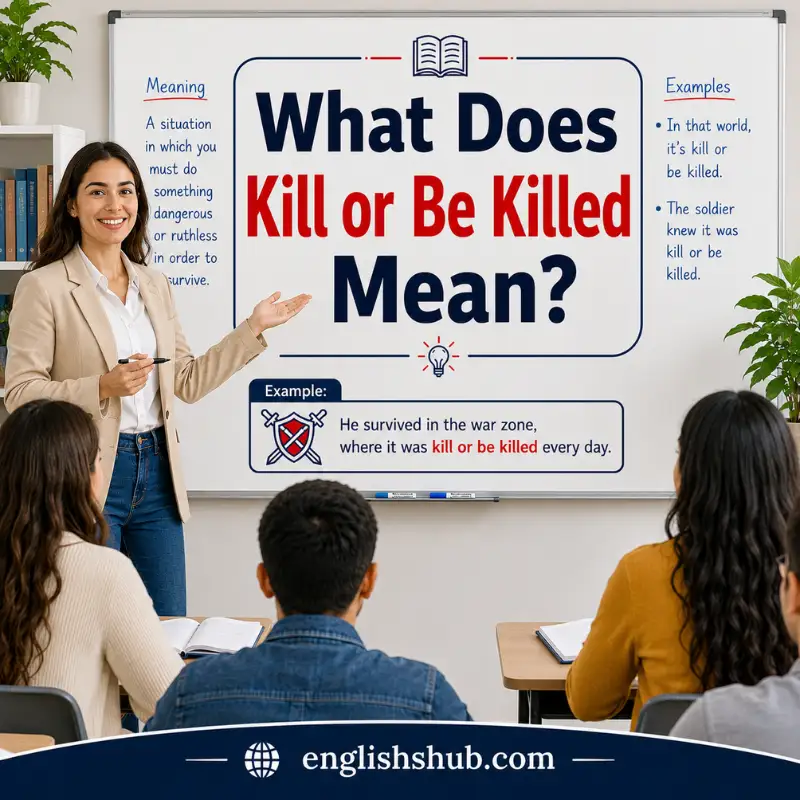
What Does Kill or Be Killed Mean?
Kill or be killed means that a person or side faces two extreme outcomes: act against the threat or become its victim. The phrase focuses on survival, defeat, or overwhelming pressure.
The literal meaning is straightforward. If a situation genuinely involves possible death, the phrase can describe a life-or-death struggle. However, modern English also uses it metaphorically. In that setting, “kill” may suggest defeating, eliminating, overpowering, or outcompeting an opponent rather than causing physical death.
That broader sense is supported by ordinary English usage of kill. Cambridge lists both the literal sense of causing death and figurative senses involving stopping or destroying something. Merriam-Webster likewise includes meanings such as defeating or putting an end to something.
For example:
- Literal: The soldiers believed it was kill or be killed.
- Figurative: The company entered a kill-or-be-killed market.
- Less dramatic: The company entered a highly competitive market.
The third version communicates the general idea without the violent imagery.
What Is the Literal and Figurative Meaning?
The literal meaning applies when the phrase refers to actual physical danger. A writer might use it in a historical account, survival story, war narrative, or fictional scene involving a genuine threat.
The figurative meaning is different. Here, the phrase describes a situation where failure may mean losing a job, market position, competition, opportunity, or advantage. No physical killing needs to occur.
Consider these examples:
The characters were trapped in a kill-or-be-killed struggle.
This sentence could describe real physical danger.
The startup entered a kill-or-be-killed market.
Here, the phrase is figurative. The market is not literally demanding violence. Instead, the writer wants to emphasize intense competition.
This distinction matters because context controls interpretation. The same words can create very different mental pictures depending on the subject around them.
Collins gives “kill or be killed” as an example connected with the law of the jungle, whose American-English meaning describes a system in which the strongest survive without normal ethical or legal restraints.
How Does the Grammar of Kill or Be Killed Work?
The grammar becomes easier when you expand the shortened expression.
Kill or be killed can be understood as:
- You kill.
- Or you are killed.
The first part uses kill as an active verb. The implied subject performs the action.
The second part uses be killed, a passive construction. The implied subject receives the action.
That contrast creates the phrase’s sharp structure. It does not repeat the subject because English allows the subject to remain understood from context.
A useful comparison is:
| Form | Voice | Meaning |
|---|---|---|
| You kill | Active | You perform the action |
| You are killed | Passive | The action happens to you |
| Kill or be killed | Contrasting phrase | Act first or face the opposing result |
The phrase therefore is not simply a list of two verbs. Its structure presents opposite roles in the same imagined situation.
English learners sometimes write killed or be killed, but that changes the first part unnecessarily. The established form is kill or be killed.
When Should You Use It in Writing and Speech?
Use kill or be killed when you want to describe an unusually severe, competitive, or dangerous situation. It works best when the surrounding context supports its strong language.
Natural contexts include:
- survival stories
- military or historical writing
- action fiction
- competitive sports
- business competition
- gaming
- dramatic commentary
For example:
- The championship felt like kill or be killed.
- The novel depicts a kill-or-be-killed struggle for survival.
- Investors described the market as kill or be killed.
- The final round created a kill-or-be-killed atmosphere.
However, the phrase can sound excessive when the problem is ordinary.
Instead of:
It was kill or be killed when choosing a restaurant.
Use:
Choosing a restaurant was surprisingly competitive.
The second sentence better matches the stakes.
This is mainly a question of tone rather than grammatical correctness. The phrase is grammatically established, but its dramatic effect makes it unsuitable for many neutral situations.
Why Does the Phrase Sound So Strong?
The expression sounds strong because it removes the possibility of a peaceful middle ground. It presents the situation as an extreme choice between defeating the other side and becoming the one that loses.
That creates an urgent, aggressive feeling.
Compare these expressions:
| Expression | Strength | Typical effect |
|---|---|---|
| Competitive | Low to moderate | Neutral |
| Highly competitive | Moderate | Serious but professional |
| Fierce competition | Moderate to strong | Energetic |
| Ruthless competition | Strong | Harsh and unforgiving |
| Kill or be killed | Very strong | Extreme and dramatic |
This tone makes the phrase useful in fiction, commentary, speeches, and dramatic descriptions. It can make a situation feel immediate even when the meaning is figurative.
For example, “The industry is highly competitive” sounds factual. “The industry is kill or be killed” suggests that the writer sees the competition as much harsher.
That difference is useful when choosing vocabulary. Strong language should match strong circumstances.
How Do You Hyphenate Kill-or-Be-Killed?
When the phrase appears before a noun as a compound adjective, hyphens are normally useful:
- a kill-or-be-killed competition
- a kill-or-be-killed environment
- a kill-or-be-killed mentality
- a kill-or-be-killed market
- a kill-or-be-killed struggle
The hyphens show that the entire expression works together to modify the following noun.
When the phrase stands independently, you generally do not need those internal hyphens:
The competition felt like kill or be killed.
Compare:
It was a kill-or-be-killed competition.
The first version uses the expression as a standalone phrase. The second uses it as a compound adjective.
This distinction is especially useful in edited American English because punctuation helps readers understand how several words function together.
Is Kill or Be Killed Standard, or Are There Informal Variants?
Kill or be killed is the established form. You may also encounter kill or get killed, especially in informal speech or dialogue.
The two versions are understandable, but they do not have exactly the same register.
| Expression | Typical status | Best use |
|---|---|---|
| Kill or be killed | Established | General writing, formal prose, fiction |
| Kill or get killed | Informal | Casual dialogue or strongly conversational speech |
| Survive or die | Direct alternative | Literal or dramatic situations |
| Win or lose | Neutral alternative | Competition |
| Compete aggressively | Professional | Business or formal writing |
| Highly competitive | Neutral | General informative writing |
The passive structure in be killed gives the established phrase a compact, balanced form. The alternative get killed sounds more conversational.
For an English learner, kill or be killed is the safest default when the expression itself is appropriate.
That does not mean every occurrence of “kill or get killed” is wrong. Register matters. Dialogue often reflects informal speech, while edited prose usually benefits from the established expression.
What Are Better Alternatives for Less Dramatic Writing?
Sometimes you want to communicate pressure without using violent wording. In that case, choose an alternative based on the exact meaning.
For competition
Use:
- highly competitive
- fiercely competitive
- intense competition
- tough competition
- competitive environment
Example:
The technology sector is highly competitive.
For survival
Use:
- fight for survival
- struggle to survive
- survive or fail
- stay alive
- face a life-or-death situation
Example:
The hikers faced a serious struggle to survive.
For business pressure
Use:
- high-stakes competition
- intense market pressure
- pressure to stay competitive
- race to gain market share
Example:
Small companies face intense market pressure.
For a general either-or situation
Use:
- succeed or fail
- win or lose
- act or accept the consequences
- no room for error
These alternatives often sound more precise in academic, professional, and informational writing. The right replacement depends on whether the original phrase emphasizes danger, competition, urgency, or finality.
What Are Common Mistakes With Kill or Be Killed?
Several mistakes occur because readers focus on the dramatic meaning rather than the structure.
Mistake 1: Changing the first verb to “killed”
Incorrect:
Killed or be killed.
Standard:
Kill or be killed.
The first verb remains in its base form.
Mistake 2: Treating every use as literal
A sentence such as:
The industry is kill or be killed.
usually describes ruthless competition, not actual physical violence.
Context determines whether the phrase is literal or figurative.
Mistake 3: Using it for ordinary problems
The phrase is too strong for minor inconvenience, routine disagreement, or ordinary competition.
Instead, use words such as difficult, competitive, intense, or high-stakes, depending on the situation.
Mistake 4: Forgetting hyphens before a noun
Write:
a kill-or-be-killed environment
rather than:
a kill or be killed environment
The hyphenated form makes the compound modifier easier to read.
Mistake 5: Assuming “kill” always means physical death
English gives kill several figurative meanings. It can refer to ending, defeating, destroying, or stopping something, depending on context.
That flexibility helps explain why the phrase works in figurative descriptions of competition.
For additional English word-choice practice, EnglishShub also explains related either/or structures in its guide to
FAQs
No. The phrase can describe real physical danger, but it is often figurative. In business, sports, gaming, or other competitive settings, it can mean that someone must succeed or risk serious defeat. Context determines whether the language should be understood literally or metaphorically.
It can function as a fixed expression and, in figurative contexts, as an idiomatic expression. Its literal meaning concerns life-or-death danger, while its figurative use describes extreme pressure, ruthless competition, or an all-or-nothing situation.
Yes. The established construction uses the active verb kill followed by the passive phrase be killed. The subject is understood from context. This compact structure contrasts someone performing an action with that same person receiving the action.
Write kill or be killed. The first verb stays in its base form, while the second side uses the passive construction be killed. “Killed or be killed” does not preserve the standard structure of the expression.
Use hyphens when the expression works as a compound modifier before a noun, such as a kill-or-be-killed competition. When the phrase stands independently, as in “It was kill or be killed,” the internal hyphens are generally unnecessary.
“Kill or get killed” is understandable and appears in informal speech, but kill or be killed is the established form. Use the standard version in careful writing. The informal variant can fit dialogue when you deliberately want a conversational or rough voice.
Conclusion
Kill or be killed describes an extreme either-or situation in which one side must act, survive, or avoid defeat. It can refer to literal danger, but it frequently works as figurative language for fierce competition and intense pressure. The phrase uses an active kill alongside passive be killed, and it becomes kill-or-be-killed when it modifies a noun. Because the expression has a dramatic tone, choose it when the context supports that intensity. For neutral writing, alternatives such as “highly competitive” or “high-stakes” may communicate the idea more precisely.