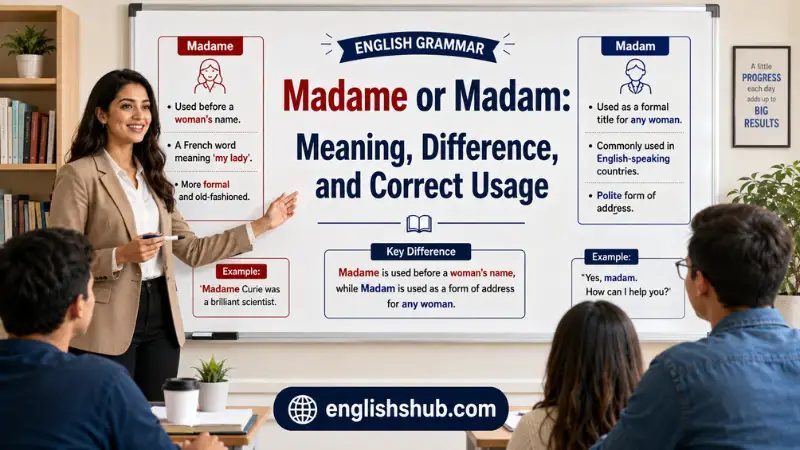
Madame or madam can both be correct, but standard English does not use them in exactly the same way. In American English, madam is the usual formal address for a woman, while madame is mainly retained for French titles, names, and French-related contexts. The difference matters in letters, business writing, official titles, and references to well-known women. Choosing the right form is less about spelling preference and more about language, context, and whether the word stands alone as an English address or belongs to a French proper name.
Quick Answer
Use madam for ordinary formal English address: “Good morning, madam” or “Dear Madam.” Use Madame when you are preserving the French form, especially before a French surname or in an established name such as Madame Curie. In American English, ma’am is also a common spoken contraction of madam.
TL;DR
- Madam is the usual formal English form of address.
- Madame preserves a French title or established name.
- Madam President is standard English usage.
- Madame Curie keeps the established French-style title.
- Ma’am is the common spoken contraction of madam.
At a Glance: Madam vs. Madame
| Context | Best Choice | Example | Why |
| Formal English address | madam | “Thank you, madam.” | Standard English form |
| Formal letter to an unnamed woman | Madam | “Dear Madam,” | Established salutation |
| Official position | Madam | “Madam President” | English title construction |
| French title | Madame | “Madame Dupont” | Preserves French usage |
| Established French-associated name | Madame | “Madame Curie” | Recognized name form |
| Spoken American English | ma’am | “Yes, ma’am.” | Common contraction |
| Married woman’s English title | Mrs. | “Mrs. Smith” | Used before a surname |
| Gender-neutral marital-status title | Ms. | “Ms. Smith” | Does not specify marital status |
What Does Madam Mean in English?

Madam is a formal and polite form of address for a woman. Cambridge Dictionary identifies it as a formal way to speak to a woman and gives Dear Madam as the traditional opening of a formal letter when the recipient’s name is unknown.
The word can also appear before an official position. Examples include Madam President, Madam Secretary, and Madam Speaker. In these cases, madam functions as an honorific connected to the person’s office rather than her surname.
Merriam-Webster also records madam as a polite form of address and traces the word to Middle English from Anglo-French ma dame, meaning “my lady.” The word therefore has a French historical origin even though madam is now an established English word.
When Should You Use Madam?
Use madam when you are addressing a woman formally in English and are not using her personal name. For example, a hotel employee might say, “May I help you, madam?” A formal letter may begin, “Dear Madam,” when the recipient’s name is unknown.
You can also use Madam with an official position. For example:
- Madam President, the meeting is ready to begin.
- Madam Chair, may I respond?
- Madam Secretary, I have a question.
- Thank you, Madam Speaker.
This use is different from putting a title before an ordinary surname. In standard American English, Madam Smith is generally not the normal way to address an American woman named Smith. Ms. Smith, Mrs. Smith, or another preferred title is usually more appropriate.
What Does Madame Mean in English?
Madame is the French form. Cambridge Dictionary defines it in English as a title for a woman, especially a married woman from France. It gives names such as Madame Bovary as examples.
However, saying that madame is simply “wrong English” would be too broad. English retains the form in French names, historical references, cultural expressions, and other established uses. For example, Madame Curie is widely recognized in English with the French-style title.
The French meaning is broader within French itself. Larousse explains madame as a title used for women and also as a title before a woman’s function or position, such as Madame la Présidente.
So the useful distinction is this: madam belongs naturally to ordinary formal English, while madame is normally retained when the French form itself is relevant.
Madame or Madam: Which One Should You Use?
A simple context test can solve most cases.
Step 1: Are you writing ordinary formal English?
Choose madam.
Thank you, madam.
Step 2: Are you addressing an official position?
Choose Madam before the position.
Madam President, may I speak?
Step 3: Are you referring to a French woman by an established French-style title?
Choose Madame.
Madame Dupont arrived this morning.
Step 4: Is the word part of an established name or cultural expression?
Keep the established spelling.
Madame Tussaud
Step 5: Are you speaking casually in American English?
Ma’am may sound more natural than the full word madam. Cambridge identifies ma’am as a contraction of madam.
This framework is more reliable than memorizing “madam is English and madame is French,” because real English usage includes names and expressions that preserve the French spelling.
Madam, Madame, Ma’am, Mrs., and Ms.
These forms are related, but they are not interchangeable.
Madam is a formal English address. It can stand alone or appear with an official position.
Madame is the French form and is commonly retained in French names, titles, and cultural contexts.
Ma’am is a contraction of madam. It is especially familiar in American speech and can sound more natural than the full form in everyday conversation.
Mrs. is a title used before a surname for a married woman. It is therefore not a direct replacement for madam. Cambridge lists Mrs. as a title used before the family or full name of a married woman.
Ms. is commonly used before a woman’s surname without specifying marital status. This makes it useful when marital status is irrelevant or unknown.
Compare:
- “May I help you, madam?” — formal direct address
- “Yes, ma’am.” — common American spoken form
- “Mrs. Brown will attend.” — title plus surname
- “Ms. Brown will attend.” — title plus surname without specifying marital status
- “Madame Dupont arrived.” — French-style title and name
The key difference is grammatical and contextual, not simply the number of letters in the word.
How Are Madam and Madame Pronounced?
In American English, madam is pronounced approximately /ˈmæd.əm/. Cambridge gives this pronunciation for both its British and American English entries.
Madame has more than one English pronunciation. Cambridge lists /məˈdæm/ and also gives /ˈmæd.əm/ in its English pronunciation information.
That variation explains why pronunciation alone is not a reliable way to choose the spelling. Two forms may sound similar in some English contexts, while their written uses remain different.
When writing, focus first on context. If you are addressing an unnamed woman formally in English, use madam. If the established name or French context calls for Madame, retain it.
Common Mistakes With Madam and Madame
Mistake 1: Using Madame in every formal English greeting
Less natural: “Dear Madame, I am writing about your application.”
For ordinary English correspondence, Dear Madam is the established form when the woman’s name is unknown. Cambridge specifically identifies Dear Madam as a traditional formal-letter opening.
Mistake 2: Changing an established name to Madam
Incorrect: “Madam Curie”
If the recognized name is Madame Curie, keep the established form. The spelling belongs to the name and its historical context.
Mistake 3: Assuming madame is never used in English
English contains many French-derived words and retained French titles. Therefore, the presence of Madame does not automatically make a sentence incorrect.
Mistake 4: Confusing madam with Mrs.
Madam can address a woman without identifying her marital status. Mrs. normally accompanies a surname and traditionally identifies a married woman.
Mistake 5: Using madam before every surname
In American English, Madam Wilson is usually less natural than Ms. Wilson or another appropriate title. Madam normally works as a standalone form of address or with an official position.
FAQs
Both are valid words, but madam is normally the correct choice for ordinary formal English address. Madame is generally retained for French titles, French-associated names, and established expressions rather than used as the default English form.
Use Madam President in standard English. Cambridge specifically lists constructions such as Madam President, Madam Secretary, and Madam Speaker for women holding senior positions.
Yes. Dear Madam is an established formal salutation when you are writing to a woman whose name you do not know. If you know the recipient’s name, a more specific greeting may be preferable.
Yes. Ma’am is a contraction of madam. It is especially common in American spoken English, where it can sound more natural than the full word in everyday polite address.
Usually, no, unless there is a specific French, historical, artistic, institutional, or stylistic reason. In ordinary American English, Ms., Mrs., or the person’s preferred title is generally more natural before a surname.
Yes. Dictionaries record additional meanings. Merriam-Webster and Cambridge both note that madam can refer to a woman who runs a brothel, while Cambridge also records a British informal use for a bossy young girl. Context therefore matters.
Conclusion
Madame or madam is not a simple spelling choice. Use madam for standard formal English address, including “Dear Madam” and titles such as “Madam President.” Use Madame when a French title, French name, or established expression calls for the original form. If you are unsure in ordinary American English, madam is usually the safer choice. For a named woman, however, check the established title and her preferred form rather than changing it to fit an English pattern.