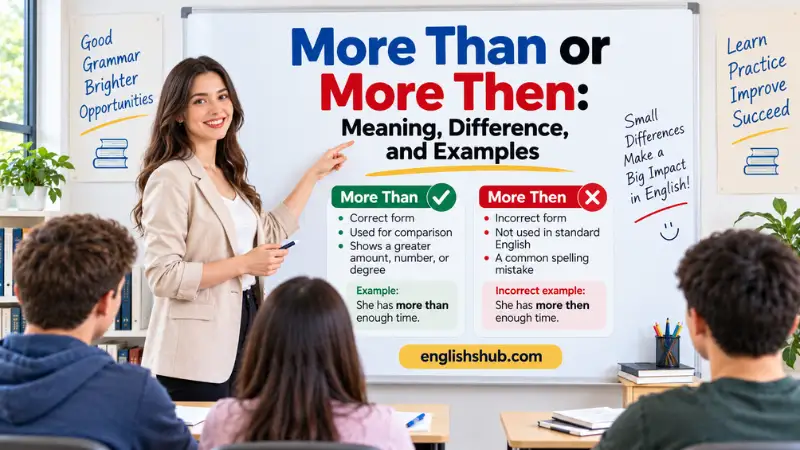
If you are unsure about more than or more then, the standard choice is more than. Use than when you compare quantities, people, things, amounts, or degrees. For example, “The box weighs more than 20 pounds.” Use then mainly for time, sequence, consequence, or a previous point in time. “We finished dinner, then we went home.”
The confusion is understandable because than and then look and sound similar. However, they perform different grammatical jobs. Once you focus on the meaning of the sentence rather than the spelling alone, the choice becomes much easier.
Quick Answer
More than is the correct phrase for comparisons, quantities, amounts, and many expressions of degree or emphasis. More then is usually a spelling mistake when then is being used in place of than. Use then separately when you mean “at that time,” “next,” or “in that case.”
TL;DR
- More than is the standard phrase for comparison and quantity.
- Than connects the two sides of a comparison.
- Then usually relates to time, sequence, or consequence.
- “More then” is usually a mistake, not an alternative spelling.
- More than can also mean “very” or “extremely” in some contexts.
- More and then can appear together when they perform separate jobs.
More Than vs. More Then at a Glance
| Form | Main Function | Correct Example | Status |
| more than | Comparison or greater amount | We need more than five chairs. | Correct |
| more than | Greater degree | She is more than capable. | Correct |
| more than | Emphasis or excess | The result was more than expected. | Correct |
| more then | Intended comparison | We need more then five chairs. | Incorrect |
| then | Time or sequence | We ate, then we left. | Correct |
| more … then | Separate words with separate jobs | He wanted more, then he changed his mind. | Correct |
What Does More Than Mean?
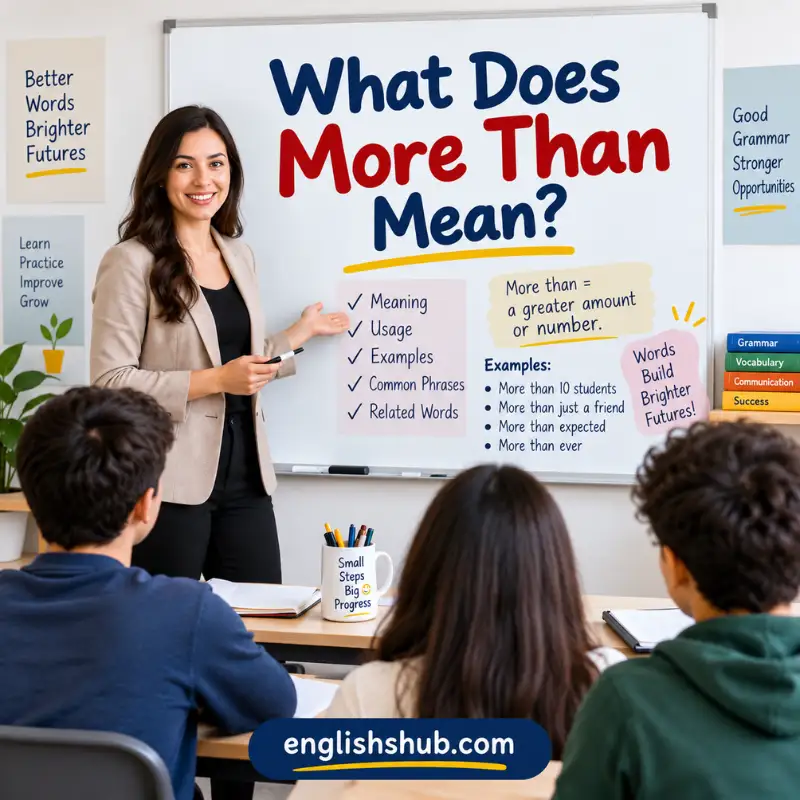
More than generally expresses a greater amount, number, degree, or extent. It often introduces the second part of a comparison.
For example:
- The building is more than 100 years old.
- Elena earns more than her brother.
- We waited more than an hour.
- This problem is more than I expected.
The phrase can also add emphasis. Merriam-Webster lists more than as an expression meaning “to a great degree,” “very,” or “extremely,” as in “more than happy.”
Cambridge likewise shows than being used with more or less to compare numbers or amounts, such as “more than 20 books.”
So, more than is not limited to one grammatical pattern. Its exact meaning depends on what follows it and what the sentence is comparing or emphasizing.
When to Use More Than for Comparisons
Use more than when one person, object, action, amount, or quality is greater than another.
A basic comparison pattern is:
A + verb + more than + B
Examples:
- Marcus studies more than his brother.
- I value time more than money.
- The new model costs more than the old one.
- She practices more than anyone on the team.
You can also use more than after comparative structures:
- This route is more difficult than the other one.
- The blue sofa is more comfortable than the gray sofa.
- The second test was more challenging than the first.
Here, than introduces the thing being compared.
This is why replacing than with then changes the sentence from a standard comparison into an error.
Incorrect:
This route is more difficult then the other one.
Correct:
This route is more difficult than the other one.
A simple rule works well: if the sentence asks “greater than what?” use than.
More Than for Quantities and Amounts
More than is also common when stating that a number or amount exceeds a particular figure.
Examples include:
- More than 500 students attended the event.
- The repair took more than three hours.
- She has more than $100 in her wallet.
- The bridge is more than two miles long.
- We received more than 50 applications.
In these sentences, than does not compare two adjectives such as taller and shorter. Instead, it marks a quantity that is greater than a stated number or amount.
Cambridge gives the same basic construction with examples involving numbers and amounts.
The phrase can also occur with measurements:
- more than 10 miles
- more than six months
- more than 20 pounds
- more than 100 pages
- more than $1,000
This is one reason more then is such a noticeable error in professional writing. The correct spelling appears in countless ordinary expressions involving numbers, measurements, and quantities.
More Than for Degree, Emphasis, and Excess
Not every use of more than involves a measurable number.
The phrase can also show a greater degree or add emphasis:
- She is more than willing to help.
- The team is more than capable of winning.
- You are more than welcome to stay.
- The explanation was more than enough.
- The repair was more than I could afford.
In these sentences, more than can suggest something beyond an expected level.
Merriam-Webster specifically records the emphatic use of more than with adjectives such as happy and welcome. Cambridge also records expressions such as more than likely and more than happy.
Compare:
I am happy to help.
with:
I am more than happy to help.
The second sentence adds emphasis. It does not mean that happiness is literally being measured with a number.
Why More Then Is Usually Incorrect
More then is usually incorrect when the writer intends the comparison phrase more than.
The reason is grammatical, not simply visual. Than is used for comparison, while then normally expresses time, order, consequence, or a previous point in time. Scribbr makes the same distinction and specifically identifies more than as the appropriate form in common expressions.
Compare these sentences:
Incorrect:
She has more then enough experience.
Correct:
She has more than enough experience.
Incorrect:
The project cost more then we expected.
Correct:
The project cost more than we expected.
Incorrect:
He is more confident then his teammate.
Correct:
He is more confident than his teammate.
The error often happens because the two words are similar in pronunciation. However, choosing the correct form requires looking at the sentence’s function.
When Then Is Correct
Then is a different word with different jobs. It commonly refers to time or sequence.
For example:
- We finished the meeting, then we went home.
- First, read the instructions; then answer the questions.
- She lived in Chicago then.
- Back then, the building was much smaller.
Then can also express a consequence:
If you finish early, then you can leave.
It can refer to a previous status:
The then manager approved the proposal.
Writing Explained and ProWritingAid both distinguish then as a word associated with time, order, and consequence, while than is associated with comparison.
Therefore, remember:
Than = comparison
Then = time, order, or consequence
This is not an absolute description of every historical or grammatical use, but it is a highly useful rule for ordinary modern English.
Can More and Then Appear Together?
Yes. This is an important exception to the simple “never write more then” warning.
The two words can appear next to each other when more and then belong to separate parts of the sentence.
For example:
I asked for more, then changed my mind.
Here, more means an additional amount, while then means “after that.” The comma makes the separate functions especially clear.
Another example is:
The store offered more, then the manager changed the price.
Again, the words are not forming the phrase more then. They simply happen to occur close together.
Writing Explained makes this distinction explicitly: more then is not a standard fixed phrase, but more and then can occur as separate words in a sentence.
So it is better to say:
“More then” is normally incorrect as a phrase.
That is more accurate than claiming the two words can never occur together.
Common Mistakes and Corrections
| Incorrect | Correct | Why |
| She has more then five books. | She has more than five books. | Quantity requires than. |
| He earns more then I do. | He earns more than I do. | The sentence compares earnings. |
| This costs more then expected. | This costs more than expected. | The amount exceeds an expectation. |
| I am more then happy to help. | I am more than happy to help. | This is an emphatic more than expression. |
| Finish this, than call me. | Finish this, then call me. | The sentence gives a sequence. |
| We ate dinner than went home. | We ate dinner then went home. | Then means “after that.” |
| She is taller then her sister. | She is taller than her sister. | Than introduces the comparison. |
| I wanted more, then I left. | I wanted more, then I left. | Here more and then are separate words. |
The key is to avoid correcting the spelling without checking the sentence’s meaning. A spell-checker may flag many obvious cases, but context is what determines whether than or then is required.
A Simple Memory Trick and Decision Rule
The easiest memory aid is:
Than = comparison.
Then = time or order.
The letters can help, too. Than contains an a, as does comparison. Then contains an e, as does event and sequence.
When proofreading, ask one question:
Is the sentence comparing something?
If yes, use than.
The red car is faster than the blue car.
Is the sentence describing what happened next or when something happened?
If yes, use then.
We checked the car, then we called the mechanic.
Is a number or amount being exceeded?
Use more than.
The package weighs more than 10 pounds.
Is an adjective being strongly emphasized?
Use more than.
She is more than ready.
This meaning-based test is more reliable than trying to remember the spelling in isolation.
Related Expressions: Less Than, Rather Than, and Other Than
Once you understand more than, several related expressions become easier.
Less than
Use less than when the amount or degree is below another amount or level.
The trip took less than two hours.
He spent less than $50.
The opposite comparison uses more than:
The trip took more than two hours.
Rather than
Rather than introduces a preferred alternative or contrast.
I would walk rather than drive.
She chose to wait rather than complain.
Writing Explained identifies rather than as another standard expression using than.
Other than
Other than commonly means “except for,” “apart from,” or “besides.”
Other than Monday, I am available any day.
I have no complaints other than the long wait.
Scribbr also distinguishes other than from the incorrect other then.
These expressions reinforce the larger point: than frequently belongs to comparison or contrast structures, while then serves a different grammatical function.
FAQs
More than is correct when you are comparing amounts, quantities, degrees, or qualities. More then is normally a spelling mistake because then does not introduce this type of comparison. For example, write “She has more than five books,” not “She has more then five books.”
Remember than = comparison and then = time or sequence. If you can ask “greater than what?” or identify two things being compared, use than. If you can replace the word with “after that” or “at that time,” then is likely correct.
The fixed phrase more then is not standard English for comparison. However, the words more and then can appear next to each other when they perform separate functions. For example, “I wanted more, then I left” is grammatical because more and then are separate parts of the sentence.
No. More than can introduce a comparison, quantity, degree, or emphasis. You can write “more than 20 students,” but also “more than happy,” “more than capable,” or “more than I expected.” The meaning depends on the construction around the phrase.
More than is standard in both everyday and formal English. It appears naturally in conversation, academic writing, business writing, journalism, and professional communication. The phrase itself does not make a sentence informal.
No. Than appears in many comparison and contrast structures. Examples include better than, less than, rather than, other than, and faster than. Therefore, learning the broader function of than is more useful than memorizing only the phrase more than.
They can be pronounced differently, although the distinction may be subtle in natural speech and can vary by accent. In standard dictionary descriptions, than is associated with comparison, while then is associated mainly with time, sequence, or consequence. Because their sounds can be similar, writers should rely on meaning when choosing the spelling.
Test Your Understanding
1. Choose the correct sentence.
A. The building is more then 100 years old.
B. The building is more than 100 years old.
C. The building is more then 100 years old than expected.
D. The building is then more 100 years old.
2. Which sentence uses then correctly?
A. She is taller then her sister.
B. We waited more then an hour.
C. We finished dinner, then we went home.
D. He has more then enough time.
3. Which sentence uses more than for emphasis?
A. She is more than happy to help.
B. She left more than walked home.
C. She more then helped.
D. She then than helped.
4. Which sentence is grammatical because more and then have separate functions?
A. I wanted more then you did.
B. I wanted more, then I changed my mind.
C. I wanted more then five.
D. I wanted more then expected.
5. Which sentence correctly uses than in a comparison?
A. This test is harder then the first one.
B. This test is harder than the first one.
C. This test then harder than the first one.
D. This test is than harder the first one.
Answer Key
- B — Than introduces the comparison between the building’s age and 100 years.
- C — Then shows the next event in a sequence.
- A — More than happy is an emphatic expression meaning very happy or extremely willing.
- B — More means an additional amount, while then means “after that.”
- B — Than correctly introduces the second part of the comparison.
Conclusion
When choosing between more than or more then, use more than for comparisons, quantities, amounts, degrees, and many expressions of emphasis. Then has a different role: it normally refers to time, sequence, consequence, or a previous point in time. The most useful habit is to check meaning before spelling. If you are comparing something, choose than. If you mean “after that” or “at that time,” choose then. Remember, too, that more and then can legitimately appear together when they belong to separate parts of a sentence.