
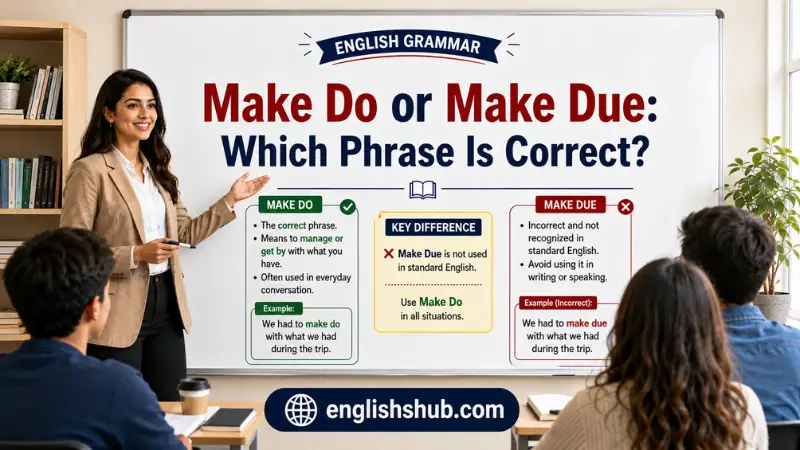
The correct phrase is make do, not make due, when you mean managing with what is available. The expression describes using an imperfect substitute, coping with limited resources, or getting along without something better. Make due often appears because do and due sound alike in many varieties of American English. However, the two words have different roles and meanings. Understanding the idiom, its common sentence patterns, and the separate uses of due makes the choice much easier in everyday and professional writing.
Quick Answer
Make do is the standard phrase when you mean “manage with what you have” or “get by with an imperfect option.” Make due is not the standard modern form of that idiom. For example, write “We had to make do with old equipment,” but use due separately for ideas such as a payment being owed or an event being expected.
TL;DR
- Make do means manage with what is available.
- Make due is not the standard modern idiom.
- Use make do with for an available substitute.
- Use make do without when something is missing.
- Made do is the correct past form.
- Due remains correct for deadlines, payments, and expectations.
At-a-Glance Comparison
| Expression | Meaning | Correct Modern Use | Example |
|---|---|---|---|
| make do | Manage with available means | Yes | We can make do. |
| make do with | Use an imperfect substitute | Yes | We made do with folding chairs. |
| make do without | Manage despite lacking something | Yes | They made do without a car. |
| made do | Past form of make do | Yes | She made do with an old laptop. |
| making do | Progressive form | Yes | We are making do for now. |
| make due | Intended as the idiom make do | No in standard modern usage | Avoid it when you mean “manage.” |
| due | Owed, expected, scheduled, or appropriate | Yes, in its own constructions | The payment is due Friday. |
What Does “Make Do” Mean?
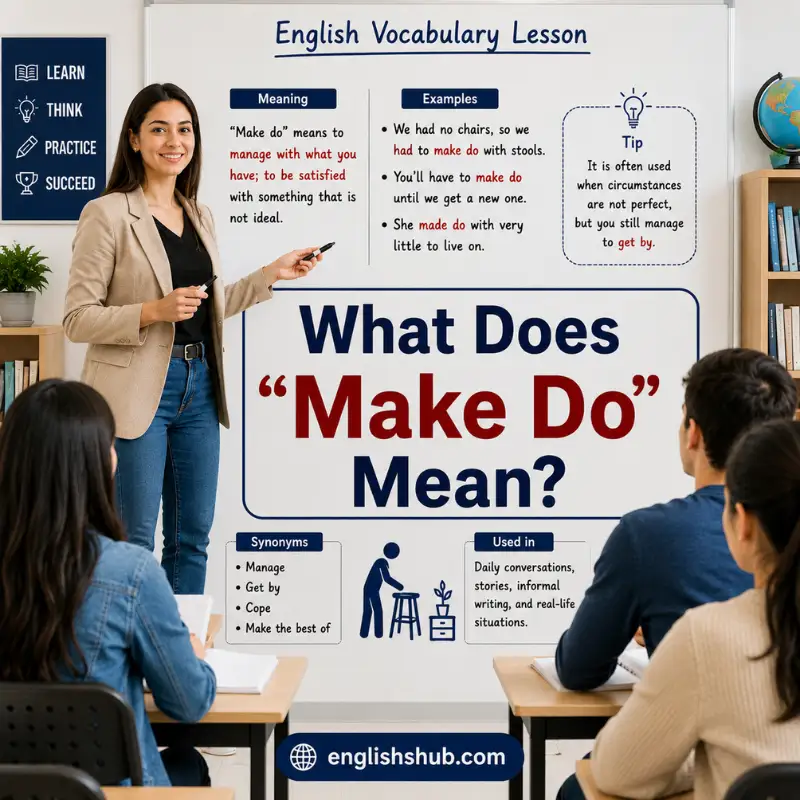
Make do is an idiom that means to manage with what you have, especially when the available option is less convenient or less desirable than what you wanted. Cambridge defines the expression as managing without desired things or with something of lower quality than preferred. Merriam-Webster similarly defines it as managing with the means at hand.
The phrase often suggests a temporary or imperfect solution. For example, if your printer stops working, you might make do with handwritten notes. If you forget your charger, you might make do without your phone for a few hours.
The key idea is not simply “doing something.” It is making the available option sufficient for the situation.
Consider these examples:
- We don’t have enough chairs, so we’ll make do.
- The printer broke, so we made do with the old one.
- We had no internet, so we made do without it.
- Until the new supplies arrive, we’re making do.
That meaning is why make do works even when the situation is not ideal.
Why Do “Do” and “Due” Get Confused?
The main reason is pronunciation. In many American English contexts, do and due are pronounced alike or very similarly. That makes the incorrect spelling make due easy to produce when someone writes the expression from memory.
The problem becomes stronger because due is a perfectly real word. It appears in familiar expressions such as due date, payment due, and due to. A spellchecker may also miss the error because due itself is spelled correctly.
However, pronunciation does not determine the spelling of an idiom. The established expression is make do.
You can think of the distinction this way:
Do → make something work or serve the purpose.
Due → something owed, expected, scheduled, or appropriate.
Merriam-Webster lists meanings of due that include something owed, payable, appropriate, or expected at a particular time. Those meanings are separate from the idiom make do.
So, if you hear “We had to make do,” remember that the sound alone cannot tell you which spelling belongs on the page.
How to Use “Make Do With” and “Make Do Without”
The two most useful sentence patterns are make do with and make do without. They express related but slightly different situations.
Make do with
Use make do with + noun when you have an alternative available but it is not ideal.
Examples:
- We had to make do with a smaller table.
- She made do with her old computer.
- The class made do with photocopied worksheets.
- We can make do with the supplies we already have.
The noun after with identifies the substitute or available resource.
Make do without
Use make do without + noun when the person manages despite not having something.
Examples:
- We had to make do without air conditioning.
- The team made do without its usual equipment.
- I can make do without my tablet for a few days.
- They are making do without a second car.
The difference is simple: with emphasizes the substitute, while without emphasizes the missing item.
You can also use make do by itself when the context already makes the missing or substitute resource clear.
Is “Make Do” Appropriate in Formal Writing?
Yes. Make do is a normal English idiom, and writers can use it in many professional and formal contexts when its conversational meaning fits the passage.
For example:
The department had to make do with a smaller budget during the transition.
That sentence is suitable for a report, article, or workplace discussion. The expression does not automatically make writing informal.
Still, some contexts may favor a more precise alternative. In a technical report, you might write manage with available resources if the emphasis is on resource management rather than everyday language.
Compare:
- Natural: The team had to make do with limited equipment.
- More formal: The team had to operate with limited equipment.
- Plain and direct: The team had to use the equipment available.
The best choice depends on tone and purpose. Do not replace make do merely because you think it is grammatically informal. It is a standard idiom in modern English.
What Does “Make Do” Look Like in Different Tenses?
The phrase follows the normal tense changes of the verb make. The word do does not change when it forms the idiom.
| Tense/Form | Correct Form | Example |
|---|---|---|
| Present | make do | We make do with what we have. |
| Third-person present | makes do | She makes do with limited supplies. |
| Past | made do | They made do with an old printer. |
| Present progressive | making do | We are making do until Friday. |
| Present perfect | has/have made do | He has made do before. |
| Future | will make do | We will make do for now. |
The past form is especially important because made due is another common error.
Correct:
She made do with the smaller room.
Incorrect for the intended idiom:
She made due with the smaller room.
Writing made do preserves the original expression while changing only the tense of make.
This pattern also helps explain why make do is a verb phrase rather than a fixed spelling that never changes.
When Is “Due” the Correct Word?
Due is completely correct in many other constructions. The mistake is not the word itself; the problem occurs when writers use it in place of do in the idiom.
Cambridge gives several common meanings of due, including something owed and something expected at a particular time. It can also occur in the expression due to, meaning “because of.”
For example:
- The rent is due Friday.
- The train is due at noon.
- The report is due tomorrow.
- She is due a refund.
- The delay was due to heavy traffic.
- He received the due credit.
These sentences have nothing to do with make do.
A useful test is to ask what due means in the sentence. If it means owed, expected, scheduled, appropriate, or caused by, it may be the right word. If you mean manage with what is available, choose make do.
Is “Make Due” Ever Used?
The modern standard idiom is make do, but the history is more nuanced than simply saying that make due has never existed.
Historical and editorial sources document make due as an older variant. Writing Explained notes that the form appeared in earlier English but became nonstandard in modern usage, while Grammarist also discusses its continued occasional appearance.
That historical fact does not change the practical rule for contemporary American writing. If you are writing an email, essay, article, report, résumé, or school assignment today, use make do when you mean “manage with what is available.”
For example:
- Modern standard: We had to make do with the old equipment.
- Avoid: We had to make due with the old equipment.
This distinction is useful because it explains why readers may encounter make due without assuming that the modern standard has changed. A form can appear in historical or nonstandard writing without being the preferred form today.
Make Do vs. Get By, Settle For, and Improvise
Several expressions overlap with make do, but they are not identical.
| Expression | Main Idea | Example |
|---|---|---|
| make do | Manage with an imperfect option | We made do with the old printer. |
| get by | Manage or survive in a difficult situation | We can get by on a smaller budget. |
| settle for | Accept something less desirable | She settled for a cheaper model. |
| improvise | Create or use an unplanned solution | We improvised a stand from a box. |
| cope | Deal with a difficulty | He coped with the change well. |
| make the best of it | Accept a poor situation positively | We made the best of the delay. |
The important difference is that make do usually centers on limited resources or an imperfect substitute.
For example, you might settle for a cheaper hotel because you prefer to save money. You might make do with a cheaper hotel because the preferred hotel has no rooms available.
Likewise, you might improvise a tool by creating a new solution. You might make do with an existing tool that is not ideal but still works.
These distinctions help you choose the most accurate expression rather than treating every synonym as interchangeable.
A Simple Test for Choosing “Make Do”
When proofreading, use this three-step test.
1. Do you mean “manage with what is available”?
If yes, choose make do.
We don’t have the right cable, so we’ll make do.
2. Are you using an imperfect substitute?
If yes, make do with is usually the natural pattern.
We’ll make do with the older cable.
3. Does the sentence concern something owed, expected, or scheduled?
If yes, due may be correct, but not as the idiom make due.
The replacement cable is due tomorrow.
This test works because it focuses on meaning rather than sound. That is especially useful for homophones and other real-word errors that spellcheck may not catch.
For students, one memory aid is simple:
Make do = make what you have work.
The word due belongs to a different family of meanings, such as payment due, due date, and due tomorrow.
FAQs
Yes. Make do is a standard English idiom meaning to manage with what is available, especially when the available option is less desirable than the preferred one. Cambridge classifies it as an idiom, and Merriam-Webster defines it as managing with the means at hand.
Yes. Made do is the correct past form of make do. For example, “We made do with the old equipment” means that we managed by using the old equipment because a better option was unavailable.
Yes. Make do without means to manage despite lacking something. For example, “We had to make do without electricity for several hours” means that the people managed even though electricity was unavailable.
In contemporary standard English, avoid make due when you mean “manage with what is available.” Historical sources show that the form has existed, but make do is the established modern expression for current American writing.
The main reason is pronunciation. In many American English contexts, do and due sound the same or nearly the same. Because due is also a familiar word, writers can select it from sound even though it does not belong in the established idiom.
Depending on context, useful alternatives include manage, get by, cope, use what is available, and make the best of it. However, these expressions are not always exact substitutes because each emphasizes a slightly different idea.
Conclusion
Use make do when you mean to manage with what is available, especially when the available option is less than ideal. The common patterns are make do with for an available substitute and make do without for managing despite a missing resource. The past form is made do, not made due. Although historical sources show that make due has existed, it is not the standard modern form. When the sentence concerns something owed, expected, or scheduled, use due in its normal construction instead.