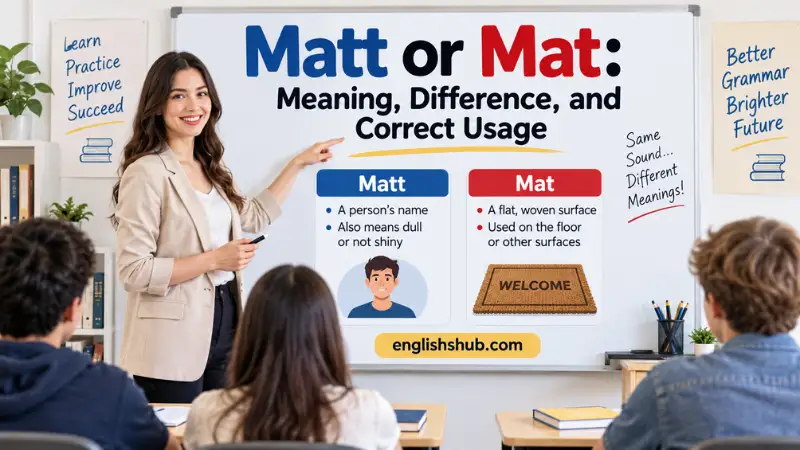
The choice between matt or mat depends on what you mean. In American English, mat usually refers to a physical piece of material, such as a yoga mat, doormat, or bath mat. For a non-shiny surface, matte is generally the clearest American spelling, while matt is strongly associated with British English in that sense. Dictionaries also recognize mat and matt as variants of matte, so the issue is more nuanced than simply calling one spelling wrong.
The personal name Matt is another matter. It is normally a short form of Matthew and should be capitalized. Once you identify whether you mean an object, a surface, or a person’s name, the correct spelling becomes much easier to choose.
Quick Answer
Use mat for a physical floor covering, exercise pad, table protector, or similar object. Use matte in most American English writing for a dull, non-glossy surface or finish. Matt is commonly used for that adjective in British English and is also a common personal name. Dictionaries recognize some overlap among the finish-related spellings.
TL;DR
- Mat usually names a physical object such as a yoga mat or doormat.
- Matte is the clearest U.S. spelling for a non-shiny finish.
- Matt is common in British English for a dull surface.
- Matt is also a personal name and is capitalized.
- Some dictionaries list mat and matt as variants of matte.
- Choose the spelling according to meaning, region, and context.
Mat, Matt, and Matte at a Glance
| Word | Main Meaning | Typical U.S. Use | Example |
| mat | Flat piece of material | Physical object | Put the shoes on the mat. |
| matt | Non-shiny or dull | More associated with British English | The wall has a matt finish. |
| matte | Non-shiny or dull | Preferred/common American spelling | The wall has a matte finish. |
| Matt | Personal name | Common male given name | Matt called this morning. |
| mats | Plural of mat | Physical objects | The gym ordered new mats. |
| matted | Tangled or made into a dense mass | Verb/adjective form of mat | The dog’s fur became matted. |
The key point is that mat and matte can belong to different word families and meanings. Merriam-Webster, for example, defines mat as a physical covering and separately records mat as a variant of the adjective matte.
What Does Mat Mean?
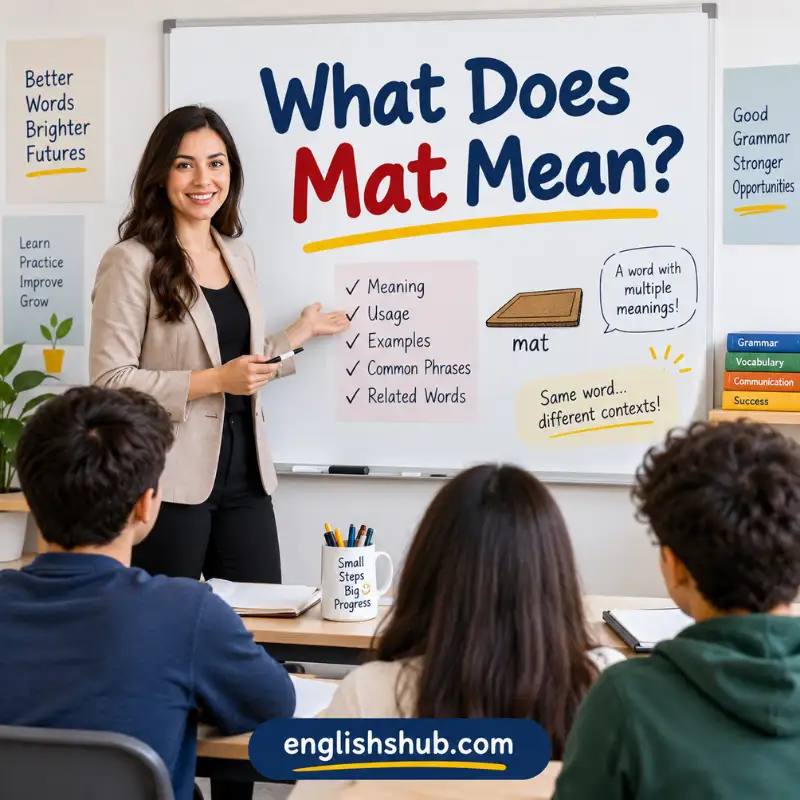
Mat is most commonly a noun referring to a relatively flat piece of material placed on a floor, table, or another surface. It can provide protection, comfort, decoration, or a place to exercise. Oxford lists examples such as floor mats, prayer mats, exercise mats, and table mats.
For example:
- Please wipe your feet on the mat.
- She bought a new yoga mat.
- Put the hot pan on a mat.
- The children practiced gymnastics on a padded mat.
- The welcome mat was covered with mud.
The word also has other noun meanings. A mat can describe a dense or tangled mass, such as a mat of roots or a mat of hair. As a verb, mat can mean to tangle or form a dense mass. Merriam-Webster gives matted and matting as its standard inflected forms.
For instance:
Correct: The rain matted the dog’s fur.
Correct: A thick mat of roots covered the soil.
So if you are naming something that people stand on, sit on, exercise on, or place under another object, mat is normally the word you want.
What Does Matt Mean?
Matt has two especially important uses.
First, Matt is a personal name, usually a short form of Matthew. As a name, it is capitalized:
- Matt joined us for dinner.
- I sent the document to Matt.
- Matt teaches English at the local school.
Second, matt is a legitimate spelling of the adjective meaning dull or non-shiny, especially in British English. Oxford labels matt as British English and notes matte as especially common in North American English.
For example:
The designer chose a matt finish for the cabinets.
This sentence is natural in British English. An American writer would usually choose:
The designer chose a matte finish for the cabinets.
Therefore, matt is not simply a misspelling. It is a legitimate regional spelling. The important question is whether your audience expects American or British English.
What Does Matte Mean?
Matte is an adjective describing something that lacks shine or gloss. It commonly describes paint, paper, photographs, makeup, screens, metal, and other surfaces.
For American readers, matte is generally the safest and clearest spelling for this meaning. Merriam-Webster defines matte as lacking luster or gloss and lists mat and matt as less common variants.
Examples include:
- We chose matte paint for the bedroom.
- The photographer printed the image on matte paper.
- She prefers matte lipstick.
- The laptop has a matte screen.
- The car has a matte black finish.
- The designer selected matte silver hardware.
The word can also function as a noun in specialized contexts. For example, matte has technical meanings in film and metallurgy. Those meanings are different from the everyday adjective describing a non-shiny surface.
For ordinary American writing, however, matte finish, matte paint, and matte paper are the forms most readers will recognize immediately.
Matt or Mat: Which Should You Use?
The easiest way to choose is to ask what the word names or describes.
Step 1: Is it a physical object?
If yes, use mat.
- yoga mat
- bath mat
- door mat
- floor mat
- exercise mat
- table mat
For example:
Please leave your shoes on the mat.
Step 2: Are you describing a non-shiny surface?
If you are writing for an American audience, choose matte.
The photographer used matte paper.
If you are writing in British English, matt is a traditional and standard choice.
The photographer used matt paper.
Step 3: Are you referring to a person?
If the person’s name is Matt, capitalize it.
Matt will send the report tomorrow.
This three-step test is more reliable than trying to remember which spelling “looks right.”
American vs. British English
The biggest regional difference concerns the adjective for a dull or non-glossy surface.
| Meaning | American English | British English |
| Floor covering | mat | mat |
| Exercise pad | mat | mat |
| Non-shiny finish | matte | matt |
| Personal name | Matt | Matt |
Oxford identifies matt as British English and says matte is especially used in North American English. The Language Portal of Canada likewise presents matt as primarily British while discussing matte and mat as alternative forms.
There is, however, an important qualification: dictionaries do not always restrict these spellings as rigidly as a simple U.S.-versus-U.K. table suggests. Merriam-Webster lists mat and matt as variants of matte, while Collins also records the relationship among the three forms.
Therefore, the practical rule for a U.S. website is simple: use mat for the object and matte for the finish. That choice minimizes ambiguity and matches familiar American usage.
Common Mistakes and Corrections
Because the words sound alike, writers sometimes choose the spelling based on pronunciation. That can create errors.
| Incorrect or Less Clear | Better Choice | Why |
| I bought a yoga matt. | I bought a yoga mat. | A yoga pad is a mat. |
| The wall has a matt finish. | The wall has a matte finish. | Matte is the clearest U.S. form. |
| Please wipe your feet on the matte. | Please wipe your feet on the mat. | The object is a floor mat. |
| The screen has a mat finish. | The screen has a matte finish. | Here the word describes a non-shiny surface. |
| mat called me yesterday. | Matt called me yesterday. | A person’s name is capitalized. |
Consider the sentence “I bought a new matte for the bathroom.” The problem is not only spelling. The intended object is probably a mat. Changing matte to mat restores the correct meaning.
Similarly, “The photographer chose a matt print” is not necessarily grammatically wrong. It can be appropriate in British English. For American readers, however, “matte print” is the more natural choice.
This distinction matters because dictionary-valid does not always mean equally common in every variety of English.
If you enjoy word-choice comparisons, EnglishShub also explains how meaning determines choices such as
counsel and council and imminent and eminent.
Synonyms, Related Words, and Context
For the physical noun mat, useful related words include rug, pad, floor covering, doormat, and carpet. These are not perfect synonyms, though.
A rug is generally a larger floor covering, while a mat is often smaller or designed for a particular purpose. A pad emphasizes cushioning or protection. A doormat specifically refers to a mat placed near an entrance.
For the adjective matte, useful near-synonyms include dull, flat, non-glossy, lusterless, and unpolished. Merriam-Webster’s thesaurus lists terms such as flat, dull, lusterless, and unpolished as related words.
However, these alternatives are not interchangeable in every sentence:
Natural: The phone has a matte finish.
Possible but less precise: The phone has a dull finish.
“Dull” can suggest a lack of brightness, interest, or quality, while matte specifically describes a surface without a glossy reflection.
The opposite of matte in many everyday contexts is glossy or shiny. That is a contextual contrast rather than a universal grammatical antonym.
Pronunciation, Capitalization, and Word Forms
In the relevant meanings, mat, matt, and matte are pronounced /mæt/, with the vowel sound found in words such as cat. Oxford gives /mæt/ for matt, and Merriam-Webster gives the same pronunciation for matte.
Because the forms sound alike, pronunciation cannot tell you which spelling to write.
Capitalization does matter when Matt is a person’s name:
Correct: Matt lives in Chicago.
Incorrect: matt lives in Chicago.
The physical noun has ordinary word forms:
- one mat
- two mats
- matted hair
- matting material
For example:
The cat’s fur became matted.
This is different from the adjective matte. A sentence such as “The cat’s fur became matte” would normally change the intended meaning because matte describes surface appearance rather than tangled strands.
Examples in Everyday English
Here are several examples that show how context controls the spelling:
- The children sat on a large mat during story time.
Mat names a physical object. - I rolled up my exercise mat after class.
The object used for exercise is a mat. - Please put the vase on a protective mat.
The mat protects the surface. - The new paint has a matte finish.
Matte describes the lack of shine. - She chose matte paper for the wedding invitations.
The paper has a non-glossy surface. - The photographer prefers matte prints.
The adjective describes the print finish. - The laptop’s matte screen reduces distracting reflections.
Matte modifies screen. - Matt sent me the revised document.
Matt is a person’s name. - The dog’s fur became matted after the rain.
Matted describes tangled fur. - The British catalog describes the cabinet as having a matt finish.
Matt is appropriate in this regional context. - The entrance mat was soaked after the storm.
Mat means a floor covering. - The designer chose matte black hardware.
Matte describes the finish.
A useful way to remember the distinction is:
Thing you step on → mat.
Surface without shine → matte in most U.S. writing.
British spelling for that finish → matt.
Person named Matthew → Matt.
FAQs
Both can be correct, but they usually represent different meanings or regional conventions. Mat commonly names a physical floor covering or pad. Matt can describe a non-shiny surface, especially in British English, and it is also a common personal name. For U.S. writing, matte is generally the clearest finish spelling.
Matte is the standard-looking and most recognizable choice for most American readers when describing a non-shiny finish. However, major dictionaries recognize matt as a variant. Therefore, matt is not simply an impossible spelling, although matte is usually the better U.S. editorial choice.
A yoga mat is spelled with one t. It is a physical exercise pad, so the word is the noun mat. Writing “yoga matt” or “yoga matte” changes the standard spelling and does not describe the object correctly.
Yes. Some dictionaries recognize mat as a variant of matte when it means lacking gloss or shine. Merriam-Webster explicitly records this usage. Still, American writers who want the clearest everyday spelling will usually choose matte for a finish.
No. Matt can also be a legitimate adjective meaning non-shiny, particularly in British English. However, when capitalized as Matt, it is commonly a personal name, usually a short form of Matthew. Context and capitalization tell you which meaning is intended.
They can have the same meaning: a dull or non-glossy surface. The main difference is regional preference. Matt is strongly associated with British English, while matte is especially common in North American English. Some dictionaries also recognize additional variant usage.
Test Your Understanding
1. Which spelling is best for a floor covering at your front door?
A. Matte
B. Matt
C. Mat
D. Matts
Answer: C. Mat
A floor covering is a mat.
2. Which sentence is best for a U.S. audience?
A. The photographer used matt paper.
B. The photographer used matte paper.
C. The photographer used Matt paper.
D. The photographer used mat paper only because it was a floor covering.
Answer: B. Matte paper
Matte is the clearest American spelling for a non-glossy finish.
3. Which sentence uses Matt as a proper noun?
A. The wall has a matt finish.
B. The printer uses matte paper.
C. Matt emailed the report.
D. The child rolled out a mat.
Answer: C. Matt emailed the report.
Matt is capitalized because it is a person’s name.
4. Which form is traditionally associated with British English for a dull finish?
A. Mat
B. Matt
C. Matte
D. Mats
Answer: B. Matt
Oxford identifies matt as British English and matte as especially North American.
5. Which sentence is incorrect in standard everyday U.S. usage?
A. She bought a yoga mat.
B. The car has a matte finish.
C. Matt called after lunch.
D. She bought a yoga matt.
Answer: D. She bought a yoga matt.
A yoga exercise pad is a mat, with one t.
Answer Key
- C — Mat names the physical floor covering.
- B — Matte is the clearest U.S. spelling for a non-shiny finish.
- C — Matt is capitalized as a personal name.
- B — Matt is the traditional British spelling for the dull-surface adjective.
- D — The standard noun is mat, not matt.
Conclusion
The best choice depends on meaning and regional English. Use mat for a physical object such as a yoga mat, bath mat, or doormat. For a non-shiny surface, matte is usually the clearest choice for American readers, while matt is especially associated with British English. Dictionaries also recognize mat and matt as variants in the finish-related sense, so those forms are not always errors. Finally, capitalize Matt when you mean the person’s name. Once you identify the context, the spelling becomes straightforward.