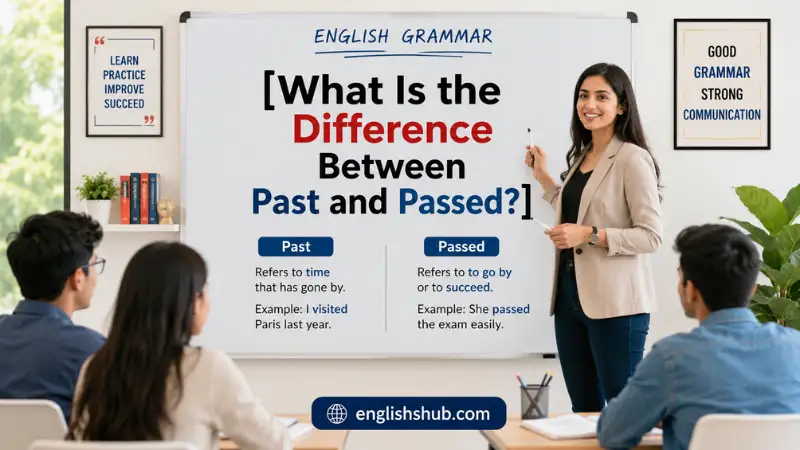
Choosing past or passed becomes much easier once you check the job the word performs. Passed is the simple past and past participle of the verb pass. Meanwhile, past usually refers to an earlier time or means beyond a particular point. Because both words sound alike, writers often create errors such as walked passed or time has past.
The reliable solution is to check grammar instead of pronunciation. If the sentence needs the action verb pass for an earlier time, use passed. If another verb already expresses the action and the word describes time, position, or direction, use past. This distinction matters because a spell-checker may accept either real word even when the sentence uses the wrong one.
Quick Answer
For past or passed, use passed when you need the past-tense or past-participle form of the verb pass: “Lena passed the store” and “The hours have passed.” Use past for earlier time or movement beyond a point: “the past year” and “Lena walked past the store.” In the future-tense test, passed changes to will pass, while past remains unchanged.
TL;DR
- Passed is primarily a form of the verb pass.
- Past can name or describe an earlier time.
- Write walked past, but write passed the building.
- Write time passed, but write the past year.
- Change the sentence to future tense when unsure.
Past or Passed at a Glance
| Form or Context | Correct Choice | Grammatical Job | Example |
|---|---|---|---|
| Moving beyond something | passed | Verb | The bus passed our car. |
| Succeeding in a test | passed | Verb | Jordan passed the exam. |
| Giving something | passed | Verb | She passed me the folder. |
| Time moving forward | passed | Verb | Three hours passed. |
| Earlier time | past | Noun | We cannot change the past. |
| Previous period | past | Adjective | Sales improved this past month. |
| Beyond a place or time | past | Preposition | Walk past the bank. |
| Moving beyond without an object | past | Adverb | The cyclist sped past. |
What Is the Difference Between Past and Passed?

The main difference is grammatical: passed comes from the verb pass, while past usually functions as a noun, adjective, preposition, or adverb.
Consider these two sentences:
- Elena passed the library.
- Elena walked past the library.
In the first sentence, passed supplies the action. Elena passed something. In the second, walked already supplies the action, while past shows the direction of that movement.
The MLA Style Center’s guidance on passed and past
confirms that passed expresses an action such as movement, progression, success, or approval. It also identifies past as a word that can perform four nonverb roles.
For most everyday questions, the simplest rule is:
If you need the verb pass, use passed for a completed action. Otherwise, check whether past expresses earlier time or movement beyond a point.
When to Use Passed as a Verb
Use passed when someone or something completed the action described by pass. The word works as both the simple past and the past participle.
According to the Cambridge Dictionary entry for pass,
the verb can express movement, successful completion, transfer, approval, or the movement of time.
Common meanings include:
- Movement: The red truck passed us on the highway.
- Success: Amira passed her driving test.
- Transfer: He passed the microphone to Carlos.
- Approval: The committee passed the proposal.
- Elapsed time: Several weeks passed before we received an answer.
Use passed after has, have, or had when forming a perfect tense:
- The storm has passed.
- We have passed that building twice.
- The deadline had passed before Lee submitted the form.
Pass is a regular verb, so it normally becomes passed by adding -ed. Other verbs have more than one accepted past form, as explained in the guide to
When to Use Past as a Noun, Adjective, Preposition, or Adverb
Use past when the sentence concerns an earlier period or a position beyond something.
The Cambridge Dictionary definition of past
records its uses for both time and position.
Past as a noun
As a noun, past names a former time or someone’s history:
- We should learn from the past.
- His past influenced his decision.
- That disagreement belongs in the past.
Past as an adjective
As an adjective, past describes a noun:
- The past year brought several changes.
- Please review your past assignments.
- A past president attended the meeting.
Past as a preposition
As a preposition, past comes before a noun or pronoun and means beyond:
- Walk past the pharmacy.
- It is past midnight.
- The balance is past its limit.
Past as an adverb
As an adverb, past describes movement beyond a point without naming the object:
- A motorcycle raced past.
- We watched the clouds drift past.
- She smiled as I walked past.
Use the Future-Tense Test
The future-tense test is one of the most dependable ways to choose the correct word.
Merriam-Webster’s passed-versus-past guide
recommends changing the sentence to future tense and watching what happens to the target word.
Compare these forms:
- Present or past: We passed the stadium.
- Future: We will pass the stadium.
Because passed changes to will pass, it is the verb.
Now try past:
- Present or past: We drove past the stadium.
- Future: We will drive past the stadium.
The word past remains unchanged because drive is the verb.
This test also prevents mistakes after helping verbs. Write “did pass,” not “did passed,” because did already carries the past tense. English sometimes has competing verb forms, such as those discussed in
but past is never the past-tense form of pass.
Passed vs. Past With Movement and Position
Movement creates the most confusion because both words can describe going beyond a location. The sentence structure reveals the answer.
Use passed when it is the main action:
- The runner passed the finish line.
- Our train passed three small towns.
- Maya passed me near the entrance.
Use past after another movement verb:
- The runner moved past the finish line.
- Our train traveled past three small towns.
- Maya walked past me near the entrance.
The difference becomes clearer when the examples share the same meaning:
- We passed the school.
- We drove past the school.
Both sentences describe moving beyond the school. However, passed supplies the action in the first sentence. In the second, drove supplies the action, while past describes the route.
Therefore, write walked past, ran past, drove past, went past, and looked past. Do not write walked passed or went passed.
Past or Passed With Time
Time expressions require you to decide whether time performs an action or whether past describes a period.
Use passed when time moves or elapses:
- Two hours passed before the doctor arrived.
- The years have passed quickly.
- The deadline passed at noon.
- Ten minutes had passed by the time we called.
In each example, time or a deadline performs the action expressed by pass.
Use past when it describes a time, period, or point:
- The past two weeks were difficult.
- It is past noon.
- The payment is past due.
- We discussed her past experience.
Compare these two correct patterns:
- Several months have passed.
- During the past several months, sales increased.
The expression in years past is also correct. Here, past means earlier or gone by: “In years past, the town held a winter festival.”
Common Expressions With Passed and Past
Fixed expressions become easier when you identify their underlying grammar.
Use passed in verb phrases:
- passed away — died
- passed out — became unconscious or distributed something
- passed by — moved beyond or failed to affect
- passed on — transferred information or declined something
- passed down — transferred to a younger generation
- passed a law — officially approved legislation
The correct expression for death is passed away, not past away. The complete distinction appears in the EnglishsHub guide to
Use past in expressions involving time, position, or a previous condition:
- past due
- past midnight
- past tense
- past experience
- past the entrance
- past the point of no return
A useful distinction appears in these sentences:
- The deadline has passed.
- The bill is past due.
The first sentence describes an action. The second describes the bill’s current condition relative to its deadline.
Why Past and Passed Sound the Same
In mainstream American English, past and passed are homophones. Both are usually pronounced /pæst/.
The ending explains the match. In passed, the regular -ed ending follows the voiceless /s/ sound, so the ending is pronounced /t/. Therefore, pass plus the /t/ ending sounds the same as past.
Because pronunciation cannot reveal the spelling, voice typing and basic spell-checkers may select the wrong word. Meaning and sentence structure provide stronger evidence.
The same issue appears with
the words sound alike, but context controls the spelling. Do not rely on sound alone when proofreading homophones.
Synonyms, Near-Synonyms, and Contextual Opposites
Neither word has one synonym that works in every sentence. Choose an alternative based on the intended meaning.
For passed, possible alternatives include:
- moved by or overtook for movement;
- succeeded for an examination;
- handed or transferred for giving;
- elapsed for time;
- approved or enacted for legislation.
For past, possible alternatives include:
- previous, former, or earlier before a noun;
- history when past is a noun;
- beyond when describing position;
- ago in certain time expressions.
The opposites also depend on context. Future contrasts with past as a time period. Failed contrasts with passed for an examination. However, failed is not an opposite in “She passed the building.” In that context, stopped before or remained behind may express the contrasting idea.
Therefore, do not substitute a synonym until you identify the meaning of the original sentence.
Common Past and Passed Mistakes
These corrections show how grammar determines the correct spelling.
- Incorrect: We walked passed the station.
Correct: We walked past the station. - Incorrect: Three days have past.
Correct: Three days have passed. - Incorrect: Elena past her final exam.
Correct: Elena passed her final exam. - Incorrect: The account is passed due.
Correct: The account is past due. - Incorrect: It is passed my bedtime.
Correct: It is past my bedtime. - Incorrect: Did you passed the bakery?
Correct: Did you pass the bakery? - Incorrect: The passed week felt unusually long.
Correct: The past week felt unusually long. - Incorrect: The dog ran passed the gate.
Correct: The dog ran past the gate.
Since both spellings are real words, spell-check may not flag these mistakes. This problem also affects other homophones, including
A Five-Step Proofreading Checklist
Use this checklist whenever the choice interrupts your writing:
- Find the action verb. If the missing word supplies the action pass, choose passed.
- Look for another movement verb. After walked, ran, drove, or went, use past.
- Try the future tense. If the word changes to will pass, the original form is passed.
- Check the time pattern. Write time passed, but write the past hour.
- Recognize fixed expressions. Use passed away, passed out, past due, and past midnight.
One short memory aid can reinforce the process:
Passed performs an action; past points to time or position.
The rule covers ordinary usage. A specialized expression such as passed ball in baseball uses a participial form before a noun, but that narrow construction does not change the everyday decision process.
FAQs
Write time has passed. The sentence needs the past participle of the verb pass after has. You could also write “time passed quickly” in the simple past. Use past in a descriptive phrase such as “the past hour.”
Walked past is correct. Walked already supplies the verb, while past describes movement beyond a person or place. You could instead use passed as the main verb: “She passed the store.”
Write days have passed because have requires the past participle passed. For example, “Several days have passed since our meeting.” Use past before a noun in “the past several days.”
Past due is correct. The expression means that something has gone beyond its required payment or completion date. Here, past describes the item’s position relative to the deadline; it is not the verb passed.
Write past my bedtime when you mean that the current time is later than your usual bedtime. For example, “It is past my bedtime.” However, a different structure could use the verb: “We passed the scheduled bedtime without noticing.”
Passed is primarily the simple past or past participle of the verb pass. It may work like an adjective in specialized participial expressions such as a passed ball. For normal word-choice questions, treating it as a form of the verb provides the most useful rule.
Test Your Understanding
- Which word completes the sentence: “Nora walked ___ the reception desk”? A. pass
B. passed
C. past
D. passing - Which word completes the sentence: “Two hours have ___ since lunch”? A. past
B. passed
C. pass
D. passing - Which sentence is correct? A. The bus went passed our street.
B. The bus went past our street.
C. The bus past our street.
D. The bus has past our street. - Which word completes the sentence: “The committee ___ the new policy”? A. past
B. passing
C. pass
D. passed - Which sentence uses past correctly? A. She past the examination.
B. The storm has past.
C. It is past midnight.
D. We passed due the library.
Answer Key
- C — past. Walked is the verb, while past describes movement beyond the desk.
- B — passed. The helping verb have requires the past participle passed.
- B — The bus went past our street. Went supplies the action, so past describes the route.
- D — passed. The sentence needs the past-tense verb meaning “approved.”
- C — It is past midnight. Past correctly means later than a stated time.
Conclusion
Choosing past or passed depends on grammar, not pronunciation. Use passed when the sentence needs the completed action of the verb pass, whether it concerns movement, success, transfer, approval, or elapsed time. Use past for an earlier period or a position beyond something. Therefore, write the hours passed, but the past few hours; write we passed the store, but we walked past the store. When uncertainty remains, move the sentence into future tense. If the word changes to will pass, passed is the form you need.
More Discover Related to: englishshub.com
https://englishshub.com/passed-away-or-past-away/
https://englishshub.com/fourth-or-forth/
https://englishshub.com/herd-or-heard/
https://englishshub.com/dreamed-or-dreamt/
https://englishshub.com/sneaked-or-snuck/