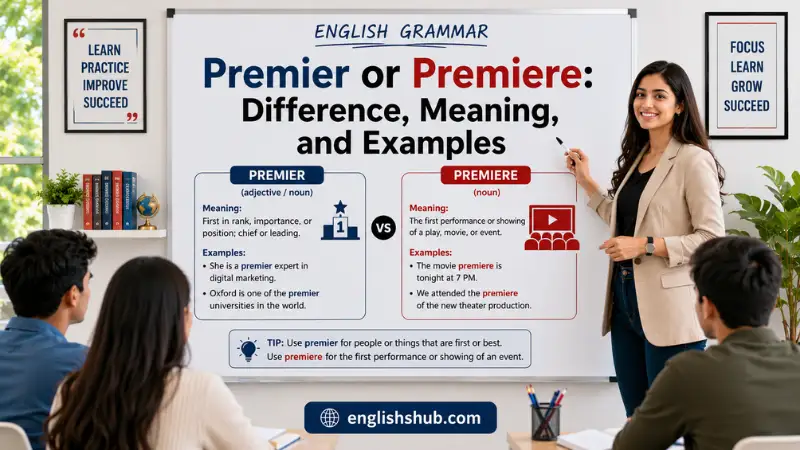
Choosing premier or premiere depends on meaning and grammar. Use premier for someone or something that ranks first in importance, quality, or position. The same spelling can name a government leader. By contrast, use premiere for the first public performance or showing of a movie, play, television program, or similar work.
The distinction also affects grammatical function. Premier is usually an adjective or political noun, while premiere commonly works as a noun or verb. Some accepted uses overlap, so the rule is more nuanced than simply removing or adding the final e. Once you identify whether the sentence concerns rank, government, or a public debut, the correct choice becomes much easier.
Quick Answer
Use premier for a leading or top-ranked person, place, organization, or service, and for a head of government. Use premiere for the first public showing or performance of an entertainment work, or as a verb meaning “to appear or be presented publicly for the first time.” Therefore, the choice between premier or premiere depends on context.
TL;DR
- Premier commonly means leading, foremost, or most important.
- A premier can also be a government leader.
- A premiere is a first public performance or showing.
- Movies, plays, and television programs can premiere.
- Sound alone may not reveal the correct spelling.
Premier or Premiere at a Glance
| Context | Correct Form | Word Class | Meaning | Example |
|---|---|---|---|---|
| Quality or rank | premier | Adjective | Leading or most important | It is the region’s premier research center. |
| Government | premier | Noun | Head of a government | The provincial premier addressed reporters. |
| First public showing | premiere | Noun | Debut performance or exhibition | We attended the documentary’s premiere. |
| First public presentation | premiere | Verb | Be shown or performed publicly for the first time | The play will premiere in October. |
| First episode of a season | premiere | Noun modifier or adjective | Opening episode | The season premiere airs Friday. |
| Several government leaders | premiers | Plural noun | More than one premier | The premiers discussed transportation. |
| Past public debut | premiered | Past-tense verb | Appeared publicly for the first time | The series premiered last spring. |
What Does Premier Mean?
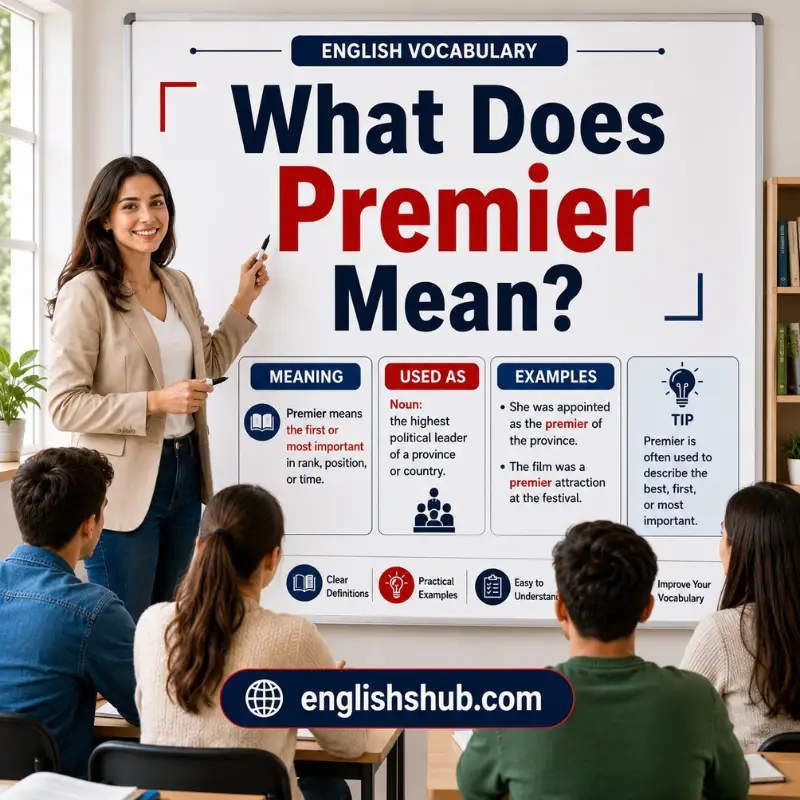
Premier usually functions as an adjective meaning first in position, rank, importance, or quality.
The Merriam-Webster definition of premier
also records the meaning “first in time,” although modern writers often use it for high rank or distinction.
Examples include:
- Maya is the firm’s premier trial attorney.
- The museum holds the city’s premier collection of modern art.
- That university is a premier center for language research.
- The conference became the premier event in its field.
In each example, premier suggests a leading position. However, it does not always mean objectively “the best.” A company may describe itself as a premier service for promotional effect, so the word can express reputation or status rather than a measurable fact.
As a noun, premier identifies a head of government. For example, “The premier met the finance minister” refers to a political leader, not an entertainment event.
What Does Premiere Mean?
Premiere most often names the first public performance, showing, or exhibition of a creative work.
The Merriam-Webster entry for premiere
recognizes it as a noun, verb, and adjective.
As a noun:
- The cast attended the movie’s premiere.
- Tickets for the world premiere sold out quickly.
- The season premiere introduced two new characters.
As a verb, premiere means to appear, perform, or present something publicly for the first time:
- The studio will premiere the documentary in Chicago.
- The documentary will premiere at the festival.
- Her new composition premiered on Saturday.
The first verb example is transitive because the studio presents something. The second is intransitive because the documentary itself makes its public debut. In both structures, premiere retains the idea of a first public presentation.
A private rehearsal, unfinished preview, or ordinary repeat showing is not automatically a premiere. The word normally points to a meaningful public debut within the stated context.
Premier or Premiere: A Simple Decision Rule
Use three questions to choose premier or premiere correctly.
- Does the word mean leading, foremost, or highest-ranked?
Choose premier: “This is the state’s premier teaching hospital.” - Does it name a government leader?
Choose premier: “The premier announced a new policy.” - Does it describe a first public showing or performance?
Choose premiere: “The film will premiere tonight.”
A short replacement test also works:
- If leading fits, use premier.
- If head of government fits, use premier.
- If debut or first public showing fits, use premiere.
Consider “The premier attended the premiere.” The first word names a government leader. The second names an entertainment event. Although the words look and often sound alike, their positions and meanings make the distinction clear.
A Movie Premier or Premiere?
A movie’s first public showing is a movie premiere, not normally a movie premier. The final e matters because the phrase names a debut event.
Correct examples include:
- The movie premiere begins at 7 p.m.
- Actors walked the red carpet before the premiere.
- The film will premiere in Los Angeles.
- Critics attended the international premiere.
Television uses several related phrases:
- Series premiere: the first episode of an entire series
- Season premiere: the first episode of a new season
- Premiere episode: an opening episode
- Series finale: the last episode of an entire series
- Season finale: the last episode of a season
A premier movie could theoretically mean a leading or top-ranked movie, but that wording sounds promotional and does not mean its first showing. Stage writers who confuse other entertainment terms may also find
the distinction between cue and queue useful.
Premier in Government Titles and Capitalization
As a political noun, premier can refer to the head of a national or regional government. The exact office depends on the political system. For example, the term appears in references to Canadian provincial leaders and leaders in several parliamentary systems.
Use lowercase when the word is generic:
- The premier answered questions.
- Several premiers attended the meeting.
- The province elected a new premier.
Capitalization may be appropriate when an organization’s official style treats the term as a formal title before a name:
- Premier Chen addressed the assembly.
- The statement came from Premier Chen’s office.
However, editorial styles differ in their treatment of official titles. Therefore, follow the government’s established wording or your publication’s style guide.
Do not confuse a political premier with a capital city or legislative building. The related guide to
explains that separate government-related spelling distinction.
Pronunciation: Do the Two Words Sound the Same?
Premier and premiere are often pronounced alike in American English, commonly with a sound resembling “pri-MEER.” As a result, many speakers treat them as homophones in everyday conversation.
However, dictionaries record more than one accepted pronunciation for each word. Some speakers use three syllables, while stress and vowel sounds can also vary. Therefore, saying that the words always sound exactly the same for every English speaker would be too broad.
Pronunciation cannot reliably determine the spelling. Instead, identify the meaning and grammatical role:
- leading organization → premier
- government leader → premier
- first public showing → premiere
- make a public debut → premiere
English contains many sound-alike words that still require different spellings. The same meaning-first method works for pairs such as
Word Forms: Premiered, Premiering, Premieres, and Premiership
The correct word form depends on whether the sentence uses a noun, adjective, or verb.
Forms of premier
- premier: singular political noun or adjective
- premiers: plural political noun
- premiership: the office, position, or period of serving as premier
- premierships: plural form of premiership
Examples:
- The two premiers signed an agreement.
- Her premiership lasted four years.
- The firm remains a premier employer.
An adjective does not take a plural ending, so write “two premier programs,” not “two premiers programs.”
Forms of premiere
- premiere: base verb or singular noun
- premieres: third-person verb or plural noun
- premiered: past tense and past participle
- premiering: present participle
Examples:
- Three premieres are scheduled this month.
- The show premieres tomorrow.
- The film premiered in May.
- Two documentaries are premiering at the festival.
Some dictionaries accept premier as a less common verb spelling. Nevertheless, premiere is the clearer modern choice for an entertainment debut.
Can Premiere Be an Adjective?
Yes, some dictionaries accept premiere as an adjective equivalent to premier. It also appears before nouns in established media phrases such as premiere episode and premiere performance.
Still, the clearest spelling depends on the intended meaning:
- premier institution: a leading or highly ranked institution
- premiere episode: the first episode
- premiere performance: a first public performance
- premier performance: potentially a leading, outstanding, or earliest performance
Because the last pair can be ambiguous, a more specific phrase often works better. Write debut performance, first performance, or world premiere when you mean the first public presentation.
Editors do not treat every adjectival use in exactly the same way. Therefore, avoid an absolute rule that premiere can never modify a noun. At the same time, use premier when the intended meaning is clearly “leading” or “highest-ranked.”
Synonyms, Near-Synonyms, and Contextual Opposites
Synonyms for adjective premier include leading, foremost, principal, top, and highest-ranked. However, these words differ in tone. Top sounds less formal, while foremost and principal often sound more formal.
Eminent can also suggest distinction, especially for a respected person. Nevertheless, it is not interchangeable in every sentence.
comparison helps separate reputation from timing.
For noun premiere, useful near-synonyms include:
- debut
- opening night
- first showing
- first performance
- launch
These are not perfect substitutes. A product may have a launch, while a stage production usually has an opening night or premiere. Likewise, debut can describe a person’s first appearance, not only the first showing of a work.
There is no single antonym covering every sense. Contextual opposites include lowest-ranked or secondary for adjective premier, and final performance, closing night, or last showing for premiere.
Common Errors and Corrections
Error 1: Using premier for a movie debut
Incorrect: The movie premier attracted hundreds of fans.
Correct: The movie premiere attracted hundreds of fans.
The sentence names the first public showing, so it needs premiere.
Error 2: Using premiere for high rank
Incorrect: She works for the state’s premiere law firm.
Preferred: She works for the state’s premier law firm.
Although some dictionaries accept adjectival premiere, premier communicates “leading” more clearly here.
Error 3: Dropping the final e from the verb
Incorrect or uncommon: The series will premier next month.
Standard and clearer: The series will premiere next month.
The shorter verb spelling has dictionary recognition, but many readers will view it as an error.
Error 4: Adding the final e to a political title
Incorrect: The provincial premiere addressed the legislature.
Correct: The provincial premier addressed the legislature.
The sentence names a government leader.
Error 5: Assuming the words are interchangeable
Incorrect: The premiere hotel hosted the film’s premier.
Correct: The premier hotel hosted the film’s premiere.
The hotel is leading, while the event is a first showing. Similar spelling traps,
such as loose or lose,
also become easier when you check meaning first.
Why Premier and Premiere Share a History
The words resemble each other because they share the idea of being first.
The etymological history of premier
traces the adjective through French to a Latin source associated with being first, chief, or of the highest rank.
Premier entered English centuries before the entertainment noun premiere. The latter came from French première, connected with a phrase meaning a first performance. English adopted the noun in the late nineteenth century, while the verb appeared in the 1920s.
Therefore, the modern distinction grew from two related senses of “first.” Premier developed around rank, position, importance, and political leadership. Meanwhile, premiere became closely associated with a work’s first public presentation.
The shared history explains the spelling similarity, but it does not make the words freely interchangeable.
American and British English: Does the Rule Change?
The basic distinction remains useful in both American and British English. Writers generally use premier for rank or a government leader and premiere for a first public performance or showing.
Political frequency varies because countries organize and name their governments differently. American readers may encounter premier most often in international news or discussions of Canadian provincial governments. British readers also see it as a synonym or shortened reference for a prime minister, although the exact official title still depends on the jurisdiction.
Standard English normally writes premiere without an accent mark. The French-influenced form première sometimes appears in specialized, historical, or deliberately French contexts, but the accent is unnecessary in ordinary American English.
Because adjectival practices vary among dictionaries and publications, use premier for “leading” and a clearer phrase such as first episode when ambiguity may distract readers.
FAQs
A movie’s first public showing is a premiere. For example, write “The movie premiere took place in New York.” The phrase movie premier would normally suggest a government leader connected with a movie, or it would appear to be a spelling mistake.
Use season premiere for the first episode of a television season. Here, premiere names the opening episode or functions attributively before an understood noun. By contrast, a series premiere is the first episode of the entire television series.
Yes. Premiere can mean to present something publicly for the first time or to make a first public appearance. Write “The theater will premiere the play” or “The play will premiere in June.” Its common forms are premieres, premiered, and premiering.
Yes. As a noun, premier means a head of government. Its plural is premiers. The word may refer to a national leader or the leader of a regional government, depending on the country and its official political structure.
Yes. Some dictionaries recognize an adjectival use, and phrases such as premiere episode are common. However, use premier when you mean leading or highest-ranked. If premiere performance feels ambiguous, replace it with first performance or debut performance.
They are often pronounced alike, especially with the common “pri-MEER” pronunciation. However, dictionaries record several accepted pronunciations, and not every speaker says the words identically. Meaning and grammatical function provide a more reliable spelling guide than sound.
Test Your Understanding
- Which sentence correctly refers to a first public film showing?
A. We attended the film’s premier.
B. We attended the film’s premiere.
C. We attended the film’s premiership.
D. We attended the film’s premiering leader.
- Which sentence correctly uses premier as an adjective?
A. The play will premier tonight.
B. The premiere met the governor.
C. It is the city’s premier art museum.
D. The show’s premiering was a leader.
- Which sentence correctly uses the political noun?
A. The provincial premiere announced the budget.
B. The provincial premier announced the budget.
C. The provincial premiered announced the budget.
D. The provincial premiering announced the budget.
- Which form completes the sentence: “The documentary _____ at the festival last May”?
A. premier
B. premiers
C. premiered
D. premiership
- Which phrase most clearly means “the first episode of a new television season”?
A. season premier
B. premier season
C. season premiership
D. season premiere
Answer Key
- B — Premiere names the film’s first public showing.
- C — Premier modifies the museum and means leading or highly ranked.
- B — The noun premier names the government leader.
- C — Premiered is the correct past-tense verb for a public debut.
- D — Season premiere is the established phrase for a season’s opening episode.
Conclusion
The choice between premier or premiere becomes straightforward when you identify the intended meaning. Use premier for a person or thing that ranks first in importance or quality, and use the same spelling for a government leader. Use premiere for a first public performance or showing and for the verb describing that debut.
Remember the three-part test: rank, government, or performance. Rank and government usually require premier; a public entertainment debut requires premiere. Although a few accepted uses overlap, choosing the clearest standard form will prevent ambiguity in most American English writing.
More Discover Related to: englishshub.com
https://englishshub.com/imminent-or-eminent/
https://englishshub.com/capital-or-capitol/
https://englishshub.com/cue-or-queue/
https://englishshub.com/fourth-or-forth/
https://englishshub.com/loose-or-lose/