
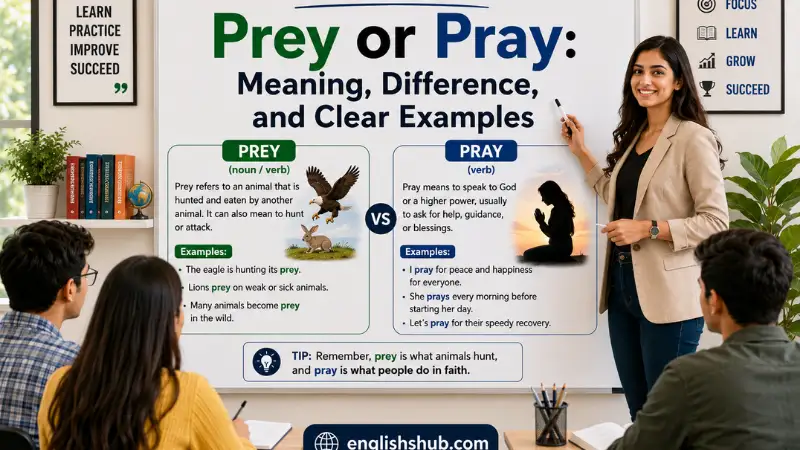
Choosing between prey or pray becomes easy when you focus on meaning instead of sound. Pray is a verb for speaking to a deity, making an earnest request, or expressing a strong hope. Prey can be a noun for an animal or vulnerable target. It can also be a verb meaning to hunt, exploit, or harm.
Both words sound like “pray,” so pronunciation cannot reveal the correct spelling. In addition, a basic spell-checker may accept either word because both exist in English. Therefore, writers must examine the word’s meaning and grammatical role. In their ordinary uses, these homophones are not interchangeable.
Quick Answer
Use pray when someone worships, makes an earnest request, or strongly hopes for something. Use prey for an animal or person being hunted, targeted, or exploited, or for the action of hunting or exploiting. When choosing prey or pray, remember that only prey normally functions as a noun.
TL;DR
- Pray is always a verb in ordinary modern English.
- Prey can function as a noun or verb.
- People pray for help, guidance, peace, or another outcome.
- Predators and dishonest people prey on their targets.
- The insect’s standard name is praying mantis.
Prey or Pray at a Glance
| Form or Pattern | Grammatical Role | Meaning | Example |
|---|---|---|---|
| pray | Verb | Worship or address a deity | They pray together each evening. |
| pray | Verb | Ask or hope earnestly | I pray that everyone arrives safely. |
| prey | Noun | Animal hunted for food | The owl watched its prey. |
| prey | Noun | Vulnerable target | New users can become easy prey for scammers. |
| prey on/upon | Verb pattern | Hunt, exploit, or harm | Some insects prey on smaller insects. |
| fall prey to | Fixed expression | Become a victim of something | He fell prey to a fake offer. |
What Is the Difference Between Prey and Pray?

The main difference involves meaning and grammatical function. Pray describes an action connected with worship, an earnest request, or a strong hope. Prey names a hunted or vulnerable target, or it describes the act of hunting and exploiting.
Compare these sentences:
- The family will pray for the missing hikers.
- The eagle will search for prey near the river.
- Fraudsters sometimes prey on inexperienced shoppers.
- I pray that the weather improves by morning.
The first and fourth sentences involve requests or hopes. Therefore, they need pray. The second sentence needs a noun naming what the eagle hunts, so prey is correct. Meanwhile, the third sentence uses the verb phrase prey on to describe exploitation.
Only prey normally serves as a noun. If you can place the, its, or some directly before the word, you probably need prey: the prey, its prey, or some prey.
What Does Pray Mean?
Pray is a verb that most often means to communicate with God, a god, or another object of worship. Depending on the person’s tradition, prayer may express thanks, praise, confession, concern, or a request.
Common patterns include:
- pray: The visitors stopped to pray.
- pray for + person or result: We prayed for her recovery.
- pray to + object of worship: The worshippers prayed to God.
- pray that + clause: I pray that you find peace.
The verb can also express a strong hope without describing a formal religious act:
I pray we have enough fuel to reach the next town.
Here, the speaker strongly hopes for a favorable result. In addition, pray once appeared more commonly in polite requests. The expression pray tell preserves that older sense and means “please tell me,” often with a playful or impatient tone.
What Does Prey Mean?
Prey can work as a noun or a verb. As a noun, it commonly means an animal that another animal hunts for food. The word can also describe a vulnerable person or group targeted for harm or exploitation.
- The snake waited for its prey.
- Small fish provide prey for larger species.
- The dishonest seller viewed tourists as easy prey.
As a verb, prey means to hunt, exploit, victimize, or have a harmful effect. It normally appears with on or upon.
Merriam-Webster’s entry for prey on or prey upon
records both hunting and human exploitation.
- Falcons prey on smaller birds.
- The scheme preyed upon people’s fears.
- That unresolved problem has been preying on his mind.
Do not normally place a direct object immediately after this verb. Write “Scammers prey on vulnerable people,” not “Scammers prey vulnerable people.”
Why Prey and Pray Sound the Same
Prey and pray are homophones because both have the standard pronunciation /preɪ/, which rhymes with day, say, and way.
The Merriam-Webster comparison guide
confirms that the words sound alike despite their different meanings.
Their histories also differ.
traces it through French to Latin precari, meaning to ask or entreat. In contrast,
the history of prey
connects it with Latin praeda, meaning booty or plunder.
Therefore, their matching sound does not indicate a shared meaning. English contains many similar pairs.
For example, die and dye
also sound alike, yet context determines the correct spelling.
Prey or Pray in Common Sentence Patterns
Sentence structure offers several useful clues when sound does not help.
Patterns with pray
Use pray for before the person, condition, or result someone requests:
- We pray for peace.
- Jordan prayed for guidance.
Use pray to before the deity or object of worship:
- They prayed to God for strength.
Use pray that before a complete clause:
- I pray that the children return safely.
Patterns with prey
A determiner often introduces the noun prey:
- The tiger followed its prey.
- The owl found some prey.
The verb usually follows the pattern prey on/upon + target:
- The parasite preys on fish.
- The caller preyed upon her trust.
Similarly, grammatical clues help separate other homophones. In herd or heard, an article often points to the noun herd, while an auxiliary such as have can point to heard.
Praying vs. Preying: Verb Forms
Both verbs are regular, but they keep their different middle vowels in every form.
| Base Form | Third-Person Singular | Past Form | -ing Form |
|---|---|---|---|
| pray | prays | prayed | praying |
| prey | preys | preyed | preying |
Examples show why the vowel matters:
- Maya prays before breakfast.
- The owl preys on mice.
- We prayed for better weather.
- The hawk preyed on small animals.
- They are praying for good news.
- Criminals were preying on new customers.
The noun related to pray is prayer. For example, “She said a prayer” uses a noun, while “She prayed” uses a verb.
Voice typing may confuse these forms because praying and preying sound alike. The same risk affects words such as
Therefore, proofread for meaning after using dictation software.
Common Phrases with Pray and Prey
Several established phrases preserve the correct spelling.
Expressions with pray
- Pray for someone: request help, protection, or a good outcome for that person.
- Pray to God: direct prayer toward God.
- Pray that: express a strong hope followed by a clause.
- Pray tell: “please tell me,” usually in humorous, dramatic, or old-fashioned language.
For example, “And how, pray tell, did the cat open the cabinet?” uses pray tell playfully.
Expressions with prey
- Bird of prey: a hunting bird such as an eagle, hawk, or owl.
- Easy prey: a target that is easy to attack or exploit.
- Fall prey to: become a victim of something.
- Prey on someone’s mind: cause continuing worry.
- Predator and prey: the hunter and the hunted organism.
These phrases depend on fixed meanings. Like back and forth in the
changing one homophone produces an error or an unintended joke.
Is It Praying Mantis or Preying Mantis?
Praying mantis is the standard name of the insect. Its raised front legs resemble hands held in prayer, which explains the spelling. Merriam-Webster records the established name in its
dictionary entry for praying mantis.
However, a mantis is also a predator. Therefore, the following sentence can correctly use both forms:
The praying mantis was preying on a moth.
In this sentence, praying belongs to the insect’s name, while preying describes what it was doing.
Do not write preying mantis when you simply mean the insect. That wording could describe a mantis actively hunting, but it is not the conventional common name.
Synonyms, Near-Synonyms, and Useful Contrasts
The closest alternatives depend on the intended meaning.
For pray, possible near-synonyms include:
- petition — make a formal or earnest request;
- implore — ask urgently;
- beseech — ask with strong emotion, often formally;
- hope — desire a particular outcome;
- worship — show religious devotion.
These words are not fully interchangeable. For example, “They worship every Sunday” does not necessarily mean they make a particular request. Likewise, “I hope the bus arrives” usually sounds less intense than “I pray the bus arrives.”
For the noun prey, context-specific alternatives include quarry, victim, and target. For the verb, near-synonyms include hunt, exploit, victimize, and target.
Predator forms a natural contrast with the noun prey. However, neither pray nor prey has one universal antonym. A contextual contrast with prey on might be protect, defend, or support.
Common Mistakes and Corrections
These errors occur because both choices pass an ordinary spelling check.
- Incorrect: Eagles are powerful birds of pray.
Correct: Eagles are powerful birds of prey.
Prey names what hunting birds capture. - Incorrect: Some fake charities pray on people’s sympathy.
Correct: Some fake charities prey on people’s sympathy.
The verb means “exploit,” so use prey on. - Incorrect: Please prey for my family.
Correct: Please pray for my family.
The request concerns prayer, not hunting. - Incorrect: A preying mantis rested on the branch.
Correct: A praying mantis rested on the branch.
Praying mantis is the established insect name. - Incorrect: The unfinished project was praying on her mind.
Correct: The unfinished project was preying on her mind.
Preying on the mind means causing continuing worry. - Incorrect: The group preyed before the ceremony.
Correct: The group prayed before the ceremony.
Worship requires the verb pray.
Meaning-based proofreading also prevents confusion between
another pair that a basic spell-checker may overlook.
A Simple Prey or Pray Decision Rule
Use this four-step test:
- Does the word mean worship, request earnestly, or hope strongly?
Choose pray. - Does the sentence need a noun for something hunted or targeted?
Choose prey. - Does the verb mean hunt, exploit, or harm?
Choose prey, usually followed by on or upon. - Is the word part of a fixed expression?
Write pray for, pray tell, bird of prey, fall prey to, and praying mantis.
Two letter connections can support the test:
- The a in pray can remind you of ask.
- The e in prey can remind you of eat or exploit.
However, meaning remains more dependable than any letter trick.
FAQs
Yes. Pray can express a strong or earnest hope even when the sentence does not describe a formal religious activity. For example, “I pray the storm passes quickly” means the speaker strongly hopes for that result. Depending on context, the wording may still carry a spiritual tone.
Prey can be both. As a noun, it names an animal or vulnerable target that another pursues. As a verb, it means to hunt, exploit, or harm. The verb normally appears with on or upon, as in “The hawk preys on mice.”
Write prey on someone when you mean exploit, target, or victimize that person. If you mean asking for divine help for a person, write pray for someone. To describe considering an issue through prayer, pray about or pray over is usually clearer.
Yes. Both prey on and prey upon are standard. Prey on often sounds more natural in everyday American English, while prey upon can sound slightly more formal or literary. Their central meanings remain the same.
Prey commonly keeps the same form when referring collectively to hunted animals: “The wolves followed their prey.” Dictionaries also recognize preys, but it is much less common. Writers often use prey animals, prey species, or a specific animal name when clarity matters.
They are definitely homophones because they share a pronunciation but have different spellings and meanings. Some sources use homonym as a broad label that includes homophones. However, homophone is the most precise and useful term for this particular relationship.
Test Your Understanding
- Which word correctly completes the sentence?
“The community gathered to _____ for the injured firefighter.” A. prey
B. pray
C. preys
D. preying - Which sentence uses prey as a noun? A. They prey on people’s fears.
B. We pray for better weather.
C. The fox quietly followed its prey.
D. She prayed before dinner. - Which phrase correctly means “exploit inexperienced customers”? A. pray on inexperienced customers
B. prey inexperienced customers
C. pray for inexperienced customers
D. prey on inexperienced customers - What is the standard name of the insect? A. prey mantis
B. preying mantis
C. praying mantis
D. prayed mantis - Which sentence is correct? A. The concern has been praying on his mind.
B. The concern has been preying on his mind.
C. The concern has been prey on his mind.
D. The concern has been prayed on his mind.
Answer Key
- B — pray. The people are making a religious or earnest request.
- C — The fox quietly followed its prey. A possessive determiner introduces the hunted target.
- D — prey on inexperienced customers. The verb pattern prey on means exploit or victimize.
- C — praying mantis. The insect’s raised front legs create a prayer-like appearance.
- B — The concern has been preying on his mind. This expression describes something causing continuing worry.
Conclusion
The correct choice between prey or pray depends on meaning and grammatical function. Use pray for worship, earnest requests, and strong hopes. Use prey as a noun for a hunted or vulnerable target. As a verb, it means to hunt, exploit, or cause harm and usually appears with on or upon.
Because both words sound like /preɪ/, pronunciation cannot guide the spelling. Instead, look for sentence patterns such as pray for, prey on, and fall prey to. Finally, remember the quick connection: people may ask when they pray, while predators may eat their prey.
More Discover Related to: englishshub.com
https://englishshub.com/fourth-or-forth/
https://englishshub.com/die-or-dye-which-word-is-correct/
https://englishshub.com/cue-or-queue/
https://englishshub.com/herd-or-heard/
https://englishshub.com/breeched-or-breached/