
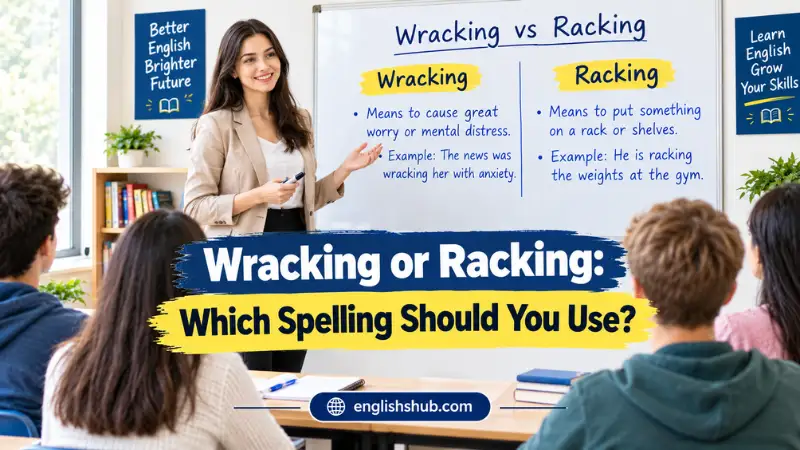
If you are unsure about wracking or racking, the safest choice depends on the phrase and meaning. In standard U.S. writing, racking is the usual choice in expressions such as racking your brain, nerve-racking, and racking up points. However, wracking is also a real word and is appropriate when the idea is ruin, destruction, or severe distress. The two forms are pronounced the same, which makes the spelling easy to confuse. The key is to look at the meaning and the phrase, not the sound alone. Modern dictionaries also recognize overlap between rack and wrack in several expressions.
Quick Answer
Use racking as the safer default for racking your brain, nerve-racking, and racking up points or debt. Use wracking when the meaning is closer to wrecking or ruining something, as in wracking a structure or describing something as storm-wracked. However, some established phrases allow both spellings, including wracking my brain and nerve-wracking.
TL;DR
- Racking is the safer choice for common strain and effort phrases.
- Wracking is strongly associated with ruin, wreckage, and destruction.
- Racking your brain is the traditional edited form.
- Nerve-racking is a safe standard choice.
- Wracking your brain is also found in edited English.
- Rack up is the correct phrase for accumulating points or debt.
Wracking or Racking at a Glance
| Context | Safer Choice | Example |
|---|---|---|
| Thinking very hard | racking | I was racking my brain. |
| Something very stressful | nerve-racking | The interview was nerve-racking. |
| Accumulating something | racking | They are racking up points. |
| Physical storage | racking | The warehouse uses steel racking. |
| Ruining or wrecking | wracking | The storm was wracking the coastline. |
| Severe emotional distress | racked/wracked | She was racked with guilt. |
| Storm damage | wracked / storm-wracked | The storm-wracked town needed repairs. |
| Fixed destruction phrase | wrack and ruin / rack and ruin | The building fell into wrack and ruin. |
The important point is that English does not give every phrase a perfectly strict rack = strain and wrack = destruction division. Merriam-Webster specifically notes that the forms have been used interchangeably in some expressions for more than a century.
What Do Rack and Wrack Mean?
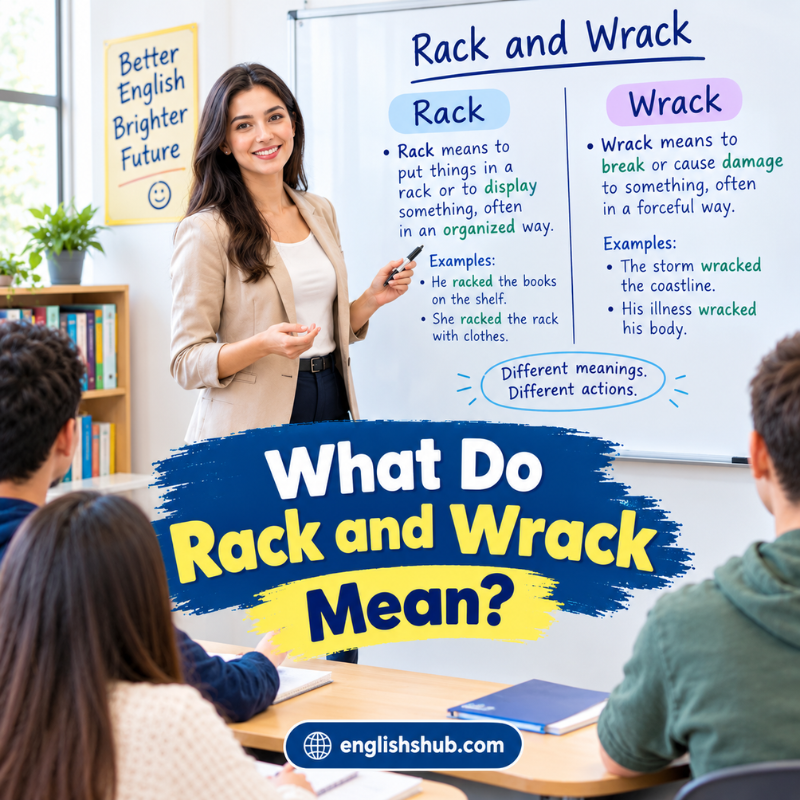
Rack and wrack began as different words, and their older meanings help explain the modern spelling distinction.
The noun rack can refer to a frame for holding things. It can also refer to an instrument of torture that stretched the body. As a verb, rack can mean to cause severe physical or mental suffering or to stretch or strain something. Merriam-Webster therefore connects rack with ideas such as pain, anguish, straining, and torment.
Wrack has a stronger historical connection with wreckage, ruin, and destruction. Merriam-Webster defines the verb wrack as “to utterly ruin” or “wreck,” while the noun can refer to ruin or destruction.
For a direct dictionary reference, see the
Merriam-Webster entry for rack and the Merriam-Webster entry for wrack.
That distinction gives you a useful starting point:
- Rack → strain, stretch, torment, accumulate, or place on a rack.
- Wrack → wreck, ruin, destroy, or cause severe devastation.
Still, modern usage has blurred the boundary in several familiar phrases.
Is “Racking” the Safer Choice?
Yes. When you need a general-purpose choice in U.S. writing, racking is usually the safer form for the common phrases connected with thinking, nerves, strain, and accumulation.
For example:
I spent an hour racking my brain for the answer.
The final exam was nerve-racking.
The team is racking up points.
She was racked with guilt after the argument.
The connection is easy to remember. Rack has a long-established figurative sense involving stretching, straining, or tormenting. Cambridge also lists rack as a verb meaning to cause great physical or mental pain and gives rack your brain as an established idiom.
If you are writing a school assignment, professional document, or general American-English article and you are uncertain, choosing racking in these familiar phrases is unlikely to cause a problem.
The important exception is that wracking has become established in some of the same expressions. That means you should not treat every occurrence of wracking as an automatic spelling error.
When Is “Wracking” Correct?
Wracking is appropriate when it is the verb form of wrack, especially when the meaning involves wrecking, ruining, or causing serious destruction.
Consider these examples:
The hurricane was wracking the coastal region with powerful winds.
Years of conflict had wracked the country.
The abandoned building was wracked by fire.
The storm left a wracked landscape behind.
Here, the idea is not simply “strain.” The sentences emphasize damage, destruction, or severe disruption.
The noun wrack also appears in expressions connected with ruin and wreckage. The familiar phrase wrack and ruin has a long history, although rack and ruin is also documented. Merriam-Webster lists rack and ruin as a noun expression while also discussing wrack and ruin and the broader overlap between the two spellings.
So, when the meaning clearly points toward wreck, ruin, or destruction, wrack/wracking can be the more meaningful choice.
Racking vs. Wracking in Common Phrases
Some expressions deserve special attention because writers frequently switch the two forms.
Racking your brain
The traditional edited form is:
I am racking my brain to remember her name.
However, wracking my brain is also widely encountered. Merriam-Webster explains that both forms have appeared in edited prose for a long time.
If you want the safest conventional choice, use racking my brain.
Nerve-racking
For a stressful or anxiety-producing situation, nerve-racking is a strong default:
Giving the presentation was nerve-racking.
However, nerve-wracking is also common in modern English. Merriam-Webster and Dictionary.com both recognize the usage rather than treating it as an impossible spelling.
Racking up
Use racking up when you mean accumulating or scoring something:
The player is racking up points.
The company is racking up new orders.
He kept racking up credit-card debt.
Here, wracking up is not the normal choice. The verb rack up has its own established meaning: to accumulate or score.
Racked with pain or guilt
Both racked and wracked appear in phrases describing intense suffering:
She was racked with pain.
He was wracked with grief.
The traditional distinction would favor racked for physical or mental torment and wracked for destruction. Yet actual edited usage permits overlap. Merriam-Webster explicitly describes wracked with pain as a long-established and widely accepted variant.
That is why context and conventional phrase choice matter more than trying to apply a rigid rule to every sentence.
Why Are the Two Spellings So Confusing?
The biggest reason is pronunciation. Rack and wrack are both pronounced approximately /ræk/. The w in wrack is silent.
That means these phrases sound alike when spoken:
- racking my brain
- wracking my brain
- nerve-racking
- nerve-wracking
A listener cannot reliably tell you which spelling the writer intended.
Meaning does not always solve the problem either. Stress, pain, torment, and destruction can overlap. A person who is extremely stressed may feel mentally “strained,” while another writer may describe the same experience as mentally “wrecked.”
This overlap explains why both spellings continue to appear in established expressions. Merriam-Webster notes that rack and wrack have been used interchangeably in phrases such as rack/wrack one’s brain and nerve-racking/nerve-wracking since the late 19th century.
So do not rely on pronunciation. Use the phrase and intended meaning as your guide.
Synonyms, Near-Synonyms, and Contrasts
The two words connect to different groups of related vocabulary.
For rack, useful near-synonyms include:
- strain — put pressure on something
- torment — cause repeated or severe suffering
- afflict — cause pain, trouble, or distress
- torture — cause extreme suffering
- stress — place pressure on someone or something
For wrack, the strongest related words include:
- wreck — damage severely
- ruin — destroy the usefulness or condition of something
- destroy — cause something to cease to exist or function
- devastate — cause widespread or severe destruction
These are not perfect substitutes.
For example:
The difficult decision strained her patience.
You would not normally replace strained with wrecked.
Likewise:
The hurricane devastated the town.
Here, tormented would change the meaning because the sentence focuses on physical destruction.
The distinction is useful because it gives you a semantic test. If the sentence means strain or torment, rack is a strong traditional choice. If it means wreck or ruin, wrack may fit better.
Merriam-Webster’s entries support these different synonym groups for rack and wrack.
A Simple Rule for Choosing the Right Form
When you are unsure, use this four-step test.
Step 1: Check for a fixed phrase.
If you see rack up, use rack.
If you mean “think very hard,” rack your brain is the safest conventional form.
If you mean something is extremely stressful, nerve-racking is a strong default.
Step 2: Ask whether the sentence means strain or ruin.
- Strain, torment, or accumulation → rack
- Wreck, ruin, or destruction → wrack
Step 3: Check whether modern usage allows both.
Expressions such as wracking my brain, nerve-wracking, and wracked with pain have established usage. You do not need to “correct” every occurrence automatically.
Step 4: Choose consistency for formal writing.
If you want the least controversial form, use racking in the conventional brain, nerve, and up expressions. Reserve wracking for contexts where the destructive sense is clear.
This approach is more reliable than memorizing a rule that claims the two words can never overlap.
Common Mistakes and Corrections
| Incorrect or Less-Safe Form | Better Choice | Reason |
|---|---|---|
| I was wracking my brain for the answer. | I was racking my brain for the answer. | Racking is the safer conventional form. |
| We are wracking up points. | We are racking up points. | The fixed phrase is rack up. |
| The interview was wrack-racking. | The interview was nerve-racking. | Nerve-racking is the established expression. |
| The storm racked the coastline. | The storm wracked the coastline. | Wrack strongly fits destruction and damage. |
| She was racked with guilt. | She was racked with guilt. | This is an established use of rack. |
| The region was wracked by conflict. | The region was wracked by conflict. | Wrack naturally emphasizes severe disruption or devastation. |
| The warehouse installed metal wracking. | The warehouse installed metal racking. | Storage structures come from rack. |
| The old town fell into wrack and ruin. | Wrack and ruin is possible; rack and ruin is also established. | Both expressions have documented usage. |
One particularly important correction is racking up. Because wrack can mean “wreck,” writers sometimes assume that wrack up should work whenever something becomes severe. It does not. The established verb phrase for accumulating something is rack up.
For another English word-choice example involving a form that looks plausible but changes meaning, see
Therefor or Therefore: Clear Rules and Simple Examples.
Similarly, the distinction between standard and specialized forms is useful when learning pairs such as
Ruff or Rough: Meaning, Difference, and Correct Use.
FAQs
No. Wracking my brain is an established variant. However, racking my brain is the safer traditional choice when you mean thinking very hard. Merriam-Webster notes that both forms occur in edited prose.
Both forms are used. Nerve-racking is a strong conventional choice, while nerve-wracking is also widely used. For conservative formal writing, nerve-racking is the safer default.
Yes. Wracking is the present participle of wrack. The verb wrack can mean to ruin, wreck, or destroy. It also appears as a variant of rack in several expressions.
Write racking up when you mean accumulating or scoring something. For example, “The team is racking up wins.” Wracking up is not the standard form of this phrase.
No. Rack and wrack are pronounced the same way in standard U.S. English. Because the w in wrack is silent, you must use context and phrase knowledge to choose the spelling.
When you want the safest conventional choice, use racking for racking your brain, nerve-racking, and racking up. Use wracking when the meaning clearly involves wrecking, ruining, or severe destruction.
Test Your Understanding
- Which sentence uses the safest conventional spelling?
A. I was wracking my brain for the answer.
B. I was racking my brain for the answer.
C. I was wrecking my brain for the answer.
D. I was rackking my brain for the answer.
- Which phrase correctly means “accumulating points”?
A. wracking up points
B. wrecking up points
C. racking up points
D. wracking points up
- Which sentence best fits the destructive sense of wrack?
A. I was wracking my brain for a solution.
B. The team was racking up victories.
C. The hurricane wracked the coastline.
D. She was racking the billiard balls.
- Which statement about nerve-wracking is most accurate?
A. It is always a spelling error.
B. It is never used in edited English.
C. It is an established variant, although nerve-racking is a strong conventional choice.
D. It means something different from nerve-racking.
- Why are rack and wrack easy to confuse?
A. They have identical spellings.
B. They have the same pronunciation in standard U.S. English.
C. They are always synonyms.
D. They are both nouns only.
Answer Key
- B — Racking my brain is the safer traditional form for thinking very hard.
- C — Rack up means to accumulate or score something.
- C — Wrack can emphasize wrecking, damaging, or destroying something.
- C — Nerve-wracking is established usage, but nerve-racking is the safer conventional choice.
- B — Both forms are pronounced /ræk/, so sound cannot distinguish them.
Conclusion
The choice between wracking or racking depends on both meaning and phrase. For standard U.S. writing, racking is the safest default in expressions such as racking your brain, nerve-racking, and racking up. Wracking is especially useful when the meaning points toward wrecking, ruin, or severe destruction. However, English allows overlap in several established phrases, so wracking my brain and nerve-wracking are not automatically errors. When proofreading, check the phrase first, then use meaning to confirm the spelling.
Related Grammar and Language Guides
Unformal or Informal: Correct Word Choice and Usage
Flys or Flies: Which Spelling Is Correct?
Therefor or Therefore: Clear Rules and Simple Examples