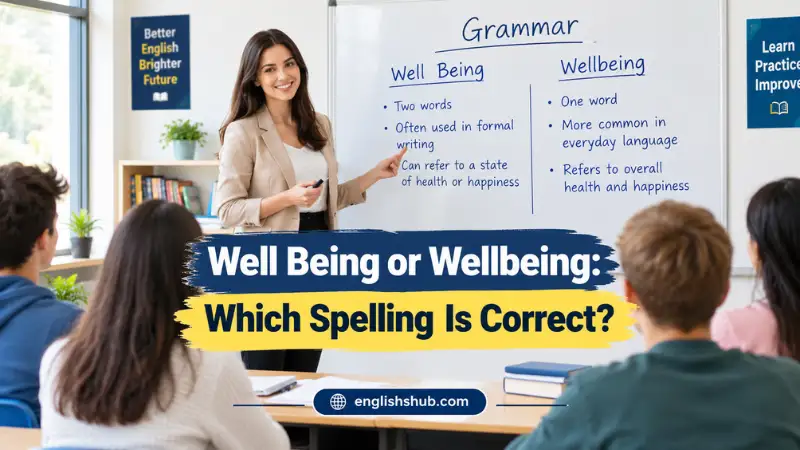
If you are choosing between well being or wellbeing, the form you will usually want in American English is well-being. Merriam-Webster lists well-being as a noun meaning the state of being happy, healthy, or prosperous, and Cambridge likewise gives well-being as its main dictionary form.
However, the story is not simply “hyphen good, one word bad.” Wellbeing is also used as a legitimate closed form by some organizations and publications. For example, Microsoft’s style guide explicitly uses wellbeing and tells its writers not to hyphenate it.
The two-word form well being is different. When you mean the noun describing a person’s welfare or overall condition, that spelling is generally not the standard choice.
Quick Answer
For well being or wellbeing, the safest standard U.S. choice is well-being. Wellbeing is also an established spelling in some styles and organizations, so it is not useful to call it universally wrong. However, well being as three separate words is normally not the noun spelling. If your employer, publication, or style guide specifically uses wellbeing, follow that house style consistently.
TL;DR
- Well-being is the safest default in American English.
- Wellbeing is an established closed-form variant in some styles.
- Well being is usually not the noun spelling.
- Well-being is an uncountable noun.
- Use phrases such as mental well-being and overall well-being.
- Follow a documented house style when it prefers wellbeing.
Well Being, Wellbeing, and Well-Being at a Glance
| Form | Standard Use | Best Advice | Example |
|---|---|---|---|
| well-being | Established noun form | Best default for U.S. writing | Her well-being matters. |
| wellbeing | Established closed variant in some styles | Use when the relevant style permits or requires it | The company promotes employee wellbeing. |
| well being | Usually not the noun spelling | Avoid for the noun meaning welfare | Her well-being matters. |
| well being as separate words | Possible when well and being have independent grammatical roles | Judge the actual sentence | She is well, being careful about her health. |
The key point is that spelling and style are related, but they are not identical. Merriam-Webster and Cambridge use the hyphenated form as their dictionary entry, while Microsoft’s own style guide deliberately uses the closed form.
What Does Well-Being Mean?
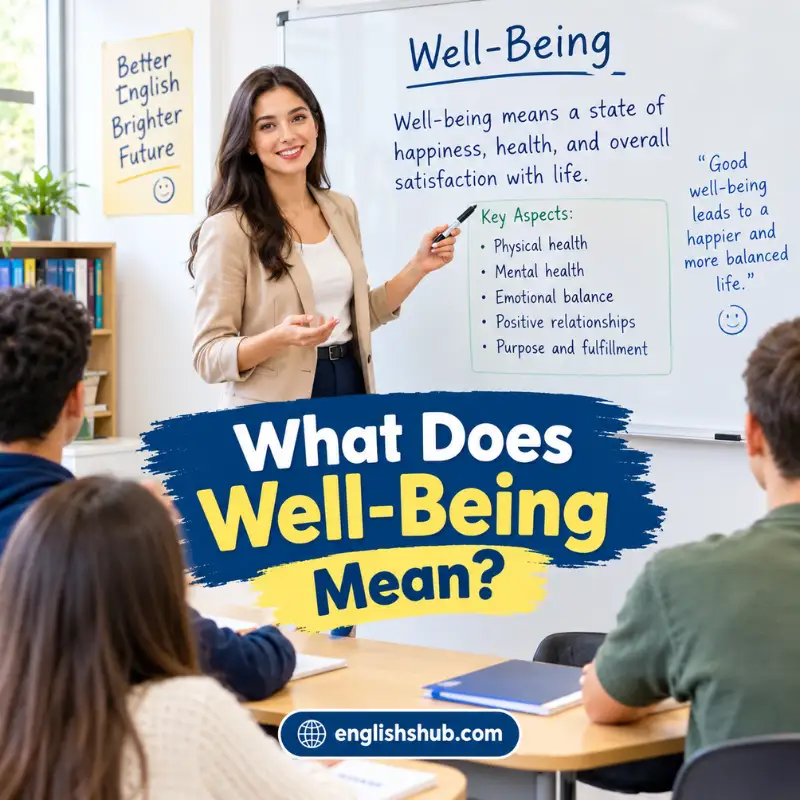
Well-being is a noun referring to a state of being healthy, happy, prosperous, or generally doing well. Merriam-Webster gives welfare as a synonym, while Cambridge defines it in terms of feeling healthy and happy.
The word is often used for a person’s overall condition rather than one narrow part of life.
For example:
- Her well-being is important to her family.
- The program focuses on employee well-being.
- Sleep can affect a person’s overall well-being.
- The school considered the students’ emotional well-being.
- The policy aims to protect the well-being of the community.
The noun is normally uncountable when it means general welfare. You usually say:
The job affected his well-being.
You would not normally say:
The job affected his well-beings.
The plural form can appear in specialized contexts when writers discuss the well-being of different individuals or groups, but ordinary general writing usually treats well-being as an uncountable noun.
Merriam-Webster records the word’s first known use as 1561, showing that this is not a recently invented expression.
Is Well-Being One Word or Two?
The answer depends on what you mean by “one word.”
Well-being is written as one hyphenated compound noun. The hyphen connects well and being so readers recognize the combination as one lexical unit.
Compare:
Exercise can improve your well-being.
Here, well-being is one noun.
But well and being can appear next to each other independently in a sentence:
She is doing well, being careful about her schedule.
In that sentence, well is not part of a noun called well-being. It is an adverb describing is doing, while being belongs to a separate construction.
That distinction matters because well being is not simply an alternative way to type the noun well-being. If you mean the established noun, use the hyphenated form or a recognized closed style such as wellbeing.
A useful test is:
If you can replace the expression with “welfare,” you probably mean the noun well-being.
For example:
The law protects the well-being of children.
You could replace it with:
The law protects the welfare of children.
That confirms the noun meaning.
Wellbeing vs. Well-Being in American English
For a general U.S. audience, well-being is the safest default.
Merriam-Webster’s U.S. dictionary entry is well-being, and Cambridge’s U.S. dictionary also presents well-being as the main form.
That makes the hyphenated form a strong choice for:
- school assignments;
- general professional writing;
- formal correspondence;
- edited articles;
- academic prose;
- general U.S. publications.
For example:
The university is committed to student well-being.
The report examines employee well-being.
The policy was designed to protect public well-being.
However, do not turn this preference into an absolute rule. A particular organization can have its own style. Microsoft’s U.S.-oriented style guide, for instance, explicitly instructs writers to use wellbeing instead of well-being.
So the practical U.S. rule is:
No house style? Choose well-being. A documented house style? Follow it.
Wellbeing in British and International English
English spelling conventions are not identical everywhere. Some British and international publications use wellbeing as a closed compound, while other dictionaries and publishers continue to use well-being.
This is why you may see both forms in edited English.
Cambridge’s main dictionary entry is well-being, but its corpus examples also show the closed spelling wellbeing in actual English usage.
Grammar references also report regional differences, although they do not always agree about which form is preferred. That disagreement is important: it shows why a simple rule such as “wellbeing is British and well-being is American” is too broad.
A better approach is:
- U.S. general writing: well-being is the safest default.
- A publication with a house style: follow its stated preference.
- British or international writing: check the publication’s style if consistency matters.
- Mixed-audience writing: well-being is a clear, widely recognized choice.
The goal is not to declare one spelling universally correct. The goal is to use the form that fits the audience and style.
When “Well Being” Is Actually Two Words
The spelling well being can occur when well and being have separate grammatical jobs.
For example:
She is well, being careful to rest when she needs to.
Here, well describes how she is, while being begins a participial phrase. The two words are adjacent, but they do not form the noun well-being.
Another example is:
He was doing well, being supported by his family.
Again, well belongs to the verb phrase was doing well. It is not part of the noun well-being.
Now compare:
His well-being improved.
This sentence refers to his general welfare. The hyphenated noun is the correct form.
The distinction is therefore grammatical, not merely visual:
| Sentence | What the words are doing |
|---|---|
| Her well-being improved. | One compound noun |
| He is doing well. | Well is an adverb |
| She is well, being careful. | Well and being have separate roles |
| The policy protects their wellbeing. | Closed compound noun under a style that permits it |
So if you are simply spelling the noun, do not write well being.
Common Phrases With Well-Being
Well-being appears naturally with many descriptive words. These combinations can help you recognize the noun in real writing.
Mental well-being
Regular breaks can support mental well-being.
Emotional well-being
The teacher considered the students’ emotional well-being.
Physical well-being
Exercise can contribute to physical well-being.
Overall well-being
The program focuses on employees’ overall well-being.
Social well-being
Strong relationships can contribute to social well-being.
Financial well-being
The course discusses financial well-being as part of long-term stability.
Student well-being
The school introduced new policies to support student well-being.
Employee well-being
The company provides resources related to employee well-being.
Notice that the word does not need to refer only to physical health. The APA Dictionary of Psychology uses well-being for a broader state involving happiness, contentment, health, outlook, and quality of life.
That broader meaning explains why well-being can naturally describe emotional, social, psychological, and other aspects of life.
Well-Being Synonyms and Near-Synonyms
The closest common synonyms include welfare, wellness, health, happiness, prosperity, and satisfaction. Merriam-Webster’s thesaurus lists several of these as related synonyms.
However, they are not interchangeable in every sentence.
Well-being vs. welfare
These words overlap strongly.
The organization cares about the well-being of its employees.
The organization cares about the welfare of its employees.
Both can work. However, welfare can also refer to assistance programs or government support, so it may carry a different association in some contexts.
Well-being vs. wellness
Wellness often suggests an active approach to maintaining or improving health and functioning.
The company offers a workplace wellness program.
Well-being is broader:
The company is concerned about employee well-being.
Well-being vs. happiness
Happiness is one part of well-being, but the words are not identical.
Financial security improved her overall well-being.
The sentence does not necessarily mean that she felt happy every moment. It refers to her broader condition.
Well-being vs. health
Health is another important part of well-being, but well-being can include more than health.
The school considered students’ physical health and emotional well-being.
A useful substitution rule is:
Use a synonym only when it preserves the specific part of the meaning you need.
Pronunciation and Word Forms
The pronunciation is the same regardless of whether a publication writes the word as well-being or wellbeing. Cambridge gives the U.S. pronunciation as approximately /ˌwelˈbiː.ɪŋ/, with stress on the second main part of the word.
The spelling changes, but the underlying lexical item remains the same.
Common forms include:
- well-being — noun
- wellbeing — closed noun variant in some styles
- well-being’s — possessive singular
- well-beings — plural in contexts where separate states of welfare are being discussed
Examples:
The patient’s well-being is the priority.
The program supports children’s well-being.
The report compares the well-beings of different groups.
The last form is much less common than the singular uncountable use, so ordinary writers will rarely need it.
The main pronunciation lesson is simple: you cannot hear the hyphen. The difference between well-being and wellbeing is written, not spoken.
Common Mistakes and an Easy Memory Rule
Mistake 1: Writing well being as the noun
Incorrect:
The school cares about student well being.
Correct:
The school cares about student well-being.
Or, under a style that uses the closed form:
The school cares about student wellbeing.
Mistake 2: Assuming wellbeing is always wrong
That is too strong.
Microsoft’s style guide explicitly uses wellbeing and tells its writers not to use well-being.
So calling wellbeing “never correct” would ignore real editorial usage.
Mistake 3: Switching forms randomly
Avoid:
The company supports employee well-being. Its wellbeing policy is updated every year.
If both sentences refer to the same noun and the same editorial context, consistency is usually better.
Choose one style and keep it consistent.
Mistake 4: Assuming every dictionary controls every publication
Dictionaries record and describe usage. A publication may have its own editorial policy.
For example, Merriam-Webster uses well-being, while Microsoft’s style guide explicitly prefers wellbeing.
Easy memory rule
For ordinary U.S. writing, remember:
Use well-being by default.
Then make one exception:
If your publication has a documented style that uses wellbeing, follow that style.
And one warning:
Do not use well being as the ordinary spelling of the noun.
That three-part rule is more reliable than memorizing an absolute “right versus wrong” claim.
FAQs
Both forms occur in edited English. Well-being is the safest default for general American English because major dictionaries such as Merriam-Webster and Cambridge use it as their main entry. However, some organizations explicitly use wellbeing as their house style.
For the noun meaning a person’s welfare or overall condition, neither the spaced form nor the hyphenated form is literally “one word.” The standard U.S. spelling is the hyphenated compound well-being. Wellbeing is a closed variant used by some styles.
Yes. Well-being is the standard dictionary form used by major U.S. reference sources. That makes it the safest choice for general American writing, although an individual publisher may choose the closed spelling wellbeing.
Yes, if the relevant publication or organization accepts or prefers it. Microsoft, for example, explicitly instructs its writers to use wellbeing. The important point is to follow the applicable house style rather than assuming one spelling governs every publication.
They overlap, but wellness often emphasizes an active state or approach to maintaining good health, while well-being is broader and can describe overall welfare, happiness, health, and quality of life. The two words are related but not perfect substitutes.
Yes. Well-being is a noun, normally used as an uncountable noun when referring to general welfare or quality of life. For example, “The policy protects employee well-being” uses well-being as the object of the verb protects.
For general U.S. writing, remember well-being. If a specific publication uses wellbeing, follow its style. Avoid well being when you simply mean the noun describing someone’s welfare.
Test Your Understanding
1. Which spelling is the safest default for general U.S. writing?
A. well being
B. wellbeing
C. well-being
D. well-being’s
2. Which sentence uses the standard noun correctly?
A. The school protects student well being.
B. The school protects student well-being.
C. The school protects student wellbeing only if every dictionary requires it.
D. The school protects student well beingness.
3. Which statement about wellbeing is most accurate?
A. It can never be used in edited English.
B. It is always preferred in American English.
C. It is an established form used by some styles and organizations.
D. It is only a spelling mistake made by English learners.
4. Which sentence contains well and being as separate words rather than the noun well-being?
A. Her well-being improved.
B. Employee well-being matters.
C. She is doing well, being careful about her schedule.
D. The policy supports their well-being.
5. Which phrase uses a natural collocation?
A. emotional well-being
B. emotional well beingness
C. emotional wellbeingness
D. emotional well-good
Answer Key
- C — well-being. Major U.S. dictionary sources use the hyphenated form as the main entry, making it the safest general choice.
- B — The school protects student well-being. Here well-being is the compound noun meaning the students’ welfare or overall condition.
- C — It is an established form used by some styles and organizations. Microsoft’s style guide is a clear example of a professional style that deliberately uses wellbeing.
- C — She is doing well, being careful about her schedule. In this sentence, well and being belong to separate grammatical constructions.
- A — emotional well-being. Emotional well-being is a natural and widely used noun phrase. Cambridge’s examples include emotional well-being among its documented collocations.
Conclusion
When choosing well being or wellbeing, use well-being as your default in general American English. It is the established hyphenated dictionary form and works naturally in formal, academic, and professional writing. Wellbeing is also legitimate in some editorial systems, so it should not be labeled universally wrong. The spaced form well being is normally not the spelling of the noun. The simplest rule is: choose well-being unless a documented house style specifically calls for wellbeing, and then use that form consistently.
Related Grammar and Language Guides
Unformal or Informal: Correct Word Choice and Usage
Therefor or Therefore: Clear Rules and Simple Examples
Ruff or Rough: Meaning, Difference, and Correct Use