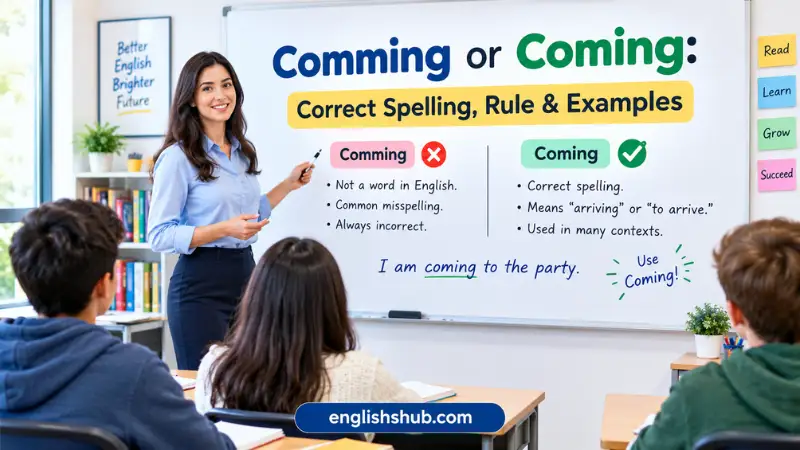
When choosing between comming or coming, write coming with one m. Comming is normally a spelling mistake in modern standard English.
Coming is formed from the verb come. To add -ing, remove the final silent e: come − e + ing = coming. You do not double the m.
The word appears in sentences about movement, arrival, approaching events, and participation. For example, “Maya is coming home,” “Winter is coming,” and “Thank you for coming” all use the same spelling. Learning the silent-e rule also makes words such as making, writing, and driving easier to spell.
Quick Answer
Coming is the correct spelling. Comming is not the standard spelling of the -ing form of come. Remove the final silent e from come, and then add -ing: come → coming. Keep only one m, as in “The bus is coming now.”
TL;DR
- Write coming with one m.
- Treat comming as a spelling error in ordinary writing.
- Form it by dropping the final e from come.
- Do not apply the consonant-doubling rule.
- American and British English both use coming.
- Coming can perform several grammatical jobs.
Comming or Coming at a Glance

| Form | Status or Function | Example |
|---|---|---|
| coming | Correct -ing form | Ava is coming with us. |
| comming | Nonstandard misspelling | Incorrect: Ava is comming with us. |
| comeing | Incorrect; final e was not dropped | Incorrect: Ava is comeing with us. |
| come | Base form and past participle | Please come inside. / They have come home. |
| came | Simple past form | Ava came yesterday. |
| cominged | Incorrect attempted past form | Incorrect: Ava cominged yesterday. |
Which Spelling Is Correct?
Coming is the standard spelling in modern English. Use it in casual messages, school assignments, business emails, news writing, and formal documents.
Correct:
- I am coming to the meeting.
- Your package is coming tomorrow.
- Thank you for coming early.
- We discussed the coming changes.
Incorrect:
- I am comming to the meeting.
- Your package is comming tomorrow.
The spelling does not change because the sentence is informal. “I’m coming soon” remains correct in a text message, just as “The director is coming shortly” is correct in a formal email.
You might occasionally see comming in a historical text, name, username, quotation, or typing error. Preserve it only when you must reproduce that original wording exactly. Otherwise, correct it to coming.
Why Coming Has One M
The base verb is come. It ends in a silent e. When most verbs ending in silent e take the suffix -ing, that e disappears.
The formation is:
come − e + ing = coming
The same basic pattern appears in:
- make → making
- write → writing
- drive → driving
- hope → hoping
- dance → dancing
Therefore, comeing is incorrect because it keeps the final e. Comming is also incorrect because it adds an unnecessary second m.
A useful memory sentence is: Drop the quiet e, keep one m, and add ing.
Why Running Doubles but Coming Does Not
Writers often produce comming because they know that some short verbs double their final consonant before -ing. For example:
- run → running
- sit → sitting
- swim → swimming
- stop → stopping
These verbs end directly in one vowel followed by one consonant. Under the standard consonant-doubling pattern, the last consonant doubles.
Come has a different written structure. It ends in silent e, so it follows the silent-e pattern instead:
- come → coming
- not come → comming
- not come → comeing
The Britannica Dictionary’s consonant-doubling guidance
explains that doubling applies to particular consonant-ending patterns. Because come ends in e, it does not enter that pattern as written.
What Does Coming Mean?
Coming often describes movement toward a person or place:
- The train is coming toward the station.
- Diego is coming home after work.
It can also describe an approaching event or period:
- Rain is coming tonight.
- We will hire more staff in the coming months.
Additionally, it can refer to attending or participating:
- Are you coming to the game?
- Thank you for coming to my graduation.
As a noun, coming can mean an arrival or approach:
- The coming of spring brought warmer days.
as the present participle of come and also records noun and adjective uses. Therefore, its precise meaning depends on its job in the sentence.
How Coming Works in Grammar
Coming as a Present Participle
A present participle is an -ing verb form. It can join a form of be to create a progressive construction:
- I am coming now.
- She was coming down the stairs.
- They will be coming later.
The helping verb carries the tense. Coming keeps the same form.
Coming as a Gerund
A gerund is an -ing form performing a noun-like job:
- Coming early gave us time to prepare.
- She enjoys coming here on weekends.
- Thank you for coming.
In the first example, the entire phrase coming early acts as the subject.
Coming as an Adjective
Coming can describe a noun by meaning “approaching” or “next”:
- the coming week
- the coming election
- the coming school year
Here, coming describes the time or event that lies ahead.
Coming as a Noun
An established noun use can mean an arrival or approach:
- The coming of winter changed our plans.
- We prepared for his coming.
This noun use often appears in the pattern the coming of + noun.
Come, Came, Come, and Coming
Come is an irregular verb, so its forms do not follow a simple -ed pattern.
| Time or Function | Correct Form | Example |
|---|---|---|
| Base form | come | Please come to my office. |
| Present with he, she, or it | comes | She comes here every Friday. |
| Simple past | came | She came here yesterday. |
| Past participle | come | She has come here before. |
| Present participle | coming | She is coming here now. |
Do not use coming as the simple past form:
- Incorrect: She coming yesterday.
- Correct: She came yesterday.
Do not create cominged:
- Incorrect: He cominged home late.
- Correct: He came home late.
The quick decision is simple: use came for a completed past action and coming for the -ing form.
Common Mistakes and Corrections
Mistake 1: Doubling the M
Incorrect: The guests are comming soon.
Correct: The guests are coming soon.
The writer added a second m even though come follows the silent-e pattern.
Mistake 2: Keeping the Final E
Incorrect: The guests are comeing soon.
Correct: The guests are coming soon.
The final e in come normally drops before -ing.
Mistake 3: Adding ED to Coming
Incorrect: The guests cominged yesterday.
Correct: The guests came yesterday.
The past tense of come is came. It is not formed by adding -ed to coming.
Mistake 4: Omitting a Helping Verb
Incorrect: She coming to class now.
Correct: She is coming to class now.
When coming forms a progressive verb phrase, it usually needs a form of be.
Pronunciation of Coming
In standard American English, coming is commonly pronounced /ˈkʌmɪŋ/, approximately KUM-ing. It has two syllables, and the first syllable receives the main stress.
records the same basic pronunciation and provides both American and British coverage.
Pronunciation cannot tell you whether to write one or two m’s. A doubled consonant does not usually create an extra consonant sound in a word such as running. Therefore, remember the written formation instead of relying only on sound:
COME − E + ING = COMING
Coming in American and British English
American English and British English both use coming. This word does not have a regional spelling pair like color/colour or aging/ageing.
Correct in American English:
- The mail is coming today.
Correct in British English:
- The post is coming today.
The vocabulary around the sentence may change by region, but the spelling of coming remains the same. Canadian and Australian standard English also use coming.
Alternatives to Coming
The best alternative depends on the meaning and grammatical function.
| Meaning of Coming | Possible Alternative | Example |
|---|---|---|
| Moving toward a place | approaching | The train is approaching. |
| Reaching a destination | arriving | The train is arriving. |
| Happening soon | upcoming | Check the upcoming events. |
| Following in time | next | We can meet next week. |
| Arrival as a noun | arrival | We awaited her arrival. |
These words are not interchangeable everywhere.
“Rosa is coming home” sounds natural, but “Rosa is upcoming home” is incorrect. Likewise, upcoming can modify a noun in “the upcoming concert,” while it cannot replace the verb phrase in “The concert is coming.”
Therefore, choose an alternative according to both meaning and grammar.
Easy Memory Trick and Three-Step Check
Remember:
One word comes in; one e goes out; one m stays.
Then use this three-step check:
- Find the base verb. Is it come?
- Remove the final silent e.
- Add -ing without doubling the m.
The result is always coming when you need the -ing form of come.
You can also compare it with home. The familiar phrase coming home contains two words that each have one m. Writing “comming home” breaks that visual pattern.
Related Spelling Patterns
English spelling changes depend on the word’s structure.
For example, laid or layed
involves an irregular past-tense form, while
depends on changing consonant-plus-y to -ies.
Other distinctions involve spaces, apostrophes, or regional forms.
Compare at least or atleast, else’s or elses,
and color or colour. Each pair requires its own rule, so one spelling pattern should not be applied to every word.
FAQs
Is comming ever correct?
Comming is not the standard modern spelling of the -ing form of come. It may appear in an old text, proper name, username, or exact quotation, but ordinary writing requires coming.
Why does coming have only one m?
Coming has one m because it is formed by removing the silent e from come and adding -ing. The consonant-doubling pattern used in running does not apply.
Is comeing a correct spelling?
No. Comeing incorrectly keeps the final silent e. Write come − e + ing = coming.
Is coming a verb or a noun?
It can serve several functions. It is a present participle in “She is coming,” a gerund in “Coming early helped,” an adjective in “the coming week,” and a noun in “the coming of spring.”
What is the past tense of coming?
The question is better expressed as “What is the past tense of come?” The answer is came: “She came yesterday.” Use was coming when describing an action that was in progress.
Should I write coming soon or comming soon?
Write coming soon. For example, “A new course is coming soon” uses the standard spelling.
Is coming spelled differently in British English?
No. Both American and British English spell the word coming. There is no accepted regional version with two m’s.
Test Your Understanding
1. Which sentence uses the correct spelling?
A. Our cousins are comming tonight.
B. Our cousins are comeing tonight.
C. Our cousins are coming tonight.
D. Our cousins are cominged tonight.
2. How is coming formed?
A. Come + m + ing
B. Come − e + ing
C. Come + ed
D. Com + m + ing
3. Which sentence uses coming as an adjective?
A. The coming week will be busy.
B. They are coming by train.
C. Coming early saved time.
D. We celebrated her coming.
4. Which sentence correctly describes a completed past action?
A. Nina coming home yesterday.
B. Nina has came home.
C. Nina cominged home yesterday.
D. Nina came home yesterday.
5. Why does running have two n’s while coming has one m?
A. All words beginning with c use one consonant.
B. The words belong to different English dialects.
C. Run follows a consonant-doubling pattern, while come drops its silent e.
D. Coming is always a noun.
Answer Key
- C. Coming is the correct -ing form of come.
- B. Remove the final silent e and add -ing.
- A. Coming modifies the noun week, so it works as an adjective.
- D. Came is the simple past form of come.
- C. The two verbs follow different spelling patterns before -ing.
Conclusion
When deciding between comming or coming, choose coming. Form it by removing the final silent e from come and adding -ing: come → coming. Do not double the m.
Use coming for movement, approaching events, attendance, and several related grammatical functions. Also remember that its simple past form is came, not cominged. The shortest memory rule is: drop the e, keep one m, and add ing.
Related Grammar and Language Guides
Laid or Layed: Correct Spelling, Rule, and Examples
Babys or Babies: Which Spelling Is Correct?
At Least or Atleast: Correct Spelling and Usage