

Choosing between aesthetic or esthetic is easier than the two spellings suggest. Both are correct in American English, and both carry the same meanings. However, aesthetic is the more familiar and widely accepted form, so it is usually the best choice for articles, school assignments, business writing, and everyday communication.
The shorter spelling esthetic is mainly an American variant. It appears most often in skincare, cosmetology, dentistry, business names, and professional course titles. Still, these fields do not give it a separate definition. The spelling changes, but the underlying word does not.
Quick Answer
Both aesthetic and esthetic are correct spellings of the same word. In modern American English, aesthetic is the safest general choice. Esthetic is a less common U.S. variant that often appears in beauty-related terminology and official names. British English normally uses aesthetic.
TL;DR
- Both spellings have the same meanings.
- Aesthetic is preferred in most American writing.
- Esthetic is a recognized U.S. variant.
- British English normally uses aesthetic.
- Both forms can work as nouns or adjectives.
- Preserve esthetic when it appears in an official name.
Aesthetic vs. Esthetic at a Glance
| Context | Best Choice | Reason | Example |
|---|---|---|---|
| General U.S. writing | Aesthetic | Most familiar spelling | The room has a modern aesthetic. |
| British English | Aesthetic | Standard British form | The sculpture has aesthetic value. |
| Academic writing | Aesthetic | Widely recognized internationally | The essay examines aesthetic theory. |
| U.S. beauty services | Either form | Both appear in the field | The clinic offers esthetic treatments. |
| Official business name | Official spelling | Names should remain accurate | Luna Esthetic Center |
| One document | One consistent form | Prevents distracting variation | Use the same form throughout. |
What Is the Difference Between Aesthetic and Esthetic?
The difference lies in spelling and regional preference, not meaning. Aesthetic is the standard international form. It is also the most familiar spelling in both American and British English.
Esthetic drops the initial a.
The Merriam-Webster entry for aesthetic
identifies it as a U.S. variant of the same adjective and noun.
Compare these sentences:
- The designer created an aesthetic balance between color and space.
- The designer created an esthetic balance between color and space.
Both sentences express the same idea. However, the first looks more natural to most readers.
Therefore, avoid treating the pair like two words with separate definitions.
Unlike loose and lose,
the choice does not change the sentence’s meaning.
Meanings and Grammar Roles
Aesthetic and esthetic can function as adjectives or nouns.
Aesthetic as an Adjective
As an adjective, the word describes something related to beauty, art, taste, sensory appeal, or appearance.
- The architect considered the building’s aesthetic impact.
- Maya chose the lamp for aesthetic reasons.
- The update made several esthetic improvements to the office.
In these examples, the word modifies impact, reasons, and improvements.
Aesthetic as a Noun
As a noun, aesthetic often means a particular style, taste, or visual identity.
- The restaurant has a warm, rustic aesthetic.
- Her photographs share a quiet, minimalist aesthetic.
- The brand changed its esthetic to appeal to younger customers.
A useful test is to replace the noun with style. If the sentence still makes sense, the noun use is probably correct.
Aesthetic or Esthetic in American and British English
American English accepts both spellings. Nevertheless, American writers usually choose aesthetic in general, academic, artistic, and business contexts.
British English strongly favors aesthetic. The spelling esthetic may seem distinctly American or unusual to British readers. Therefore, use aesthetic when writing for an international audience.
This pair does not follow a strict pattern such as colour/color. Americans regularly write aesthetic, so it is inaccurate to label it exclusively British.
Use these audience rules:
- American audience: Prefer aesthetic, although esthetic remains valid.
- British audience: Use aesthetic.
- International audience: Use aesthetic.
- Organization with a house style: Follow its preferred spelling.
A similar regional choice appears in
acknowledgement or acknowledgment,
though the preferred forms differ.
Are Aesthetic and Esthetic Pronounced Differently?
The two spellings normally have the same pronunciation. In standard American speech, both are commonly pronounced approximately es-THET-ik, with stress on the second syllable.
Merriam-Webster gives the pronunciation as /es-ˈthe-tik/ and also records an initial vowel variation in American speech. British pronunciation may begin with a longer vowel sound.
Because both spellings sound alike, pronunciation cannot help you choose between them. Instead, consider your audience and the official terminology you need to preserve.
Both words begin with a vowel sound. Therefore, write:
- Correct: an aesthetic choice
- Correct: an esthetic treatment
- Incorrect: a aesthetic choice
Aesthetics, Esthetics, and Other Word Forms
The word family follows the same spelling pattern:
| Form | More Common Spelling | Recognized Variant | Example |
|---|---|---|---|
| Adjective or noun | aesthetic | esthetic | The room has a calm aesthetic. |
| Plural or field of study | aesthetics | esthetics | She studies aesthetics. |
| Adverb | aesthetically | esthetically | The colors work aesthetically. |
| Profession | aesthetician | esthetician | He trained as an esthetician. |
Aesthetics can refer to the artistic qualities of something or to the branch of philosophy that studies beauty, art, and taste. Although it ends in -s, the academic subject can take a singular verb:
- Aesthetics is an important branch of philosophy.
When the word refers to several visual qualities, plural agreement may fit:
- The competing designs’ aesthetics are very different.
Context determines whether the form acts as singular or plural.
Aesthetic or Esthetic in Beauty and Skincare
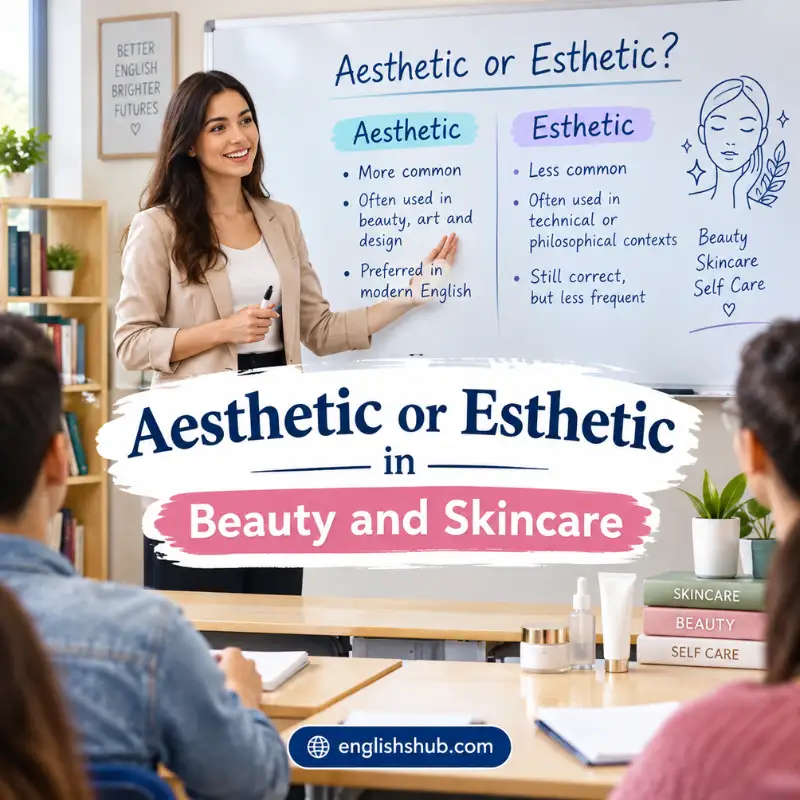
Both spellings appear in American beauty and appearance-related fields. For example, businesses may advertise aesthetic services, esthetic treatments, or medical aesthetics.
However, esthetic does not mean “skincare” while aesthetic means “art.” They remain spelling variants. The shorter form simply appears more often in some American training programs, licenses, and business names.
The Merriam-Webster definition of aesthetician
recognizes esthetician as a variant. It defines the occupation as a licensed provider of cosmetic skincare treatments and services.
Follow the official wording when referring to a specific name:
- Correct: She attends the Northern School of Esthetics.
- Inaccurate: She attends the Northern School of Aesthetics.
Changing an official name can create a factual error, even when both ordinary spellings are valid.
Modern Uses of “Aesthetic”
In contemporary conversation and online writing, the noun aesthetic often refers to a recognizable personal or visual style.
- The café has a 1950s aesthetic.
- Neutral colors are part of his design aesthetic.
- Her page combines a vintage aesthetic with modern photography.
- That outfit fits your aesthetic.
The expression my aesthetic means “my preferred style or visual identity.” Meanwhile, that’s aesthetic informally means that something looks stylish, attractive, or consistent with a particular visual theme.
This use is broader than simple beauty. An aesthetic can be dark, playful, rough, futuristic, nostalgic, or intentionally plain. Therefore, beautiful cannot replace aesthetic in every sentence.
Where the Word Came From
English adopted aesthetic through European philosophical language. Its deeper source is Greek aisthētikos, which relates to perception through the senses.
The Online Etymology Dictionary’s history of aesthetic
traces the English form through German and French to the Greek source. The word first had a close connection with sensory perception. Later, it became strongly associated with art, beauty, and taste.
The unusual opening ae reflects that history. American English later developed the shorter form esthetic, but the older spelling remained common. That is why American usage accepts both instead of replacing aesthetic completely.
Synonyms, Near-Synonyms, and Opposites
Possible alternatives depend on the intended meaning.
| Word | Relationship | Best Context |
|---|---|---|
| artistic | Near-synonym | Art, creativity, or skilled design |
| attractive | Near-synonym | Pleasing appearance |
| visual | Related term | Something perceived through sight |
| stylish | Near-synonym | Fashionable appearance |
| tasteful | Near-synonym | Good judgment in design |
| unattractive | Contextual opposite | Lacking visual appeal |
| ugly | Strong contextual opposite | Visually unpleasant |
| unaesthetic | Direct but uncommon opposite | Not aesthetically pleasing |
These words are not always interchangeable. Consider:
- The museum studies aesthetic theory.
- The museum studies attractive theory.
The second sentence fails because attractive means pleasing, while aesthetic can describe a field concerned with art, perception, and beauty.
Similarly, an artistic person creates or understands art. An aesthetic person is possible but less natural unless the context concerns sensitivity to beauty or appearance.
Common Aesthetic or Esthetic Mistakes
Calling Esthetic a Misspelling
Incorrect claim: Esthetic is not a word.
Correction: Esthetic is a recognized American variant, although it is less common.
Calling Aesthetic Exclusively British
Incorrect claim: Americans should always write esthetic.
Correction: American English accepts both, and aesthetic is usually the safer choice.
Assigning Different Meanings
Incorrect claim: Aesthetic concerns art, but esthetic concerns skincare.
Correction: The words share the same meanings. Industry preferences do not create separate definitions.
Mixing Forms Without a Reason
Inconsistent: The course covers aesthetic theory and esthetic principles.
Consistent: The course covers aesthetic theory and aesthetic principles.
Switching can be appropriate when preserving a name: “The article discusses aesthetic design at the Metro Esthetic Center.”
Confusing Aesthetic With Ascetic
Aesthetic relates to beauty, art, or sensory appeal. Ascetic describes severe self-discipline or a life without ordinary comforts. They are different words despite their similar appearance.
How to Choose the Correct Spelling
Use this three-step process.
- Identify your audience.
Choose aesthetic for British, international, academic, or general American readers. - Check for an official spelling.
Preserve esthetic in a company name, license, course, quotation, or professional title that uses it. - Stay consistent.
If no official name controls the choice, select one spelling and use it throughout the document.
The simplest memory rule is:
When unsure, choose aesthetic. Use esthetic when a specific American name or style requires it.
Meaning-based tests help with pairs such as
Here, however, audience and consistency matter more because both forms carry the same meaning.
FAQs
Both spellings are correct in American English. However, aesthetic is more familiar and works across more contexts. Use esthetic when it matches an official name, professional term, or established house style.
Aesthetic is the standard British spelling, but it is not exclusively British. American writers also use it widely. Esthetic is the form mainly limited to American English.
Choose aesthetics for general, academic, artistic, or international writing. Esthetics remains acceptable in American English, especially in beauty training and related professional contexts.
Both forms are recognized. Aesthetician is the broader spelling, while esthetician appears frequently in the American skincare profession. Follow the spelling used by the relevant licensing body, school, employer, or individual.
Yes, the expression occurs in informal conversation and online writing. It generally means “That looks stylish” or “That fits a recognizable visual theme.” In formal prose, a more precise description may sound better.
No. They are spelling variants of the same adjective and noun. Their meanings, grammar roles, and usual pronunciations remain the same.
Write an aesthetic because the word begins with a vowel sound. The same rule gives an esthetic treatment. The article depends on pronunciation, not the first written letter alone.
Test Your Understanding
- Which spelling is the safest choice for a general American article?
A. Estetick
B. Esthetical
C. Aesthetic
D. Ascetic
- Which statement is accurate?
A. Esthetic is always incorrect.
B. Aesthetic and esthetic have different meanings.
C. Aesthetic is used only in Britain.
D. Esthetic is a recognized American variant.
- Which sentence uses the correct article?
A. She made a aesthetic choice.
B. She made an aesthetic choice.
C. She made the aesthetic choice because every choice needs the.
D. She made some an aesthetic choice.
- Which sentence correctly preserves an official name?
A. The Metro Esthetic Center changed its schedule.
B. The Metro Aesthetic Center changed its schedule, although its legal name uses Esthetic.
C. The Metro Ascetic Center changed its schedule.
D. The Metro Estetick Center changed its schedule.
- What does aesthetic mean in “The apartment has a minimalist aesthetic”?
A. A strict religious practice
B. A medical diagnosis
C. A visual style
D. A spelling error
Answer Key
- C. Aesthetic is the most familiar general spelling in American English.
- D. Dictionaries recognize esthetic as a U.S. variant of aesthetic.
- B. The vowel sound at the beginning requires the article an.
- A. Writers should preserve the verified spelling of an official name.
- C. Here, the noun aesthetic refers to the apartment’s visual style.
Conclusion
Both options in aesthetic or esthetic are correct, and the spelling does not change the meaning. For most American, British, academic, and international writing, choose aesthetic. Use esthetic when it matches an official name, professional label, or established American house style. Above all, keep your choice consistent. If uncertainty remains, the form with the opening a is the safest default.
Related Grammar and Language Guides
Acknowledgement or Acknowledgment: Which Is Correct?
Fourth or Forth: Simple Difference and Clear Examples
Loose or Lose: Meaning, Difference, and Examples


[…] aesthetic or esthetic, […]
[…] aesthetic or esthetic, […]