

Choosing between censored or sensored depends on the intended meaning, but censored is correct in most everyday sentences. Use it when words, images, information, or other material has been hidden, removed, muted, or restricted.
Sensored has a different and much narrower use. It can describe a machine or control system that uses sensors, especially in technical writing. However, it does not mean that content was blocked. You may also need sensed if something detected or perceived a change.
Quick Answer
Use censored for content that has been removed, hidden, muted, or restricted. Use sensored only in specialized technical contexts for equipment operating with sensors; sensor-equipped is usually clearer in general writing. If a device detected something, the correct past-tense verb is normally sensed, not sensored.
Key Takeaways
- Censored describes restricted or altered content.
- Sensored can describe equipment that uses sensor feedback.
- Sensed means detected, noticed, or perceived.
- Sensor-equipped is clearer than sensored for general readers.
- The words sound alike but are not interchangeable.
Censored, Sensored, Sensor, and Sensed at a Glance
| Word | Meaning | Grammatical Role | Typical Context | Example |
|---|---|---|---|---|
| censored | Removed, hidden, or restricted | Past-tense verb or participial adjective | Media, speech, documents | The station censored the interview. |
| sensored | Operating with or equipped with sensors | Specialized technical adjective | Motors and control systems | The controller supports sensored operation. |
| sensor | A device that detects or measures something | Countable noun | Electronics and measurement | The sensor detected smoke. |
| sensed | Detected, noticed, or perceived | Past tense of sense | Devices or human perception | The camera sensed movement. |
| sensor-equipped | Fitted with one or more sensors | Compound adjective | Clear general or technical prose | A sensor-equipped door opens automatically. |
| sensorless | Operating without a physical sensor | Technical adjective | Motor-control engineering | The motor can run in sensorless mode. |
Censored or Sensored: What Is the Main Difference?
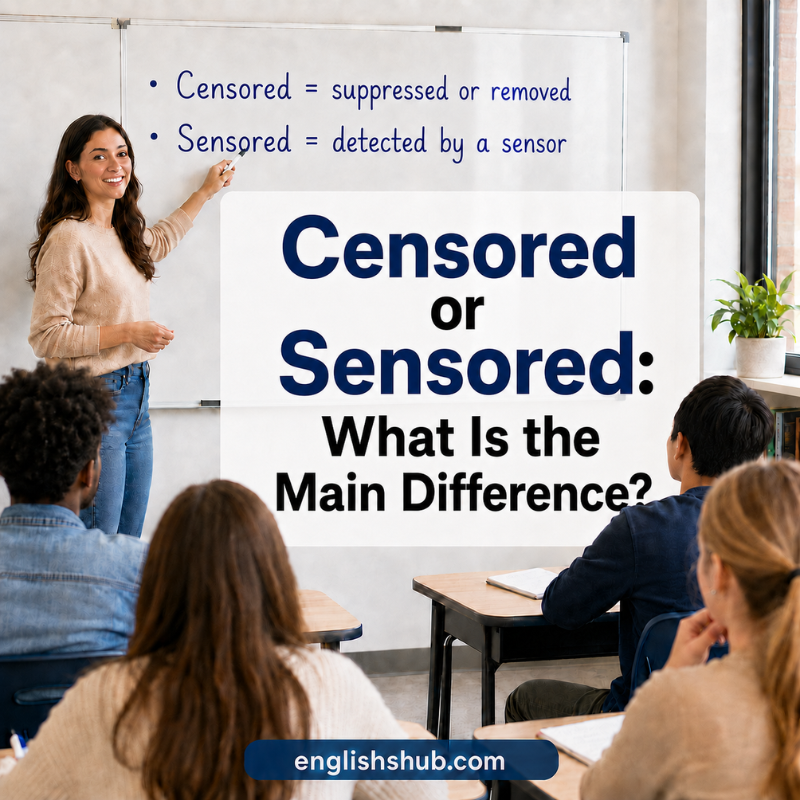
The central difference is restriction versus detection equipment. Censored comes from censor, a verb meaning to examine material and suppress or remove parts considered objectionable or sensitive. Therefore, a censored movie, message, photograph, report, or website has had material restricted.
Sensored is built from the noun sensor. It appears mainly as a specialist adjective for a system that relies on physical sensor feedback. For example, engineers may compare a sensored motor-control method with a sensorless method.
A simple subject check resolves most cases:
- Content being restricted: use censored.
- Equipment fitted with sensors: use sensored or sensor-equipped.
- Something detecting a change: use sensed or detected.
The words belong to different meaning families despite their similar pronunciation.
What Does Censored Mean?
Censored is the past tense and past participle of the verb censor.
The Merriam-Webster definition of censor
describes the verb as examining something to suppress or delete material considered objectionable. That definition explains why the word commonly appears with speech, news, movies, books, images, and confidential records.
As a past-tense verb, it names a completed action:
- The network censored several words.
- Officials censored parts of the document.
It can also work as a participial adjective:
- Viewers saw a censored version.
- The archive released censored records.
The word does not always reveal who imposed the restriction or why. A government, publisher, broadcaster, online platform, employer, or individual could be responsible. If the agent matters, identify it in the sentence rather than relying on the word alone.
Is Sensored a Real Word?
Sensored is a documented specialist formation, although it remains uncommon in everyday American English. It usually means operating with sensors or using sensor feedback. Engineers may contrast sensored control with sensorless control, particularly when discussing electric motors.
Published engineering literature demonstrates that the term is not automatically a spelling error.
For example, an IEEE paper on motor-control fault detection
discusses a transition from sensored to sensorless control. This usage matters because it disproves the broad claim that sensored can never be correct.
However, grammatical possibility does not guarantee clear style. Outside an established technical context, these alternatives usually sound more natural:
- sensor-equipped machine
- system fitted with sensors
- sensor-controlled motor
- sensor-based operation
- device monitored by sensors
Never use sensored to describe hidden profanity, blurred pictures, removed scenes, blocked posts, or redacted information. Those things are censored.
Sensored vs. Sensed
Sensed is the word you need when a person, animal, or device detected or perceived something. It is the standard past-tense form of the verb sense.
Correct examples include:
- The alarm sensed movement.
- She sensed a change in his mood.
- The thermostat sensed a drop in temperature.
- The robot sensed an obstacle ahead.
By contrast, sensored does not normally name the act of detecting something. It describes a technical configuration:
- Awkward or incorrect: The camera sensored motion.
- Correct: The camera sensed motion.
- Correct: The camera’s sensor detected motion.
- Possible but less natural: The sensored camera system recorded the event.
- Clearer: The sensor-equipped camera system recorded the event.
This distinction separates an action from a feature. Sensed reports what happened, while sensored describes how certain equipment is configured.
Grammar and Pronunciation
Censored and sensored can sound the same in ordinary American pronunciation. The base words censor and sensor are homophones for many speakers, so listening alone may not reveal the intended spelling.
Their grammar and meanings provide better clues:
- Censor can be a noun or verb.
- Censored can be a past-tense verb or participial adjective.
- Sensor is normally a countable noun.
- Sensored is a specialized adjective formed from that noun.
- Sense is a noun or verb.
- Sensed is the ordinary past-tense and participial form of sense.
A sensor is a device that detects or measures a physical property.
The National Institute of Standards and Technology’s sensor glossary
gives examples such as speed, temperature, and flow. That technical definition helps separate a sensor’s measuring function from a censor’s role in suppressing information.
Correct Examples in Different Contexts
The noun following the disputed word often reveals the correct choice.
Media and entertainment
- The broadcaster censored the offensive language.
- We watched a censored version of the film.
- Several images were censored before publication.
- The lyrics sounded different on the censored recording.
All these examples involve communication or content that someone altered or restricted.
Documents and online content
- Sensitive names were censored in the public report.
- The forum allegedly censored her comment.
- A censored copy of the letter appeared online.
- The photograph was censored to protect the child’s identity.
Depending on the exact editing method, redacted, blurred, muted, removed, or moderated may provide greater precision.
Technology and engineering
- The motor supports both sensored and sensorless control.
- The engineer tested the drive in sensored mode.
- A sensor-equipped gate opened as the vehicle approached.
- The device’s temperature sensor triggered an alarm.
The Cambridge English Dictionary entry for sensor
defines it as a device that records a presence or change. Consequently, technical writing should connect sensor language with detection, measurement, or feedback rather than content restriction.
Common Mistakes and Corrections
The most frequent error is writing sensored when censored is intended.
- Incorrect: The movie was sensored for television.
Correct: The movie was censored for television. - Incorrect: Her account was sensored after the post.
Correct: Her post was censored or removed. - Incorrect: The report contained sensored information.
Correct: The report contained censored information.
Another mistake is using sensored instead of sensed:
- Incorrect: The detector sensored smoke.
- Correct: The detector sensed smoke.
- More precise: The smoke sensor detected smoke particles.
Finally, avoid replacing every form with censored. A sensor-equipped device has not necessarily restricted anything:
- Incorrect: The censored door opened automatically.
- Correct: The sensor-equipped door opened automatically.
Spell-checking software may not flag these errors because each form can appear in written English. Proofread for meaning, not spelling alone.
A Three-Question Test for Choosing the Right Word
Use this decision process whenever the spelling remains unclear:
- Was content hidden, removed, muted, or restricted?
Choose censored. Common objects include a book, comment, movie, image, speech, report, website, or broadcast. - Is equipment being described as using sensors?
In a recognized technical context, sensored may be acceptable. For a broad audience, choose sensor-equipped, sensor-controlled, or sensor-based. - Did someone or something detect or perceive a condition?
Choose sensed. You can also use a more specific verb such as detected, measured, noticed, or recognized.
This framework is more reliable than pronunciation. It tests what the sentence actually says and selects the word from the correct meaning family.
Easy Ways to Remember the Difference
Connect each spelling with its base word:
- Censored → censor → content control
- Sensored → sensor → sensor-equipped
- Sensed → sense → detected or perceived
The opening letters also provide a useful clue. The c in censored can remind you of content control. Meanwhile, sensored visibly contains the complete word sensor.
However, do not let the memory aid erase the usage distinction. Sensored remains a narrow technical term, not the usual verb for detection. If the sentence says that a device noticed a change, write sensed or detected. If it describes the device’s hardware, sensor-equipped will often be the clearest choice.
FAQs
Sensored can be correct in specialized technical writing. Engineers sometimes use it for equipment or control methods that rely on physical sensors, especially when contrasting them with sensorless systems. In general prose, sensor-equipped or sensor-based is usually clearer.
Write censored content when words, images, scenes, or information have been hidden, altered, blocked, or removed. Sensored content would suggest a connection with detection devices, which is not the intended meaning in ordinary discussions of media or communication.
The correct word is censored. A television station may mute profanity, blur an image, remove a scene, or otherwise alter material before broadcast. Those actions restrict content; they do not equip the program with a sensor.
Not normally. Sensor is chiefly a noun, while sensored functions as a specialized adjective in expressions such as sensored control. When a device detects something, use sensed or detected: “The alarm sensed movement.”
They are generally pronounced alike in American English because censor and sensor are homophones for most speakers. Context and meaning determine the spelling. Use censored for restricted information and technical sensored for systems operating with sensors.
Censored broadly indicates that material was suppressed, restricted, or altered. Redacted more specifically means that selected information was obscured or removed from a document before release. Therefore, a redacted document is altered, but redacted often describes the exact method more precisely.
Conclusion
When choosing between censored or sensored, use censored for restricted speech, media, documents, images, and other content. Sensored is possible in narrow engineering contexts, particularly when a system using sensor feedback is contrasted with a sensorless one.
For most general readers, sensor-equipped is clearer than sensored. Meanwhile, use sensed when a person or device detected something. Checking whether the sentence concerns restriction, equipment, or detection will lead you to the correct word.