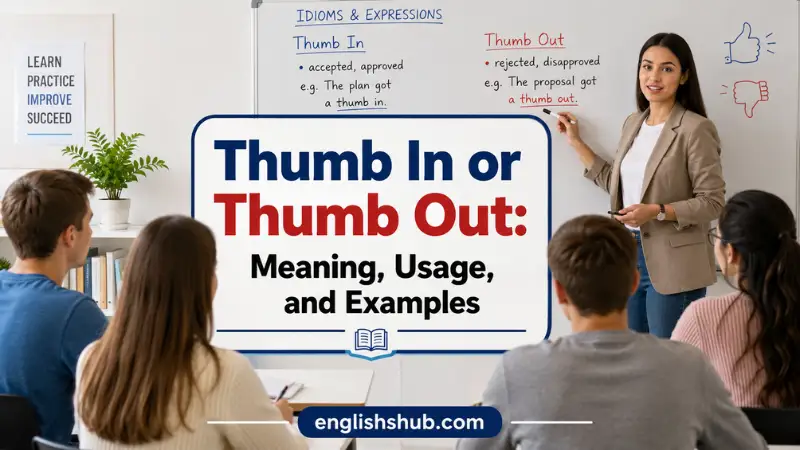
Choosing thumb in or thumb out is a question of meaning, not a contest between correct and incorrect English. Both expressions can describe a thumb’s position. The surrounding words tell readers what the thumb is inside, outside, or moving toward.
For example, “Keep your thumb in your pocket” and “Leave your thumb out of your pocket” are both grammatical. However, they describe different positions. Without that reference point, a short instruction may leave readers guessing. A drawing or earlier sentence can supply the missing information, but an isolated caption may not.
This guide explains the English wording, not which hand position to use for a sport or exercise. It also separates literal placement from expressions such as thumbs-up, which can communicate approval.
Quick Answer
Use thumb in or thumb out according to the position you mean; neither is automatically wrong. In can indicate an inside position, while out can indicate an outside position. Name the reference point when readers might be unsure. For approval, use thumbs-up rather than assuming thumb out carries that meaning.
TL;DR
- Name the boundary: a pocket, a sleeve, or the edge of a picture.
- Distinguish being inside something from moving inward.
- Short labels work when the surrounding context supplies the missing words.
- Use thumbs-up for approval, not merely for an outward position.
- Treat unclear wording differently from a grammar error.
Thumb In and Thumb Out at a Glance
| Intended meaning | Clear wording | What supplies the context? |
|---|---|---|
| Inside a pocket | “Her thumb stayed in her pocket.” | The pocket’s opening |
| Outside a sleeve | “His thumb poked out of the sleeve.” | The sleeve |
| Moving toward the palm | “The drawing shows the thumb moving inward toward the palm.” | The stated direction |
| Not included in a picture | “Keep your thumb out of the picture.” | The picture’s boundary |
What Does Thumb In Mean?
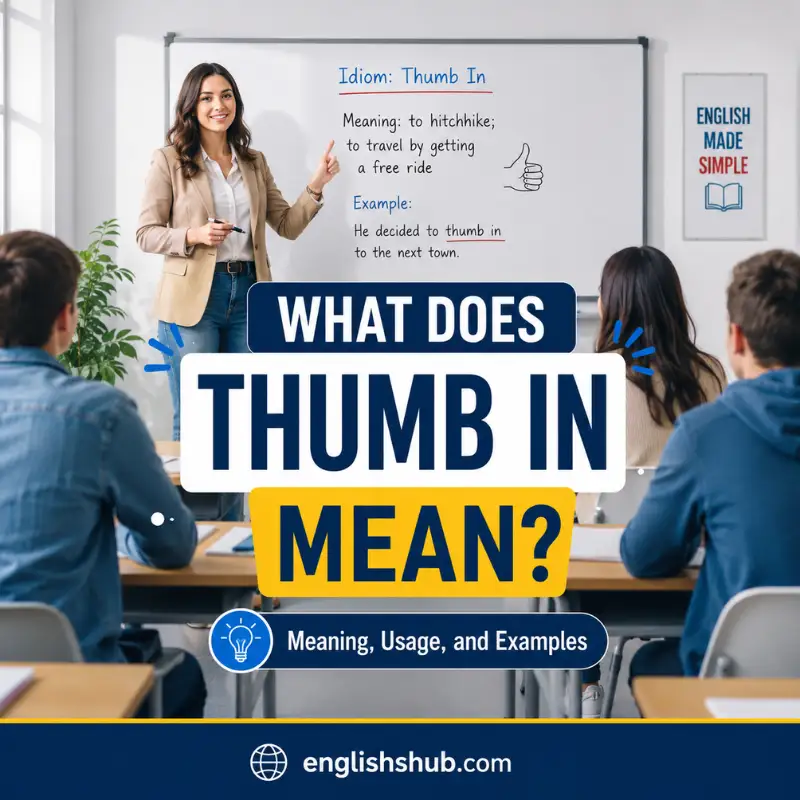
Thumb in can describe a thumb inside something or, in a suitable context, tucked inward. However, the words alone do not identify the boundary. Merriam-Webster’s entry for in includes senses involving location within limits and movement toward the inside. These help explain the following examples.
“Nora left her thumb in her coat pocket.”
Here, in describes location. It does not tell us whether Nora bent her thumb toward her palm. Compare “The artist drew the thumb tucked inward toward the palm.” This version describes the hand’s shape instead.
Now consider “Keep your thumb in position while I finish the sketch.” The expression in position means in the intended place. It does not necessarily mean inside anything or bent inward. The thumb could be pointing outward and still be in position.
Therefore, read the whole phrase after thumb. Adjacent words do not always form a separate expression with one fixed meaning.
What Does Thumb Out Mean?
Thumb out can describe a thumb outside a boundary or extending away from the hand. Again, the rest of the sentence determines the meaning. Merriam-Webster’s entry for out includes outward direction and movement away from an inside or central position.
“A thumb stuck out through the hole in the mitten.”
In this example, the mitten supplies the boundary, and the thumb projects through it. By contrast, “Keep your thumb out of the photo” asks for the thumb to remain outside the picture’s visible area.
That second example matters: out does not always mean “visible.” Something outside a camera’s frame will not appear in the resulting picture.
Similarly, “The illustrator drew the thumb pointing outward” describes direction. It does not tell us whether the hand signals approval. Add the detail your reader needs instead of making out carry several meanings at once.
Are Thumb In and Thumb Out Complete Sentences?
On their own, thumb in and thumb out are usually short labels or shortened instructions, not complete standard sentences. They can still be natural in a conversation or beside a drawing.
Compare these versions:
- Label: “Thumb in.”
- Complete instruction: “Tuck your thumb in.”
- Complete statement: “Your thumb is inside your pocket.”
The instruction has a verb, tuck. Its subject, you, is understood, as it often is in commands. The noun phrase your thumb names what the action affects. That makes it the direct object.
explains another choice where recognizing a direct object helps.
In “Keep your thumb in your pocket,” in introduces a prepositional phrase naming the location. In “Keep your thumb in,” traditional grammar calls standalone in an adverb; the context supplies the location.
For written instructions, expand a short label if readers cannot see what you mean. Informal does not automatically mean incorrect, but missing context can make otherwise natural wording unclear.
Thumb In or Thumb Out: A Three-Question Check
Choose the wording by answering three questions.
- Relative to what? Identify the pocket, sleeve, palm, frame, or other reference point.
- Location or movement? Use wording such as “is inside” for location and “moves inward” for direction.
- Position or message? Describe placement literally; name approval directly if that is the intended message.
For a clothing description, “Her thumb rests inside the pocket” answers the first two questions. For a picture-editing note, “Move the thumb outside the cropped area” describes movement relative to an image boundary.
Neither sentence establishes a universal rule about hand position. Instead, each makes the intended relationship clear.
This habit also helps with short-word comparisons such as
examine the whole construction, not just two neighboring words. Before changing in to out, check whether the change preserves the writer’s meaning.
Thumb Out Is Not the Same as Thumbs-Up
Thumbs-up expresses approval or encouragement; thumb out can simply describe placement. Merriam-Webster records the approval meaning in its entry for
Compare these original examples:
- “Eli gave the revised poster a thumbs-up.”
- “Eli’s thumb extended out beyond the edge of the paper.”
The first sentence communicates a positive response. The second describes a physical position, without telling us Eli’s opinion. Moreover, a figurative thumbs-up can describe approval without reporting an actual hand movement.
For rejection or disapproval, the corresponding expression is
It is not thumb in. Moving a thumb inward does not, by itself, give the phrase a fixed negative meaning.
Some expressions have conventional wording, while other combinations describe an ordinary scene. The distinction also matters with the fixed expression
Do not assume every familiar-looking pair of words works like an idiom.
When Thumb Is a Verb
Thumb can name an action as well as a body part.
Merriam-Webster’s thumb entry
records verb uses involving turning pages and requesting a ride by signaling with the thumb.
“Lena thumbed through the sketchbook before choosing a page.”
Here, thumbed through describes browsing the pages. Similarly, “The character thumbed a ride into town” uses thumbed as a verb. That sentence reports an action; it is not a recommendation about travel.
Compare “The character held a thumb out beside the road.” In that version, held is the verb and thumb is a noun. The situation may suggest the same activity, but the grammatical structures differ.
The regular verb forms are thumbs, thumbed, and thumbing. Context also separates the verb in “She thumbs through the catalog” from the plural noun in “Her thumbs rested on the cover.”
Clearer Alternatives and Contextual Opposites
Use a more specific expression when in or out leaves room for doubt. For location, inside and outside can be direct substitutes in a suitable sentence: “His thumb stayed in the pocket” means the same as “His thumb stayed inside the pocket.”
For direction, inward and outward form a useful contrast. Meanwhile, tucked describes a tucked position, and extended describes something stretched or held out. These are context-dependent alternatives, not universal synonyms.
For example, replacing “The thumb is out of the picture” with “The thumb is extended” changes the information. The first concerns the image boundary; the second concerns position or shape.
The main vocabulary is neutral in tone. Full instructions often suit formal descriptions better than a two-word label, but outside is not automatically more formal than out.
Choose the opposite that matches the same relationship: inside versus outside a pocket, inward versus outward movement, or approval versus disapproval.
Common Wording Mistakes and Corrections
First, distinguish a grammar error from unclear wording or a change in meaning.
Agreement error: “Both thumbs is outside the pockets.”
Correct: “Both thumbs are outside the pockets.”
The plural subject thumbs needs are, not is. The choice of outside is not the error.
Unclear without context: “Keep your thumb out.”
Clearer: “Keep your thumb out of the cropped picture.”
The short command is grammatical, but the revision names the missing boundary. In a conversation about the picture, the shorter version may be enough.
Unclear if approval is intended: “The editor gave the design a thumb out.”
Clearer: “The editor gave the design a thumbs-up.”
This revision uses the established expression for a positive response. However, do not replace every literal mention of an outward thumb with thumbs-up. A correction must preserve the intended meaning, not merely substitute a more familiar phrase.
FAQs
Thumb is one syllable, pronounced /θʌm/. The final b is silent. An approximate guide is “thum,” with the opening sound in think. Adding in or out does not make the silent letter audible.
For the ordinary position wording, write thumb in as two words. Joining them into thumbin does not create the standard expression. If you encounter a username, brand, or deliberately stylized spelling, treat that separate context on its own terms.
Use thumb for one and thumbs for more than one: “One thumb is visible, but both thumbs appear in the next drawing.” Also remember that the established expression a thumbs-up contains an s, even when describing one gesture.
This is a meaning-and-context choice, not a choice between an American spelling and a British spelling. In either setting, identify the intended position. If a particular activity uses specialist terminology, explain that terminology rather than inventing a country-wide rule.
Yes, a caption can use a short label when the picture makes its meaning clear. However, an instruction sent without the picture may need more detail. Specify “outside the sleeve” or “outside the frame” if either interpretation could fit.
The surrounding message determines the meaning. It may describe a literal position, refer back to a photo, or belong to a private joke. Do not assume a universal slang definition from the phrase alone; ask what the sender means if context is missing.
Test Your Understanding
- An artist says, “Your thumb is in position.” What does this establish? A. The thumb is inside a pocket.
B. The thumb is in the intended place.
C. The thumb is bent toward the palm.
D. The thumb is hidden behind the fingers. - An editing note says, “Keep the thumb out of the final photo.” What should the final photo show? A. The thumb pointing upward.
B. The thumb extending sideways.
C. The thumb resting near the edge.
D. No part of the thumb in the image. - Which phrase completes “The reviewer gave the proposal ___” to express approval? A. a thumbs-up
B. a thumbs-down
C. a thumb in
D. a thumb out - In which sentence does thumb function as a verb? A. Her thumb rested inside the pocket.
B. He held his thumb away from the page.
C. They thumb through the album each summer.
D. Both thumbs appeared in the drawing. - You are editing an instruction for a reader with no picture or prior context. Which revision supplies the missing reference point in “Keep your thumb in”? A. Keep your thumb in carefully.
B. Keep your thumb in your pocket.
C. Keep your thumb in for now.
D. Keep your thumb in, please.
Answer Key
- B. Being in position means being in the intended place, without specifying an inward bend or enclosure.
- D. The instruction places the thumb outside the picture’s visible area.
- A. A thumbs-up is the established expression for approval or encouragement.
- C. Thumb through describes browsing pages, while the other sentences use thumb or thumbs as a noun.
- B. Adding your pocket identifies what the thumb should be inside.
Conclusion
The choice between thumb in or thumb out depends on the relationship you want to describe. Name the boundary, distinguish location from movement, and expand short instructions when the context is missing. Both forms can work in ordinary English, but they do not communicate the same position. For approval, use thumbs-up. When editing, check the full sentence before deciding whether a word is wrong or simply needs more explanation.
Related Grammar and Language Guides
On To or Onto: What’s the Difference?