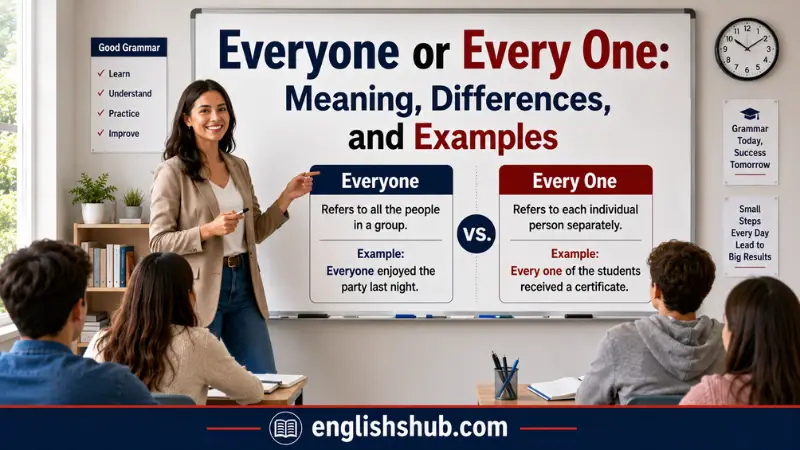
Everyone or every one can both be correct, but they do not mean the same thing. Use everyone as one word when you mean all the people in a group. Use every one as two words when you mean each individual person or thing. The two forms sound alike, so the space between them carries the main grammatical difference.
That distinction becomes especially clear in sentences with of. You would write “Every one of the reports is complete,” not “Everyone of the reports is complete.” Once you understand what each form represents, the choice becomes simple.
Quick Answer
Use everyone when you could replace it with everybody: “Everyone enjoyed the event.” Use every one when you could replace it with each one: “Every one of the chairs was occupied.” Both forms usually take a singular verb, but only every one can refer to individual objects as well as people.
TL;DR
- Everyone means every person or everybody.
- Every one means each individual person or thing.
- Write every one of, never everyone of.
- Both forms normally take singular verbs, such as is, has, and does.
- Use the “everybody” and “each one” tests when you are unsure.
Everyone or Every One: The Main Difference
The central difference concerns how the group is viewed. Everyone presents all the people together without stressing separate individuals. By contrast, every one draws attention to each member or item separately.
| Form | Meaning | Refers To | Common Pattern | Example |
|---|---|---|---|---|
| everyone | Every person; everybody | People only | everyone + singular verb | Everyone is ready. |
| every one | Each individual one | People or things | every one of + plural noun or pronoun | Every one of the boxes is labeled. |
Merriam-Webster defines everyone as every person or everybody. Cambridge also explains that the one-word form means every person, while the two-word phrase identifies individual members of a group.
Consider these two sentences:
- Everyone received a certificate.
- Every one of the certificates had a gold border.
The first sentence refers to all the people who received something. The second examines each certificate in a set.
What Does Everyone Mean?
Everyone is an indefinite pronoun. It refers to all the people in a group without naming each person. It has the same basic meaning as everybody, and it does not refer directly to objects.
Examples of Everyone
- Everyone welcomed the new teacher.
- Is everyone available on Friday?
- Everyone in the audience remained quiet.
- Not everyone agreed with the final decision.
- Please tell everyone that the room has changed.
- Everyone deserves a fair opportunity.
In each example, everyone represents people. The sentence does not separate or list them individually.
Everyone Takes a Singular Verb
Although everyone refers to several people, standard English treats it as grammatically singular. Therefore, use is, was, has, does, or another singular verb form. Cambridge’s grammar guidance likewise pairs everyone and related indefinite pronouns with singular verbs.
Correct:
- Everyone is waiting outside.
- Everyone has received the update.
- Everyone does their part.
Incorrect:
- Everyone are waiting outside.
- Everyone have received the update.
- Everyone do their part.
A plural noun inside a nearby phrase does not change the agreement:
- Everyone in the two departments is attending.
- Everyone among the finalists has completed an interview.
What Does Every One Mean?
Every one is a two-word phrase that means each individual one. It can refer to people, animals, objects, documents, ideas, or other countable members of a group.
Most often, it appears before an of phrase:
- Every one of the applicants
- Every one of these folders
- Every one of them
- Every one of our neighbors
The phrase focuses on the members separately while still including all of them. Collins specifically distinguishes the two-word form as a reference to each individual person or thing in a particular group.
Examples of Every One
- Every one of the windows was open.
- She checked every one of the calculations.
- Every one of our guests received a welcome bag.
- The peaches looked fresh, so I bought every one.
- Every one of those suggestions deserves consideration.
- I remember every one of my first students.
Here, one stands for a specific member or item. Context tells the reader what kind of “one” the sentence means.
Every One Also Takes a Singular Verb
The grammatical head of the phrase is one, so the verb is normally singular. The plural noun after of does not control the verb.
Correct:
- Every one of the answers is correct.
- Every one of the employees has an access card.
- Every one of those machines works properly.
Incorrect:
- Every one of the answers are correct.
- Every one of the employees have an access card.
- Every one of those machines work properly.
This rule often causes confusion because the plural noun sits close to the verb. However, the subject remains every one, not answers, employees, or machines.
How to Choose Everyone or Every One
A quick substitution test usually gives the correct answer.
1. Replace It With Everybody
When everybody preserves the meaning, choose everyone.
- Everyone enjoyed the performance.
- Everybody enjoyed the performance.
Because both sentences mean the same thing, the one-word form is correct.
2. Replace It With Each One
When each one preserves the meaning, choose every one.
- Every one of the lamps needs a new bulb.
- Each one of the lamps needs a new bulb.
Since the second sentence still works, the two-word form fits.
3. Look for Of
If the expression comes directly before of, write every one as two words.
- Every one of us
- Every one of the books
- Every one of their proposals
- Every one of these examples
The construction everyone of is not standard. Grammar references consistently show the two-word form in this pattern.
Everyone or Every One in Common Situations
The right form depends on whether you mean people collectively or individual members and items.
Emails and Workplace Writing
Use everyone when addressing or discussing all people:
- Hello, everyone.
- Everyone should submit the form by noon.
- Thank you, everyone, for your support.
Use every one when emphasizing separate files, tasks, people, or results:
- I reviewed every one of the applications.
- Every one of our team members completed the training.
- Please verify every one of the figures before publishing.
School and Academic Writing
- Everyone in the class received the assignment.
- Every one of the sources must appear in the reference list.
- The instructor answered every one of our questions.
- Everyone was allowed to revise their first draft.
Objects and Products
Because everyone refers to people, it cannot replace every one when the noun represents a thing.
Correct:
- Every one of the batteries was tested.
- I inspected every one before shipment.
Incorrect:
- Everyone of the batteries was tested.
- I inspected everyone before shipment.
The incorrect second sentence would normally suggest that people, not batteries, were inspected.
Invitations and Announcements
- Everyone is invited to attend.
- We have a seat for everyone.
- Every one of the invited speakers has confirmed.
- Every one of these tickets includes admission.
These examples show how a small space can shift the sentence from a whole group of people to individual members or items.
Common Mistakes and Corrections
Mistake 1: Writing Everyone Of
Incorrect: Everyone of the players received a medal.
Correct: Every one of the players received a medal.
The word of introduces the group whose members are being considered separately. Therefore, the two-word phrase is required.
Mistake 2: Using a Plural Verb
Incorrect: Everyone are welcome.
Correct: Everyone is welcome.
Incorrect: Every one of the rooms have a window.
Correct: Every one of the rooms has a window.
Both subjects are grammatically singular, even though they involve multiple people or things.
Mistake 3: Using Every One for a General Group
Awkward: Every one enjoyed the movie.
Natural: Everyone enjoyed the movie.
The two-word form can stand alone when the individual items or people are already clear. However, a general statement about all people normally calls for everyone.
Compare:
- Everyone enjoyed the movie.
- I watched the audience carefully, and every one appeared engaged.
In the second example, every one emphasizes each person in the previously identified audience.
Mistake 4: Writing Each and Everyone
Incorrect: Each and everyone of the volunteers helped.
Correct: Each and every one of the volunteers helped.
The established expression is each and every one because it emphasizes individuals. Here, every one remains two words.
Pronouns After Everyone
A singular verb does not prevent the use of they, them, or their when referring back to everyone.
Natural modern examples include:
- Everyone should bring their identification.
- Everyone said they understood the instructions.
- We gave everyone the materials they needed.
Cambridge states that they and them can refer back to indefinite pronouns such as everyone when gender is not specified. Merriam-Webster and MLA also document singular they as established usage.
The verb immediately controlled by everyone still stays singular:
- Everyone is bringing their identification.
- Everyone has shared their opinion.
Therefore, “Everyone has their own reason” combines a singular verb with a gender-neutral possessive pronoun. This pattern is standard in much modern writing.
Is There a US and UK Difference?
The basic rule is the same in American and British English. US dictionaries define everyone as every person, while British grammar references make the same distinction between everyone and every one.
As a result, writers in both regions should use:
- everyone for all people
- every one for each individual person or thing
- a singular verb with either form
Regional spelling preferences do not affect this pair. The choice depends on meaning and grammar, not location.
A Simple Memory Trick
Remember these two equations:
everyone = everybody
every one = each one
Also, watch for the word of. When of follows immediately, you almost always need the two-word phrase:
- every one of us
- every one of the options
- every one of them
Finally, ask whether the sentence refers only to people. If it clearly refers to objects, everyone cannot be correct.
FAQs
Everyone is one word when it means every person or everybody. The two-word phrase every one is also correct, but it means each individual person or thing.
Write everyone is. Although the word refers to multiple people, it functions as a singular indefinite pronoun and takes a singular verb.
Use everyone has in standard English. For example, write “Everyone has a responsibility,” not “Everyone have a responsibility.”
Yes. Every one can refer to people or countable things. For example, “Every one of the plates was clean” and “Every one of the students was prepared” are both correct.
No. Write every one of as three separate words. For example, “Every one of the proposals was considered” is correct, while “Everyone of the proposals” is not.
Yes. Everyone’s is the possessive form of everyone. For example, “Everyone’s opinion matters” means the opinion of every person. Do not confuse it with every ones, which is not the correct possessive form.
Final Takeaway
Use everyone when you mean all people and every one when you mean each individual person or thing. The fastest check is simple: substitute everybody for the one-word form and each one for the two-word form. Also, remember that every one of always needs a space. With those tests, choosing between everyone or every one becomes straightforward.