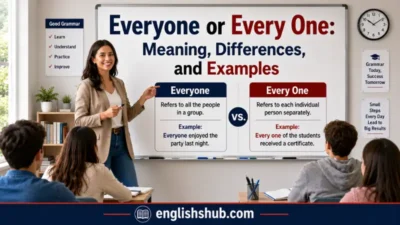

Each or every can refer to all members of a group, but the viewpoint changes. Each focuses on members separately, one by one. Every includes all members without exception and presents them as a complete set.
Because their meanings overlap, both words may fit the same sentence. However, grammar sometimes permits only one choice. Group size, noun form, sentence position, and intended emphasis all matter. This guide explains the difference with clear examples for US and UK English.
Quick Answer
Use each when you want to consider people or things separately, especially in a pair. Use every when you mean all members of a complete group without exception. Moreover, both normally come before a singular countable noun and take a singular verb: “Each student has a key” and “Every student has a key.”
TL;DR
- Each emphasizes individual members.
- Every emphasizes complete inclusion.
- Both normally take a singular noun and singular verb.
- Use each of, but use every one of.
- Only each can stand alone or follow a plural subject.
- Use every for regular times and intervals.
The Main Difference Between Each and Every
The clearest difference concerns focus. Each mentally separates the members of a group. By contrast, every moves across the whole group and excludes no member.
Compare these sentences:
- Each employee received a different access code.
- Every employee received an access code.
First, the sentence highlights separate employees and suggests individual treatment. Meanwhile, the second emphasizes complete coverage. Therefore, no employee was left without a code.
Merriam-Webster defines each through distinct individuals within a set. It defines every as each individual or part without exception. Oxford also explains that each considers people or things separately, while every refers to all members. times either word is correct:
- Each window was open.
- Every window was open.
Even so, the emphasis differs. Similarly, the first version invites readers to picture the windows one at a time. The second presents the statement as a complete check.
When to Use Each
Therefore, choose each when separate identity, treatment, or distribution matters. It is especially useful when members receive different items or have distinct features.
For example:
- Each applicant answered a different question.
- Each child chose their own book.
- She wore a ring on each hand.
- We spoke to each customer separately.
- The tickets cost £15 each.
As a result, every example keeps the individual members visible. Therefore, each often works well with words such as different, separate, individual, and own.
Use Each for Two or More Members
Each can refer to two people or things as well as larger groups. Oxford describes it as referring to every one of two or more members considered separately. these sentences are natural:
- Each twin wore a blue jacket.
- She held a coin in each hand.
- A lamp stood at each end of the sofa.
Therefore, for exactly two members, each is normally the clearest choice. Cambridge’s learner guidance uses each for two or more and every for three or more. Flexible Sentence Positions
In addition, unlike every, each can function before a noun, stand alone, follow a plural subject, or follow an amount.
- Each answer is worth five points.
- The designs are attractive, and each has a purpose.
- Students each have a locker.
- Notebooks cost $4 each.
Merriam-Webster lists each as an adjective, pronoun, and adverb. Oxford likewise records its use before nouns, after plural subjects, and after amounts. e Every
Choose every when complete inclusion is the main point. As a result, the word shows that the statement applies throughout a group without an exception.
For example:
- Every seat was occupied.
- Every answer needs evidence.
- She checked every page.
- Every visitor received a badge.
- We enjoyed every minute.
Although several people or things are involved, every takes a singular noun. It also takes a singular verb when its phrase serves as the subject. Cambridge and Oxford both give the pattern every + singular noun + singular verb. very candidate is prepared.
- Every room has a window.
Incorrect:
- Every candidates are prepared.
- Every room have a window.
Use Every for Frequency and Intervals
Every is also the standard choice for repeated events and measured intervals.
- I exercise every day.
- The bus arrives every ten minutes.
- We meet every other Friday.
- She calls every weekend.
- Replace the filter every six months.
In these examples, every expresses repetition across a sequence. Oxford and Cambridge recognize this use for recurring times and numerical intervals. not normally replace it with each in an interval phrase. “The bus arrives each ten minutes” is not standard. However, each day is correct when individual days matter: “Each day brought a new problem.”
Each or Every With Singular Nouns and Verbs
In addition, when either word appears directly before a countable noun, use a singular noun. In addition, use a singular verb when that noun phrase is the subject.
| Pattern | Correct Example | Incorrect Example |
|---|---|---|
| each + singular noun | Each player has a number. | Each players have a number. |
| every + singular noun | Every player has a number. | Every players have a number. |
| each of + plural noun | Each of the players has a number. | Each of the player has a number. |
| every one of + plural noun | Every one of the players has a number. | Every of the players has a number. |
Although a plural noun follows of, the grammatical head remains singular. Therefore, formal edited English normally uses a singular verb:
- Each of the rooms is ready.
- Every one of the files has a label.
Oxford notes that these structures take a plural noun or pronoun after of, but they usually take a singular verb. important pattern behaves differently. When each follows a plural subject, the verb agrees with that plural subject:
- They each have a ticket.
- The apartments each include a balcony.
In those sentences, they and apartments control the verb. Consequently, the plural verb is correct.
Each Of vs Every One Of
First, use each of before an object pronoun or a determiner plus a plural noun:
- each of us
- each of them
- each of the answers
- each of those houses
By contrast, with every, add one:
- every one of us
- every one of them
- every one of the answers
- every one of those houses
Therefore, every of us is incorrect in standard English. Cambridge directly contrasts each of with every one of. a related spacing rule also matters:
- Everyone means every person.
- Every one refers to all individual members of a stated or understood group.
For example, compare:
- Everyone was ready.
- Every one of the volunteers was ready.
- I checked the cups, and every one was clean.
Merriam-Webster defines everyone as every person. Cambridge explains that every one can refer back to a noun already mentioned. ach or Every With Almost and Nearly
For example, words such as almost, nearly, and practically naturally modify every:
- Almost every shop was closed.
- Nearly every guest arrived early.
- Practically every seat was taken.
- Not every rule has an exception.
However, almost each and nearly each are generally not standard choices. Cambridge specifically recommends these adverbs with every, not each. e logic is straightforward. Every describes complete coverage, so almost can reduce that coverage. In contrast, each focuses on separate members rather than the completeness of the set.
When Both Words Are Correct
Similarly, sometimes the choice changes emphasis rather than grammar.
- Each student submitted the assignment.
- Every student submitted the assignment.
In fact, both sentences report complete submission. Still, each makes the students feel individually accountable. Every stresses that the entire group complied.
For example, consider another pair:
- Each painting has a unique frame.
- Every painting has a frame.
In this case, the first version supports comparison among separate paintings. Moreover, unique reinforces their differences. The second simply confirms that no painting lacks a frame.
Use this decision test:
- Picture members one by one? Choose each.
- Mean the whole group without exceptions? Choose every.
- Referring to exactly two members? Prefer each.
- Describing a regular interval? Choose every.
- Need the word to stand alone? Choose each or every one.
Common Each or Every Mistakes
Using a Plural Noun
Incorrect: Each employees received a badge.
Correct: Each employee received a badge.
Incorrect: Every rooms has a desk.
Correct: Every room has a desk.
Therefore, both words normally come before a singular countable noun.
Using the Wrong Verb
Incorrect: Every answer are important.
Correct: Every answer is important.
Incorrect: Each of the keys open the door.
Correct: Each of the keys opens the door.
Although several answers or keys exist, the grammatical subject is singular.
Writing Every Of
Incorrect: Every of the guests signed in.
Correct: Every one of the guests signed in.
Alternatively, write “Every guest signed in.”
Using Every Alone
Incorrect: The rooms were inspected, and every was clean.
Correct: The rooms were inspected, and every one was clean.
Alternatively, you may write, “The rooms were inspected, and each was clean.”
Confusing Every Day With Everyday
Every day means daily:
- I practise pronunciation every day.
Everyday is an adjective meaning ordinary or routine:
- These are my everyday shoes.
Cambridge and Merriam-Webster distinguish the two-word time expression from the one-word adjective. nd Every” Correct?
Yes. In fact, each and every is an established emphatic phrase meaning every single member without exception. Merriam-Webster describes it as a more forceful way of saying each. te each and every volunteer.
- The rule applies to each and every application.
However, the phrase is stronger and wordier than either term alone. Therefore, reserve it for genuine emphasis. In routine professional prose, each or every usually sounds cleaner.
US and UK Usage
Overall, the core rules are the same in standard American and British English. For example, both varieties use each for members considered separately and every for complete inclusion. They also use singular nouns after both words and singular verbs when the phrase acts as the subject. Oxford’s American and British learner dictionaries present the same agreement patterns. regional differences may appear in surrounding vocabulary or spelling. However, they do not change the central choice between these two words.
FAQs
Therefore, use each person is. The noun person is singular, so it takes a singular verb. Similarly, write “Each person has a ticket.”
Both may be correct. However, use each student to emphasize students separately. Use every student to show that the statement includes the complete group.
Therefore, each is normally clearer for exactly two things. For example, write “a handle on each side.” Cambridge’s learner grammar reserves every for three or more members. be followed by a plural noun?
Not directly in the normal determiner pattern. Instead, write “each book,” not “each books.” However, a plural noun follows each of, as in “each of the books.”
In “they each have,” the plural pronoun they controls the verb. In “each has,” each is the singular subject. Therefore, the verb changes to match the subject.
Yes. In addition, the phrase adds emphasis and means every individual without exception. Still, it can sound repetitive, so use it only when emphasis improves the sentence.
Final Takeaway
Choosing each or every depends mainly on focus. Use each to separate a group into individual members or to refer naturally to a pair. Use every for complete coverage, general rules, and regular intervals. Finally, remember their shared pattern: both normally take a singular countable noun and a singular verb.