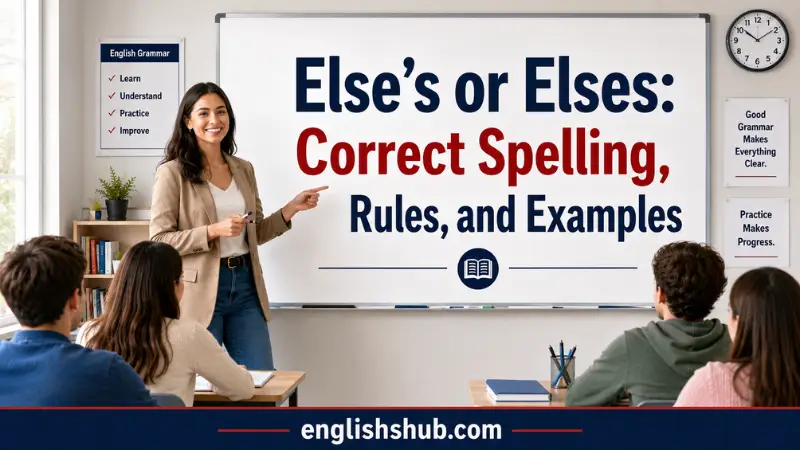
Else’s or elses is a choice between a correct possessive form and a common spelling error. Use else’s with an apostrophe when something belongs to another person or is connected with another person. For example, write “someone else’s phone.” The form elses is not a standard plural or possessive form in everyday English.
The rule applies to phrases such as someone else’s, anyone else’s, everyone else’s, and nobody else’s. Although these phrases may refer to different people, the apostrophe always attaches to else because it comes at the end of the complete expression.
Quick Answer
Else’s is correct when showing possession. It means that something belongs to, relates to, or is associated with another person. Write “someone else’s idea” or “everyone else’s schedule.” Do not write elses because else does not normally have a plural form. The apostrophe before the s is essential.
TL;DR
- Use else’s to show possession or association.
- Write someone else’s, not someone elses.
- Put the apostrophe after else, not after someone.
- Elses is not a standard plural form.
- The same rule applies in American and British English.
Else’s or Elses: The Basic Difference
The difference comes down to the apostrophe.
| Form | Status | Purpose | Example |
|---|---|---|---|
| else’s | Correct | Shows possession or association | That is someone else’s coat. |
| elses | Incorrect in standard usage | Does not form a valid plural or possessive | Someone elses coat |
| elses’ | Incorrect | Treats elses as a plural noun | Everyone elses’ opinions |
| someone’s else | Incorrect | Places the possessive ending incorrectly | Someone’s else phone |
The word else means “other,” “additional,” or “different” in expressions such as “someone else” and “anything else.” Merriam-Webster classifies it as an adjective or adverb depending on its role.
When the full expression becomes possessive, English places ’s at the end:
- someone else → someone else’s
- anyone else → anyone else’s
- everybody else → everybody else’s
- no one else → no one else’s
Therefore, the apostrophe belongs immediately after else.
Why Else’s Needs an Apostrophe
An apostrophe followed by s often shows possession. It tells the reader that something belongs to or is associated with a person, animal, organization, place, or noun phrase.
Consider these examples:
- Maria’s laptop
- the teacher’s desk
- somebody’s jacket
- somebody else’s jacket
In the final example, the complete phrase somebody else identifies the possessor. As a result, the possessive ending goes at the end of that phrase.
Cambridge Grammar gives the same rule directly: when else follows words such as someone or everyone, add ’s to else. Its example “everyone else’s husband” shows the possessive marker at the end of the expression.
Think of It as One Complete Unit
The phrase someone else means “another person.” Even though it contains two words, it functions as a complete unit.
First, identify the owner:
- Who owns the bag?
- Someone else.
Next, make the whole expression possessive:
- someone else + ’s
- someone else’s bag
This pattern resembles possessives formed from longer names or noun phrases. English generally places the possessive ending at the end of the complete phrase.
Why Elses Is Incorrect
The form elses looks as though it might be the plural of else. However, standard English does not normally use else as a countable noun with a regular plural.
You can have:
- someone else
- two other people
- several others
- everybody else
However, you do not usually have “two elses.”
Because elses is not the standard plural, it cannot replace else’s in a possessive expression. Removing the apostrophe changes a correct possessive into a spelling error.
Incorrect: Someone elses keys are on the counter.
Correct: Someone else’s keys are on the counter.
Incorrect: I accidentally opened everyone elses files.
Correct: I accidentally opened everyone else’s files.
Incorrect: That is nobody elses responsibility.
Correct: That is nobody else’s responsibility.
The University of West Florida Writing Lab also uses “someone else’s paper” as an example of correct possessive punctuation.
Common Phrases That Use Else’s
The possessive form often follows indefinite pronouns. These pronouns refer to people or things without naming them specifically.
Someone Else’s
Someone else’s means that something belongs to another unspecified person.
- I think this is someone else’s order.
- She accidentally took someone else’s umbrella.
- We should hear someone else’s opinion.
- That password may belong to someone else’s account.
- He was sitting in someone else’s seat.
The phrase may describe legal ownership, temporary possession, responsibility, ideas, relationships, or other connections.
Anyone Else’s
Anyone else’s refers to any other person.
- Did anyone else’s computer stop working?
- Her score was higher than anyone else’s.
- I do not want to copy anyone else’s work.
- Was anyone else’s luggage damaged?
- The decision should not depend on anyone else’s approval.
In some sentences, the noun after the possessive form is understood rather than repeated.
For example:
- My answer was different from anyone else’s.
Here, anyone else’s means “anyone else’s answer.”
Everyone Else’s
Everyone else’s means something associated with every other person in a group.
- Everyone else’s application arrived on time.
- My desk is smaller than everyone else’s.
- Everyone else’s name appears on the list.
- The update changed everyone else’s settings.
- Her schedule conflicts with everyone else’s schedule.
Although everyone refers to all members of a group, it is grammatically singular. Therefore, writers commonly use a singular verb after it.
Correct: Everyone else’s ticket is valid.
Correct: Everyone else has arrived.
Nobody Else’s and No One Else’s
Both phrases mean that something belongs to no other person.
- It is nobody else’s business.
- That mistake was no one else’s fault.
- You cannot control anybody else’s reaction.
- The choice is no one else’s responsibility.
- She did not use anyone else’s notes.
No one else’s is written as three words. The possessive ending still appears after else.
Else’s or Elses in Complete Sentences
Seeing the form in context makes the rule easier to remember.
Correct Examples
- That bicycle is someone else’s property.
- I received someone else’s package by mistake.
- Her presentation was clearer than everyone else’s.
- Do not share anyone else’s private information.
- The dog wandered into someone else’s yard.
- Nobody else’s answer matched mine.
- We used somebody else’s reservation.
- Everyone else’s work has been reviewed.
- Is this no one else’s concern?
- He often takes credit for someone else’s ideas.
- My room is quieter than everybody else’s.
- She did not want anyone else’s advice.
- That responsibility belongs to someone else.
- The jacket must be somebody else’s.
- I cannot make someone else’s decision for them.
Cambridge Dictionary also uses “someone else’s” to mean something belonging to another person.
Incorrect and Corrected Examples
Incorrect: This must be someone elses notebook.
Correct: This must be someone else’s notebook.
Incorrect: I cannot access anyone elses profile.
Correct: I cannot access anyone else’s profile.
Incorrect: Everybody elses results were better.
Correct: Everybody else’s results were better.
Incorrect: We should respect no one elses privacy.
Correct: We should respect no one else’s privacy.
Incorrect: That is someone’s else responsibility.
Correct: That is someone else’s responsibility.
Incorrect: My opinion is different from everyone elses.
Correct: My opinion is different from everyone else’s.
Where Should the Apostrophe Go?
Place the apostrophe immediately before the final s:
else + ’s = else’s
Do not place it inside the phrase:
- someone’s else
- anyone’s else
- everyone’s else
These forms incorrectly suggest that someone, anyone, or everyone alone owns something called “else.”
Instead, treat the full expression as the possessor:
- someone else’s phone
- anyone else’s suggestion
- everyone else’s tickets
The same pattern applies when the noun is omitted:
- This phone is someone else’s.
- My suggestion differs from everyone else’s.
- That ticket may be anybody else’s.
Possession Does Not Always Mean Ownership
The possessive form can express more than physical ownership. It may show responsibility, authorship, experience, relationships, or association.
Physical Ownership
- someone else’s car
- anyone else’s coat
- everybody else’s luggage
Ideas or Creative Work
- someone else’s argument
- another writer’s article
- everybody else’s suggestions
Responsibility
- nobody else’s fault
- someone else’s duty
- everyone else’s responsibility
Personal Experience
- someone else’s childhood
- another person’s problem
- everybody else’s reaction
Therefore, else’s remains correct even when nothing is literally owned.
Else’s Versus Others’ and Other’s
Writers sometimes confuse else’s with other’s and others’. However, these forms follow different rules.
Else’s
Use else’s after words such as someone, anyone, or everyone.
- someone else’s desk
- nobody else’s concern
Other’s
Use other’s when referring to one of two people or things, usually in a reciprocal expression.
- Each respected the other’s opinion.
- One team studied the other’s strategy.
Others’
Use others’ when something belongs to multiple other people or things.
- We respected the others’ decisions.
- The students reviewed the others’ projects.
Compare these sentences:
- I borrowed someone else’s notes.
- I borrowed the other student’s notes.
- I borrowed the other students’ notes.
Each form has a different structure. As a result, they should not be exchanged automatically.
Is Else’s Correct Without a Noun After It?
Yes. Else’s can stand without a following noun when the missing noun is clear from context.
- This bag is someone else’s.
- My result was lower than everyone else’s.
- The blue umbrella may be anybody else’s.
- Her writing style differs from everyone else’s.
In the first sentence, someone else’s means “someone else’s bag.” English avoids repeating the noun because the meaning is already clear.
However, do not remove the apostrophe:
Incorrect: This bag is someone elses.
Correct: This bag is someone else’s.
Does the Rule Change in American and British English?
No meaningful regional difference applies here. Standard American and British English both use else’s as the possessive form.
Cambridge provides examples such as “someone else’s coat,” while American writing guidance also uses constructions such as “someone else’s paper.”
Punctuation conventions differ between the United States and United Kingdom in some areas. For instance, quotation-mark styles may vary. Nevertheless, the possessive spelling else’s remains the same.
A Simple Memory Trick
Ask whether you could replace the phrase with another person’s.
For example:
- someone else’s phone
- another person’s phone
Because another person’s needs an apostrophe, someone else’s also needs one.
Use this three-step check:
- Identify the person or group connected with the item.
- Check whether the phrase ends with else.
- Add ’s after else.
So:
- somebody else + ’s = somebody else’s
- nobody else + ’s = nobody else’s
- everyone else + ’s = everyone else’s
This method works in most everyday sentences.
Common Mistakes to Avoid
Leaving Out the Apostrophe
Wrong: anyone elses answer
Right: anyone else’s answer
The apostrophe signals possession. Without it, the expression is misspelled.
Putting the Apostrophe Too Early
Wrong: anyone’s else answer
Right: anyone else’s answer
The complete phrase anyone else identifies the person. Therefore, the ending belongs after else.
Adding an Apostrophe After Elses
Wrong: elses’
Right: else’s
The form elses’ assumes that elses is a regular plural noun. It is not standard in this meaning.
Confusing Else’s With Else Is
In many words, ’s can represent either possession or the contraction of is. However, else’s usually appears as a possessive form in everyday writing.
- someone else’s phone
- nobody else’s concern
- everyone else’s opinion
To avoid confusion, check whether a noun belongs to or is associated with another person.
FAQs
Yes. Else’s is a correct possessive form. It usually appears after expressions such as someone, anyone, everyone, somebody, or nobody.
Not in standard everyday English when you mean possession. Use else’s instead. The capitalized form ELSES may appear as a proper name or acronym in specialized contexts, but that use is unrelated to ordinary grammar.
Use someone else’s. The apostrophe shows that something belongs to or is associated with another person.
Use everyone else’s. Do not add a plural s before the apostrophe because elses is not the correct plural form.
No. The phrase means “another person,” so the possessive ending must follow the complete expression: someone else’s.
Everyone else’s is grammatically singular because everyone is an indefinite singular pronoun. However, it can refer collectively to all other people in a group.
Final Takeaway
When deciding between else’s or elses, choose else’s whenever you need a possessive form. Write someone else’s idea, anyone else’s property, and everyone else’s schedule. The apostrophe belongs directly before the final s. Since elses is not a standard plural in this context, it should not replace the correct possessive spelling.