
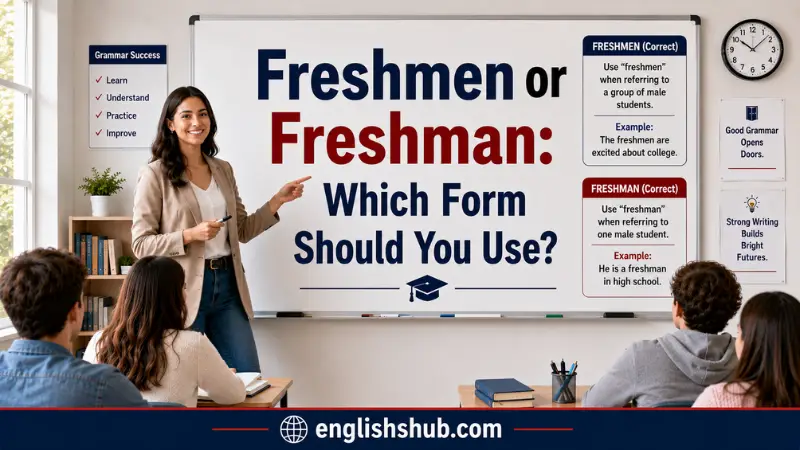
Freshmen or freshman is a choice based mainly on number. Use freshman for one first-year student and freshmen for two or more. However, number is not the only issue. When the word describes another noun, standard English normally keeps the singular form. That is why writers say freshman year, freshman class, and freshman orientation, even when those phrases involve many students.
The terms appear most often in American education. In British English, fresher and first-year student are usually more natural. Many institutions also prefer first-year student because it is gender-neutral and clear.
Quick Answer
Use freshman for one student: “Maya is a freshman.” Use freshmen for several students: “The freshmen attended orientation.” Before another noun, use the singular modifier freshman, as in freshman year or freshman class. Therefore, the correct choice in freshmen or freshman depends on whether the word names students or describes another noun.
TL;DR
- Freshman means one first-year student.
- Freshmen means two or more first-year students.
- Write freshman year, not freshmen year.
- Write freshman students or, more simply, freshmen.
- In UK English, fresher or first-year student is usually more natural.
- Use first-year student when inclusive or institution-specific style matters.
Freshmen or Freshman: The Basic Difference
Both words are correct, but they serve different grammatical purposes. Freshman is the singular noun. Freshmen is its irregular plural. Dictionaries identify freshman as a mainly US term for a student in the first year of high school, college, or university. They list freshmen as the plural form.
| Situation | Correct form | Example |
|---|---|---|
| One first-year student | freshman | Elena is a freshman. |
| Two or more first-year students | freshmen | Three freshmen joined the club. |
| Word placed before another noun | freshman | The freshman class met today. |
| Gender-neutral alternative | first-year student(s) | All first-year students received an email. |
| Common UK informal term | fresher(s) | The freshers attended welcome events. |
A quick substitution test can help. Replace the word with student or students. If student fits, choose freshman. If students fits, choose freshmen.
- One student arrived. → One freshman arrived.
- Several students arrived. → Several freshmen arrived.
However, this test changes when the word directly modifies another noun. In that position, use freshman.
What Does Freshman Mean?
Freshman is a singular countable noun. It usually refers to one person in the first year of high school or college in the United States. It can also describe someone in the first term of a role or activity. For example, American writing may mention a freshman senator, freshman player, or freshman employee. Cambridge and Collins both record educational and broader newcomer-related uses.
Correct examples include:
- My sister is a high school freshman.
- A freshman asked where the library was.
- The coach selected one freshman for the starting lineup.
- As a freshman, Daniel lived on campus.
Because freshman is singular, it takes a singular verb: “The freshman is ready,” not “The freshman are ready.”
Freshman as a Modifier
The word freshman can also appear before another noun. In this position, it acts as a noun modifier, sometimes called an attributive noun. English usually keeps such modifiers singular. Merriam-Webster specifically recommends the singular form in phrases such as freshman year.
Common examples include freshman year, freshman class, freshman orientation, freshman seminar, and freshman athletes.
Although freshman students is grammatical, it may sound redundant. In many sentences, freshmen is shorter and smoother.
- Acceptable: The freshman students met their advisers.
- Better: The freshmen met their advisers.
What Does Freshmen Mean?
Freshmen is the plural noun. Use it when you mean two or more people in their first year. Unlike most English plurals, it does not end in -s. Instead, the final element changes from man to men.
Correct examples include:
- The freshmen toured the science building.
- Several freshmen joined the soccer team.
- Both freshmen received scholarships.
- The committee interviewed five freshmen.
Because freshmen is plural, it takes a plural verb: “The freshmen are excited,” not “The freshmen is excited.”
Do not use freshmen for one person.
- Incorrect: She is a freshmen.
- Correct: She is a freshman.
Also, avoid using freshmen directly as the normal modifier before a noun.
- Incorrect: freshmen year
- Incorrect: freshmen class
- Correct: freshman year
- Correct: freshman class
Why Is the Plural Freshmen, Not Freshmans?
The plural is freshmen because freshman follows an irregular plural pattern. It changes in the same way as man becomes men. Therefore, adding -s produces the nonstandard form freshmans. Thesaurus.com and Merriam-Webster identify freshmen as the plural of freshman.
Compare these patterns:
| Singular | Plural |
| man | men |
| chairman | chairmen |
| freshman | freshmen |
| woman | women |
The spelling may seem unusual because many nouns form plurals with -s or -es. For example, student becomes students. Still, irregular nouns follow their established forms.
- Incorrect: two freshmans
- Correct: two freshmen
- Incorrect: many freshman
- Correct: many freshmen
A simple memory aid is to focus on the ending: one man, one freshman; several men, several freshmen.
Freshman Year or Freshmen Year?
The standard phrase is freshman year. Here, freshman does not count students. Instead, it modifies the noun year. Therefore, it remains singular.
- Correct: My freshman year was challenging.
- Correct: She changed majors during freshman year.
- Correct: Their freshman year begins in August.
- Incorrect: My freshmen year was challenging.
The same rule applies to other phrases:
- freshman class, not freshmen class
- freshman orientation, not freshmen orientation
- freshman dorm, not freshmen dorm
- freshman team, not freshmen team
- freshman curriculum, not freshmen curriculum
Freshman Students or Freshmen Students?
Use freshman students when the first word modifies students. Better yet, use freshmen alone when the context is clear.
- Correct: The freshman students attended a workshop.
- Better: The freshmen attended a workshop.
- Incorrect: The freshmen students attended a workshop.
Here, freshman describes the type of students rather than counting them. English commonly keeps a noun modifier singular. However, first-year students is often clearer in modern institutional writing.
Matching Freshman and Freshmen With Verbs
Subject-verb agreement offers another reliable clue. A singular subject requires a singular verb, while a plural subject requires a plural verb.
Singular patterns
- The freshman is studying biology.
- Every freshman receives a handbook.
- One freshman was absent.
Plural patterns
- The freshmen are studying biology.
- Several freshmen have volunteered.
- Two freshmen were absent.
Words such as each, every, and one usually signal the singular form.
- Every freshman must register.
- Each freshman received a key.
- One freshman missed the bus.
By contrast, words such as many, several, both, and numbers above one signal the plural.
- Many freshmen live on campus.
- Both freshmen joined the meeting.
- Six freshmen entered the contest.
Freshman’s or Freshmen’s: Understanding Possessives
Apostrophes show possession, not ordinary plurality. Therefore, freshman’s and freshmen’s have different meanings.
Freshman’s
Freshman’s is singular possessive. It refers to something belonging to one freshman.
- The freshman’s backpack was missing.
- A freshman’s schedule can change.
Freshmen’s
Freshmen’s is plural possessive. It refers to something belonging to several freshmen. Because freshmen does not end in s, add ’s.
- The freshmen’s schedules were posted.
- We reviewed the freshmen’s survey responses.
Do not confuse these forms with the ordinary plural.
- freshmen = more than one first-year student
- freshman’s = belonging to one freshman
- freshmen’s = belonging to multiple freshmen
United States and United Kingdom Usage
The grammar remains the same wherever the words appear. However, regional preference differs.
United States
In American English, freshman and freshmen commonly refer to first-year high school and college students. The term also appears in sports and politics. For instance, a first-season college athlete may be called a freshman, while a newly elected legislator may be described as a freshman member. Cambridge marks the educational meaning as US usage, and Collins defines it as an American term.
Even so, many American colleges now use first-year student in official communication. The University of Washington, for example, updated its editorial guidance in May 2025 to prefer first-year student or first-year when possible.
United Kingdom
In British English, freshman is understood but is less typical. University students often use the informal noun fresher for someone who has recently started college or university. Cambridge Dictionary labels fresher as UK informal, while Cambridge University’s glossary describes a first-year undergraduate as someone often called a fresher.
Common UK alternatives include:
- first-year student
- student in their first year
- first-year undergraduate
- fresher, in informal university contexts
- freshers, for several new university students
Therefore, a UK university may hold Freshers’ Week, while a US college may organize freshman orientation or first-year orientation.
Should You Use First-Year Student Instead?
First-year student is often the best choice in formal, inclusive, or international writing. It avoids the gendered ending in freshman and works naturally in both American and British contexts.
Several US universities explicitly recommend this alternative. The University of Puget Sound calls first-year student a more inclusive option, while UMBC’s style guide also recommends replacing freshman with first-year student.
Use first-year student when a school’s style guide requires it, when gender-neutral language matters, or when you write for an international audience.
However, freshman and freshmen remain standard dictionary words. They are not grammatical errors. The best choice depends on your audience, context, and house style.
Common Mistakes With Freshman and Freshmen
When choosing freshmen or freshman, check number, sentence position, and possession.
Mistake 1: Using the Plural for One Person
- Incorrect: Maria is a freshmen.
- Correct: Maria is a freshman.
Mistake 2: Using the Singular for Several People
- Incorrect: Three freshman joined the club.
- Correct: Three freshmen joined the club.
Mistake 3: Writing “Freshmens”
- Incorrect: The freshmens entered the hall.
- Correct: The freshmen entered the hall.
Freshmen is already plural, so it needs no final s.
Mistake 4: Writing “Freshmans”
- Incorrect: Two freshmans won awards.
- Correct: Two freshmen won awards.
Mistake 5: Writing “Freshmen Year”
- Incorrect: I learned a lot during freshmen year.
- Correct: I learned a lot during freshman year.
Mistake 6: Using the Wrong Verb
- Incorrect: The freshmen is waiting.
- Correct: The freshmen are waiting.
A Simple Test for Choosing the Correct Form
First, decide whether the word names one person, names several people, or describes another noun.
- One person: use freshman.
- Several people: use freshmen.
- Before another noun: usually use freshman.
- Belonging to one person: use freshman’s.
- Belonging to several people: use freshmen’s.
- Inclusive or international context: consider first-year student(s).
Next, check the verb. Freshman pairs with singular verbs such as is and has. Freshmen pairs with plural verbs such as are and have. Because the words often sound similar, rely on grammar rather than pronunciation.
More Correct Examples in Context
School and College
- I became a freshman last fall.
- The freshmen received campus maps.
- Her freshman year went quickly.
- Freshman orientation starts Monday.
Sports
- The freshman scored the winning goal.
- Two freshmen made the varsity team.
- The coach met with all first-year players.
Formal Communication
- Every freshman must submit the form.
- The freshmen are invited to the reception.
- First-year students should contact their advisers.
- The freshman class will elect representatives.
FAQs
Freshman is singular. It refers to one person in the first year of high school, college, or another activity. For more than one person, use freshmen.
Yes. Freshmen is the irregular plural of freshman. The ending changes from -man to -men, just as man changes to men.
Freshman year is correct. In this phrase, freshman modifies the noun year, so it stays singular. The same rule applies to freshman class and freshman orientation.
Yes, freshman students is grammatical. However, freshmen is often shorter and more natural. You can also use first-year students, especially in formal or inclusive writing.
Use freshman for one student and freshmen for several students. Before another noun, use freshman, as in freshman class. Then check whether your verb agrees with the singular or plural subject.
It is understood, but it is mainly associated with American English. British speakers often use first-year student or the informal university term fresher instead.
Final Takeaway
Freshmen or freshman becomes easy once you identify the word’s job. Use freshman for one person and freshmen for more than one. Keep freshman singular before another noun, as in freshman year and freshman class. In addition, consider first-year student when you need inclusive, formal, or internationally clear language.


[…] freshman and freshmen usage. […]