
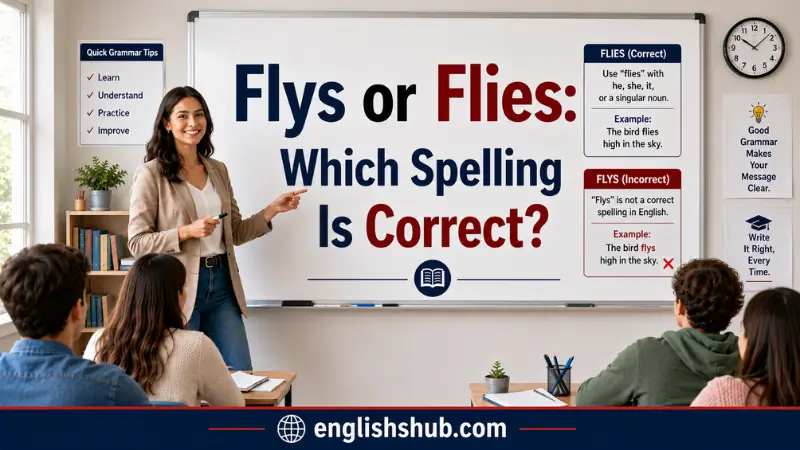
Flys or flies can look confusing because many English plurals form by adding only -s. However, the correct spelling is almost always flies. Use flies for more than one fly and for the third-person singular form of the verb fly. In standard modern English, flys is normally a spelling mistake.
Quick Answer
For flys or flies, use flies in standard English. Flies is the plural noun for flying insects, as in “Three flies entered the kitchen.” It is also the present-tense verb used with he, she, it, or one singular subject, as in “The bird flies south.” The same rule applies in American and British English.
TL;DR
- Flies is the correct plural of the noun fly.
- Flies is also the present-tense verb used with a singular subject.
- Fly follows the consonant-plus-y rule: change y to i and add -es.
- Flys is generally incorrect, although it may appear in names or informal fitness labels.
- Use fly’s for singular possession and flies’ for plural possession.
Flys or Flies: The Basic Difference

The choice is simple in edited English: write flies. Major dictionaries list flies as both the plural noun and the third-person singular present form of fly. Merriam-Webster gives the noun plural as flies, while Collins lists flies among the word forms of both the noun and verb.
The spelling has two main jobs:
- It can name more than one insect.
- It can describe what one person, animal, object, or idea does.
Consider these examples:
- Several flies gathered near the window.
- A small plane flies over our town each morning.
- Time flies during a good conversation.
- Maya flies to London twice a year.
In each sentence, flies is correct. Adding only -s to create flys does not follow the standard spelling rule.
Why Does Fly Become Flies?
The noun fly ends in a consonant followed by y. In this pattern, English usually changes the final y to i before adding -es.
The change works like this:
fly → fli + es → flies
The same pattern appears in many common nouns:
| Singular | Plural |
|---|---|
| baby | babies |
| city | cities |
| story | stories |
| puppy | puppies |
| fly | flies |
Therefore, the final y does not remain in the plural form.
However, words ending in a vowel plus y usually keep the y and add only -s:
| Singular | Plural |
| boy | boys |
| key | keys |
| day | days |
| toy | toys |
The letter before y controls the usual pattern. In fly, the letter l is a consonant, so the plural becomes flies. Scribbr’s overview of plural nouns likewise explains that English plurals may require a spelling change rather than a simple -s.
When Flies Is a Plural Noun
As a noun, flies means more than one fly. Most often, it refers to small winged insects.
Correct examples:
- Two flies landed on the table.
- Fruit flies appeared near the ripe bananas.
- The screen keeps flies out of the room.
- Fishermen tied artificial flies before the trip.
Cambridge identifies flies as the plural of fly, and Merriam-Webster uses the same plural form across the noun’s different meanings.
The word can refer to more than insects. For example, an artificial fishing lure can be a fly, so several lures are flies. In theater, the flies can mean the hidden area above a stage where scenery and equipment are stored. Collins also records this theatrical plural use.
Context tells the reader which meaning applies:
- The flies buzzed around the food.
Here, the word names insects. - The crew raised the scenery into the flies.
Here, the word names the space above a theater stage. - Her fishing box contains colorful flies.
Here, the word names artificial lures.
Although the meanings differ, the spelling remains the same.
When Flies Is a Verb
Flies is also a present-tense form of the verb fly. Use it with he, she, it, or another singular third-person subject.
Examples:
- He flies helicopters.
- She flies to Manchester for work.
- The eagle flies above the valley.
- My drone flies well in calm weather.
- The afternoon flies by when we are busy.
Cambridge gives flies as the form used when a bird, insect, or aircraft moves through the air. The verb can also describe traveling by aircraft or controlling one.
With I, you, we, they, or a plural subject, use fly instead:
| Subject | Correct Verb | Example |
| I | fly | I fly to Chicago each month. |
| You | fly | You fly more often than I do. |
| He, she, or it | flies | She flies to Edinburgh. |
| We | fly | We fly together. |
| They | fly | They fly at sunrise. |
| The birds | fly | The birds fly south. |
| The bird | flies | The bird flies south. |
This difference concerns subject-verb agreement. A singular third-person subject takes flies, while plural subjects take fly.
Time Flies or Time Flys?
The correct expression is time flies. Here, time is a singular subject, and flies is the third-person singular form of the verb.
Correct:
- Time flies when you are having fun.
- The weekend flies by.
- Summer flies past once school ends.
Incorrect:
- Time flys when you are having fun.
- The weekend flys by.
The phrase does not literally mean that time has wings. Instead, it means that time seems to pass quickly. Merriam-Webster records time flies as the standard expression for this idea.
A useful check is to replace time with it:
- It flies.
- Time flies.
Because it flies is correct, time flies is also correct.
Fly, Flies, Flying, Flew, and Flown
The verb fly changes form according to tense and subject. The full pattern helps prevent spelling mistakes.
| Form | Use | Example |
| fly | Base form or present with plural subjects | Birds fly south. |
| flies | Present with a singular third-person subject | A bird flies south. |
| flying | Present participle | The bird is flying south. |
| flew | Simple past | The bird flew south. |
| flown | Past participle | The bird has flown south. |
Cambridge lists flew as the past tense and flown as the past participle.
Do not use flies for the past:
- Correct: The plane flew yesterday.
- Incorrect: The plane flies yesterday.
Likewise, use flown with a helping verb such as has, have, or had:
- The pilot has flown this route before.
- We had flown for six hours before landing.
Flies, Fly’s, and Flies’: Do Not Confuse Them
These three forms sound similar, but apostrophes change their grammatical job.
Flies
Use flies for a plural noun or a present-tense verb.
- The flies disappeared.
- The plane flies daily.
Fly’s
Use fly’s to show that something belongs to one fly. It can also represent fly is in rare contexts.
- The fly’s wings were damaged.
- The fly’s trapped inside the jar.
In the second sentence, fly’s means fly is. However, writing the full words may sound clearer.
Flies’
Use flies’ to show possession by more than one fly.
- The flies’ movement attracted the cat.
- Scientists observed the flies’ feeding behavior.
Apostrophes do not create ordinary plurals. Therefore, fly’s is not the plural of fly.
What About Butterfly, Housefly, and Dragonfly?
Compound nouns ending in fly normally change the same way when pluralized.
- butterfly → butterflies
- dragonfly → dragonflies
- housefly → houseflies
- horsefly → horseflies
- stonefly → stoneflies
Collins lists forms such as houseflies, horseflies, and stoneflies, which follow the same final-y pattern.
Open compounds also change the final noun:
- fruit fly → fruit flies
- crane fly → crane flies
- fishing fly → fishing flies
Therefore, write “three butterflies” and “several fruit flies,” not butterflys or fruit flys.
Can Flys Ever Be Correct?
In standard modern prose, flys is generally not the correct plural or verb form. Use flies in schoolwork, business writing, articles, emails, and other edited content.
Still, Flys may appear as part of a registered name, username, product label, artistic title, or deliberately unusual spelling. Proper names do not always follow ordinary spelling rules. When a name officially uses Flys, reproduce the name as its owner presents it.
Fitness writing creates another gray area. Some exercise pages use chest flys or cable flys, while others use chest flies or the specialist spelling flyes. Even the American Council on Exercise has pages that display different variants in exercise labels.
For general edited English, chest flies is the safest regular plural. However, when following a gym’s program, app, or branded exercise library, preserve its official exercise name if consistency matters.
Is the Rule Different in the US and UK?
No meaningful regional difference applies to the basic spelling. American and British English both use flies as the plural noun and the singular present-tense verb.
Cambridge’s American learner entry gives the noun plural as flies. Its British materials also use flies for the verb form. Collins lists the same word forms in British and American dictionary entries.
A small vocabulary difference may appear around clothing. American English commonly refers to a pants opening as a fly. British English can also use the plural flies in expressions such as “Your flies are undone.” Collins records that British usage.
That regional meaning does not change the spelling rule.
Common Mistakes With Flys or Flies
Writers usually make one of four errors.
Adding Only S
Incorrect: Three flys entered the room.
Correct: Three flies entered the room.
Because fly ends in a consonant plus y, change y to i and add -es.
Using Flies With a Plural Subject
Incorrect: The birds flies south.
Correct: The birds fly south.
The subject birds is plural, so the verb stays in its base form.
Using Fly With a Singular Subject
Incorrect: The bird fly south.
Correct: The bird flies south.
The singular subject bird requires the third-person singular form.
Adding an Apostrophe for a Plural
Incorrect: Several fly’s covered the fruit.
Correct: Several flies covered the fruit.
Use an apostrophe only for possession or a contraction, not for a regular plural.
Correct and Incorrect Examples
Reviewing paired examples makes the distinction easier.
| Incorrect | Correct |
| A bee flys near the flowers. | A bee flies near the flowers. |
| Two flys landed on the glass. | Two flies landed on the glass. |
| My parents flies often. | My parents fly often. |
| The pilot fly to New York weekly. | The pilot flies to New York weekly. |
| Time flys during vacation. | Time flies during vacation. |
| The fly’s are everywhere. | The flies are everywhere. |
| Those butterflys are colorful. | Those butterflies are colorful. |
| The plane has flew overseas. | The plane has flown overseas. |
The key question is whether the word acts as a noun or a verb. Next, check whether the noun is plural or the verb’s subject is singular.
How Do You Choose Flys or Flies Quickly?
The fastest flys or flies test is to identify the word’s job. If it names more than one insect or object, choose flies. If it describes one singular subject in the present tense, choose flies again. However, if the subject is plural, use fly.
An Easy Memory Trick
Remember this short pattern:
One fly, two flies. One bird flies, two birds fly.
The first pair tests the noun:
- one fly
- two flies
The second pair tests the verb:
- one bird flies
- two birds fly
You can also connect fly with try. Both words end in a consonant plus y:
- one try, two tries
- one fly, two flies
- she tries
- she flies
That parallel makes the spelling easier to recall.
FAQs
Flys is not the standard plural noun or present-tense verb form in modern edited English. It may appear in proper names, stylized labels, or informal exercise terminology. In ordinary writing, choose flies.
The plural of fly is flies. Change the final y to i and add -es: fly → flies.
Write the bird flies. Bird is a singular third-person subject, so the present-tense verb is flies.
Write birds fly. The subject birds is plural, so use the base verb fly without -s or -es.
The correct phrase is time flies. Time acts as a singular subject, so it takes the verb form flies.
For standard edited English, chest flies is the safest plural. Fitness sources also use chest flys and chest flyes as specialized labels, so follow an official program’s wording when naming that specific exercise.
Final Takeaway
When deciding between flys or flies, choose flies in standard English. It names more than one fly and works as the present-tense verb after he, she, it, or another singular subject. Use fly with plural subjects, flew for the simple past, and flown after has, have, or had. The spelling rule is straightforward: when fly changes form, the final y usually becomes i before -es.