
When choosing between parties or partys, use parties. It is the correct plural of party in standard American English. Because party ends in a consonant followed by y, the y changes to i before -es is added.
This spelling applies when party means a celebration, a political organization, or a person or group involved in an agreement. However, apostrophes create two other valid forms: party’s and parties’. Knowing what the sentence means makes the right choice easy.
Quick Answer
Parties is correct when you mean more than one party. Partys is a misspelling in standard English. Change the final y in party to i and add -es: party becomes parties. Use party’s for something belonging to one party and parties’ for something belonging to multiple parties.
Key Takeaways
- Parties is the correct plural of party.
- Partys is not a standard English word.
- A consonant before final y triggers the -ies ending.
- Party’s shows singular possession or forms a contraction.
- Parties’ shows possession by more than one party.
Parties or Partys at a Glance
| Form | Purpose | Example | Status |
| party | One event, group, or participant | The party starts at eight. | Correct |
| parties | More than one party | Both parties signed the contract. | Correct |
| partys | Intended plural | Two partys are planned. | Incorrect |
| party’s | Singular possessive or contraction | The party’s date changed. | Correct |
| parties’ | Plural possessive | The parties’ lawyers met. | Correct |
Is Parties or Partys Correct?
Parties is the only correct choice when the sentence needs the plural of the noun party. Merriam-Webster lists the plural as
matching the standard spelling rule for nouns that end in a consonant plus y.
Use it for any meaning of the countable noun:
- We attended two birthday parties in June.
- Several political parties joined the debate.
- The parties reached a settlement.
The spelling partys may appear in an informal typo, brand name, username, or stylized title. Those special uses do not make it a standard plural. In edited English, write parties.
Why Party Changes to Parties
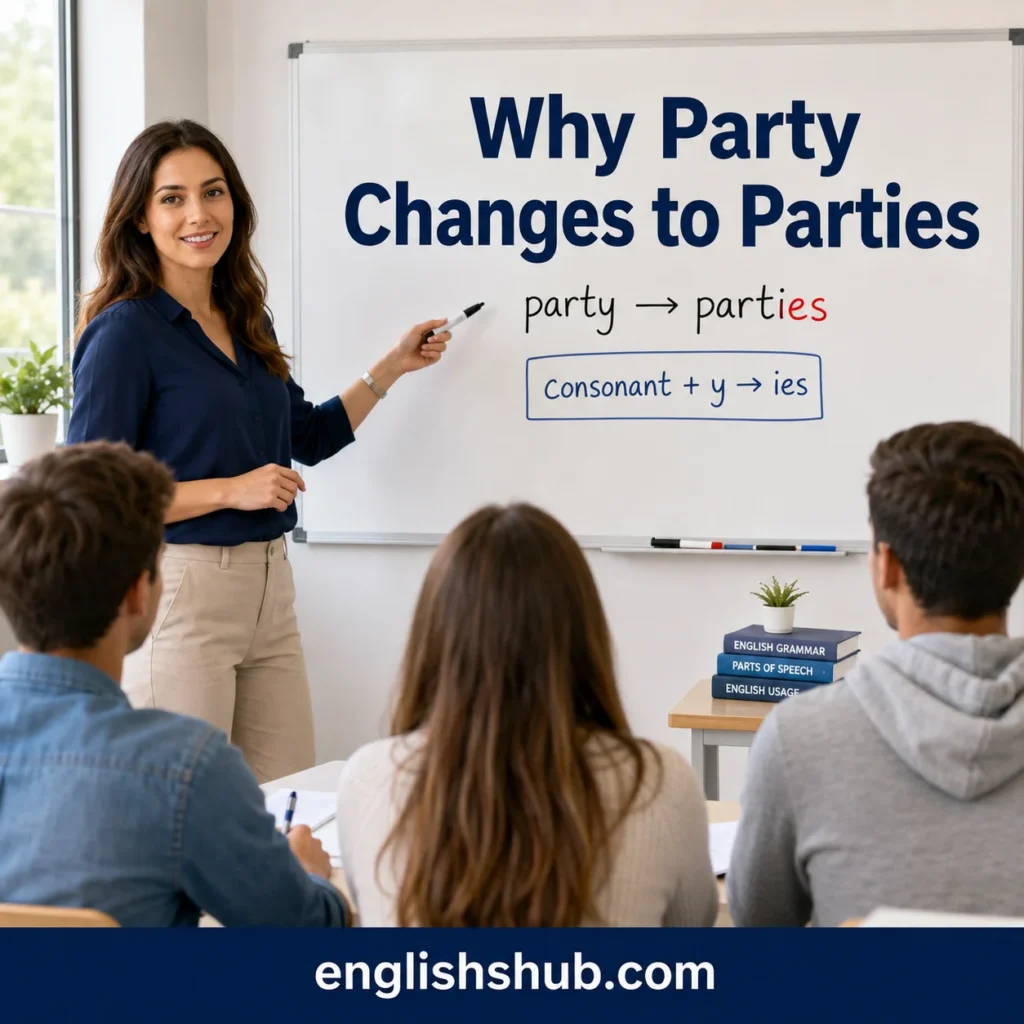
The spelling changes because the letter before the final y is a consonant. In party, that letter is t. For many common nouns with this pattern, remove the y and add -ies.
The change looks like this:
- Start with party.
- Identify the consonant t before the final y.
- Remove the y.
- Add -ies to form parties.
The same pluralization rule produces cities from city, babies from baby, stories from story, and countries from country. This is why adding only -s to create partys does not work.
When Words Ending in Y Simply Add S
Not every noun ending in y changes to -ies. If a vowel comes directly before the final y, keep the y and add -s. Common examples include boy → boys, day → days, key → keys, and toy → toys.
The contrast provides a useful memory aid:
- consonant + y: party → parties
- vowel + y: day → days
Check only the letter immediately before the y. Cambridge’s overview of
also notes that plural formation depends on a noun’s ending. Once you spot the consonant in party, the correct spelling follows naturally.
What Parties Means
Parties is a plural countable noun, but it does not always refer to celebrations. Context determines which meaning applies.
- Social events: The office held two holiday parties.
- Political organizations: Several parties nominated candidates.
- People in an agreement: Both parties accepted the terms.
- Sides in a legal case: The parties presented their evidence.
- Groups taking part in an activity: Search parties entered the woods.
Although these meanings differ, their plural spelling remains the same. A legal document, news report, invitation, or casual message should use parties whenever it refers to more than one party.
Parties as a Verb
Parties can also be the third-person singular present form of the verb party. In this use, it describes one person or thing celebrating or enjoying social events.
- She parties with friends after final exams.
- He rarely parties during the workweek.
- The group parties after every home victory.
The same consonant-plus-y spelling change applies to the verb: party becomes parties with he, she, it, or another singular subject. With plural subjects and the pronouns I and you, use the base form: “They party on weekends” and “I party only on special occasions.”
Parties, Party’s, and Parties’
An apostrophe changes the grammatical job of the word. It does not create an ordinary plural.
Party’s usually shows that something belongs to one party: “The party’s platform changed.” It can also shorten party is or party has: “The party’s over” means “The party is over,” while “The party’s begun” means “The party has begun.”
Parties’ is the plural possessive form. First form the plural parties, then add an apostrophe after the final s: “The parties’ agreement is binding.” This means the agreement relates to or belongs to multiple parties. The standard possessive pattern places an apostrophe after a regular plural ending in s, as shown in
Merriam-Webster’s possessive guidance.
A Fast Test for Choosing the Right Form
Choose the form by deciding what your sentence needs:
- One event, group, or participant? Use party.
- More than one? Use parties.
- Ownership by one party, or “party is/has”? Use party’s.
- Ownership involving several parties? Use parties’.
Try replacing the word with a short phrase. If “more than one party” fits, choose parties. If “belonging to one party” fits, choose party’s. When “belonging to several parties” expresses the intended meaning, write parties’. This meaning test is more reliable than choosing the form that merely looks familiar.
Common Mistakes and Corrections
Writers often confuse plural endings with apostrophes. These corrections show the difference:
- Incorrect: Three partys are scheduled.
Correct: Three parties are scheduled. - Incorrect: Both party’s accepted the offer.
Correct: Both parties accepted the offer. - Incorrect: The parties decision was unanimous.
Correct: The parties’ decision was unanimous. - Incorrect: The parties’s leaders met.
Correct: The parties’ leaders met.
Another frequent error appears in phrases such as third parties. Use that form for multiple outside people or organizations. Write third party’s only when one third party possesses something: “The third party’s approval is required.”
Subject-Verb Agreement with Parties
As a plural noun, parties normally takes a plural verb. Write “The parties are negotiating,” not “The parties is negotiating.” Likewise, use have, were, and agree with a plural subject.
- Both parties have signed.
- The political parties were prepared.
- The parties agree on the main issue.
Do not let a singular noun later in the sentence distract you. In “The parties to the contract are present,” the subject is parties, so are is correct. By contrast, “Each party is present” uses a singular subject and therefore needs is.
Examples in Everyday and Formal Writing
The correct plural works naturally in casual and formal settings:
- Invitation: We are planning two graduation parties this month.
- Conversation: Those parties usually end before midnight.
- Politics: Smaller parties released separate policy statements.
- Business: All parties must review the revised proposal.
- Legal writing: The parties agreed to resolve the dispute privately.
- Real estate: Both parties received a copy of the inspection report.
These examples also reveal why context matters. A party can be an event, an organization, or a participant in a transaction. Nevertheless, the spelling rule never changes: more than one is always parties.
FAQs
The plural of party is parties. Because the noun ends in a consonant followed by y, remove the y and add -ies. The rule applies whether party means a celebration, political group, legal side, or participant in an agreement.
Partys is not correct as a standard English plural or verb form. It may appear deliberately in a company name, social-media handle, artistic title, or other stylized wording. Preserve such a spelling only when it is part of an official name; otherwise, use parties.
Birthday parties is correct. Here, birthday describes the plural noun parties, meaning more than one celebration. For example, “The venue hosts children’s birthday parties” uses both the correct plural and a possessive noun describing the children.
Parties means more than one party, while party’s shows possession by one party or shortens party is or party has. Compare “Two parties were canceled” with “The party’s music was loud.” Only the second sentence requires an apostrophe.
Write parties’ when something belongs to, involves, or relates to multiple parties. In “The parties’ attorneys met,” several parties have attorneys. Form the plural first, then place the apostrophe after its final s to mark plural possession.
Yes. Parties is the present-tense verb used with a third-person singular subject: “She parties on weekends.” Use the base form party with I, you, we, and they: “They party after important victories.”
Conclusion
For the choice parties or partys, write parties whenever you mean more than one party or need the third-person singular verb. The consonant before the final y requires the change from y to -ies. Apostrophes serve a different purpose: party’s marks singular possession or a contraction, while parties’ marks plural possession. Check the intended meaning first, then apply the matching form. That simple habit keeps the spelling accurate in casual, academic, business, and legal writing.