Choosing between people’s and peoples depends on meaning. People’s is the possessive form of people, so it describes something connected to or belonging to a group of human beings. Peoples is a plural noun for two or more distinct cultural, ethnic, national, or historical groups. A third form, peoples’, shows possession by those distinct groups. Although the spellings look similar, the apostrophe performs an important job. Once you decide whether you mean ordinary people or separate communities, the correct form becomes much easier to identify.
Quick Answer
Use people’s when something belongs to or concerns people: people’s names, people’s choices, or people’s lives. Use peoples without an apostrophe for multiple distinct populations, nations, or cultural groups: the peoples of the Pacific. Use peoples’ when those groups possess something: the Indigenous peoples’ traditions.
Key Takeaways
- People’s is the normal possessive form of people.
- Peoples means multiple distinct cultural, ethnic, or national groups.
- Peoples’ is the possessive form of peoples.
- An apostrophe does not make a noun plural.
- In everyday writing, people’s is usually the form you need.
People’s vs. Peoples vs. Peoples’ at a Glance
| Form | Grammatical job | Meaning | Example |
| people’s | Possessive noun | Belonging or relating to people | We should respect people’s privacy. |
| peoples | Plural noun | Two or more distinct cultural, ethnic, or national groups | Many peoples have lived in the region. |
| peoples’ | Plural possessive noun | Belonging or relating to multiple distinct groups | The treaty affected the peoples’ lands. |
The main question is not simply whether the sentence refers to more than one person. People already serves as the ordinary plural of person. Instead, ask whether the sentence refers to several individuals collectively or to several distinct communities.
Why People’s Is Usually Correct
For most everyday sentences, people’s is the correct choice. The noun people is already plural when it means more than one person. Because it does not end in s, its possessive form takes an apostrophe followed by s.
This pattern matches other irregular plurals:
- children becomes children’s
- women becomes women’s
- men becomes men’s
- people becomes people’s
Purdue OWL gives the same general rule: add apostrophe + s to a plural noun that does not end in s. Therefore, people’s is grammatically regular even though the plural noun itself is irregular. You can review the broader rule in
Purdue OWL’s apostrophe guide.
Consider these examples:
- The survey measured people’s opinions.
- Noise can disturb people’s sleep.
- The new policy may change people’s lives.
- A good editor protects people’s words from being misquoted.
- The park was designed with people’s safety in mind.
In each sentence, the noun after people’s belongs to, affects, or is associated with human beings. The relationship does not always indicate literal ownership. People’s safety, for example, means the safety of people.
Is people’s singular or plural?
People’s is normally a plural possessive. The base word people refers to multiple persons, while apostrophe + s adds possession. The ending may resemble a singular possessive such as student’s, but the base noun remains plural.
The word people can also mean one nation or community as a collective unit. In that less common sense, a people’s history can mean the history of one particular people. Context reveals whether the writer means human beings generally or one defined community.
When to Use Peoples
Use peoples without an apostrophe when you mean more than one distinct group. These groups may be defined by culture, ethnicity, nationality, shared history, or another collective identity.
- The museum explores the peoples of the ancient Mediterranean.
- Several Indigenous peoples maintain their own languages.
- The island’s peoples developed different artistic traditions.
- Scholars studied trade among the region’s peoples.
In these examples, peoples does not merely mean a large number of individuals. It presents the communities as separate collective groups. Grammarly likewise notes that peoples is used for distinct ethnic groups, while
records the broader meanings of people as both human beings and a community.
This distinction matters in historical, legal, anthropological, and cultural writing. The United Nations, for instance, uses Indigenous Peoples when discussing the identities and collective rights of distinct communities. Its materials recognize rights involving culture, traditions, identity, land, and self-determination. See the UN overview of
for a real-world example of this usage.
Avoid peoples when you simply mean several individuals:
- Incorrect: Five peoples were waiting outside.
- Correct: Five people were waiting outside.
- Incorrect: Many peoples enjoyed the concert.
- Correct: Many people enjoyed the concert.
The number of individuals does not make peoples appropriate. Distinct group identity does.
When Peoples’ Is Correct
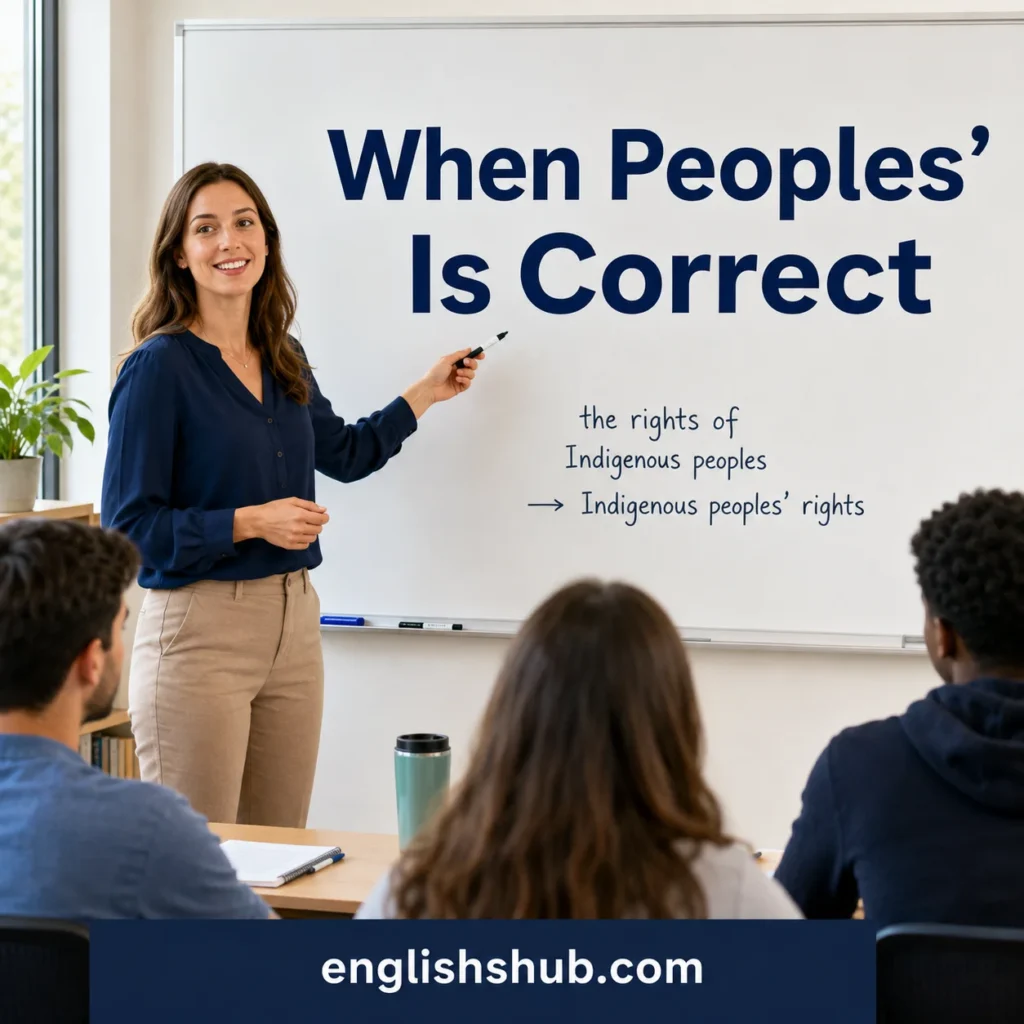
Peoples’ is the possessive form of peoples. Since peoples is a plural noun ending in s, add only an apostrophe after the final s.
- The exhibition celebrates the Arctic peoples’ cultures.
- The agreement recognized the two peoples’ rights.
- Researchers documented the neighboring peoples’ oral histories.
- Climate change threatens many island peoples’ homelands.
The form is valid, but it appears less often because the situation is specific. A writer must be discussing two or more distinct groups and then show that something belongs or relates to those groups.
Compare these sentences:
- People’s rights must be protected. This refers to the rights of people generally.
- Indigenous peoples’ rights must be protected. This refers to the rights of multiple distinct Indigenous communities.
- An Indigenous people’s rights must be protected. This refers to the rights of one particular Indigenous community.
The punctuation follows the intended number of groups. It should not be chosen by appearance alone.
A Two-Question Test for Choosing the Right Form
Use this quick method whenever the spellings cause uncertainty.
Question 1: Do you mean separate cultural, national, or ethnic groups?
If no, use people for the noun or people’s for possession.
- People often disagree.
- People’s views often differ.
If yes, use peoples as the plural noun.
- The book describes the peoples of Central Asia.
Question 2: Does something belong or relate to the noun?
If ordinary people possess or are associated with it, choose people’s.
- people’s feelings = the feelings of people
If multiple distinct groups possess or are associated with it, choose peoples’.
- the peoples’ languages = the languages of the distinct groups
Try replacing the possessive with an of phrase. If people’s needs becomes the needs of people, the apostrophe + s is correct. If the peoples’ territories becomes the territories of the peoples, the apostrophe belongs after the final s.
Common Mistakes and How to Fix Them
Using peoples for several individuals
Incorrect: There were twenty peoples in the room.
Correct: There were twenty people in the room.
Use people as the usual plural of person. Reserve peoples for separate collective groups.
Writing peoples’ for an ordinary plural possessive
Incorrect: The storm damaged peoples’ homes.
Correct: The storm damaged people’s homes.
The sentence refers to homes belonging to individuals in general, not to homes associated with several distinct nations or cultures.
Adding an apostrophe merely to make a plural
Incorrect: Many people’s attended the event.
Correct: Many people attended the event.
An apostrophe marks possession here; it does not create a plural. Purdue OWL also warns writers not to use apostrophes simply to form plurals.
Confusing people’s with peoples’ because people is plural
Writers sometimes assume every plural possessive must end in an apostrophe. However, the placement depends on the spelling of the base plural. Plurals that do not end in s take apostrophe + s. Plurals that already end in s take only a final apostrophe.
- people → people’s
- peoples → peoples’
Using persons when people sounds natural
Persons is possible in legal, official, or highly formal contexts, but people is the usual choice in everyday American English. Merriam-Webster explains that both forms may occur for countable groups, although
people is generally preferred.
Its possessive form is persons’, as in missing persons’ records, but that does not change the rules for people’s.
How the Apostrophe Changes the Meaning
A small punctuation mark can change the grammatical job of the word.
Peoples names groups:
The conference brought together many peoples.
Peoples’ describes something connected to those groups:
The conference highlighted those peoples’ traditions.
People’s describes something connected to people generally:
The conference changed people’s expectations.
Reading the noun that follows often helps. If the phrase answers “whose traditions?” or “whose expectations?”, a possessive form is likely needed. If the word stands alone as the subject or object and names communities, peoples may be enough.
Pronunciation offers little help because people’s, peoples, and peoples’ usually sound alike. Written context and intended meaning must guide the spelling.
Clearer Alternatives in Formal Writing
Although peoples’ is correct in the right context, a sentence can become crowded when several possessives appear together. An of construction may improve clarity.
- Crowded: The neighboring peoples’ leaders’ statements differed.
- Clearer: The statements of the neighboring peoples’ leaders differed.
- Clearest in some contexts: Statements from the leaders of the neighboring peoples differed.
Rewriting can also prevent ambiguity. The people’s representative might mean one representative selected by the public, while a representative of the people may emphasize whom that person serves. Choose the construction that communicates the intended relationship most directly.
In culturally sensitive writing, name the specific communities whenever that information is relevant and known. A precise name is often more respectful and informative than a broad label. Follow the capitalization preferences of the communities or the style guide governing your publication.
FAQs
Use people’s lives when referring to the lives of individuals generally. Use peoples’ lives only when discussing the lives or ways of life of multiple distinct cultural or national groups. The ordinary phrase is almost always people’s lives.
Use other people’s for ordinary individuals: Consider other people’s feelings. Use other peoples’ when referring to distinct communities: The course examines other peoples’ traditions.
Yes. Peoples is the accepted plural of people when people means a nation, ethnic group, cultural community, or other distinct population. It is not the normal word for a countable number of individuals.
No. People’s is not normally a contraction of people is. In standard English, people usually takes the plural verb are: People are waiting. The apostrophe in people’s marks possession.
The people’s choice is the standard phrase for a choice made or favored by the public. The peoples’ choice would be appropriate only if several distinct peoples made or shared the choice.
Capitalization depends on context and the publication’s style. Many institutions capitalize Indigenous Peoples when referring collectively to distinct Indigenous communities. When discussing a particular community, use its specific name and preferred terminology whenever possible.
The singular possessive is person’s, as in one person’s bag. The plural possessive of persons is persons’, while the ordinary plural possessive is people’s: several people’s bags.
Conclusion
Use people’s for something belonging or relating to people, which makes it the right form in most everyday sentences. Choose peoples only for multiple distinct cultural, ethnic, national, or historical groups. When those groups possess something, write peoples’. Remember the simplest test: first decide whether you mean individuals or separate communities, then decide whether the sentence shows possession. Meaning comes first; apostrophe placement follows.