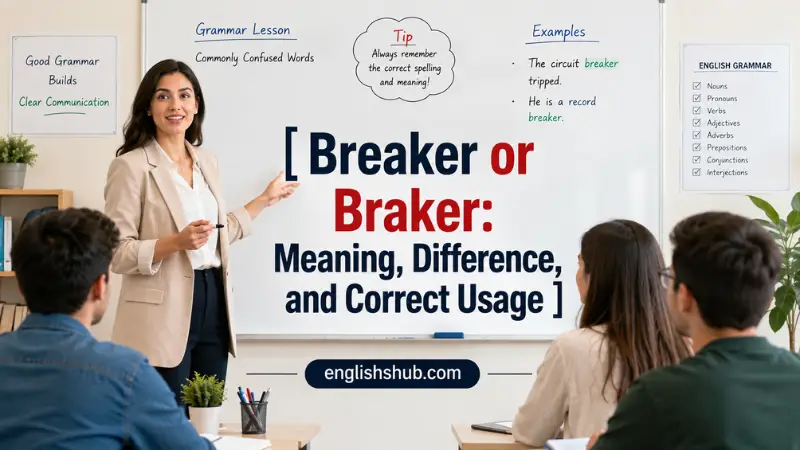
When choosing between breaker or braker, use breaker in nearly every ordinary situation. It is the standard noun for someone or something that breaks, interrupts, or surpasses something. Therefore, phrases such as circuit breaker, deal breaker, and record breaker all use breaker.
However, braker is not always a meaningless misspelling. Dictionaries record it as a rare occupational noun related to a specialized machine called a brake. The two spellings are real, but they are not interchangeable.
Quick Answer
Breaker is correct for electrical devices, breaking waves, people who break rules, achievements that surpass records, and conditions that end agreements. Braker is a rare specialized word for a worker who operates a particular type of machine. In almost all everyday choices between breaker or braker, write breaker.
Key Takeaways
- Breaker is the correct choice in familiar modern contexts.
- Braker has a rare, specialized occupational meaning.
- A circuit protection device is a circuit breaker.
- Conditions that end agreements are deal breakers.
- Use the base word to choose the spelling.
- Pronunciation alone cannot reveal the correct form.
Breaker and Braker at a Glance
| Context | Correct form | Meaning or use | Example |
|---|---|---|---|
| Electricity | breaker | Device that interrupts a circuit | The breaker tripped. |
| Ocean | breaker | Wave that breaks into foam | Breakers reached the shore. |
| Business | deal breaker | Unacceptable condition | The extra fee was a deal breaker. |
| Sports | record breaker | Someone who surpasses a record | She became a record breaker. |
| Conduct | rule breaker | Person who violates a rule | The coach warned the rule breaker. |
| Specialized occupation | braker | Worker using a particular brake machine | The factory employed a braker. |
Is Breaker or Braker Correct?
Breaker is the correct word in almost every context readers are likely to encounter. It comes from the verb break and functions as an agent noun. In other words, it names a person or thing that breaks, interrupts, opens, or surpasses something.
Braker should not replace it in expressions connected with electricity, waves, records, rules, or agreements. These forms are incorrect:
- circuit braker
- deal braker
- record braker
- rule braker
- tie braker
Nevertheless, saying that braker can never be correct goes too far. It has an established but extremely narrow meaning. Context—not pronunciation—determines which spelling belongs in a sentence.
What Does Breaker Mean?
A breaker is generally a person, object, machine, or force that breaks something.
Merriam-Webster’s entry for “breaker”
records meanings that include a person or thing that breaks, an electrical device, and a wave breaking into foam.
Those definitions explain why the word appears in several unrelated settings. The shared idea is that something becomes broken, interrupted, opened, defeated, or brought to an end.
Common meanings include:
- An electrical safety device: A circuit breaker opens an electrical circuit under unsafe conditions.
- A breaking wave: Breakers form when waves crest and collapse into foam.
- A person who violates something: A rule breaker does not follow a rule.
- A person who surpasses something: A record breaker exceeds an earlier record.
- An unacceptable condition: A deal breaker causes someone to reject an arrangement.
- A machine: Some industrial breakers crush rock, coal, or other material.
The Cambridge English Dictionary
also records the coastal-wave meaning and uses involving people who force things open. This range shows why the surrounding words matter when interpreting breaker.
Is Braker a Real Word?
Yes, braker is a real word, but it is rare and specialized. It is not the ordinary spelling of breaker, nor should it be used as a general name for an electrical device.
Merriam-Webster defines “braker”
as a worker who rolls dough for baked goods or macaroni products in a machine called a brake. The dictionary also gives rollerman as another name for that worker.
This occupational sense will be unfamiliar to most readers. As a result, braker in an ordinary sentence is much more likely to be a spelling error, a surname, a company name, or another proper noun. Use the rare common noun only when the specialized occupation is genuinely intended.
Break, Brake, Breaker, and Braker
The easiest way to understand the spellings is to look at their base words.
| Word | Part of speech | Basic meaning | Related form |
|---|---|---|---|
| break | verb or noun | damage, separate, interrupt, or pause | breaker |
| brake | verb or noun | slow or stop movement; a stopping mechanism | braker in rare specialized use |
| breaker | noun | person or thing that breaks | circuit breaker |
| braker | rare noun | worker operating a specific brake machine | occupational usage |
Break and brake are homophones in standard American English. They sound alike but have different spellings and meanings. Their derived forms can also sound alike, which explains much of the confusion.
Consider these examples:
- Press the brake to slow the car.
- Do not break the glass.
- Reset the circuit breaker.
- The historical job title was braker.
A useful rule follows from this word family: if the meaning involves breaking or interrupting something, retain the ea from break and write breaker.
Common Breaker Compounds
The word breaker appears in many open, closed, and hyphenated compounds. Familiar examples include circuit breaker, icebreaker, lawbreaker, tie-breaker, and deal breaker.
Circuit breaker
A circuit breaker interrupts electrical current when unsafe conditions arise. In ordinary home use, people often shorten the full term to breaker:
- The circuit breaker tripped during the storm.
- Check the breaker panel before calling an electrician.
Because the device breaks or interrupts a circuit, circuit braker is incorrect.
Deal breaker
A deal breaker is a fact or condition that makes someone reject a plan, purchase, agreement, or relationship:
- A long commute would be a deal breaker for Maya.
- Hidden fees became the biggest deal breaker.
Major US dictionaries commonly show deal breaker as two words. Follow the style guide used by your school, publisher, or workplace when the term modifies another noun.
Record breaker and rule breaker
A record breaker surpasses an existing achievement. A rule breaker violates an established rule.
When these expressions appear before another noun, writers may use a hyphen for clarity:
- a record-breaking performance
- a rule-breaking student
Notice that the adjective normally changes to breaking. It does not become record-breaker performance.
Tie-breaker and icebreaker
A tie-breaker settles an equal score or result. An icebreaker begins a conversation or reduces social tension. Dictionary styles may vary on whether certain compounds are closed or hyphenated, so checking a current dictionary is sensible.
Common Spelling Mistakes
Most errors occur because writers connect every related idea with brake. However, a braking system and an electrical circuit use different base words.
| Incorrect | Correct | Reason |
|---|---|---|
| The circuit braker tripped. | The circuit breaker tripped. | The device breaks the circuit. |
| That price is a deal braker. | That price is a deal breaker. | The condition breaks the deal. |
| He is a rule braker. | He is a rule breaker. | The person breaks a rule. |
| She became a record braker. | She became a record breaker. | She broke a record. |
| The tie braker begins now. | The tie-breaker begins now. | It breaks the tie. |
| Press the car breaker. | Press the car brake. | A vehicle uses a brake to slow down. |
Another mistake is treating braker as an accepted alternative spelling. It is not comparable to variations such as color/colour. The two forms have separate origins and uses.
How to Remember the Difference
Use this three-step test whenever the spelling is uncertain:
- Find the base action. Is someone or something breaking, interrupting, opening, or surpassing something?
- Keep the base spelling. If the answer is yes, start with break.
- Add the agent ending. Break + er becomes breaker.
You can also remember this short pattern:
A breaker breaks; a brake slows.
That rule resolves nearly every everyday example. A circuit breaker breaks a circuit, a tie-breaker breaks a tie, and a record breaker breaks a record.
Reserve braker for a clearly identified specialized occupation or an official proper name. If the rare word might confuse readers, define it at first use.
Breaker or Braker in American and British English
American and British English both use breaker in familiar expressions. The standard spelling does not change simply because the audience is in the United Kingdom rather than the United States.
For example, both varieties recognize electrical circuit breakers and ocean breakers. British English also uses breaker for a person or business that dismantles old vehicles or ships for salvage.
The rare word braker remains meaning-specific. It is not a regional substitute for breaker. Therefore, writers should not present the choice as an American-versus-British spelling difference.
FAQs
Braker is usually a misspelling when someone means an electrical device, ocean wave, deal-ending condition, or person who breaks something. However, it is also a rare dictionary word for a worker who operates a specialized machine used to roll dough.
The correct expression is circuit breaker. The device interrupts—or breaks—the electrical circuit when certain unsafe conditions occur. Circuit braker is not an accepted alternative spelling and should be corrected in technical, professional, and everyday writing.
Deal breaker is generally written as two words when used as a noun. For example, “The high monthly fee was a deal breaker.” Some related modifiers may be hyphenated when clarity requires it, but deal braker is always wrong.
People sometimes form braker informally for someone who brakes, as in left-foot braker. However, this use is uncommon and may look like an error. In general writing, “a driver who brakes with the left foot” is usually clearer.
They are normally pronounced alike in American English: /ˈbreɪkər/. Because pronunciation does not reveal the spelling, choose the form by meaning. Use breaker for something connected with break and reserve braker for its rare specialized use.
Record breaker is correct because the person, performance, or achievement breaks an existing record. When the idea modifies a noun, use record-breaking, as in “a record-breaking performance.” Neither construction uses braker.
Yes. Braker can appear as a surname, organization name, brand, or other proper noun. Proper names retain their official spelling, even when that spelling differs from the common word a reader expects. Check the original source before changing a name.
Conclusion
When deciding between breaker or braker, choose breaker for nearly every familiar meaning. It is correct for electrical devices, waves, records, rules, ties, and conditions that end an agreement. The word keeps the ea because it comes from break.
Still, braker is not always meaningless. It has a rare occupational definition and can also appear as a proper name. Use it only when that narrow meaning or official name is intended. For the simplest reminder, keep this rule in mind: a breaker breaks, while a brake slows.