
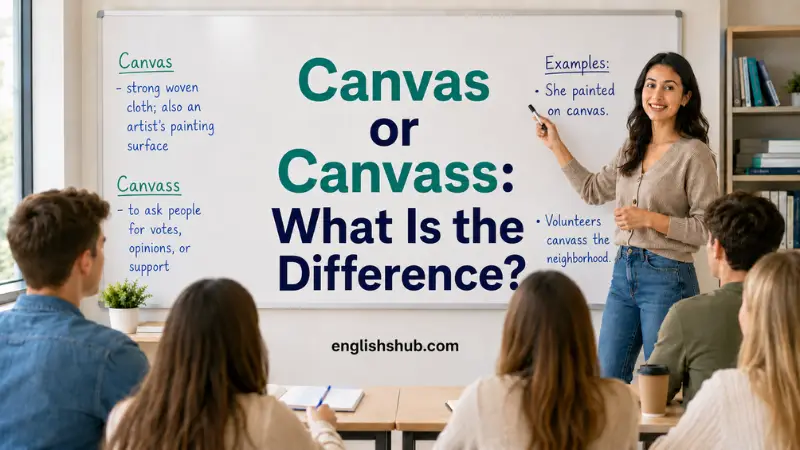
Choosing canvas or canvass depends on what you mean. Canvas usually names a strong fabric, an artist’s painting surface, or a background for creative work. Canvass usually means asking people for opinions or support, examining something carefully, or conducting organized outreach.
The two words sound the same, and only one letter separates their spellings. However, they are not interchangeable in standard modern writing. Understanding their meanings is more reliable than memorizing a simple noun-versus-verb rule.
Quick Answer
Use canvas for strong cloth, a surface used for painting, or a figurative background, as in “a blank canvas.” Use canvass for seeking votes, collecting opinions, questioning people, or examining an issue carefully. Canvass can also be a noun that names an organized survey or outreach effort.
Key Takeaways
- Canvas usually names fabric, artwork, or a creative surface.
- Canvass usually means to survey, question, examine, or seek support.
- Both words have the same standard pronunciation.
- Canvass can function as either a verb or a noun.
- Choose by meaning, not only by grammatical role.
Canvas or Canvass at a Glance
| Context | Correct Word | Meaning | Example |
|---|---|---|---|
| Art | canvas | A painting surface or work painted on it | She placed the canvas on an easel. |
| Fabric | canvas | Strong, closely woven cloth | The tools were stored in a canvas bag. |
| Figurative setting | canvas | A background for ideas or events | The wall became a canvas for the mural. |
| Opinion research | canvass | Ask people what they think | Researchers will canvass local residents. |
| Campaign activity | canvass | Seek votes or political support | Volunteers canvassed the neighborhood. |
| Careful review | canvass | Examine or discuss thoroughly | The committee canvassed every proposal. |
| Organized outreach | canvass | A survey or support-seeking effort | The group completed its annual canvass. |
What Does Canvas Mean?

Canvas is most often a noun referring to a strong, closely woven material. Manufacturers may use this cloth for bags, tents, covers, shoes, sails, and other durable products. Artists also stretch it over a frame to create a surface for painting.
The word can name either the material or the artwork painted on it. Therefore, “The artist bought some canvas” refers to the material, while “The gallery displayed three canvases” refers to individual works or painting surfaces.
Canvas also appears in figurative language. A person might describe an empty room, unwritten page, or new opportunity as “a blank canvas.” In that expression, it means an open background on which something new can be created.
Modern technology uses the same metaphor. For example, a design program may call its working area a digital canvas because users place visual elements on it.
The Merriam-Webster definition of canvas
records its uses for cloth, paintings, narrative settings, needlework, sails, and ring floors. These established senses show why context matters: the word reaches beyond an artist’s physical painting surface.
What Does Canvass Mean?
Canvass is usually a verb meaning to approach people for information, opinions, orders, donations, or political support. Campaign volunteers may canvass voters, while a business may canvass customers before releasing a product.
It can also mean to examine, debate, or consider something in detail. For instance, a hiring committee might canvass several proposals before making a decision. Investigators may canvass an area by visiting nearby homes or businesses and asking whether anyone witnessed an event.
Although it appears less often, canvass can be a noun. In that role, it names the act or result of surveying people, seeking support, or reviewing votes. For example, “The canvass lasted three days” describes an organized effort rather than the people performing it.
The Merriam-Webster entry for canvass
lists both verb and noun uses. It also includes soliciting support, determining opinions, and examining matters closely, so the word is not limited to political campaigning.
The Main Difference Between Canvas and Canvass
The main difference is meaning: canvas concerns a material, surface, object, or background, whereas canvass concerns asking, surveying, seeking, or examining.
A grammatical shortcut can help. Canvas is normally a noun, while canvass is commonly a verb. Still, that shortcut is not a complete rule because canvass can also be a noun.
Use this three-step test:
- If the sentence refers to cloth, art, or a creative background, choose canvas.
- If someone is asking people, seeking support, or studying an issue, choose canvass.
- If the word names an organized outreach effort, choose the noun canvass.
Consider this paired example:
Volunteers canvassed the neighborhood before painting their ideas on a large canvas.
The volunteers asked people for input, so the verb needs two final s letters. The painting surface is a physical object, so it uses one.
Parts of Speech and Word Forms
The word forms create another common source of spelling mistakes.
| Base Word | Grammatical Use | Related Form | Example |
|---|---|---|---|
| canvas | singular noun | canvas | The canvas is ready. |
| canvas | plural noun | canvases | The museum owns six canvases. |
| canvass | base verb | canvass | We will canvass residents. |
| canvass | past-tense verb | canvassed | They canvassed the entire block. |
| canvass | participle or gerund | canvassing | The team is canvassing today. |
| canvass | person performing the action | canvasser | Each canvasser received a map. |
| canvass | countable noun | canvasses | Two separate canvasses were conducted. |
The plural of canvas is canvases, with one s before the ending. By contrast, the past tense of canvass is canvassed, and its -ing form is canvassing.
Some dictionaries record variant spellings in limited uses. However, standard editing practice keeps canvas for material and art and canvass for surveys, outreach, or examination. Maintaining that distinction makes a sentence easier to understand.
How to Use Canvas in a Sentence
Use canvas when the sentence concerns art, durable material, a setting, or an open space for creation.
- The painter stretched a clean canvas over the wooden frame.
- We packed the supplies in a heavy canvas backpack.
- Rain struck the canvas roof of the tent.
- Her first exhibition included ten colorful canvases.
- The empty courtyard offered a blank canvas for the designer.
- The historical novel unfolds against a broad social canvas.
- Select a larger digital canvas before starting the illustration.
Notice that the word generally names something. It may name cloth, an individual painting, a physical surface, or a figurative setting. Even the digital meaning grows from the idea of a space on which someone creates.
How to Use Canvass in a Sentence
Use canvass when a person or organization gathers information, requests support, examines possibilities, or conducts outreach.
- Volunteers will canvass voters before the city election.
- The company canvassed customers about the proposed design.
- Officers are canvassing nearby stores for possible witnesses.
- We should canvass every available option before deciding.
- The charity organized a neighborhood canvass for donations.
- Committee members canvassed the arguments at length.
- Each canvasser received a list of assigned streets.
The object after the verb often reveals its meaning. Someone may canvass voters, residents, businesses, opinions, options, or an area. In every case, the action involves purposeful inquiry, examination, or solicitation.
Canvass in U.S. Elections
In American election language, canvass can describe two related but different processes.
First, political campaigns canvass communities by contacting voters. Volunteers may knock on doors, make calls, distribute information, ask about local concerns, or encourage support for a candidate. This activity happens before or during voting.
Second, election officials conduct a canvass after voting. In that context, canvassing means reviewing and compiling election returns as part of confirming the official result. It is not another word for recounting every ballot, although a jurisdiction’s procedures can include reviewing records and resolving reported discrepancies.
The U.S. Election Assistance Commission explains that election administration follows procedures established by state and local authorities. Therefore, the exact certification and canvassing process varies by jurisdiction. Writers should identify whether they mean voter outreach or the official review of returns instead of assuming the two activities are identical.
Common Mistakes and Corrections
The most common error is using the art-and-fabric spelling for an action.
Incorrect: Campaign workers will canvas the neighborhood.
Preferred: Campaign workers will canvass the neighborhood.
The workers are seeking information or support. Therefore, the standard spelling has a double s.
Incorrect: She bought a new canvass for her painting.
Correct: She bought a new canvas for her painting.
Here, the word names an artist’s surface, so it ends with one s.
Incorrect: The police conducted a canvas of nearby businesses.
Preferred: The police conducted a canvass of nearby businesses.
Although the word is a noun in this sentence, it still names an organized inquiry. This example shows why “canvas is a noun; canvass is a verb” is not a perfect rule.
Incorrect: Three canvas’s hung in the gallery.
Correct: Three canvases hung in the gallery.
The plural needs -es, not an apostrophe. An apostrophe would normally indicate possession, as in “the canvas’s rough texture.”
How to Remember the Difference
Connect the double s in canvass with seek support or survey streets. Both reminder phrases contain repeated s sounds and point toward asking people for information or help.
You can also use this short contrast:
- An artist uses a canvas.
- A survey team conducts a canvass.
The memory aid works best when paired with meaning. If people are actively asking, examining, polling, or seeking, the extra s is usually needed. If the sentence describes fabric, painting, or a creative surface, use canvas.
Word Origin and Historical Connection
The similar spellings are not accidental because canvass developed from canvas. Early senses of the verb involved handling or tossing something in a canvas sheet. Over time, the idea shifted toward examining, discussing, or “sifting” a matter thoroughly.
Political meanings developed later from the ideas of examining votes and approaching people for support.
Merriam-Webster’s history of the word canvass
traces this movement from a physical canvas sheet to examination, debate, and political activity. The history explains the connection, but modern writers should preserve the conventional spelling distinction.
FAQs
No. In standard American English, canvas and canvass are generally pronounced alike: KAN-vuhs. They are homophones because they share a pronunciation but have different spellings and meanings. The surrounding sentence usually reveals which word a speaker means.
Canvas is normally used as a noun in careful modern writing. It may name fabric, a painting surface, an artwork, or a figurative background. Some dictionaries record less common variant verbal uses, but using canvass for surveying or seeking support creates a clearer distinction.
Yes. Canvass can be a noun meaning an organized survey, outreach campaign, solicitation effort, or official review of election returns. For example, “The county completed its canvass” uses the word as a noun, not a verb.
Police generally canvass a neighborhood. They visit an area, question residents, contact businesses, or search for witnesses and useful information. The action involves organized inquiry, so the standard spelling ends in double s.
Canvas bag is the standard expression because the modifier identifies the bag’s material. The same pattern appears in canvas shoes, canvas tent, and canvas cover. Canvass bag would incorrectly suggest that the bag is connected with a survey or outreach effort.
“Blank canvas” ends with one s. Literally, it can mean an unused painting surface. Figuratively, it describes something open to development, such as an empty room, a fresh document, or a new stage of life.
Conclusion
Choose canvas or canvass by checking the sentence’s meaning. Use canvas for cloth, paintings, surfaces, and figurative backgrounds. Use canvass when someone surveys people, seeks support, examines choices, or performs an organized inquiry.
The noun-versus-verb shortcut helps in many sentences, but it has limits because canvass can also be a noun. A meaning-first check is more dependable: artists work on canvas, while campaigners, researchers, officials, and investigators conduct a canvass or canvass a group.