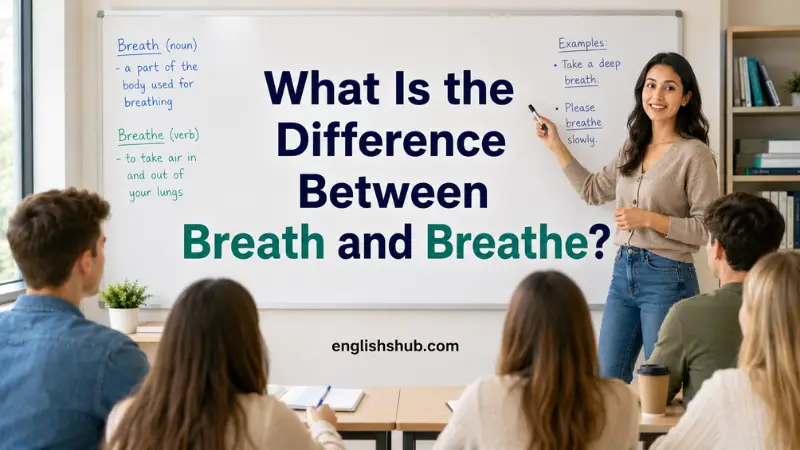
Choosing between breath or breathe becomes easy once you know each word’s job. Breath is a noun that names the air you take in or one cycle of breathing. In contrast, breathe is a verb that describes the action of moving air into and out of your lungs.
The final e changes more than the spelling. It also changes the word’s grammar and pronunciation. Therefore, checking whether your sentence needs a thing or an action usually reveals the correct choice.
Quick Answer
Use breath as a noun and breathe as a verb. You take a breath, hold your breath, or lose your breath, but you breathe slowly, struggle to breathe, or breathe fresh air. Breath sounds like “breth,” while breathe rhymes with “seethe.”
Key Takeaways
- Breath is a noun that names air or one breathing cycle.
- Breathe is a verb that describes inhaling and exhaling.
- The final e gives breathe a longer vowel sound.
- Use breath after words such as a, the, and your.
- Use breathe where the sentence needs an action.
- The past tense of breathe is breathed.
Breath or Breathe at a Glance
| Feature | Breath | Breathe |
|---|---|---|
| Part of speech | Noun | Verb |
| Main meaning | Air or one breathing cycle | To move air into and out of the lungs |
| Pronunciation | “Breth” | “Breeth” |
| Example | Take a deep breath. | Try to breathe slowly. |
| Common pattern | a/the/your + breath | to/can/should + breathe |
| Related forms | breaths | breathes, breathed, breathing |
| Figurative example | a breath of fresh air | breathe new life into |
What Is the Difference Between Breath and Breathe?
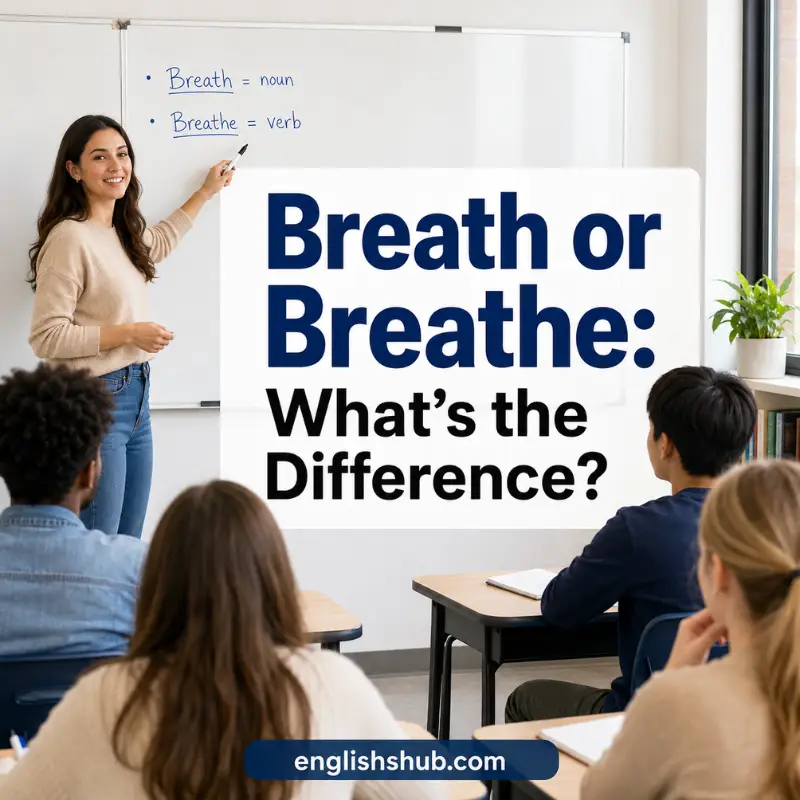
The main difference is grammatical. Breath names something, so it functions as a noun. Breathe expresses an action, so it functions as a verb.
Consider these two sentences:
- Take a deep breath before you speak.
- Breathe deeply before you speak.
In the first sentence, breath is the thing being taken. In the second, breathe is the action the person performs. Both sentences describe a similar situation, but they require different parts of speech.
The distinction appears in established dictionary guidance as well.
Merriam-Webster explains that breath is the noun and breathe is the verb.
This grammatical rule matters because the words cannot normally replace each other without making the sentence incorrect.
What Does Breath Mean?
Breath is a noun that most often means the air moved into or out of the lungs. It can also name one complete act of inhaling and exhaling.
Examples include:
- I could see my breath in the cold air.
- She took a slow breath before answering.
- Hold your breath while you go underwater.
- The runner stopped to catch his breath.
- Garlic can leave a strong smell on your breath.
A noun can follow an article or a possessive word. Therefore, phrases such as a breath, the breath, my breath, and your breath are correct.
Cambridge Dictionary defines breath as the air that enters and leaves the lungs.
It also records expressions connected with resting, waiting, and controlling one’s breathing, which explains why the noun appears in many everyday phrases.
Other Meanings of Breath
The noun may describe a brief pause, a faint movement of air, or a slight trace of something.
- Let us stop for a breath.
- Not a breath of wind moved the trees.
- The redesign gave the room a breath of fresh air.
These meanings remain nouns. Even when breath is figurative, it still names a thing, moment, or impression.
What Does Breathe Mean?
Breathe is a verb meaning to draw air into the lungs and release it. Because it describes an action, it often follows words such as to, can, could, should, or must.
Examples include:
- Remember to breathe.
- I can hardly breathe in this stuffy room.
- The coach told us to breathe slowly.
- Plants also need suitable conditions to breathe and grow.
- Open the window so the room can breathe.
The verb can be transitive or intransitive. In “She breathed deeply,” no object follows the verb. In “She breathed fresh air,” fresh air receives the action.
Cambridge defines breathe as moving air into and out of the lungs.
The dictionary also records extended meanings, such as speaking very softly or allowing air to pass around something. These uses still describe an action.
Figurative Uses of Breathe
Breathe does not always refer directly to respiration. It may mean giving energy, allowing space, speaking softly, or exposing something to air.
- The new manager breathed life into the project.
- Leave more white space so the design can breathe.
- Do not breathe a word about the surprise.
- Let the wine breathe before serving it.
- The quiet room seemed to breathe peace.
Each example still requires a verb. Something acts, changes, rests, or becomes noticeable.
How to Pronounce Breath and Breathe
The two words have different vowel and th sounds.
Breath is pronounced approximately as “breth.” It has a short e sound, like the vowel in bed. Its final th is unvoiced, like the sound in think or path. It rhymes with death.
Breathe is pronounced approximately as “breeth.” It has a long e sound, like the vowel in see. Its final th is voiced, like the sound in this or smooth. It rhymes with seethe.
Place your fingers lightly against your throat. You should feel vibration during the final sound of breathe. However, you should feel little or no vibration during the final sound of breath.
How to Remember the Correct Spelling
The easiest method is to connect the extra e in breathe with the long “ee” sound in its pronunciation. Both breathe and verb also contain the letter e, while breath and noun do not end in e.
You can use three quick reminders:
- Action needs the extra e: If someone performs the action, use breathe.
- A thing takes an article: If a or the fits before it, use breath.
- Long sound, longer spelling: Breathe has the longer “ee” sound and one extra letter.
For example, “Take a ___” must use breath because a signals a noun. By comparison, “Try to ___ slowly” needs breathe because to usually introduces the base form of a verb.
Breath and Breathe in Sentence Patterns
Sentence structure often identifies the correct word before you consider its meaning.
| Sentence pattern | Correct word | Example |
|---|---|---|
| a/an + ___ | breath | Take a breath. |
| possessive + ___ | breath | I held my breath. |
| adjective + ___ | breath | She took a deep breath. |
| to + ___ | breathe | I need to breathe. |
| modal verb + ___ | breathe | You should breathe slowly. |
| subject + ___ + adverb | breathe | He breathes quietly. |
A replacement test can also help. Replace the blank with thing or action. If the word names a thing, moment, or unit, choose breath. If it tells what someone does, choose breathe.
Notice how both words can appear correctly in one sentence:
- Breathe in, hold your breath, and then breathe out.
- She took a breath because she could not breathe comfortably.
- After catching his breath, he began to breathe more slowly.
Common Expressions and Figurative Meanings
Many fixed expressions preserve the same noun–verb rule.
Expressions With Breath
- take a breath: inhale once or pause briefly
- hold your breath: stop breathing temporarily
- catch your breath: return to normal breathing
- out of breath: breathing heavily after effort
- under your breath: in a very quiet voice
- do not hold your breath: do not expect something soon
- a breath of fresh air: a welcome and refreshing change
Expressions With Breathe
- breathe deeply: take air in and release it slowly
- breathe easy: stop worrying
- breathe a sigh of relief: relax after worry ends
- breathe new life into: restore energy or interest
- live and breathe something: care deeply about an activity
- breathe down someone’s neck: watch or pressure someone closely
- do not breathe a word: keep information secret
Merriam-Webster defines
as relaxing after a feared problem or danger has passed. The expression uses breathe because the subject performs the action, even though the entire phrase describes an emotional response.
Common Mistakes and Corrections
Most errors happen when writers spell the verb without its final e. Checking the word’s role will fix the problem.
| Incorrect sentence | Correct sentence | Reason |
|---|---|---|
| I cannot breath well. | I cannot breathe well. | The sentence needs a verb. |
| Take a deep breathe. | Take a deep breath. | The article a requires a noun. |
| She held her breathe. | She held her breath. | The possessive her modifies a noun. |
| Try to breath slowly. | Try to breathe slowly. | To introduces the verb. |
| He breathe heavily. | He breathes heavily. | A singular subject needs breathes. |
| The dog breath fast. | The dog breathes fast. | The sentence describes an action. |
Also avoid confusing breath with breathing. Breathing can name the process, as in “Her breathing became slower.” However, breath usually refers to the air, ability, or one cycle.
Related Forms of Breath and Breathe
Breath has the regular plural form breaths. The final th remains unvoiced, but the ending adds a plural sound.
- Take three slow breaths.
- His short breaths showed that he was tired.
Breathe changes form like a regular verb:
- Base form: breathe
- Third-person singular: breathes
- Past tense: breathed
- Past participle: breathed
- Present participle: breathing
Examples:
- She breathes through her nose.
- He breathed a sigh of relief.
- They were breathing slowly.
- We have breathed cleaner air since moving.
Do not add another e before -ing. The correct spelling is breathing, not breatheing.
Practice: Choose Breath or Breathe
Complete each sentence before checking the answers.
- Please _____ slowly and relax your shoulders.
- I took a deep _____ before entering the room.
- We could see our _____ in the winter air.
- Open the windows and let the house _____.
- She was out of _____ after climbing the stairs.
- He _____ new life into the old community program.
- Take two slow _____ before you answer.
- I could hardly _____ because of the smoke.
Answers
- breathe — The sentence needs an action.
- breath — A introduces a noun.
- breath — The word names visible exhaled air.
- breathe — The house is allowed to receive air.
- breath — Out of breath is a fixed expression.
- breathed — The sentence requires the past-tense verb.
- breaths — A number requires the plural noun.
- breathe — Could is followed by a base verb.
FAQs
“Take a deep breath” is correct. The article a and adjective deep describe a noun. Breathe is a verb, so you could instead say, “Breathe deeply.”
“I can’t breathe” is correct because the sentence needs a verb after can’t. Breath would be a noun and cannot perform that grammatical job.
The past tense of breathe is breathed. For example, “She breathed slowly until she felt calm.” The final e remains before the -d ending.
Breathing can work as a verb form or a noun. It is a verb in “The baby is breathing.” It functions as a noun in “Slow breathing helped him relax.”
The final e separates the verb from the related noun and helps indicate its long vowel sound. Breathe has a long “ee” sound, while breath has a short e sound.
Yes. For example, “Take a breath, then breathe out slowly” uses breath as the thing taken and breathe as the action performed. Their different grammatical roles make both spellings necessary.
“Bad breath” is correct because the phrase names air with an unpleasant smell. Bad is an adjective modifying the noun breath. The verb would require an adverb, although “breathe badly” usually describes difficulty breathing rather than odor.
Conclusion
The choice between breath or breathe depends on the job the word performs. Use breath when you need a noun that names air, a breathing cycle, or a pause. Use breathe when you need a verb that expresses an action.
When uncertain, check the word before the blank. A, the, or a possessive usually points to breath. Meanwhile, to, can, could, or should usually points to breathe. Remember: the action word has the extra e and the longer “ee” sound.