
The difference between inpatient or impatient comes down to meaning and context. Inpatient is a healthcare term for someone receiving medical treatment while staying in a hospital or similar facility. Impatient describes someone who is unwilling to wait calmly, or who is eager for something to happen.
The words look almost identical because they share patient, but the first part changes the meaning completely. Once you connect each spelling with its context, choosing the correct word becomes much easier.
Quick Answer
Inpatient refers to a person receiving medical care while staying in a hospital or healthcare facility. Impatient describes someone who cannot wait calmly, feels frustrated by delays, or is eager for something to happen. Use inpatient for medical status and impatient for feelings, behavior, or eagerness.
TL;DR
- Inpatient refers to a person receiving medical care while staying in a facility.
- Impatient describes difficulty waiting calmly or eagerness.
- Inpatient can function as a noun or healthcare modifier.
- Impatient is an adjective.
- Inpatient pairs naturally with outpatient in healthcare.
- Context usually reveals the correct spelling immediately.
Inpatient or Impatient at a Glance
| Feature | Inpatient | Impatient |
| Basic meaning | A person receiving medical care while staying in a facility | Unable or unwilling to wait calmly |
| Main context | Healthcare | Everyday, professional, and personal communication |
| Part of speech | Noun; also used as a modifier | Adjective |
| Related term | Outpatient | Patient |
| Common phrase | Inpatient care | Impatient with delays |
| Example | “He is an inpatient after surgery.” | “She became impatient after the delay.” |
Merriam-Webster defines inpatient as a hospital patient who receives lodging and treatment, while its definition of impatient covers restlessness, short temper, intolerance of delay, and eagerness.
What Does Inpatient Mean?
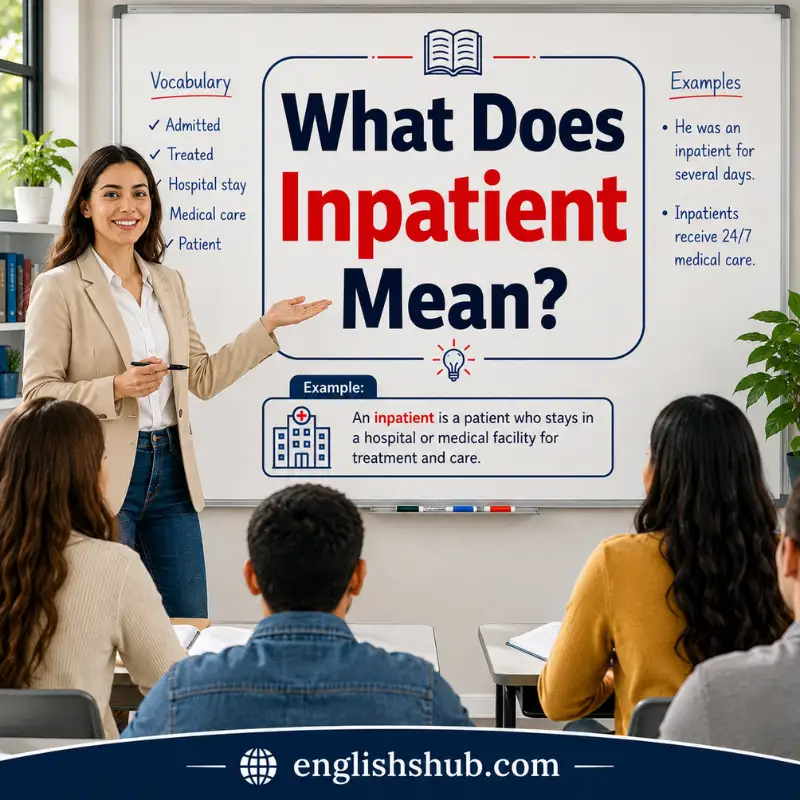
Inpatient is a healthcare noun for a person who stays in a hospital for medical treatment. Cambridge Dictionary describes an inpatient as someone who goes into a hospital for care and remains there for one or more nights while receiving treatment.
The word can also work as a modifier before another noun. Common examples include inpatient care, inpatient treatment, inpatient unit, and inpatient services. Merriam-Webster also notes that inpatient is commonly used before another noun in expressions such as inpatient surgery and inpatient treatment.
Examples:
- The hospital admitted him as an inpatient.
- She remained an inpatient after surgery.
- The facility provides inpatient care.
- The doctor recommended inpatient treatment.
- The hospital expanded its inpatient unit.
The key idea is medical status or medical care, not emotion.
What Does Impatient Mean?
Impatient is an adjective describing someone who has difficulty waiting calmly. It can suggest irritation, restlessness, or a strong desire for something to happen soon. Merriam-Webster also lists a sense in which impatient means eagerly desirous, so the word does not always describe anger or bad behavior.
For example:
- She became impatient after waiting for an hour.
- The children were impatient for lunch.
- He was impatient with the slow service.
- We were impatient to hear the results.
- The manager grew impatient with repeated delays.
These patterns make the word useful far beyond casual conversation. You can describe a customer, student, employee, traveler, child, manager, or anyone else who is struggling with a delay or eager for an outcome.
For a fuller language distinction involving the related word patience, EnglishShub also explains how patients and patience differ in meaning and spelling.
Patients and Patience explanation
Inpatient vs Impatient: The Main Difference
The simplest distinction is this:
Inpatient = medical status.
Impatient = emotional or behavioral state.
An inpatient is connected with healthcare. An impatient person is having difficulty waiting or is eager for something to happen.
Consider these pairs:
- The doctor admitted an inpatient.
The word identifies a person receiving medical care. - The customer became impatient.
The word describes the customer’s reaction to a delay.
The difference becomes even clearer when you place both words in one sentence:
The inpatient became impatient while waiting for the doctor.
Both words are correct. Inpatient identifies the person’s medical status, while impatient describes the person’s behavior at that moment.
That example shows why the two words should not be treated as interchangeable. Their similar spelling does not mean they have similar meanings.
Inpatient vs Outpatient: The Healthcare Pair
Inpatient and outpatient are the more natural comparison in healthcare. An inpatient receives care while staying in a healthcare facility, whereas outpatient care does not involve an overnight hospital stay. The Centers for Medicare & Medicaid Services glossary describes outpatient care as care that does not include an overnight hospital stay or admission as an inpatient.
Compare:
| Term | Basic meaning | Example |
| Inpatient | Receives care while staying in a healthcare facility | “She is an inpatient after surgery.” |
| Outpatient | Receives care without being admitted for an overnight stay | “He received the procedure as an outpatient.” |
This distinction is useful because impatient is not the opposite of inpatient. Impatient belongs to a completely different meaning system. It describes patience, waiting, or eagerness.
So if you see inpatient in a medical document, think about admission and treatment. If you see impatient in an email, conversation, or story, think about waiting and behavior.
How Pronunciation Helps You Tell Them Apart
The two words sound similar, but they are not pronounced exactly the same. Cambridge gives inpatient as /ˈɪn.peɪ.ʃənt/ in its American entry, while Merriam-Webster gives impatient as /ˌɪm-ˈpā-shənt/.
A simple approximation is:
- inpatient: IN-pay-shunt
- impatient: im-PAY-shunt
The stress pattern can help when you hear the words, although context remains the stronger clue. In fast speech, the difference may be easy to miss.
For spelling, focus on the first part:
- in + patient → medical context
- im + patient → not patient, or eager/restless
Do not rely on sound alone when writing. Instead, identify what the sentence means first.
Common Mistakes With Inpatient and Impatient
The most common errors happen when writers choose the word from sound rather than context.
Mistake 1: Using inpatient for frustration
Incorrect: I am inpatient because the bus is late.
Correct: I am impatient because the bus is late.
The sentence describes frustration with waiting, so impatient is required.
Mistake 2: Using impatient for medical care
Incorrect: The doctor recommended impatient treatment.
Correct: The doctor recommended inpatient treatment.
The phrase describes a type of healthcare, so inpatient is the correct modifier.
Mistake 3: Using impatient as a medical noun
Incorrect: She was admitted as an impatient.
Correct: She was admitted as an inpatient.
Here, the word names the person receiving hospital care.
Mistake 4: Treating inpatient as an adjective for personality
Incorrect: He is inpatient with slow customers.
Correct: He is impatient with slow customers.
The phrase impatient with describes someone’s reaction or attitude.
A useful editing habit is to replace the word mentally. If frustrated, restless, or unable to wait fits, choose impatient. If hospital patient or medical stay fits, choose inpatient.
How to Choose the Right Word Every Time
You can usually solve the spelling problem with three quick questions.
1. Is the sentence about waiting or eagerness?
Use impatient.
She became impatient during the long delay.
2. Is the sentence about a hospital or medical treatment?
Use inpatient.
The hospital admitted him as an inpatient.
3. Could you replace the word with “hospital patient”?
If yes, inpatient is probably correct.
This method is more reliable than memorizing isolated spellings because it makes you identify the meaning before choosing the word.
You can also watch for nearby words. Terms such as hospital, admitted, ward, treatment, care, and surgery strongly suggest inpatient. Words such as wait, delay, hurry, eager, frustrated, and results often point toward impatient.
Can You Be Both an Inpatient and Impatient?
Yes. A person can be both at the same time because the words describe different things.
For example:
The inpatient became impatient while waiting for the test results.
Here, inpatient describes the person’s healthcare status. Impatient describes the person’s reaction to waiting.
This is an important edge case because it shows that the words are not opposites. A hospital patient can be calm, anxious, cheerful, frustrated, or impatient. Likewise, someone who is impatient does not have to be in a hospital.
The distinction is therefore about what the word describes, not about whether the two words can appear in the same situation.
A Simple Three-Word Framework
You can remember the relationship by separating three meanings:
- Patient → calm and willing to wait
- Impatient → not willing to wait calmly or eager for something
- Inpatient → a person receiving medical care while staying in a healthcare facility
This framework makes the spelling easier because each word has a different job.
FAQs
Inpatient refers to a person receiving medical treatment while staying in a healthcare facility. Impatient describes someone who is unable or unwilling to wait calmly, or who is eager for something to happen. The correct word depends on whether the sentence concerns medical care or waiting and behavior.
Inpatient is primarily a noun when it names a person receiving hospital care. It is also commonly used as a modifier in healthcare expressions such as inpatient care, inpatient treatment, and inpatient surgery.
No. Impatient often suggests frustration or irritation, but it can also mean eager or strongly desirous of something. For example, “She was impatient to begin” can express eagerness rather than anger.
An inpatient stays in a healthcare facility while receiving treatment, while an outpatient receives care without an overnight hospital stay. These are healthcare categories, so neither term should be confused with impatient.
Yes. For example, “The inpatient became impatient while waiting for the nurse.” The first word describes the person’s medical status, while the second describes the person’s reaction to waiting. Their meanings remain separate even though they refer to the same person.
Think inpatient = medical stay and impatient = cannot wait calmly. You can also use the first letters as a visual clue: in- connects with being in a healthcare facility, while impatient describes being less than patient.
Yes, but only in a medical context where inpatient describes your status as a person receiving care while staying in a healthcare facility. If you mean “I cannot wait” or “I am frustrated by the delay,” write “I am impatient.”
Conclusion
The difference between inpatient or impatient becomes clear when you focus on context. Use inpatient for a person receiving medical care while staying in a healthcare facility, and use impatient for difficulty waiting, frustration, or eagerness.
The fastest test is simple: if the sentence is about a medical stay, choose inpatient. If it is about waiting or behavior, choose impatient. Remembering that distinction will help you avoid one of English’s easiest one-letter word-choice mistakes.