
If you are choosing between imminent or eminent, the correct word depends on what you mean. Imminent describes something that is about to happen soon, while eminent describes someone or something distinguished, prominent, or highly regarded. Both are adjectives, and their similar spelling and pronunciation make them easy to confuse. Merriam-Webster confirms that the words have distinct meanings even though their forms are closely related historically.
The quickest way to remember the difference is simple: imminent is about time; eminent is about standing or reputation. A storm can be imminent, while a respected scientist can be eminent.
Quick Answer
Use imminent when something is about to happen very soon, such as an imminent arrival, deadline, announcement, or storm. Use eminent when someone or something is distinguished, prominent, or highly respected, such as an eminent scholar. A third word, immanent, means existing or operating within something and belongs mainly to philosophical or theological contexts.
TL;DR
- Imminent means about to happen soon.
- Eminent means distinguished, prominent, or highly respected.
- Immanent means existing or operating within something.
- Both imminent and eminent are adjectives.
- Use imminent for timing and eminent for distinction.
- Think immediate → imminent and esteemed → eminent.
Imminent or Eminent at a Glance
| Feature | Imminent | Eminent |
|---|---|---|
| Part of speech | Adjective | Adjective |
| Main meaning | About to happen | Distinguished or prominent |
| Main idea | Nearness in time | High standing or reputation |
| Common subjects | Events, changes, arrivals, danger | People, professionals, qualities, institutions |
| Example | An imminent storm | An eminent scientist |
| Memory clue | Immediate → imminent | Esteemed → eminent |
Merriam-Webster defines imminent as something “ready to take place” or happening soon. It defines eminent in terms of standing above others in quality or position, especially being prominent or distinguished.
That gives you a reliable first test: if the sentence focuses on when something will happen, choose imminent. If it focuses on how distinguished something or someone is, choose eminent.
What Does Imminent Mean?
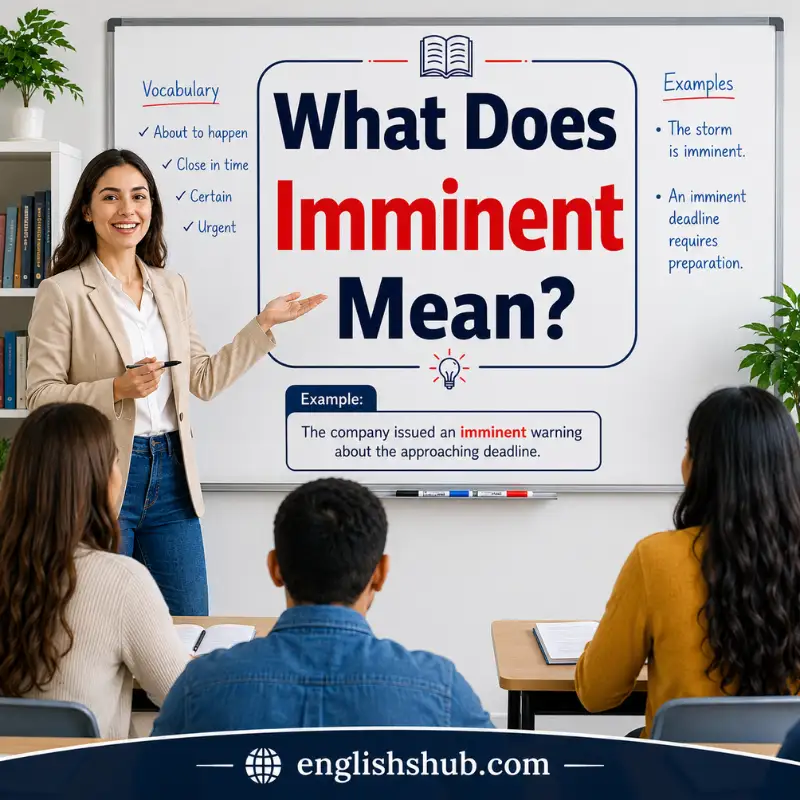
Imminent means that something is expected to happen very soon. It is an adjective connected with approaching events, conditions, changes, or actions. Merriam-Webster gives examples involving an imminent arrival and imminent danger, showing that the word can describe both ordinary events and threatening situations.
For example:
- The train’s arrival is imminent.
- The company announced an imminent change in policy.
- The deadline is imminent.
- Heavy rain appears imminent.
- The baby’s arrival is imminent.
The word often appears in serious contexts because events such as danger, disaster, or loss can be urgent. However, imminent does not automatically mean negative. A celebration, promotion, opening, arrival, or announcement can also be imminent.
For example, “The museum’s reopening is imminent” simply means the reopening is expected soon. It does not suggest danger.
You can verify the basic definition and examples in
Merriam-Webster’s definition of imminent.
What Does Eminent Mean?
Eminent describes someone or something that stands out because of distinction, achievement, importance, quality, or reputation. It is especially common when describing respected professionals, scholars, artists, leaders, and other notable figures. Merriam-Webster defines the adjective in terms of standing above others in quality or position.
Consider these examples:
- She is an eminent historian.
- The university invited an eminent professor.
- He became an eminent physician.
- The conference featured several eminent researchers.
- The museum displayed work by an eminent artist.
Here, the adjective says something about standing or reputation, not timing.
For instance, an “eminent surgeon” is a highly respected surgeon. An “imminent surgeon” would not express that meaning because imminent concerns something approaching in time.
The related noun eminence refers to a position of prominence or superiority, which helps explain why eminent is associated with distinction and high standing.
Why Are Imminent and Eminent Confused?
The words are easy to confuse because they look and sound very similar. They are also both adjectives, so their grammatical roles do not provide an obvious clue. Merriam-Webster notes that they differ by only one vowel sound in pronunciation.
Compare the opening sounds:
- imminent — begins with an “im-” sound
- eminent — begins with an “em-” sound
In rapid speech, that difference can be easy to miss. The spelling creates another problem because both words contain -minent.
Their history also helps explain the similarity. Merriam-Webster traces both words to related Latin roots involving the idea of projecting or standing out, although their meanings developed in different directions.
So the safest approach is not to rely only on sound. Instead, ask what the sentence means.
Time? Choose imminent.
Distinction? Choose eminent.
Imminent, Eminent, and Immanent Compared
Imminent, eminent, and immanent are separate adjectives with different meanings. The third form, immanent, describes something inherent, internal, or existing within something else. Merriam-Webster notes that immanent is pronounced like imminent and is especially associated with philosophical or theological discussion.
| Word | Core meaning | Typical context | Example |
|---|---|---|---|
| Imminent | About to happen | Events and situations | An imminent announcement |
| Eminent | Distinguished or prominent | People and achievements | An eminent scholar |
| Immanent | Existing within or inherent | Philosophy and theology | An immanent quality |
This distinction matters because replacing one word with another can change the entire sentence.
Compare:
- An imminent storm → a storm that is about to arrive.
- An eminent scientist → a highly respected scientist.
- An immanent quality → a quality that exists within something.
The three words may look related, but they answer different questions: When is it happening? How distinguished is it? What exists within it?
Merriam-Webster’s explanation of eminent, imminent, and immanent
How to Choose the Right Word
A simple three-question test can help you choose the correct spelling.
1. Is the sentence about something happening soon?
Use imminent.
The launch is imminent.
The focus is on timing. The launch is expected soon.
2. Is the sentence about someone or something distinguished?
Use eminent.
She is an eminent scientist.
The focus is on professional standing and reputation.
3. Is the sentence about something existing within something else?
Use immanent.
The philosopher described an immanent quality of consciousness.
The focus is on an inherent or internal quality.
For most everyday writing, you will mainly choose between the first two. Therefore, remember:
Imminent = incoming.
Eminent = exceptional.
Immanent = internal.
These memory cues are only shortcuts. The sentence’s meaning remains the final test.
Common Mistakes and Corrections
The most common errors happen when writers choose the word from sound rather than meaning.
| Incorrect | Correct | Why |
|---|---|---|
| An imminent professor | An eminent professor | The professor is distinguished |
| An eminent storm | An imminent storm | The storm is approaching |
| An eminent deadline | An imminent deadline | The deadline is near |
| An imminent historian | An eminent historian | The historian is respected |
| An eminent announcement | An imminent announcement | The announcement is about to happen |
| An imminent quality within a system | An immanent quality | The quality exists within it |
One especially common mistake is assuming that imminent always refers to danger. That is too narrow. Merriam-Webster lists ordinary examples such as an imminent arrival and imminent liftoff alongside threatening situations.
Likewise, eminent does not simply mean “famous.” It often conveys distinction, high standing, or recognized excellence, so context matters.
For a useful EnglishShub word-choice comparison,
see Censored or Sensored,
which similarly shows why identifying the intended meaning should come before selecting the word.
Imminent vs. Immediate vs. Impending
Imminent, immediate, and impending overlap, but they are not interchangeable in every sentence.
Imminent means something is expected to happen very soon:
The election results are imminent.
Immediate often means occurring at once, without delay, or directly connected:
The manager took immediate action.
Impending means approaching or about to happen and often carries a sense of concern:
The company faced an impending financial crisis.
Merriam-Webster lists impending and looming among synonyms related to imminent.
The practical difference is useful. If you mean very soon, imminent often fits. If you mean right now or without delay, immediate is usually better. If you emphasize something approaching, especially something serious, impending may be more natural.
For example:
- Imminent departure = departure expected very soon.
- Immediate departure = departure without delay.
- Impending departure = departure approaching, often with a serious or significant tone.
Choosing the more precise adjective can make professional and academic writing clearer.
Everyday and Formal Examples
Seeing the two words in different settings makes the distinction easier to remember.
Examples with imminent
- The patient’s discharge is imminent.
- The school announced an imminent schedule change.
- Their departure seemed imminent.
- The team’s victory appeared imminent.
- The announcement is imminent.
- A major storm may be imminent.
- The company’s expansion is imminent.
Each example focuses on an event or situation that is close in time.
Examples with eminent
- The university hired an eminent linguist.
- An eminent historian delivered the keynote speech.
- The journal published an article by an eminent scholar.
- Several eminent physicians attended the conference.
- She became an eminent figure in her field.
- The award recognized an eminent researcher.
Each example focuses on reputation, achievement, distinction, or importance.
The words can even appear together naturally:
The eminent physician discussed the patient’s imminent surgery.
Here, eminent describes the physician’s professional standing, while imminent describes the timing of the surgery. That single sentence provides a useful test because both words are correct, but they perform different jobs.
For another EnglishShub example of distinguishing similar-looking expressions, see
One and the Same vs. One in the Same.
FAQs
Both imminent and eminent are correct English words, but they have different meanings. Use imminent for something expected to happen soon and eminent for someone or something distinguished, prominent, or highly respected.
No. Although imminent often appears with danger, disaster, or other serious situations, it can describe positive or neutral events too. An imminent arrival, celebration, opening, promotion, announcement, or launch can simply mean that the event is expected very soon.
An eminent person is someone who stands out because of achievement, reputation, importance, or distinction. The adjective commonly describes respected professionals such as eminent scholars, physicians, historians, scientists, artists, and judges.
They are very similar in pronunciation, but Merriam-Webster notes a difference in the initial vowel sound. That small difference can be difficult to notice in fast speech, which helps explain why writers often confuse their spellings.
Immanent means existing or operating within something or being inherent in it. It is distinct from imminent and eminent and appears especially in philosophical and theological contexts.
Connect imminent with immediate because both point toward something happening soon. Connect eminent with esteemed because both can remind you of distinction and high regard. Then ask whether your sentence is about timing or reputation.
Conclusion
The choice between imminent or eminent becomes simple when you focus on meaning rather than spelling. Use imminent for something that is about to happen, while eminent describes someone or something distinguished, prominent, or highly regarded. If immanent appears, remember that it refers to something existing within or inherent. The fastest test is time = imminent, distinction = eminent, within = immanent. Once you connect each spelling to its central idea, these commonly confused adjectives become much easier to use accurately.