If you are unsure about resume or CV, the answer depends mainly on where you are applying and what type of position you want. In the United States, résumé usually means a short document tailored to a particular job, while CV usually refers to a more detailed record used especially in academic, research, and some professional settings. In British English, however, CV is the normal term for the document people send when applying for jobs. Cambridge and Oxford both identify CV as the British equivalent of North American résumé.
The words also have a language difference that is easy to miss. Résumé is a noun, while resume without the accent marks is also a completely different verb meaning “to begin again.” That distinction matters in careful writing.
Quick Answer
In American English, use résumé for most ordinary job applications and CV mainly for academic, research, or certain specialized positions. In British English, CV is the standard term for a job-application document. When an employer specifically requests one term, follow the employer’s wording and local convention.
TL;DR
- Résumé is the usual U.S. term for a job-focused career document.
- CV means curriculum vitae and has a stronger academic meaning in the U.S.
- British English normally uses CV for ordinary job applications.
- Résumé and resume can be spelling variants of the noun.
- Resume is also a verb meaning “start again.”
- Always consider country, field, and employer instructions.
Resume vs. CV at a Glance
| Feature | Résumé | CV |
|---|---|---|
| Basic U.S. use | Job-focused summary | Detailed academic or professional record |
| Typical purpose | Apply for a specific position | Show broader academic or professional history |
| U.S. business jobs | Usually preferred | Usually not the default |
| U.S. academia | Sometimes used | Commonly expected |
| Research positions | Sometimes appropriate | Often appropriate |
| British job applications | Less usual | Standard term |
| Length | Usually concise | Can be much longer |
| Main focus | Relevant qualifications | Broader career or academic record |
The distinction is a practical U.S. convention, not a universal rule of English. Purdue explains that a résumé is normally targeted to a specific position, while a CV can be substantially longer and is especially associated with academic achievements.
What Does “Resume” Mean in American English?
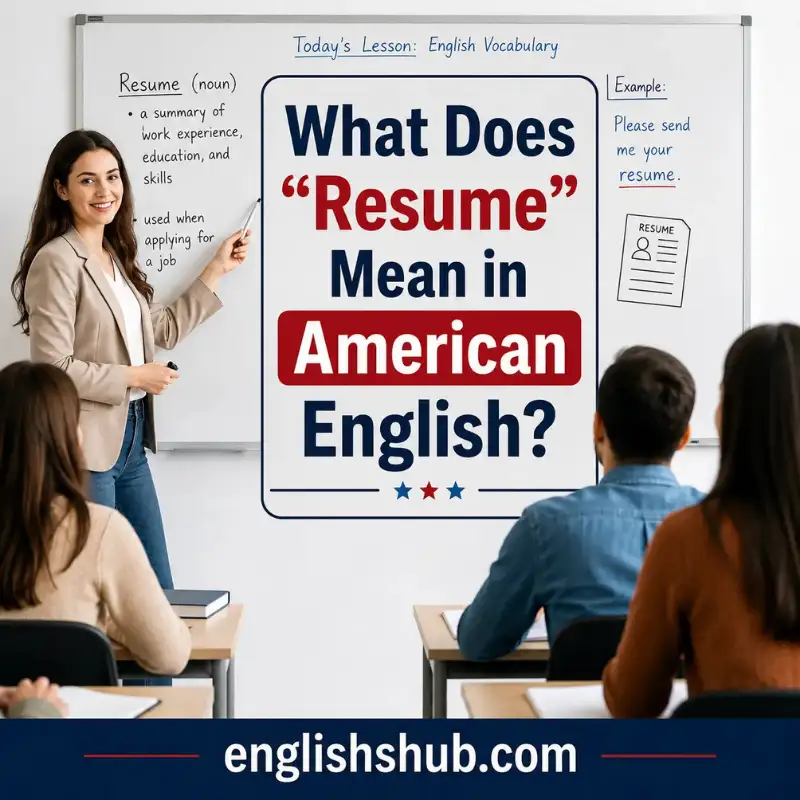
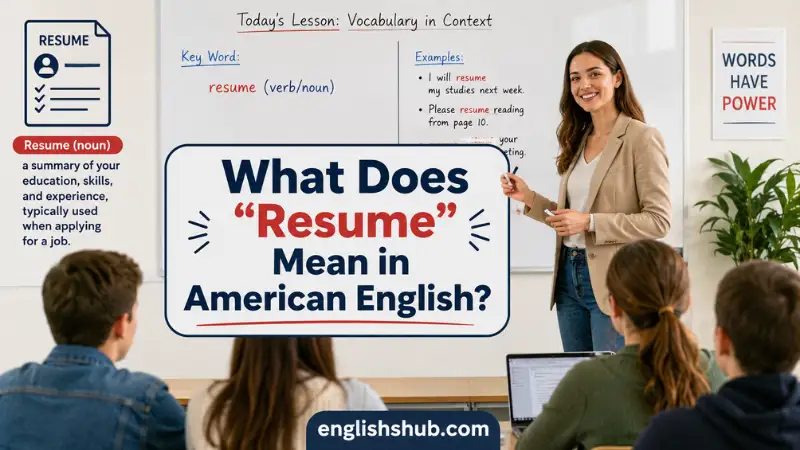
In the employment context, résumé is a noun meaning a short account of a person’s education, experience, qualifications, and career achievements.
For example:
- I sent my résumé to three companies.
- Her résumé highlights five years of marketing experience.
- Please attach your résumé to the application.
- The recruiter reviewed my résumé before the interview.
Merriam-Webster lists résumé as a U.S. noun for a short account of a person’s career and qualifications. It also lists resume and resumé as variants.
The spelling can therefore appear as résumé, resume, or, less commonly, resumé. For polished American writing, résumé is the clearest traditional spelling when the word itself is being discussed.
There is one important complication: resume without accent marks is also an English verb.
The meeting will resume at 3 p.m.
Here, resume means “begin again.” It has nothing to do with a job document.
What Does “CV” Mean?
CV is an abbreviation of curriculum vitae, a Latin expression traditionally understood as “course of life.”
In British English, CV commonly means the document a person sends when applying for a job. Cambridge labels this use mainly British and gives résumé as the usual U.S. equivalent.
In American English, however, CV usually has a narrower meaning. It often refers to a detailed academic or professional record.
A U.S. academic CV may include:
- Education
- Research experience
- Teaching experience
- Publications
- Presentations
- Grants and fellowships
- Honors and awards
- Professional memberships
- Academic service
Purdue’s career guidance specifically describes a CV as a document used to present scholarly background for PhD-level positions, research opportunities, or graduate-school admission.
For example:
The professor updated her CV before applying for the research position.
His CV includes publications from more than a decade of research.
Thus, CV is not simply a longer spelling of résumé in every U.S. context. The intended document depends on the field and purpose.
Resume or CV: Which Should You Use in the United States?
For a normal private-sector job in the United States, résumé is usually the safer and more natural choice.
Use a résumé when you are applying for positions such as:
- Marketing manager
- Sales representative
- Software developer
- Administrative assistant
- Accountant
- Graphic designer
- Customer-service specialist
- Project manager
The main idea is relevance. A résumé normally emphasizes the experience, skills, and achievements that matter most for the particular position.
For example:
I tailored my résumé for the software-engineering position.
A CV becomes more likely when the position or institution is academic, research-oriented, or otherwise asks for a detailed record.
For example:
The university asked applicants to submit a CV and research statement.
Purdue also notes that when an application does not specify which document is required, applicants should consider the context or ask the recruiter or institution which document they prefer.
So the simplest U.S. rule is:
Regular business job → résumé.
Academic or research position → CV.
That is a useful default, not an absolute law.
When Is a CV Appropriate in the U.S.?
A CV is especially appropriate when the reader needs a detailed record of academic or scholarly work.
Common situations include:
Academic positions
A university may ask a professor or researcher to submit a CV showing education, teaching, publications, research, and professional achievements.
The department requested her CV and teaching statement.
Research positions
Research jobs often require detailed information about projects, publications, presentations, and research experience.
His CV lists his research projects and conference presentations.
Graduate or professional programs
Some graduate, medical, or other advanced programs may request a CV instead of a standard résumé.
The application instructions ask for a CV describing the applicant’s academic background.
The exact requirements vary by institution and field. Purdue emphasizes that CV sections can differ significantly depending on the discipline.
Therefore, do not decide based only on document length. Purpose and context matter more than page count.
How British English Uses “CV”
British English uses CV much more broadly than American English.
In Britain, a person applying for an ordinary job would normally be asked for a CV, not a résumé.
Oxford defines CV as a written record of education and jobs sent when applying for a job and identifies North American résumé as the corresponding term.
For example:
Please send your CV with your application.
I’ve updated my CV for the marketing position.
These sentences are completely natural in British English.
That does not mean British speakers use CV to mean the same thing as a U.S. academic CV in every situation. The document itself can still vary by profession and purpose.
The key difference is the ordinary label:
- U.S. business English: résumé
- British English: CV
- U.S. academic/research contexts: CV is common
This is why calling CV “incorrect” for a British job application would be wrong. It is the standard term there.
Resume, Résumé, and CV: Spelling and Grammar
The words have several forms worth knowing.
Résumé
Résumé is a countable noun.
I sent a résumé.
She has updated her résumé.
The plural is usually résumés.
The company received hundreds of résumés.
Resume
Resume can also be used without accent marks as the noun in American English.
Please send your resume by Friday.
This spelling is extremely common in modern digital and professional writing.
However, resume is also a verb:
The meeting will resume after lunch.
The noun and verb are distinguished by meaning and pronunciation.
CV
CV is a countable noun.
I submitted my CV.
The usual plural is CVs.
The university received several CVs.
You do not normally need periods in the abbreviation:
CV
rather than:
C.V.
The same applies to the plural:
CVs
rather than:
C.V.s
When writing for a particular institution, however, follow its established style if it specifies one.
Resume Pronunciation: Why the Accent Matters
The noun résumé is pronounced differently from the verb resume.
The job-document noun is commonly pronounced approximately:
rez-uh-may
The verb resume is pronounced approximately:
ree-ZOOM
Cambridge gives the noun résumé the U.S. pronunciation /ˈrez.ə.meɪ/, while the verb resume has /rɪˈzuːm/.
The accent marks therefore do more than make the word look French. They can help readers distinguish the noun from the verb.
Compare:
I updated my résumé.
Here, the word means a career document.
The class will resume tomorrow.
Here, the word means “start again.”
In online writing, the accents are often omitted from the noun:
I updated my resume.
That spelling is accepted in American English. Context normally makes the meaning clear.
Resume or CV in Job Applications: Common Examples
The following examples show how the choice changes with context.
U.S. business application
Natural:
Please attach your résumé to the application.
A standard job application normally calls for a résumé.
U.S. university position
Natural:
Applicants should submit a CV and a statement of teaching philosophy.
The academic context supports CV.
British job application
Natural:
Please send your CV before Friday.
CV is the normal British term.
International application
If an international employer specifically asks for a CV, follow the employer’s terminology.
The company requested a CV from all applicants.
You do not need to “correct” the employer to résumé simply because you are familiar with American terminology.
Comparing the documents
A résumé is usually more targeted than a CV.
This sentence is natural when discussing the U.S. distinction.
Discussing the word itself
The word résumé comes from French.
Here, the discussion is about the English word, not the document.
Common Mistakes and Corrections
| Incorrect or Misleading Use | Better Version | Why |
|---|---|---|
| I sent my resume to the university, although they requested an academic CV. | I sent my CV to the university. | The requested document should guide the choice. |
| CV is always wrong in American English. | CV is common in U.S. academic and research contexts. | U.S. usage has more than one context. |
| Résumé is always longer than a CV. | A résumé is usually more targeted; a CV can be more detailed. | Length varies by purpose. |
| The professor sent her resume with all her publications. | The professor sent her CV with her publications. | A detailed academic record is normally a CV in the U.S. |
| The meeting will résumée at 2 p.m. | The meeting will resume at 2 p.m. | The verb is resume, without the noun’s accent marks. |
| I have updated several CV’s. | I have updated several CVs. | The standard plural does not use an apostrophe. |
| British applicants should never say CV. | British applicants commonly say CV. | CV is the standard British term for job applications. |
The biggest mistake is treating the U.S. distinction as universal. The terminology changes with region and professional context.
A Simple Resume-or-CV Decision Rule
Use this four-step test whenever you are unsure.
1. Where are you applying?
If the application is for a U.S. private-sector job, résumé is usually the best default.
If it is a British job application, CV is usually the normal term.
2. What type of position is it?
For ordinary business employment, choose résumé in U.S. English.
For academic or research work, CV is often appropriate in the U.S.
3. What does the employer request?
If the job advertisement says:
“Submit your CV.”
follow that instruction unless the context clearly indicates otherwise.
Likewise, if it asks for a résumé, send a résumé.
4. Is the word being used as a verb?
If the sentence means “start again,” use resume.
The meeting will resume at noon.
If the sentence means “career document,” use résumé or resume.
Please send your resume before Monday.
This last test is especially useful because the spelling can be identical when accents are omitted.
Resume vs. CV: Related Terms and Closest Alternatives
The terms résumé and CV are related, but they are not perfect synonyms in every context.
Résumé and curriculum vitae
In U.S. job-search language, résumé and curriculum vitae can overlap in the broad sense of a document describing someone’s qualifications. Merriam-Webster even defines résumé as a short account of career and qualifications and gives curriculum vitae as a related term.
However, American professional usage often assigns the two terms different functions.
CV and curriculum vitae
These are directly connected because CV is the abbreviation of curriculum vitae.
CV = curriculum vitae
Résumé and summary
Summary can be a useful semantic synonym for résumé in the general sense of “brief account,” but it is not always a substitute for the employment document.
For example:
She gave a summary of the meeting.
You cannot normally replace summary with résumé in that sentence without changing the meaning and register.
Résumé and cover letter
These are not synonyms.
A résumé presents qualifications and experience. A cover letter is a separate piece of correspondence that explains the applicant’s interest and suitability for a particular opportunity.
Therefore:
résumé ≠ cover letter
Keeping these terms separate prevents confusion in job-application instructions.
FAQs
Not always. In American English, a résumé is usually a concise, targeted job document, while a CV commonly provides a more detailed academic or professional record. In British English, however, CV is the ordinary term for the document used to apply for jobs.
For most ordinary U.S. business jobs, use a résumé. For academic, research, or certain specialized positions, a CV may be more appropriate. If the employer explicitly requests a CV, follow the application instructions rather than relying only on the general rule.
CV is especially associated with British English for ordinary job applications. American English also uses CV, but the term commonly refers to an academic or research-oriented document. Cambridge explicitly labels the general job-application sense as mainly British and gives résumé as the usual U.S. equivalent.
Yes. In American English, resume is an accepted spelling variant of the noun résumé. However, resume is also a verb meaning “to begin again,” so the context matters. Using résumé can make the noun meaning clearer.
Both spellings are accepted for the employment noun in American English. Résumé preserves the French accent marks and makes the word visually distinct from the verb resume. Merriam-Webster lists resume and resumé as variants of résumé.
The standard plural is résumés. You may also see resumes when the accent marks are omitted. For CV, the usual plural is CVs, without an apostrophe.
Use the terminology requested by the employer or institution. If the application is in Britain, CV is the normal term. If it is a U.S. business application, résumé is generally the better choice. International organizations can follow their own terminology, so the job advertisement is the safest guide.
Test Your Understanding
- Which term is normally preferred for an ordinary private-sector job application in the United States?
A. CV
B. Résumé
C. Curriculum vitae only
D. C.V.
- Which sentence uses resume as a verb?
A. I updated my resume.
B. She submitted her résumé.
C. The professor’s CV is detailed.
D. The meeting will resume at noon.
- Which situation most strongly supports using a CV in the United States?
A. Applying for a retail job
B. Applying for a sales position
C. Applying for an academic research position
D. Applying for a restaurant job
- Which statement about British English is correct?
A. CV is normally wrong in Britain.
B. Résumé is always required in Britain.
C. CV is the usual term for a job-application document.
D. CV is used only for university professors.
- Which plural is standard?
A. CV’s
B. CVs
C. CVes
D. C.V.’s
Answer Key
- B — Résumé. In ordinary U.S. business employment, résumé is the standard term for a targeted career document.
- D — The meeting will resume at noon. Here resume is the verb meaning “begin again.”
- C — Applying for an academic research position. A U.S. academic or research application commonly calls for a CV.
- C — CV is the usual term for a job-application document. Cambridge and Oxford identify CV as the British term corresponding to North American résumé.
- B — CVs. The abbreviation forms its plural with a simple final s, not an apostrophe.
Conclusion
The choice between resume or CV depends on both region and context. In American English, résumé is normally the best term for an ordinary job application, while CV is especially common for academic, research, and certain specialized applications. In British English, CV is the standard term for a job-application document. Also remember that resume without accents can be a noun or the unrelated verb meaning “start again.” When an employer gives specific instructions, follow those instructions first.More
Discover Related to: englishshub.com
https://englishshub.com/afterward-or-afterwards/
https://englishshub.com/aide-or-aid/
https://englishshub.com/madame-or-madam/
https://englishshub.com/past-or-passed/
https://englishshub.com/peek-or-peak/