

Ruff or rough can be confusing because the two words sound exactly alike in standard U.S. English. However, they are not interchangeable. Rough is the common word for something uneven, harsh, difficult, approximate, or unfinished. Ruff is a separate word with specialized meanings, including a historical collar, a ring of feathers or fur around an animal’s neck, a particular bird, and a card-game term. Both are pronounced /rʌf/.
The key is to choose the spelling from the meaning, not from the sound. Once you identify what the sentence describes, the correct form becomes much easier to select.
Quick Answer
Use rough for ordinary meanings such as uneven, difficult, harsh, approximate, or unfinished: a rough road, a rough day, a rough estimate, and a rough draft. Use ruff for specialized meanings such as a historical collar, an animal’s neck frill, a bird, or a card-game action. Both words are pronounced /rʌf/.
TL;DR
- Rough is the normal word for uneven, difficult, harsh, or approximate situations.
- Ruff is a separate word with several specialized meanings.
- Both words are pronounced /rʌf/ in U.S. English.
- A historical folded collar is a ruff.
- A first version of a paper or design is a rough draft.
- In golf, the correct term is the rough, not the ruff.
Ruff or Rough at a Glance
| Feature | Rough | Ruff |
|---|---|---|
| Pronunciation | /rʌf/ | /rʌf/ |
| Main grammatical role | Adjective; also noun, verb, adverb | Mainly noun; also specialized verb |
| Everyday use | Very common | Much less common |
| Uneven texture | Yes | No |
| Difficult experience | Yes | No |
| Approximate estimate | Yes | No |
| Preliminary draft | Yes | No |
| Historical folded collar | No | Yes |
| Animal neck feathers or fur | No | Yes |
| Bird name | No | Yes |
| Card-game term | No | Yes |
The most useful distinction is simple: rough describes a quality or condition in many everyday contexts, while ruff usually names a specific thing or specialized action. Oxford and Merriam-Webster document the broad range of rough, while Cambridge and Oxford document the specialized meanings of ruff.
Why Do Ruff and Rough Sound the Same?
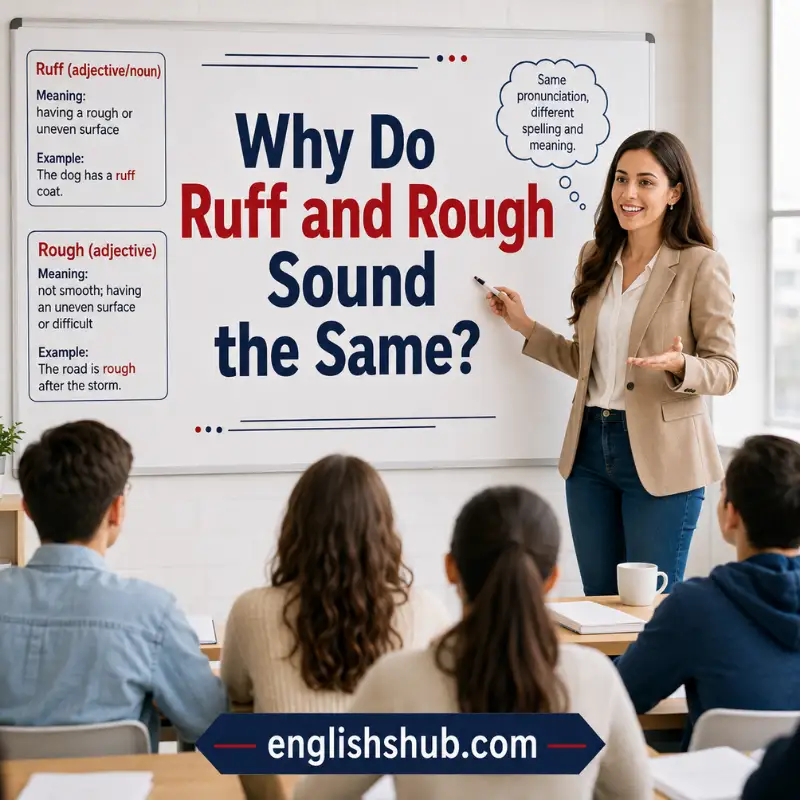
Ruff and rough are homophones. Homophones are words that have different spellings and meanings but the same pronunciation.
Both words are pronounced /rʌf/ in U.S. English. Cambridge gives the same pronunciation for both forms.
The spelling of rough can be especially confusing because the letters ough do not always have a predictable pronunciation in English. In rough, they contribute to the /ʌf/ sound. That is why you cannot reliably decide between rough and ruff simply by saying the word aloud.
Compare:
- The road is rough. — uneven surface
- The actor wore a ruff. — historical collar
They sound alike, but the meanings point to different spellings.
This is the same basic problem found with other homophones such as right/write and flower/flour. The solution is to identify the grammatical and semantic role before choosing the spelling.
What Does “Rough” Mean?
Rough is the much more common word in everyday English. Its meanings are connected, but the exact sense depends on context.
First, rough can describe a surface that is not smooth or even.
The old wooden table has a rough surface.
It can also describe difficult or unpleasant experiences.
We had a rough week at work.
The word can describe harsh, forceful, or violent treatment:
The player complained about rough treatment during the game.
Another common meaning is approximate or not fully detailed:
Can you give me a rough estimate?
It can also describe something unfinished or preliminary:
I sent my teacher a rough draft.
Oxford lists these major adjective uses, including not smooth, not exact, violent, difficult, and crude or unfinished.
So rough does not have just one meaning. The surrounding noun or situation determines which sense is intended.
What Does “Ruff” Mean?
Ruff is a real English word, but its uses are much more specialized.
One meaning is a large, stiff, folded collar associated especially with European clothing from the 16th and 17th centuries.
The historical costume included a wide white ruff.
A ruff can also mean a ring or band of feathers or fur around the neck of a bird or animal.
The bird displayed a colorful ruff around its neck.
The word can also refer to a particular Eurasian shorebird. Merriam-Webster lists the bird as a separate sense of ruff.
There is also a specialized card-game use. In card games, to ruff means to play a trump card when a player cannot follow the suit that was led.
Therefore, it would be inaccurate to say that ruff is simply a misspelling of rough. It is a legitimate word; it just does not normally carry the everyday meanings of rough.
Ruff or Rough: Which One Should You Use?
Use this four-step test when you are unsure.
Step 1: Ask what the sentence describes.
If it describes texture, difficulty, harshness, approximation, or an unfinished version, choose rough.
Step 2: Look for a specialized noun.
If the sentence describes a historical collar, animal neck feathers or fur, the bird called a ruff, or a card-game action, choose ruff.
Step 3: Check the phrase.
Some combinations strongly point to rough:
- rough day
- rough road
- rough weather
- rough estimate
- rough draft
- rough idea
- rough conditions
- rough around the edges
Step 4: Remember that pronunciation cannot settle the question.
Because both words sound /rʌf/, listening alone will not tell you which spelling belongs on the page.
A useful memory rule is:
Rough = difficult, uneven, harsh, or approximate. Ruff = a specific collar, neck frill, bird, or specialized card term.
Common Mistakes and Corrections
The most common mistake is using ruff when the sentence needs rough.
| Incorrect | Correct | Why |
|---|---|---|
| I had a ruff day. | I had a rough day. | The day was difficult. |
| The road is ruff. | The road is rough. | The road is uneven. |
| Send me a ruff estimate. | Send me a rough estimate. | The estimate is approximate. |
| She wrote a ruff draft. | She wrote a rough draft. | The draft is preliminary. |
| The fabric feels ruff. | The fabric feels rough. | The texture is not smooth. |
| He wore a rough around his neck. | He wore a ruff around his neck. | The item is a historical collar. |
The reverse error is also possible. If you mean the collar, animal neck feathers, or the specialized card-game action, replacing ruff with rough changes the word.
For example:
The actor wore a ruff in the historical play.
Here, rough would not describe the garment. The spelling must match the specific noun being named.
Rough as a Noun, Verb, and Adverb
Many learners first meet rough as an adjective, but it has other grammatical roles.
As a noun, rough can refer to the longer grass on a golf course.
Her ball landed in the rough.
Oxford specifically lists the rough as the part of a golf course where longer grass makes hitting the ball more difficult.
As a verb, rough can mean to make something rough or to create a preliminary version.
The designer roughed out three possible layouts.
The phrasal verb rough out means to produce a basic version without completing all the details. Rough up has a different meaning involving force or violence.
As an adverb, rough can describe doing something with force:
The children were playing rough.
These grammatical uses make rough considerably more flexible than ruff in ordinary English.
Synonyms, Antonyms, and Related Words
The best synonym for rough depends on its meaning.
For physical texture, useful alternatives include coarse, uneven, jagged, and rugged. For a difficult situation, tough, difficult, or challenging may fit. For an approximate figure, approximate, estimated, or inexact may work.
However, these words are not always interchangeable.
For example:
We need a rough estimate.
You could say:
We need an approximate estimate.
But the wording may become less natural because estimate already carries an approximate sense. In contrast, rough road cannot simply become approximate road because the meaning is completely different.
The most direct antonyms also depend on context:
- rough surface → smooth surface
- rough treatment → gentle treatment
- rough estimate → exact estimate
- rough draft → finished draft
Ruff does not have one simple antonym because its meanings are nouns and specialized terms rather than one general quality. For a collar, you might contrast ruff with a different type of collar; for a bird or card-game action, the appropriate contrast depends on context.
U.S. and U.K. Usage
There is no standard American-versus-British spelling difference between rough and ruff for the meanings discussed here.
American and British English both use rough for meanings such as uneven, difficult, approximate, and unfinished. They also use ruff for its established specialized meanings.
The pronunciation is likewise /rʌf/ in both major varieties for these words. Cambridge lists /rʌf/ for U.S. and U.K. pronunciation.
Some other meanings of rough have regional labels. For example, Oxford marks feeling rough in the sense of feeling unwell as British English. That does not change the spelling of the word.
So, if you are writing for a U.S. audience, do not treat ruff as a British spelling of rough. They are separate words in both varieties.
Ruff and Rough Examples in Context
Here are several examples showing how context determines the spelling.
Physical texture
The stone felt rough against my hand.
The word describes an uneven texture.
Difficult experience
Moving to a new city was rough at first.
Here, rough means difficult or unpleasant.
Approximate information
Give me a rough estimate of the total cost.
The figure does not need to be exact.
Preliminary work
I finished a rough sketch before starting the painting.
The sketch is an early version rather than the final product.
Historical clothing
The actor wore an elaborate ruff for the Elizabethan scene.
The word names a particular type of collar.
Animal feature
The bird’s white ruff stood out against its darker body.
Here, ruff refers to feathers around the neck.
Golf
His second shot landed in the rough.
This is the golf-course term, not ruff.
Card game
She ruffed the trick with a trump card.
Here, ruffed is the specialized past-tense form of the card-game verb.
Playful dog sound
In the comic, the puppy says, “Ruff!”
This is a sound imitation rather than the ordinary adjective rough. It should not be confused with the standard dictionary meanings of ruff.
Figurative expression
The proposal is still rough around the edges.
The expression means that something is not yet polished or fully refined. Oxford documents rough around the edges as an established expression.
The pattern is consistent: meaning determines spelling.
FAQs
Yes. Ruff is a legitimate English word. It can refer to a historical folded collar, a ring of feathers or fur around an animal’s neck, a particular bird, and a specialized card-game action. It is therefore incorrect to describe ruff as merely a misspelling of rough.
Yes. In standard U.S. English, both are pronounced /rʌf/. They have different spellings and meanings, which makes them homophones. Because their pronunciation is identical, you need to use context and meaning to select the correct spelling.
No, not when you mean a difficult or unpleasant day. The standard phrase is rough day. For example, “I had a rough day at work” means the day was difficult. Ruff would only work if the sentence intentionally referred to one of its specialized meanings or used the spelling playfully.
The correct phrase is rough draft. A rough draft is an early version of writing that is not yet complete or polished. The same spelling appears in phrases such as rough sketch, rough estimate, and rough idea. Oxford and Cambridge both document this approximate or preliminary sense.
The correct golf term is the rough. It refers to the area of longer grass, often beside a fairway, where hitting the ball can be more difficult. The spelling ruff is incorrect for this golf meaning.
Yes. A ruff can mean a ring or collar-like area of feathers or fur around an animal’s neck. Oxford gives this meaning for birds and animals, while Cambridge similarly defines it as a circle of hair or feathers around the neck.
Yes. Rough can work as an adjective, noun, verb, and adverb. Examples include rough road as an adjective, the rough in golf as a noun, rough out a plan as a verb, and play rough as an adverbial use.
Test Your Understanding
1. Which sentence uses the correct spelling?
A. I had a ruff morning.
B. I had a rough morning.
C. I had a ruffing morning.
D. I had a roughing morning.
2. Which sentence correctly uses ruff?
A. The road was ruff after the storm.
B. She gave me a ruff estimate.
C. The historical costume included a large ruff.
D. He submitted a ruff draft.
3. What does rough estimate mean?
A. An estimate written on a rough surface
B. An estimate that is approximate rather than exact
C. An estimate about a historical collar
D. An estimate used in a card game
4. Which sentence uses rough as a golf noun?
A. The actor wore a rough.
B. The bird grew a rough.
C. Her ball landed in the rough.
D. The dog made a rough.
5. Why are ruff and rough easy to confuse?
A. They always have the same meaning.
B. They have identical spelling.
C. They are pronounced the same in standard U.S. English.
D. They are both verbs.
Answer Key
- B — Rough is correct because the sentence describes a difficult morning.
- C — A ruff can be a historical folded collar.
- B — A rough estimate is an approximate estimate.
- C — The rough is the longer-grass area on a golf course.
- C — Both words are pronounced /rʌf/, even though their spellings and meanings differ.
Conclusion
The choice between ruff or rough becomes straightforward when you focus on meaning instead of sound. Use rough for ordinary ideas such as uneven surfaces, difficult experiences, harsh conditions, approximate figures, and unfinished work. Use ruff for its specialized meanings, including a historical collar, an animal’s neck frill, a particular bird, or a card-game action. Both words are pronounced /rʌf/, so pronunciation cannot tell you which spelling to use. When proofreading, ask what the word means in the sentence. That simple meaning-first habit will prevent most ruff/rough spelling errors.



[…] Ruff or Rough: Meaning, Difference, and Correct Use. […]