
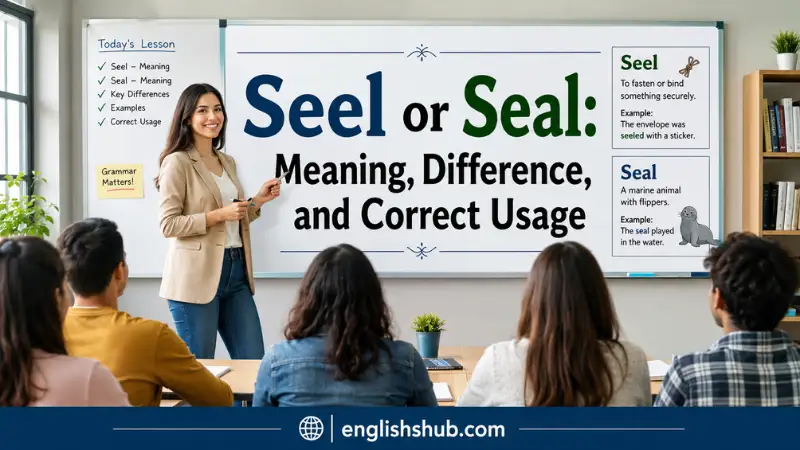
Seel or seal can look like a simple spelling mistake, but the answer is slightly more interesting. Seal is the normal modern English word for the marine animal, a closure, an official mark, or the act of closing or securing something. Seel is also a real English word, but it is rare and archaic, chiefly associated with falconry. Merriam-Webster defines seel as a verb meaning to close a bird’s eyes by sewing the eyelids, while Collins also records an obsolete sense meaning to close or blind the eyes.
For ordinary American English, therefore, seal is almost always the spelling you need. Knowing the exception is useful, though, because it prevents you from incorrectly calling seel a nonexistent word.
Quick Answer
Seal is the standard modern spelling for the animal, a closure, an official mark, or the verb meaning “to close” or “secure.” Seel is a rare, archaic verb connected mainly with falconry and historically meant closing a bird’s eyes. Both are pronounced /siːl/, so context—not sound—determines the spelling.
TL;DR
- Seal is the normal modern spelling in everyday English.
- Seel is a rare, archaic verb with a historical falconry sense.
- Both words are pronounced like “seel.”
- Use seal for envelopes, containers, agreements, marks, and marine animals.
- Use seel only when the specialized historical meaning is intended.
- Sealed and sealing come from the verb seal.
Seal or Seel at a Glance
| Feature | Seal | Seel |
|---|---|---|
| Main modern status | Common standard English | Rare and archaic |
| Part of speech | Noun and verb | Verb |
| Pronunciation | /siːl/ | /siːl/ |
| Animal meaning | Yes | No |
| Closing or securing | Yes | No |
| Official mark | Yes | No |
| Historical falconry | No | Yes |
| Everyday U.S. writing | Very common | Normally unsuitable |
The key distinction is modern everyday meaning versus specialized historical meaning. Merriam-Webster lists seal as a current noun and verb with several meanings, while its separate seel entry identifies a specialized verb.
So these sentences are correct:
- Please seal the envelope.
- The jar has a broken seal.
- We watched a seal near the rocks.
- The company sealed the agreement.
But seel does not replace seal in those sentences.
What Does Seal Mean?
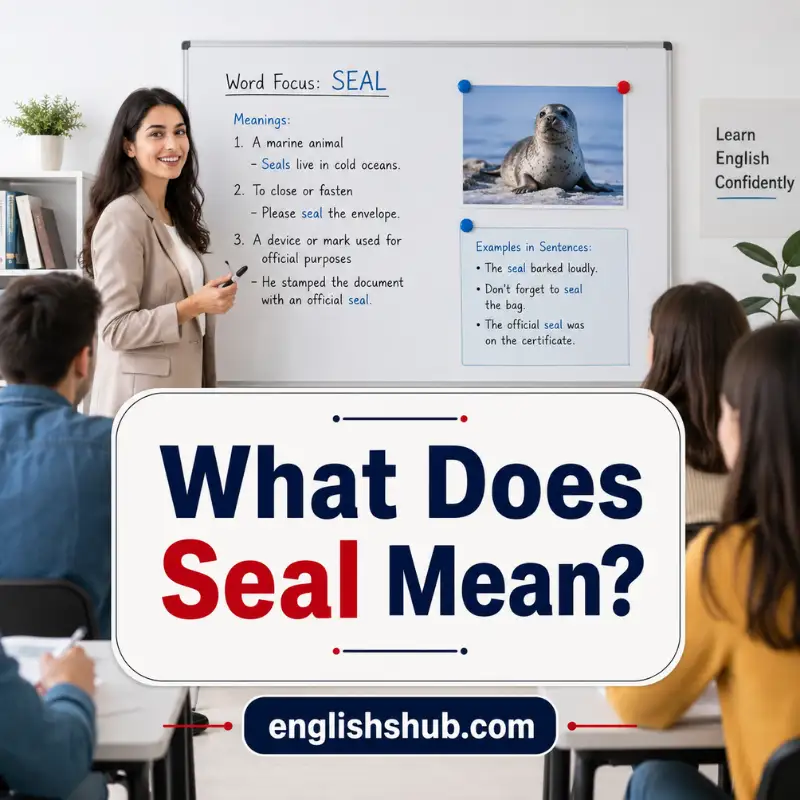
Seal has several common meanings, but they share a general idea of closing, securing, marking, or confirming something.
Seal as a noun
A seal can be a device or mark used to authenticate a document. It can also be a material or mechanism that closes an opening and prevents air, water, gas, or other substances from passing through. Cambridge gives examples involving official documents, containers, doors, and mechanical closures.
For example:
- The governor’s office placed its official seal on the document.
- Check the seal around the refrigerator door.
- The bottle’s seal was broken.
- The package had a tamper-evident seal.
Seal can also name the marine mammal:
- We saw a seal swimming near the shore.
- The young seal rested on the rocks.
- Several seals were visible from the boat.
Seal as a verb
As a verb, seal commonly means to close something securely or prevent something from entering or escaping.
- Please seal the box tightly.
- They sealed the window before winter.
- The technician sealed the pipe.
- She sealed the envelope with tape.
It can also mean to make something final or certain:
- The handshake sealed the agreement.
- The final goal sealed the team’s victory.
Cambridge specifically records the verb’s meanings involving closing, protecting a surface, closing an envelope, and formally confirming an agreement.
What Does Seel Mean?
Seel is a genuine English verb, but it is not a normal modern substitute for seal.
Merriam-Webster defines seel as closing the eyes of a bird, especially a hawk, by drawing threads through its eyelids. It labels the broader sense of closing one’s eyes as archaic.
Collins similarly identifies a falconry meaning involving sewing a hawk’s or falcon’s eyelids shut and records an obsolete meaning involving closing or blinding the eyes.
That means seel may appear in:
- historical writing,
- discussions of traditional falconry,
- older literature,
- historical dictionaries,
- specialized literary analysis.
For example:
The historical text describes an attempt to seel the young hawk.
This is not the kind of sentence most modern readers will write. The word survives mainly because dictionaries preserve older vocabulary and because historical texts sometimes retain specialized terminology.
Seel or Seal: Which One Is Correct?
For almost every modern writing situation, choose seal.
Use seal when you mean:
- a marine animal;
- something that closes an opening;
- an official mark;
- the act of closing or securing something;
- making an agreement final or certain.
Use seel only when the historical or specialized meaning is specifically intended.
A three-question test
Question 1: Am I talking about an animal?
Use seal.
The seal disappeared beneath the water.
Question 2: Am I talking about closing, securing, marking, or confirming something?
Use seal.
Please seal the package.
Question 3: Am I describing the historical falconry practice involving a bird’s eyes?
Then seel may be correct.
This test works because it focuses on meaning, not pronunciation.
Why Are Seel and Seal Confused?
The main reason is simple: they sound the same.
Both Merriam-Webster and Cambridge give seal the pronunciation /ˈsēl/ or /siːl/, while Merriam-Webster gives the same basic pronunciation for seel.
These words are therefore homophones in standard American English: words that sound alike but have different spellings and meanings.
Consider:
- seal the envelope
- seel the hawk
When someone hears the words without seeing them written, there is no sound-based clue that tells the listener which spelling is intended.
This is why context matters. English contains many such pairs, including there/their, write/right, and counsel/council. The solution is not to rely on pronunciation but to identify the meaning and grammatical role.
Seal as a Noun and Verb
One useful way to avoid confusion is to learn the common grammatical forms of seal.
| Form | Function | Example |
|---|---|---|
| seal | noun | The seal is broken. |
| seal | verb | Seal the container. |
| seals | plural noun / verb | The seals are swimming. |
| sealed | past tense / participle | She sealed the envelope. |
| sealing | present participle / gerund | He is sealing the boxes. |
| sealer | related noun | The wood needs a sealer. |
Merriam-Webster lists sealed, sealing, and seals as forms associated with the verb seal.
Notice that the everyday word family stays with ea:
- seal
- sealed
- sealing
- sealer
- reseal
You should not change seal to seel simply because the pronunciation stays the same.
For example:
Correct: The workers are sealing the windows.
Incorrect: The workers are seeling the windows.
The second spelling does not mean “sealing.” It points to the separate historical verb seel.
When Is Seel Actually Correct?
Seel is correct when the writer deliberately means its specialized historical sense.
This matters especially when reading older texts. A modern editor should not automatically “correct” seel to seal without checking the context.
For instance:
The falconer sought to seel the bird’s eyes.
Here, changing seel to seal would change the word to one that does not express the intended historical action.
At the same time, context alone does not make seel appropriate for ordinary modern writing.
These sentences need seal:
- Please seal the envelope.
- The bottle is sealed.
- We need to seal the leak.
- The agreement was sealed yesterday.
- I saw a seal at the aquarium.
These uses have nothing to do with historical falconry.
So the best rule is not “seel is wrong.” The better rule is:
Use seal for normal modern English; reserve seel for its rare historical meaning.
Common Mistakes and Corrections
Because seal is so much more common, most mistakes involve replacing it with seel.
Mistake 1: Using seel for a container
Incorrect:
Please seel the container tightly.
Correct:
Please seal the container tightly.
The verb means “close securely,” so seal is required.
Mistake 2: Using seel for the animal
Incorrect:
We saw a seel swimming near the pier.
Correct:
We saw a seal swimming near the pier.
The marine mammal is always seal in standard modern English. Cambridge defines seal as the large mammal that lives partly in the sea and partly on land or ice.
Mistake 3: Writing seeling for the normal verb
Incorrect:
They are seeling the windows.
Correct:
They are sealing the windows.
The present participle of seal is sealing.
Mistake 4: Assuming seel is always a typo
This mistake goes in the opposite direction.
Too broad:
Seel is never a real English word.
Better:
Seel is a rare, archaic English verb associated especially with historical falconry.
Merriam-Webster and Collins both confirm that seel has a dictionary-recognized meaning.
Seal, Sealed, Sealing, and Related Forms
The common word family is easy once you identify seal as the base form.
- seal — base verb
- seals — third-person singular present
- sealed — simple past and past participle
- sealing — present participle or gerund
- sealer — something or someone that seals
- reseal — seal again
Examples:
The worker seals each package.
The package was sealed before shipping.
They are sealing the windows.
We need to reseal the container.
The spelling remains stable because these forms derive from seal, not seel.
One useful proofreading habit is to identify the base word first. If the sentence means “close securely,” “make airtight,” “authenticate,” or “make final,” start with seal and then form the tense or derivative you need.
Seal Synonyms and Contextual Contrasts
Seal has several near-synonyms, but they are not interchangeable in every sentence.
| Word | Main idea | Example |
|---|---|---|
| seal | Close or secure completely | Seal the package. |
| close | Shut something | Close the door. |
| shut | Close firmly | Shut the gate. |
| secure | Make safe or firmly fixed | Secure the equipment. |
| stamp | Mark with a stamp | Stamp the document. |
| confirm | Establish something as certain | Confirm the agreement. |
For example, close is broader than seal. You can close a door without creating an airtight or tamper-resistant barrier.
Likewise, stamp focuses on applying a mark. It does not always mean physically closing something.
Compare:
Please close the box.
This simply asks someone to put the box into a closed position.
Please seal the box.
This suggests securing the box so that it stays closed or prevents access, air, liquid, or another substance from passing through.
That difference shows why these alternatives are related but not perfect synonyms.
There is also no simple antonym for every meaning of seal. Depending on context, open, unseal, break, or undo can provide the appropriate contrast.
A Simple Memory Rule for Seel and Seal
For modern writing, remember:
Seal = secure, shut, stamp, or sea animal.
If the sentence concerns an envelope, package, container, agreement, official mark, leak, or marine mammal, seal is almost certainly the right choice.
Then remember the exception:
Seel = historical falconry.
The words sound alike, so do not try to memorize the answer through pronunciation. Instead, connect each spelling with its meaning.
A quick mental check can be:
Animal or closure? → seal.
Historical bird-eye term? → seel.
This rule is simple enough for everyday writing while still respecting the legitimate dictionary meaning of seel.
FAQs
Yes. Seel is a real but rare and archaic English verb. Dictionaries define it primarily in connection with the historical falconry practice of closing a bird’s eyes. It should not, however, be used as an alternative spelling of modern seal.
No. The marine mammal is spelled seal. Cambridge and Merriam-Webster both list seal as the standard noun for the animal.
No. They are different words despite having the same pronunciation. Seal has many common modern meanings, while seel is a rare historical verb associated mainly with falconry.
Seel is pronounced like seal, approximately /siːl/. Because the two words sound alike, pronunciation cannot tell you which spelling to use. Meaning and context provide the answer.
It can appear in modern texts, but it is uncommon and normally belongs to historical, literary, or specialized discussions. Most contemporary writers will never need it. For ordinary modern usage, seal is the appropriate choice.
The simple past is sealed. For example, “She sealed the envelope yesterday.” The present participle is sealing, as in “They are sealing the boxes.”
Historically, yes. Merriam-Webster records an archaic sense involving closing the eyes, while Collins also gives an obsolete meaning related to closing or blinding the eyes. It does not normally mean “close a container” in modern English.
Test Your Understanding
1. Which sentence uses the standard modern spelling?
A. Please seel the envelope.
B. Please seal the envelope.
C. Please seel the package.
D. Please seel the container.
2. What does seel traditionally refer to?
A. Closing a door
B. Stamping a document
C. A historical falconry practice
D. Swimming like a seal
3. Which sentence is correct?
A. The workers are seeling the windows.
B. The workers are sealing the windows.
C. The workers are seel the windows.
D. The workers are seals the windows.
4. Why are seal and seel easy to confuse?
A. They have identical spellings.
B. They have opposite meanings.
C. They are pronounced alike.
D. They are both plural nouns.
5. Which sentence uses seel appropriately?
A. Please seel the jar.
B. We need to seel the leak.
C. The falconry text describes how to seel the bird’s eyes.
D. The company will seel the contract.
Answer Key
1. B — Please seal the envelope.
Seal is the standard modern verb for closing an envelope.
2. C — A historical falconry practice.
Seel is a rare historical verb associated with closing a bird’s eyes.
3. B — The workers are sealing the windows.
Sealing is the present participle of seal.
4. C — They are pronounced alike.
Both words have the pronunciation /siːl/, so sound does not distinguish them.
5. C — The falconry text describes how to seel the bird’s eyes.
That sentence uses the rare word in its historically appropriate context.
Conclusion
For almost every modern American English sentence, choose seal, not seel. Seal can name a marine animal, an official mark, a protective closure, or the action of closing and securing something. Seel is a genuine English word, but it is rare and archaic, with its best-known sense connected to historical falconry. The two words sound alike, which explains the spelling confusion. The easiest rule is simple: animal, closure, mark, or securing action = seal; historical falconry term = seel.
More Discover Related to: englishshub.com
https://englishshub.com/loose-or-lose/
https://englishshub.com/herd-or-heard/
https://englishshub.com/bass-or-base/
https://englishshub.com/legal-counsel-or-council/
https://englishshub.com/make-do-or-make-due/