
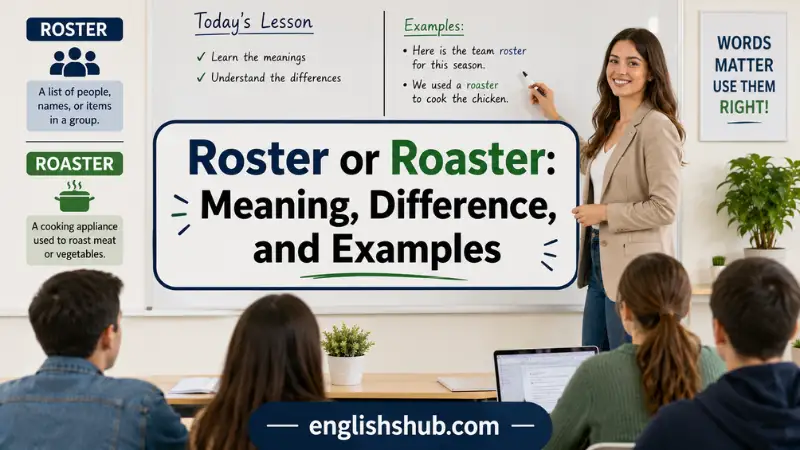
The choice between roster or roaster depends on meaning. Roster usually means a list of people, such as a team roster, employee roster, or duty roster. Roaster usually refers to a person, machine, pan, or other thing involved in roasting. The two words look almost identical, but that extra a changes the word and its meaning.
For American English, the simplest rule is this: roster relates to lists and assignments, while roaster relates to roasting. Oxford and Merriam-Webster both define roster around lists of people or duties, while Merriam-Webster defines roaster as something or someone that roasts.
Quick Answer
Use roster for a list, lineup, register, or schedule of people and duties. Use roaster for a person, machine, pan, or other thing connected with roasting. For example, a basketball team has a roster, while a coffee company may operate a roaster.
TL;DR
- Roster means a list, lineup, or assigned schedule.
- Roaster means something or someone that roasts.
- A team has a roster, not a team roaster.
- A coffee business may use a roaster.
- Roaster comes directly from the verb roast.
- British English may use rota for some scheduling contexts.
Roster or Roaster at a Glance
| Word | Main Meaning | Common Context | Example |
|---|---|---|---|
| roster | Organized list or schedule | Sports, work, school | The coach published the roster. |
| roster | People included on a list | Teams, organizations | The company has a strong roster of writers. |
| roaster | Device or container for roasting | Cooking | The turkey is in the roaster. |
| roaster | Person or business that roasts | Coffee | The coffee roaster developed a new blend. |
| roaster | Person taking part in a roast | Comedy | Several roasters appeared on stage. |
| rota | Duty schedule | British English | She is on the weekend rota. |
The central distinction is semantic rather than regional: roster organizes people or duties, while roaster connects to roasting. Oxford defines roster as a list of people or duties, and its American dictionary specifically includes lists of people available for jobs or teams.
What Does Roster Mean?
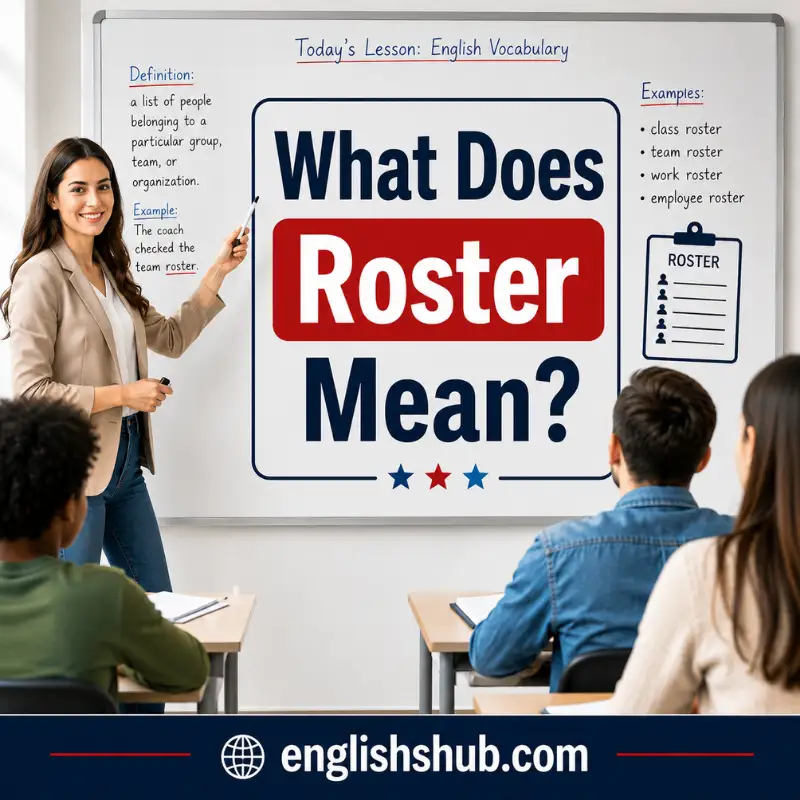
A roster is usually a noun that identifies people belonging to a group or shows who is assigned to a particular duty. Merriam-Webster defines it as a roll or list of personnel, a list showing the order of duties, or an itemized list.
Sports provide one of the clearest examples:
- The coach announced the final roster.
- Three rookies made the roster.
- The team has 18 players on its active roster.
- The club changed its roster before the season began.
A roster can also appear in workplaces:
- The manager updated the employee roster.
- Check the staff roster before choosing a shift.
- Her name is on the weekend roster.
Schools and organizations use the word in similar ways:
- The teacher printed the class roster.
- The volunteer roster includes 40 people.
- The agency keeps a roster of approved translators.
The basic idea stays the same: a roster organizes names, people, or assignments.
Roster as a Verb
In addition to its common noun use, roster can function as a verb, especially in British English. Oxford records the verb as meaning to put someone’s name on a roster, often in a passive structure such as “was rostered for Sunday.”
For example:
The driver was rostered for the Sunday shift.
This use is less central for a general U.S. audience, so American readers will most often encounter roster as a noun.
What Does Roaster Mean?
A roaster is a noun connected with the action of roasting. Merriam-Webster defines it as one that roasts, a device for roasting, or something adapted for roasting.
That gives roaster several useful meanings.
A Roaster as Cooking Equipment
A roaster can be a pan, oven, appliance, or other container used to roast food.
Examples include:
- turkey roaster
- electric roaster
- roasting pan
- coffee roaster
- commercial roasting machine
For example:
The turkey needs another 20 minutes in the roaster.
Oxford likewise defines roaster as a container, oven, or piece of equipment used for roasting.
A Roaster as a Person or Business
A roaster can also describe someone who roasts something. Coffee provides a common modern example.
The coffee roaster tested the beans after cooling.
Depending on context, coffee roaster can refer to a person, company, or machine. Oxford specifically includes a person or company that processes coffee beans, while Merriam-Webster includes “one that roasts.”
A Roaster in Comedy
The word can also appear in the context of a comedy roast, where a person humorously criticizes or teases another person.
For example:
Several professional roasters joined the comedy event.
This is a different sense from cooking, but it still connects naturally to the verb roast.
Roster vs. Roaster: The Main Difference
The fastest way to distinguish the two words is to identify the idea behind them.
Roster = list, lineup, or assignment.
Roaster = person or thing that roasts.
Compare these sentences:
The coach finalized the roster.
The coach finalized a list of players.
The chef cleaned the roaster.
The chef cleaned equipment used for roasting.
The words therefore cannot normally replace each other.
Correct: The player made the team roster.
Incorrect for that meaning: The player made the team roaster.
The second sentence sounds as though roaster refers to something involved in roasting.
The reverse problem happens with cooking:
Correct: The coffee beans went into the roaster.
Incorrect for that meaning: The coffee beans went into the roster.
A roster is a list. It cannot normally hold coffee beans.
The Three-Question Test
When you hesitate, ask:
- Am I talking about names, people, players, workers, or assignments?
Use roster. - Am I talking about cooking, coffee, roasting equipment, or someone who roasts?
Use roaster. - Am I talking about a British work-duty schedule?
Roster may work, but rota is often preferred in British English.
This meaning-first approach is more reliable than choosing the spelling by appearance alone.
Roster in Sports, Work, and School
Roster has several common collocations in American English. A collocation is a word combination that English speakers commonly use together.
Sports
Sports writers frequently use:
- team roster
- active roster
- final roster
- player roster
- roster spot
- roster change
Examples:
The coach released the final roster on Monday.
The rookie earned a spot on the active roster.
The team added two players to its roster.
In these sentences, roster means the group of players selected or available to the team.
Workplaces
Workplaces can use:
- staff roster
- employee roster
- work roster
- duty roster
- shift roster
- on-call roster
For example:
Check the staff roster before requesting a shift change.
Here, the roster may show employees, shifts, or assignments.
Schools and Organizations
Schools may keep a class roster or student roster.
Organizations can maintain:
- member roster
- volunteer roster
- contributor roster
- client roster
- artist roster
For example:
The agency has a growing roster of freelance writers.
Here, roster means a group or list of people associated with the agency.
Roaster in Cooking, Coffee, and Comedy
The word roaster becomes natural when the surrounding context involves roasting.
Cooking
We bought a new electric roaster for Thanksgiving.
The chicken is cooking in the roaster.
Clean the roaster after it cools.
Coffee
Coffee provides another important use:
The coffee roaster can process several batches each day.
The local roaster specializes in single-origin beans.
Here, roaster may refer to the machine or to a person or business involved in roasting coffee. Dictionary.com also lists equipment, a person or thing that roasts, and other roasting-related meanings.
Comedy
The verb roast also has a humorous meaning, so roaster can describe someone participating in a comedy roast.
The event featured several celebrity roasters.
The exact meaning comes from context. In a sentence about coffee, roaster is likely related to coffee. In a comedy context, it refers to the person doing the humorous roasting.
Pronunciation and Word Formation
The pronunciation difference is useful, especially in American English.
Cambridge gives the U.S. pronunciation of roster as approximately /ˈrɑː.stɚ/ and roaster as approximately /ˈroʊ.stɚ/. In simple terms, roaster has the long o sound associated with roast, while roster has a different first vowel.
You can think of the relationship this way:
roast → roaster
The extra a is part of the spelling of roast:
roast → roaster
English uses this type of -er formation in many words:
- teach → teacher
- drive → driver
- bake → baker
- sing → singer
- roast → roaster
Roster does not mean “someone who rosts.” It has a separate history and meaning.
The history is actually interesting. Oxford traces roster to Dutch rooster, meaning “list,” with an earlier sense connected to a gridiron. Etymonline likewise records roster from Dutch rooster, while roaster developed from the verb roast.
So the modern words look related, but their modern functions are different.
American vs. British English
There is no American-versus-British spelling change between roster and roaster. Both varieties use those spellings for their respective meanings.
The more interesting regional difference concerns roster and rota.
In American English, a workplace schedule can naturally be called a:
work roster
duty roster
In British English, rota is often preferred for a schedule assigning duties. Cambridge-style dictionary usage also distinguishes the scheduling sense of roster from British rota.
For example:
American English:
I’m on the weekend work roster.
British English:
I’m on the weekend work rota.
However, roster itself is not exclusively American. It remains an English word in British usage, particularly when referring to lists of people or groups.
Most importantly, rota is not another spelling of roaster.
The three words have different core meanings:
| Word | Core Meaning | Example |
|---|---|---|
| roster | List, lineup, or schedule | Check the staff roster. |
| roaster | Person or thing that roasts | The coffee roaster is running. |
| rota | Duty schedule, especially British | She’s on the weekend rota. |
Common Mistakes and Corrections
The most common mistakes happen when writers choose the wrong word because the spellings look similar.
Mistake 1: Team roaster
❌ The coach announced the team roaster.
✅ The coach announced the team roster.
A sports team has a roster, meaning a list of players.
Mistake 2: Staff roaster
❌ Check the staff roaster for tomorrow’s shift.
✅ Check the staff roster for tomorrow’s shift.
The document contains employees and assignments, so roster is correct.
Mistake 3: Coffee roster
❌ The coffee roster needs cleaning.
✅ The coffee roaster needs cleaning.
The machine performs roasting, so roaster is correct.
Mistake 4: Turkey roster
❌ Put the turkey in the roster.
✅ Put the turkey in the roaster.
The second sentence refers to cooking equipment.
Mistake 5: Coffee roaster as a list
❌ The café published its coffee roaster.
✅ The café published its coffee roster.
If the café publishes a list of people or businesses, roster is the better word. If it operates roasting equipment or is a company that roasts coffee, roaster is appropriate.
This example shows why context matters more than memorizing a single phrase.
Synonyms, Related Words, and Contrasts
For roster, useful related words include list, listing, register, roll, lineup, schedule, and directory. Merriam-Webster’s thesaurus includes several of these as related words.
They are not perfect synonyms in every sentence.
For example:
The team’s roster contains 20 players.
You could say:
The team’s list contains 20 players.
But directory would sound unnatural because a directory usually provides contact or organizational information.
Similarly, schedule can overlap with roster when the roster assigns people to times or duties, but a schedule does not necessarily list people.
For roaster, useful related terms depend on the meaning:
- oven
- roasting pan
- roasting machine
- cooker
- coffee roaster
- coffee roasting company
These are contextual alternatives, not universal synonyms.
For example:
The coffee roaster is operating normally.
Replacing roaster with oven could change the meaning because commercial coffee roasting equipment is not necessarily an oven.
The closest everyday contrast is therefore not a perfect synonym pair. Instead, remember the concepts:
roster → organization and lists
roaster → roasting and equipment/people
How to Remember the Difference
Use this simple memory sentence:
The roster lists the players; the roaster roasts the food.
The word roaster contains the spelling of roast:
roast → roaster
That makes the extra a easy to remember.
For roster, think about a roll or list of names.
Another useful test is to replace the word:
- If list fits, choose roster.
- If roast fits, choose roaster.
- If duty schedule fits in British English, consider rota.
For example:
Check the employee list.
That points to:
Check the employee roster.
But:
Put the chicken in the roasting appliance.
That points to:
Put the chicken in the roaster.
The replacement test is particularly helpful for English learners because it focuses on meaning rather than spelling.
Examples in Everyday English
Here are original examples covering the most common contexts:
- The coach posted the final roster before practice.
Roster means the official list of players. - My name is missing from the class roster.
The roster identifies students in the class. - The manager updated the employee roster.
The word refers to a workplace list. - Please check the duty roster before leaving.
The document shows assigned duties. - The agency has an impressive roster of writers.
Here, roster means a group or list of associated people. - The chef placed the turkey in the roaster.
The roaster is cooking equipment. - The coffee roaster handles several batches each morning.
Here, roaster can refer to a person or business. - The new machine is a much larger coffee roaster.
Here, roaster refers to equipment. - Several comedians served as roasters during the event.
The context is a comedy roast. - The hospital posted the weekend staff roster.
The roster organizes employees and their assignments. - The bakery bought a commercial roaster for its new coffee program.
The word refers to roasting equipment. - The British manager placed the new employee on the weekend rota.
Rota refers to a duty schedule in this British-English context.
The important pattern remains stable: people and assignments point toward roster; roasting points toward roaster.
FAQs
Both are correct English words, but they have different meanings. Use roster for a list, lineup, or schedule of people or duties. Use roaster for someone or something that roasts, such as a coffee-roasting machine, cooking appliance, or person involved in roasting.
Team roster is correct when you mean the list of players on a sports team. A team roaster would normally suggest something connected with roasting. For example, “The coach finalized the team roster” correctly identifies the players selected for the team.
Coffee roaster is correct when you mean a person, company, or machine involved in roasting coffee. Coffee roster would mean a list associated with coffee, which is possible in a specially constructed context but is not the normal phrase for roasting equipment or a coffee-roasting business.
No. They can sound similar, but standard American dictionary pronunciations distinguish them. Cambridge gives roster as /ˈrɑː.stɚ/ and roaster as /ˈroʊ.stɚ/. The first vowel therefore provides a useful pronunciation clue in American English.
Yes. A roaster can refer to a person who roasts something, especially in coffee-related contexts. It can also refer to a person participating in a comedy roast. Context determines which meaning applies.
Yes. British English uses roster, especially for lists of people or groups. However, rota is often preferred in British English when the meaning is specifically a work or duty schedule. American English commonly uses roster for that scheduling sense.
Remember: roster = list; roaster = roast. If you are talking about players, employees, students, names, or assignments, use roster. If you are talking about cooking, coffee roasting, roasting equipment, or someone who roasts, use roaster.
Test Your Understanding
1. Which sentence uses the correct word?
A. The coach released the final team roaster.
B. The coach released the final team roster.
C. The coach released the final team roastor.
D. The coach released the final team rota.
Answer: B
A team roster is a list of players.
2. Which sentence correctly refers to coffee equipment?
A. The café bought a new coffee roster.
B. The café bought a new coffee rota.
C. The café bought a new coffee roaster.
D. The café bought a new coffee register.
Answer: C
A coffee roaster is equipment used to roast coffee beans.
3. Which sentence uses roster to mean a workplace schedule or list?
A. The manager checked the staff roster.
B. The manager checked the staff roaster.
C. The manager checked the staff roast.
D. The manager checked the staff roasting.
Answer: A
A staff roster organizes employees or their assignments.
4. Which word is especially associated with a British duty schedule?
A. Roaster
B. Roster
C. Rota
D. Roast
Answer: C
Rota is commonly used in British English for a schedule assigning duties.
5. Which sentence correctly uses roaster for a person?
A. The basketball roaster includes 15 players.
B. The coffee roaster evaluated the beans.
C. The employee roaster lists everyone’s shifts.
D. The school roaster contains every student’s name.
Answer: B
A coffee roaster can refer to a person or business involved in roasting coffee.
Answer Key
- B — A sports team has a roster, meaning its list of players.
- C — A coffee roaster can be a machine used to roast coffee beans.
- A — A staff roster lists employees or organizes their assignments.
- C — Rota is commonly used in British English for a duty schedule.
- B — A coffee roaster can refer to a person or business involved in roasting.
Conclusion
When choosing roster or roaster, focus on meaning rather than the similar spelling. Use roster for a list, lineup, group of people, or assigned schedule. Use roaster for a person, business, machine, pan, or other thing connected with roasting. In British English, rota can also describe a duty schedule. The easiest memory aid is simple: roster = list, roaster = roast. Once you identify whether the sentence concerns organizing people or performing roasting, the correct word becomes much easier to choose.