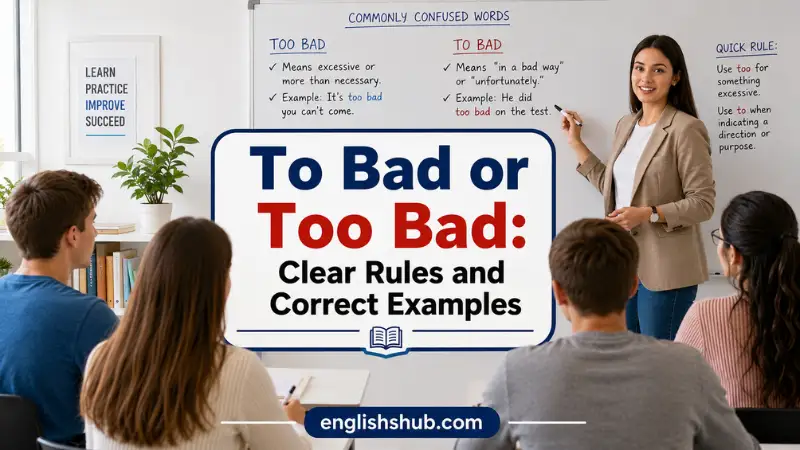
The answer to to bad or too bad is too bad when you mean “unfortunate” or “a shame.” Write “That’s too bad,” not “That’s to bad.” The extra o belongs in the expression, even in a quick text message.
However, the words to and bad can correctly appear together in a longer sentence. “The manager responded to bad reviews” is grammatical because bad describes reviews. That is a different structure, not another spelling of the expression for regret.
Meaning also affects tone. “Too bad” may express sympathy, but it can sound uncaring in the wrong setting. Knowing the spelling helps you avoid an error; checking the whole sentence helps you preserve both the meaning and the message you intend.
Quick Answer
Use too bad when you mean “unfortunate” or describe something as excessively bad. For the question to bad or too bad, the expression takes two o’s. However, to bad can occur before a noun, as in “respond to bad reviews.” It is not the correct spelling in “That’s too bad.”
TL;DR
- Write too bad for regret, disappointment, or an excessive degree of badness.
- Keep to in a construction such as “listen to bad advice.”
- A correct spelling does not prevent a response from sounding dismissive.
- Very bad describes a high degree; it does not always mean the same as too bad.
- Not too bad often gives a mild or qualified positive assessment.
To Bad and Too Bad at a Glance
| Meaning or structure | Correct wording | Example |
|---|---|---|
| An unfortunate situation | too bad | “It’s too bad the museum closes early.” |
| An unacceptable degree | too bad to use | “The recording is too bad to use.” |
| A preposition before a noun phrase | to bad advice | “Don’t listen to bad advice.” |
| An acceptable result | not too bad | “The first attempt was not too bad.” |
Why Too Bad Is the Correct Expression
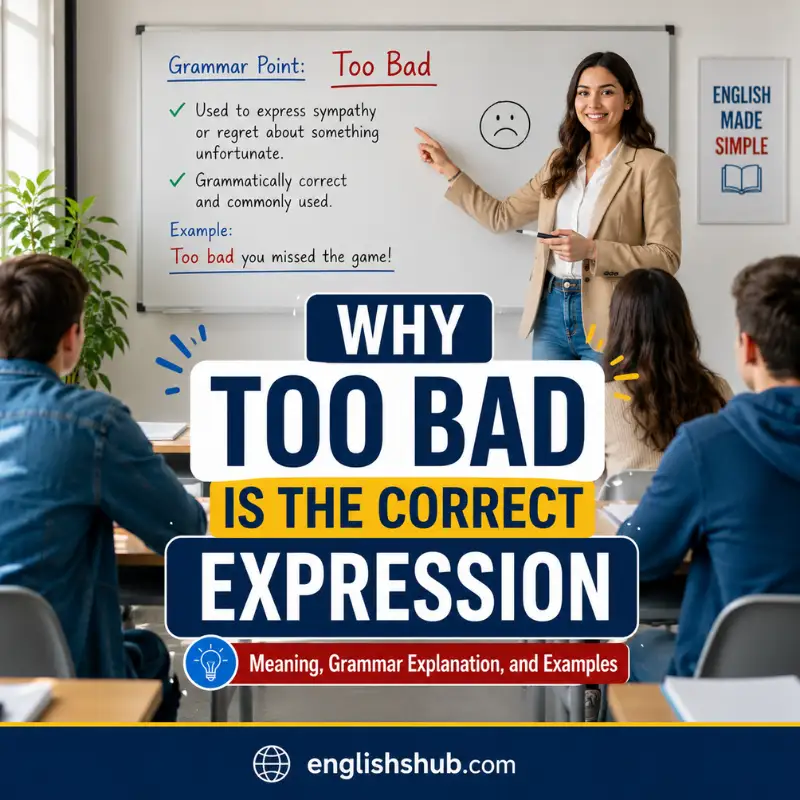
Too is an adverb, a word that can modify an adjective such as bad. Here, modifying means changing or adding to the adjective’s meaning. Merriam-Webster’s
includes excessive degree, as well as the separate meaning “also.”
Compare these examples:
- “The scan is too bad to print clearly.”
- “I saved a second scan too.”
In the first, too describes the degree of poor quality. In the second, it means “also.” Therefore, remembering only the “also” meaning will not explain every use of too.
The familiar response “That’s too bad” also has an established meaning: “That’s unfortunate.” Learn that spelling as a unit. Similar attention to established wording helps with
another expression whose small words are easy to mix up.
The spelling rule does not depend on how strongly you feel. Mild disappointment still takes too, not to.
What Does Too Bad Mean?
Too bad can express regret about a situation or describe a degree of badness that exceeds a useful limit. Context tells you which meaning applies.
“It’s too bad the first print came out blurry. Luckily, we can print another.”
This speaker means the result is unfortunate. The problem does not need to be permanent or impossible to fix. The second sentence offers a solution without contradicting the first.
Now compare “The first print is too bad to display.” Here, the speaker judges its quality against a purpose: displaying it. The pattern is too + adjective + to + verb. In this example, the quality falls below what the purpose requires.
Notice that the sentence needs both spellings. Too modifies bad, while to introduces display.
A regret statement and a quality judgment can describe the same event, but they do different jobs. “It’s too bad the print failed” expresses a reaction; “The print is too bad to use” describes a limit.
When To Bad Can Be Correct
To bad can be correct when the two words belong to a larger grammatical structure. It is not automatically an error whenever those letters appear side by side.
Merriam-Webster’s
describes its connecting roles, including relationships involving an action and its target. Consider:
- “The editor replied to bad reviews.”
- “Repeated shortcuts can lead to bad habits.”
In each sentence, bad describes the following noun. The larger groups are to bad reviews and to bad habits. The preposition to introduces the noun phrase; it does not modify the adjective bad.
You can also write “The signal changed from good to bad.” The phrase describes a change between two states. It is not the regret expression too bad.
The same habit of checking which words belong together helps with
Read beyond the neighboring words before making a correction.
However, none of these examples makes “That’s to bad” standard. That sentence still needs too when it means “That’s unfortunate.”
Is Too Bad Rude?
Too bad is not automatically rude, but it can express either sympathy or a lack of sympathy.
Merriam-Webster’s definition of too bad
records both uses.
Imagine someone says, “I couldn’t join the workshop.” Compare these replies:
- Potentially dismissive: “Too bad. We already started.”
- More clearly supportive: “That’s too bad. I can send you my notes.”
The added sentence helps make the speaker’s intention clear. Simply adding that’s does not guarantee kindness; the rest of the message still matters.
For a customer email, “I’m sorry the appointment did not work out. We can offer another time” states regret and a next step. It avoids leaving the reader to interpret a short response.
Treat this as a tone choice, not a new spelling rule. The same distinction between correctness and social effect appears in
Consider the relationship and situation, especially when the other person cannot hear your voice.
Too Bad, Very Bad, and Not Too Bad
These expressions are related, but they do not always say the same thing.
Very bad describes a high degree of poor quality or unpleasantness. Too bad can describe a degree that exceeds a limit, or it can mean unfortunate.
Compare “The audio was very bad, but we understood the speaker” with “The audio was too bad to understand.” The first allows successful understanding despite poor quality. The second says the quality prevented it.
Therefore, replacing too with very may help identify a word’s grammatical role, but it does not guarantee the same meaning.
Meanwhile, “The audio wasn’t too bad” often means it was acceptable or better than expected. The speaker is making a qualified assessment, not necessarily offering enthusiastic praise.
The surrounding words still matter. “The damage wasn’t too bad” means the damage was limited; it does not mean the damage was desirable. Keep the judgment tied to the actual thing being described.
Too Bad or Too Badly?
Use bad to describe a condition or quality in sentences such as “The result was too bad to submit.” Use badly when you need an adverb describing how an action happens.
For example, in formal edited prose:
- “The draft was too bad to publish.”
- “The argument was too badly organized to follow.”
In the second sentence, badly describes the organization, not the draft as a whole.
Merriam-Webster’s definition of badly
includes doing something in a bad manner.
Another example is “The team played too badly to win.” Here, the adverb describes performance. By contrast, “It’s too bad the team lost” expresses regret about the outcome.
Do not add -ly simply because a verb appears earlier in the sentence. “That’s too badly” is not the normal expression for “That’s unfortunate.” Choose the form that fits the meaning and structure.
Alternatives and Contextual Opposites
Choose an alternative according to the message you want to send. These options can replace a regret response, but they are not interchangeable in every sentence.
| Alternative | Typical effect | Useful context |
|---|---|---|
| “That’s unfortunate.” | Neutral and direct | Describing an unwelcome result |
| “What a shame.” | Conversational regret | A missed opportunity |
| “I’m sorry to hear that.” | Explicit sympathy | Responding to someone’s bad news |
| “That is regrettable.” | More formal, sometimes distant | A formal assessment |
For instance, “What a shame the exhibition ended early” preserves the regret in “Too bad the exhibition ended early.” However, replacing too bad with a shame in “The image is too bad to enlarge” does not preserve its quality judgment.
There is no single opposite for every use. “That’s good news” contrasts with an unfortunate development. For a practical quality limit, “good enough to use” contrasts with “too bad to use.” Match the relationship, not just the individual word bad.
How to Check To Bad or Too Bad in a Sentence
Use this three-step check when proofreading.
- Check the meaning. If the expression means “unfortunate,” write too bad. If it describes excessive badness, too is also the relevant word.
- Check the structure. Does bad describe a following noun in a phrase such as to bad advice? If so, do not automatically change to.
- Check the tone. If you intend sympathy, make that intention clear through the full response.
Apply the check to two different errors:
Incorrect: “It’s to bad the library closed early.”
Correct: “It’s too bad the library closed early.”
The sentence expresses regret, so the established expression needs two o’s.
Incorrect: “The delay led too bad decisions.”
Correct: “The delay led to bad decisions.”
Here, bad describes decisions, and to completes the relationship after led. Adding an extra o would create an error instead of fixing one.
FAQs
Yes. That’s means that is, so the sentence has a subject and a verb. Too bad describes the situation represented by that. The shorter response “Too bad” can also work naturally in conversation, though it leaves those words understood.
Write the ordinary expression as two words without a hyphen: “That’s too bad.” It is not toobad. A writer may use hyphens in an unusual compound before a noun, but that does not change the spelling of the normal response.
Use too bad when your text means “unfortunate.” A casual setting does not change the standard spelling. However, “I don’t listen to bad advice” remains correct in a text because bad describes advice rather than forming the regret expression.
Write not too bad when you mean “fairly good” or “acceptable.” For example, “My first presentation was not too bad” gives a modest assessment. Negating the description does not change too into the preposition to.
No. Too bad is the established spelling in both American and British English. Collins lists both varieties. Its British entry marks the expression informal. A regional difference does not make “That’s to bad” the standard alternative.
Yes. Both “It’s too bad that the workshop ended” and “It’s too bad the workshop ended” are grammatical. Here, that introduces the following clause and can be omitted. Keep it if it helps the sentence read more clearly.
Test Your Understanding
- Which sentence correctly expresses regret about a missed event? A. It’s to bad we missed the opening.
B. It’s too bad we missed the opening.
C. It’s two bad we missed the opening.
D. It’s too badly we missed the opening. - Complete this sentence: “The coach listened ___ bad advice.” A. too
B. two
C. to
D. too much - Which sentence clearly says the audio quality prevented understanding? A. The audio was not too bad.
B. It’s too bad the audio ended early.
C. The audio was very bad, but understandable.
D. The audio was too bad to understand. - A colleague says, “I missed the training session.” Which response most clearly expresses sympathy and offers help? A. That’s too bad. I can share my notes.
B. Too bad. You should have arrived earlier.
C. Too bad. Everyone else managed to attend.
D. That’s too bad. It isn’t my problem. - Choose the conventional form for a formal report: “The team played ___ to win.” A. to bad
B. too badly
C. too bad
D. to badly
Answer Key
- B. The expression for regret is too bad, with two o’s.
- C. To introduces the noun phrase bad advice, in which bad describes advice.
- D. Too bad to understand states that poor quality prevented understanding.
- A. The offer to share notes makes the intended support explicit.
- B. In conventional formal usage, badly describes how the team played, while too marks the degree.
Conclusion
For to bad or too bad, choose too bad when you mean “unfortunate” or describe an excessive degree. Keep to when the sentence needs it before a group such as bad advice. Then check the message: a correctly spelled response can still sound cold. Read the whole sentence, identify what each word does, and choose a more explicit expression of sympathy when a short reply could be misunderstood.
Related Grammar and Language Guides
On To or Onto: What’s the Difference?