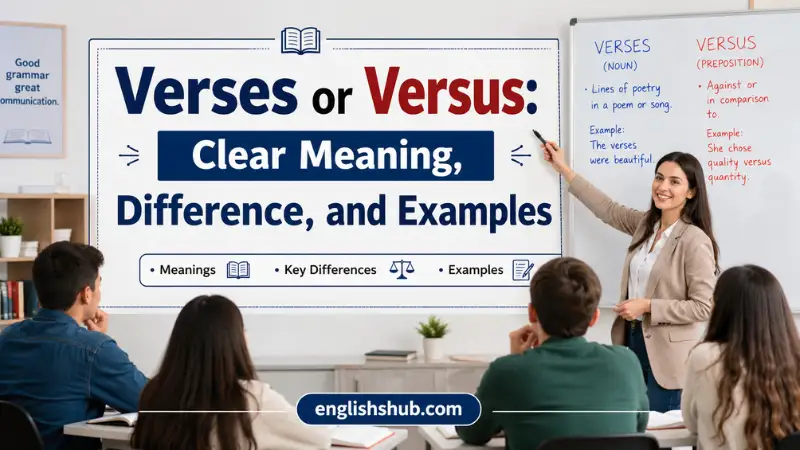
The choice between verses or versus depends on meaning. Use verses when you mean multiple sections or lines of poetry, songs, or scripture. Use versus when you mean “against,” “in contrast to,” or “compared with.” The two words can sound very similar, so they are easy to confuse in speech and writing. However, their grammatical jobs are different. Verses is normally a plural noun, while versus is a preposition. Learning that difference gives you a simple way to choose the correct form in sports, legal writing, music, academic comparisons, and everyday sentences.
Quick Answer
Use verses for multiple parts or lines of a poem, song, or scripture. Use versus for opposition, competition, or comparison. For example, “The song has three verses” is correct, while “The teams play versus each other” uses versus. In legal case names, v. is a common abbreviation for versus.
TL;DR
- Verses is usually the plural of verse.
- Versus means “against” or “in contrast to.”
- Use verses for poems, songs, and scripture.
- Use versus for sports, law, comparisons, and alternatives.
- Vs. and v. are abbreviations of versus in appropriate contexts.
- An informal verb verse also exists, but it does not replace standard versus.
Verses or Versus at a Glance
| Context | Best Choice | Meaning | Example |
|---|---|---|---|
| Multiple song sections | verses | Parts of a song | The song has three verses. |
| Poetry | verses | Lines or sections of verse | She studied several verses. |
| Scripture | verses | Numbered passages | He read two Bible verses. |
| Sports matchup | versus | Against | Miami versus Boston |
| Legal case | versus / v. | One side against another | Smith v. Jones |
| General comparison | versus | In contrast to | Cost versus quality |
| Informal competition verb | verse | Compete against | The team will verse its rival. |
What Does Verses Mean?
Verses is normally the plural form of the noun verse. A verse can mean a line of metrical writing, a group of lines in a poem or song, or a numbered section of scripture. Therefore, verses refers to more than one such unit.
For example:
- “The poet published several verses about winter.”
- “The choir practiced three verses of the hymn.”
- “She memorized several verses from the poem.”
- “The reading included two Bible verses.”
- “The song has four verses before the final chorus.”
The exact meaning depends on the type of text. In a song, a verse is one of the sections that typically occurs alongside a chorus. In scripture, a verse is a numbered division of a chapter. In poetry, the word can refer to a line or a larger poetic unit depending on context.
So, if your sentence is about written or sung material, verses is usually the form you need.
What Does Versus Mean?
Versus is a preposition meaning “against,” “in contrast to,” or “as an alternative to.” It connects two sides of a comparison or opposition. Cambridge gives examples involving sports teams, legal cases, and competing ideas, while Oxford includes sports, law, and comparisons between choices.
Examples include:
- “The championship is Lakers versus Celtics.”
- “The debate focused on quality versus quantity.”
- “The court considered Smith versus Jones.”
- “The study compares online learning versus classroom learning.”
- “The decision came down to speed versus accuracy.”
Notice that none of these sentences involves poetry or song sections. The word establishes a relationship between two sides.
A useful replacement test is simple:
If against, compared with, or in contrast to fits the sentence, versus is probably the right choice.
For example:
“Price versus quality” can be understood as “price compared with quality.”
That substitution would not work with verses.
Verses vs. Versus in Real Contexts
The fastest way to understand the distinction is to place the words in similar situations.
Music
Correct:
“The song has two powerful verses.”
The sentence discusses sections of a song.
Incorrect:
“The song has two powerful versus.”
Versus would suggest opposition or comparison, so it does not fit.
Sports
Correct:
“The Eagles play versus the Cowboys on Sunday.”
Here, the two teams are opposing each other.
Incorrect:
“The Eagles play verses the Cowboys.”
Verses normally refers to multiple textual or lyrical units, so it cannot perform the comparison job here.
Poetry
Correct:
“The student analyzed several verses from the poem.”
The word identifies multiple poetic units.
General comparison
Correct:
“The report examines experience versus education.”
The sentence compares two factors.
These examples reveal the central rule: verses belongs to the world of text and verse; versus belongs to the world of comparison and opposition.
When to Use Versus in Sports, Law, and Comparisons
Versus appears in several common contexts, but the underlying meaning remains the same.
Sports
Use versus when two teams or competitors face each other.
- “New York versus Chicago”
- “The champion versus the challenger”
- “Mexico versus the United States”
Cambridge specifically identifies versus for competing teams or people.
Legal writing
Versus can identify opposing sides in a legal case.
- “The case was Smith versus Jones.”
- “The court considered Brown versus the state.”
Legal case names also commonly use the abbreviation v.:
- “Brown v. Board of Education”
- “United States v. Nixon”
The exact presentation of legal case names depends on the applicable citation system, so do not assume that every legal document uses the same formatting.
Comparisons
Versus also introduces a contrast that is not a physical conflict.
- “Traditional learning versus online learning”
- “Quality versus quantity”
- “Saving versus spending”
- “Speed versus accuracy”
In these examples, neither side needs to be an opponent. The word simply marks a comparison or contrast. Oxford and Cambridge both recognize this broader use.
Versus, Vs., and V.: What Is the Difference?
The full word is versus. It has several abbreviations, including vs., vs, and v., depending on context and style.
Cambridge lists vs, vs., and, in some contexts, v as written abbreviations of versus.
Merriam-Webster likewise lists vs, vs., and v. as forms used for versus.
A practical guide is:
- versus — safest full form when you want maximum clarity.
- vs. / vs — common in comparisons, sports, headlines, and other space-limited contexts.
- v. — especially familiar in legal case names.
For example:
“The article compares cats versus dogs.”
A headline might use:
“Cats vs. Dogs”
A legal case may appear as:
“Smith v. Jones”
Do not replace versus with verses simply because the words sound similar.
The Informal Verb Verse Is a Special Case
There is one useful qualification that many simple explanations leave out: verse can also function as a verb in informal English meaning “to compete against or oppose.”
Merriam-Webster records this verb separately and identifies it as informal. It describes the verb as a back-formation from versus.
For example:
“Our team will verse the defending champions.”
Here, verse is a verb. Its past form can be versed, and its present participle can be versing.
This does not mean that verses has become a standard replacement for versus as a preposition.
Compare:
“The two teams will verse each other.”
“The two teams will play versus each other.”
The first uses an informal verb. The second uses the standard preposition.
For formal, academic, or professional writing, versus is generally the safer choice when you need the preposition meaning “against” or “in contrast to.”
Synonyms, Near-Synonyms, and Substitution Limits
The two words have related alternatives, but those alternatives are not interchangeable in every sentence.
| Word | Relationship | Example | Limitation |
|---|---|---|---|
| versus | Core comparison word | Cost versus quality | Best when marking contrast |
| against | Close synonym for opposition | The team played against Chicago | Less natural for some abstract comparisons |
| compared with | Comparison phrase | Speed compared with cost | Does not always imply opposition |
| in contrast to | Contrast phrase | Quality in contrast to price | More explicit and often more formal |
| verses | Related only through sound/word family | Three verses of a song | Cannot normally replace versus |
For example:
“The teams played against each other.”
This is a natural alternative to:
“The teams played versus each other.”
However, replacing versus with against in every comparison may change the tone or structure:
“Cost versus quality”
works naturally, while
“Cost against quality”
does not express the same comparison as naturally.
Likewise, verses is not a synonym for against. Its normal noun meaning concerns sections or lines of verse.
Common Verses and Versus Mistakes
These errors usually happen because the words sound similar.
| Incorrect | Correct | Why |
|---|---|---|
| The Tigers verses the Lions. | The Tigers versus the Lions. | Competition needs versus. |
| The song has three versus. | The song has three verses. | Song sections are verses. |
| She quoted two Bible versus. | She quoted two Bible verses. | Scripture passages are verses. |
| Quality verses quantity | Quality versus quantity | This is a comparison. |
| The poem contains five versus. | The poem contains five verses. | Multiple poetic units are verses. |
| The teams will versus tomorrow. | The teams will verse tomorrow. | If using the informal verb, verse is the base form. |
The last example needs care. In polished writing, it is often better to rewrite the sentence as “The teams will play against each other tomorrow.” The informal verb verse is documented, but it is less established than standard versus.
Pronunciation and Why the Words Get Confused
The spelling confusion is understandable because the words are pronounced very similarly. Merriam-Webster describes versus and verses as homophones, while its dictionary gives versus pronunciations with a final sound that can vary.
The base word verse has the U.S. pronunciation /vɝːs/. Cambridge gives the same basic pronunciation for American English.
Because pronunciation can vary in connected speech, listening alone is not a reliable way to decide between the spellings.
Instead, ask what the word means.
- Talking about song sections? verses
- Talking about Bible passages? verses
- Talking about poetry? verses
- Talking about two opposing teams? versus
- Talking about two competing ideas? versus
- Naming opposing legal parties? versus or an appropriate abbreviation
Meaning is a better guide than sound.
A Simple Three-Step Test
When you are unsure, use this process.
Step 1: Identify the subject
Ask what the sentence discusses.
If it concerns a poem, song, lyrics, or scripture, start with verses.
If it concerns a contest, conflict, comparison, or opposing sides, start with versus.
Step 2: Try a replacement
For versus, try:
- against
- compared with
- in contrast to
For verses, try:
- sections
- lines
- passages
If one replacement fits naturally, you have a strong clue.
Step 3: Check the grammar
If the word is functioning as a plural noun, verses may be correct:
“The three verses were difficult to memorize.”
If the word connects two sides of a comparison, versus is the normal choice:
“The debate was about tradition versus change.”
This test is more reliable than trying to remember the spelling from sound alone.
FAQs
Normally, no. When naming two opposing teams, use versus or an appropriate abbreviation such as vs. For example, “Dallas versus Miami” is correct. Verses normally refers to multiple sections or lines of poetry, songs, or scripture.
No. Versus also appears in legal case names and ordinary comparisons. You can write “Smith versus Jones,” “cost versus quality,” or “online learning versus classroom learning.” The shared meaning is opposition, contrast, or comparison.
They are commonly treated as homophones because they can sound alike or extremely similar in speech. Merriam-Webster explicitly describes them that way. Because pronunciation can vary, however, spelling should be chosen from context rather than sound.
The plural is verses. For example, “The poem contains several verses.” The same plural form appears when verse refers to song sections or numbered passages of scripture.
Yes. Merriam-Webster records an informal verb verse meaning to compete against or oppose someone or a team. However, that does not make verses a standard substitute for the preposition versus. In formal writing, versus or a clearer phrase such as against is usually preferable.
Use the form appropriate to your context and style. Vs. or vs. is common for general comparisons, while v. is especially associated with legal case names. If you are unsure, writing the full word versus avoids unnecessary abbreviation issues. Cambridge and Merriam-Webster both document these abbreviations.
Test Your Understanding
- Which word correctly completes the sentence? “The singer performed three ___ from her new album.”
- A. versus
- B. verses
- C. v.
- D. vs.
- Which sentence uses versus correctly?
- A. The poem contains four versus.
- B. She memorized two versus from the hymn.
- C. The debate examined freedom versus security.
- D. The song has several versus.
- Which form is most appropriate for the standard preposition meaning “against”?
- A. verse
- B. verses
- C. versus
- D. versed
- Which sentence uses the informal verb verse?
- A. The poem contains five verses.
- B. The teams will verse each other in the final.
- C. The lawyer cited several Bible verses.
- D. The song has two verses.
- Which statement is correct?
- A. Verses is the standard preposition for comparisons.
- B. Versus is the plural of verse.
- C. Verses normally refers to multiple poetic, musical, or scriptural units.
- D. Verse can never function as a verb.
Answer Key
- B — verses. The sentence refers to multiple sections of songs.
- C — freedom versus security. The sentence compares two ideas.
- C — versus. Versus is the standard preposition meaning “against” or “in contrast to.”
- B — The teams will verse each other in the final. Verse is documented as an informal verb meaning to compete against.
- C — Verses normally refers to multiple poetic, musical, or scriptural units. The other choices confuse the word’s grammatical roles.
Conclusion
When choosing verses or versus, focus on meaning rather than sound. Use verses for multiple sections or lines of poetry, songs, and scripture. Use versus for opposition, competition, legal sides, or comparisons. Remember that vs. and v. can abbreviate versus in appropriate contexts. Although dictionaries also record an informal verb verse meaning “compete against,” it does not replace the standard preposition versus. A quick context check will usually give you the right form.
Related Grammar and Language Guides
Aide or Aid: What’s the Difference?
Patient or Patience: Difference, Rules, and Examples
One in the Same or One and the Same: Meaning and Correct Use