
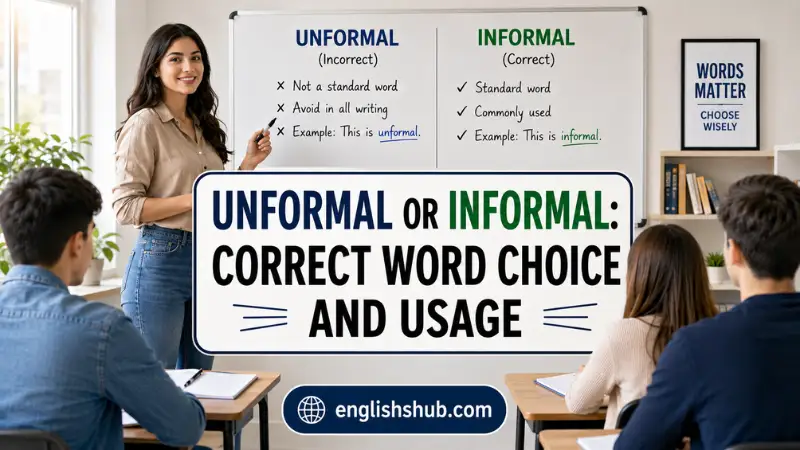
Unformal or informal? In standard modern American English, informal is the word you should normally use when you mean “not formal,” “casual,” “relaxed,” or “unofficial.” Unformal may be understandable, and rare or historical evidence exists, but it is not the normal modern choice.
This confusion is easy to understand. English often uses un- to create opposites, as in unhappy and unclear. However, English does not build every opposite with the same prefix. The established adjective is informal, formed with in-.
The key is therefore simple: if you want the standard adjective meaning “not formal,” choose informal.
Quick Answer
For unformal or informal, choose informal in standard modern English. It describes something that is not formal, official, ceremonial, or highly structured. Use it for phrases such as informal meeting, informal language, and informal clothing. Although unformal may appear in rare or historical contexts, it is not the normal word for modern U.S. writing.
TL;DR
- Informal is the standard modern word.
- Unformal is unusual and normally best avoided.
- Informal can mean casual, relaxed, unofficial, or conversational.
- Informal does not automatically mean rude or unprofessional.
- Casual and relaxed overlap with informal, but they are not perfect substitutes.
- The opposite of informal is usually formal.
Unformal or Informal at a Glance
| Feature | Informal | Unformal |
|---|---|---|
| Standard modern U.S. choice | Yes | No |
| Basic meaning | Not formal; casual or unofficial | Intended to mean “not formal” |
| Common in edited writing | Yes | No |
| Natural phrases | informal meeting, informal tone | No common standard patterns |
| Can describe language? | Yes | Not normally |
| Can describe clothing? | Yes | Not normally |
| Best advice | Use it | Avoid it in normal writing |
Merriam-Webster lists informal as an adjective meaning marked by an absence of formality or ceremony and also as suitable for ordinary, casual, or familiar use. Cambridge likewise uses the word for things that are not formal or official and for speech, behavior, and clothing suited to less formal situations.
Why Informal Is the Standard Choice
The correct modern choice is informal.
English does not always form negative adjectives by simply adding un-. Compare these established forms:
- happy → unhappy
- clear → unclear
- fair → unfair
- formal → informal
- accurate → inaccurate
- legal → illegal
- regular → irregular
The pattern depends partly on the history and structure of each word. That means you cannot reliably create a new opposite by attaching un- whenever the meaning seems logical.
The safest approach is to learn the established form rather than assume the prefix.
For example:
- Correct: The meeting was informal.
- Incorrect in standard modern usage: The meeting was unformal.
The same rule applies in professional and academic writing. If you mean that something is relaxed or not official, informal is the established choice. Merriam-Webster, Cambridge, and Oxford all document informal as a standard adjective.
For a direct dictionary reference, see the
Merriam-Webster definition of informal.
What Does Informal Mean?
Informal has several closely related meanings. The exact sense depends on what it describes.
Oxford defines it in contexts involving relaxed or friendly behavior, language suitable for ordinary conversation, informal clothing, and certain unofficial forms of work or business.
1. Not formal or ceremonial
An informal event is relaxed rather than highly structured or ceremonial.
We had an informal dinner after the conference.
2. Casual or relaxed
An informal atmosphere feels comfortable rather than stiff or highly official.
The restaurant has an informal atmosphere.
3. Conversational language
Informal language is appropriate for ordinary conversation and familiar communication.
“Thanks for your help” sounds natural in many informal messages.
4. Unofficial or less structured
An informal arrangement may exist without a formal process or official structure.
The two departments reached an informal agreement.
5. Suitable for everyday use
Informal clothing, for example, is suitable for relaxed situations rather than special or formal occasions.
The invitation says that the dress code is informal.
These meanings overlap, but they are not identical. Context tells you which part of the meaning is most important.
Why “Unformal” Causes Confusion
The form unformal looks reasonable because un- often means “not.”
That creates a tempting pattern:
formal → unformal
But standard English does not use that form as the ordinary modern opposite of formal.
This is similar to other words where the apparently logical negative form is not the established word. English learners cannot always predict which negative prefix a word takes.
Another reason for the confusion is that unformal is easy to understand. A reader can usually guess what the writer means. However, being understandable does not make a form the best standard choice.
Compare:
The teacher used an informal teaching style.
with:
The teacher used an unformal teaching style.
The first sounds natural. The second may make readers stop and wonder whether it is a mistake.
That is why the practical rule is more useful than trying to invent a prefix rule:
When you mean “not formal,” use informal.
Some sources discuss rare or historical evidence for unformal, so it is better to describe the word as unusual or nonstandard in ordinary modern usage rather than claim that the sequence of letters can never appear in English.
Formal vs Informal: Tone and Register
Informal does not mean bad, careless, or rude.
It describes a level or style of formality. A message can be informal and still be polite, thoughtful, and professional.
For example:
Formal:
Dear Ms. Carter, I am writing to confirm our appointment.
Informal but polite:
Hi Maya, just checking that we’re still meeting tomorrow.
Both can be appropriate. The best choice depends on the audience, relationship, purpose, and setting.
Cambridge describes informal as appropriate for situations with friends and family rather than official occasions, while Oxford applies the word to relaxed language, meetings, clothing, and arrangements.
A useful scale is:
formal → neutral → informal → very casual
For example:
- Formal: “I would appreciate your response.”
- Neutral: “Please let me know what you think.”
- Informal: “Let me know what you think.”
- Very casual: “Tell me what you think!”
Not every situation fits neatly into this scale, but it helps explain why informal is a register label rather than an insult.
Informal vs Casual, Relaxed, and Unofficial
Several words are close to informal, but they are not perfect synonyms.
| Word | Core idea | Example |
|---|---|---|
| informal | Not formal or official | an informal meeting |
| casual | Relaxed or unconcerned | casual clothes |
| relaxed | Calm and free from tension | a relaxed atmosphere |
| unofficial | Not formally authorized | an unofficial announcement |
| colloquial | Characteristic of everyday speech | a colloquial expression |
These words can overlap.
For example:
We had an informal meeting.
You could sometimes say:
We had a casual meeting.
But the two sentences are not always identical. Informal focuses on the level of formality. Casual can emphasize a relaxed or unplanned character.
Likewise:
The announcement was unofficial.
does not necessarily mean:
The announcement was informal.
An unofficial announcement may still use very formal language.
Similarly, colloquial is mainly useful when discussing language associated with ordinary conversation. Oxford contrasts informal language with formal language, while Collins also recognizes informal for everyday conversational language.
For more examples of how English word choices can depend on grammatical function, EnglishShub’s guide to
provides a useful comparison.
Informal, Informality, and Informally
The word family includes more than the adjective informal.
Informal — adjective
Use informal to describe a person, thing, situation, style, or type of language.
The interview was informal.
She prefers informal clothing.
Informality — noun
Use informality to name the quality or condition of being informal.
The informality of the meeting helped everyone relax.
Informally — adverb
Use informally to describe how something happens.
The two managers spoke informally before the meeting.
Cambridge lists informally as an adverb meaning in a way that is not formal or official, while Merriam-Webster gives informality and informally as related forms of informal.
This gives you a useful word-family pattern:
informal → informality → informally
Do not create unformal simply because the adjective seems as though it should have an un- prefix.
Common Mistakes and Corrections
Mistake 1: Using unformal
Incorrect:
We had an unformal meeting.
Correct:
We had an informal meeting.
Mistake 2: Writing “in formal” when you mean informal
Incorrect:
Her writing style is in formal.
Correct:
Her writing style is informal.
However, in formal can be correct when in is a separate preposition and formal is an adjective:
She spoke in formal English.
Here, in belongs to the prepositional phrase, so it should remain separate.
Mistake 3: Assuming informal means unprofessional
Incorrect idea: Informal writing is always careless.
Better understanding: Informal writing can be clear, polite, and appropriate when the audience and situation allow it.
Mistake 4: Treating informal and casual as identical
Incorrect assumption: Every use of informal can be replaced with casual.
Better: Check the intended meaning first.
The discussion was informal.
This may mean that it was unofficial or less structured. Casual could suggest something more relaxed, but it does not always preserve the same emphasis.
Mistake 5: Using informal when you mean illegal
An informal arrangement is not automatically illegal.
They reached an informal agreement.
This means the agreement was not formalized in the usual way. It does not, by itself, tell you whether the arrangement was lawful.
When “Unformal” May Appear
For ordinary modern American English, informal is the safe choice.
Still, language sources can contain rare, historical, specialized, or quoted forms. Wiktionary, for example, records unformal as an adjective meaning “not formal.”
That does not mean you should routinely replace informal with unformal. The important distinction is between existence in some evidence and standard modern usage.
If you encounter unformal in an old text, a quotation, a historical source, or a specialized context, preserve the original wording when you are reporting or quoting that source.
For normal writing today, however:
Use informal.
This distinction matters because dictionaries can record words that are rare, dated, regional, historical, or otherwise marked. A word’s appearance in a source does not automatically make it the preferred choice for contemporary U.S. prose.
Examples of Informal in Everyday English
Here are natural examples across different contexts:
- The company held an informal meeting after lunch.
- Her email sounded friendly and informal.
- The invitation called for informal dress.
- We had an informal conversation before the interview.
- The teacher encouraged an informal discussion.
- The two teams reached an informal agreement.
- His writing style is clear but informal.
- The event had an informal atmosphere.
- The manager asked for some informal feedback.
- The students spoke informally during the activity.
Now compare them with the nonstandard choice:
- Avoid: an unformal meeting
- Use: an informal meeting
- Avoid: an unformal tone
- Use: an informal tone
- Avoid: unformal language
- Use: informal language
- Avoid: an unformal event
- Use: an informal event
The meaning is usually obvious even with unformal, but standard word choice makes the sentence sound natural and polished.
EnglishShub’s recent guides use the same practical approach for other word-choice problems, such
as Therefor or Therefore and One in the Same or One and the Same.
A Simple Three-Step Test
When you are unsure about unformal or informal, use this test.
Step 1: Ask what you mean
Do you mean:
- not formal?
- casual?
- relaxed?
- conversational?
- unofficial?
If yes, informal is probably the word you need.
Step 2: Put the word into a common phrase
Try:
- informal meeting
- informal language
- informal email
- informal clothing
- informal discussion
- informal agreement
- informal tone
If the phrase sounds natural, informal is the established choice.
Step 3: Check whether you actually mean something more specific
Sometimes informal is too broad.
For example:
The party has a relaxed atmosphere.
may be more precise than:
The party has an informal atmosphere.
Likewise:
The announcement was unofficial.
may be better than:
The announcement was informal.
So the final rule is not simply “always choose informal.” It is:
Choose informal when your intended meaning is “not formal”; choose a more specific word when that better describes the situation.
FAQs
Unformal has some recorded use, including dictionary-style evidence, but it is not the normal modern choice in standard U.S. writing. When you mean “not formal,” “casual,” or “relaxed,” use informal.
Informal is the standard choice. Write informal meeting, informal language, informal clothing, and informal conversation. Unformal may be understandable, but it is unusual enough to distract readers in ordinary edited writing.
English uses different negative prefixes in different words. The fact that un- creates opposites such as unhappy does not mean it works with every adjective. The established form with formal is informal.
No. Informal describes a lower level of formality. An informal email can still be polite and professional. For example, a friendly message to a colleague may be informal without being careless or disrespectful.
They are close, but not always interchangeable. Casual often emphasizes a relaxed or everyday quality, while informal can also mean unofficial or not following formal procedures. Choose the word that matches the exact context.
The most direct opposite is formal. Depending on context, other contrasts may include official, ceremonial, structured, or conventional. However, those words do not replace formal in every sentence.
Test Your Understanding
1. Which sentence uses the standard word?
A. We had an unformal meeting.
B. We had an informal meeting.
C. We had an in formal meeting.
D. We had a nonformal meeting in every context.
2. What does “informal” usually mean in “informal conversation”?
A. Illegal conversation
B. Secret conversation
C. Relaxed or conversational communication
D. Incorrect conversation
3. Which sentence uses “in formal” correctly as two separate words?
A. Her style was in formal.
B. The meeting was in formal.
C. She spoke in formal English.
D. He wrote an in formal email.
4. Which word is the best choice if you mean “not officially authorized”?
A. informal
B. casual
C. unofficial
D. relaxed
5. Which sentence uses the noun form correctly?
A. The informality of the gathering made guests comfortable.
B. The informal of the gathering made guests comfortable.
C. The informally of the gathering made guests comfortable.
D. The unformal of the gathering made guests comfortable.
Answer Key
- B — Informal is the standard modern adjective for something that is not formal.
- C — Informal conversation means relaxed or everyday conversational communication.
- C — Here, in is a preposition and formal describes the type of English.
- C — Unofficial specifically emphasizes a lack of official authorization or status.
- A — Informality is the noun naming the quality or condition of being informal.
Conclusion
When choosing unformal or informal, use informal when you mean “not formal,” “casual,” “relaxed,” or “unofficial.” It is the established modern adjective in American English and works naturally in phrases such as informal meeting, informal language, and informal tone.
Unformal can appear in rare or historical evidence, but it is not the normal choice for contemporary edited writing. Remember the simplest rule: formal → informal, not unformal.
Related Grammar and Language Guides
Take Effect or Take Affect? Clear Rules and Examples
Therefor or Therefore: Clear Rules and Simple Examples
Aide or Aid: What’s the Difference?
Patient or Patience: Difference, Rules, and Examples
One in the Same or One and the Same: Meaning and Correct Use
[…] Unformal or Informal: Correct Word Choice and Usage […]