The choice between girlie or girly is not simply a matter of one spelling being right and the other being wrong. Both forms are recognized in English, but they can differ in grammatical function, tone, and context. Girly is commonly used as an adjective for something associated with girls or traditional femininity. Girlie can also work as an adjective, but it has additional informal noun and form-of-address uses. Cambridge lists girlie as an alternative form of girly, while other dictionaries distinguish several informal and older senses.
For most American English writing, the best choice depends on what you are trying to say. If you are describing a style, color, outfit, or quality, girly is usually the straightforward option. If you are addressing someone casually, girlie may fit better.
Quick Answer
Both girly and girlie are correct English words. Girly commonly works as an adjective meaning associated with girls or traditionally feminine. Girlie can also be an adjective, but it is especially useful in informal expressions such as “Hey, girlie!” Context matters because some girlie uses are older, specialized, or potentially offensive.
TL;DR
- Girly is commonly used to describe something feminine or associated with girls.
- Girlie is also a recognized adjective, so it is not simply a misspelling.
- Girlie can function as an informal noun or term of address.
- “Hey, girlie!” is casual and conversational.
- Some older girlie meanings have different or negative associations.
- Use the spelling that matches your meaning, grammar, and audience.
| Context | Common Choice | Example | Why |
|---|---|---|---|
| Describing clothing | girly | a girly dress | Clear adjective |
| Describing an aesthetic | girly | a girly aesthetic | Straightforward description |
| Informal adjective | girlie | a girlie weekend | Recognized alternative |
| Casual address | girlie | Hey, girlie! | Informal noun/address use |
| Online identity | girlie | a book girlie | Playful informal label |
| Formal neutral writing | Specific wording | feminine style | Often clearer and more precise |
Are Girly and Girlie Both Correct?
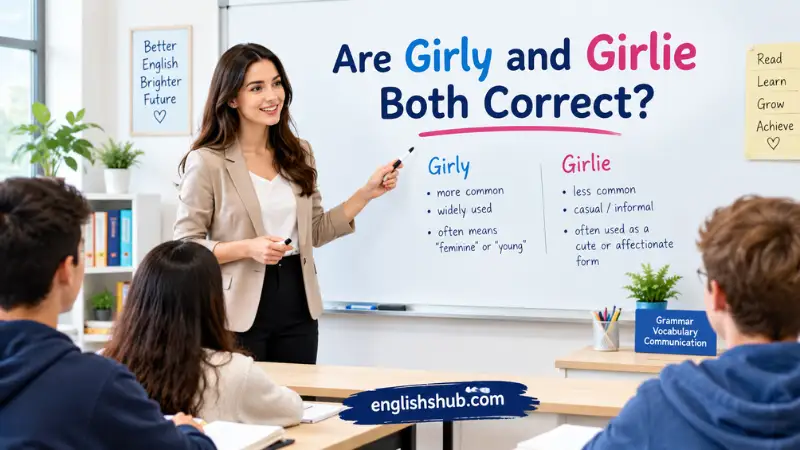
Yes. Both spellings are legitimate English forms, although they do not always have exactly the same usage or tone.
Cambridge lists girlie as an alternative form of girly. Its entry gives girly as an informal adjective and also recognizes a noun use meaning a girl or woman. Dictionary.com likewise lists girly as both an adjective and an informal noun, while its girlie entry identifies girlie as another form and records several adjective and noun meanings.
Therefore, it is misleading to teach the distinction as:
girly = correct
girlie = incorrect
A better rule is:
Both words exist, but the context determines which one sounds natural and what it means.
For example:
- She bought a girly dress.
- She bought a girlie dress.
- Hey, girlie! How are you?
- She has a very girly style.
The first two sentences use an adjective. The third uses girlie as an informal term of address. The fourth uses girly as a straightforward adjective.
For a general American English audience, girly is often the clearest choice when the goal is simply to describe something as feminine or associated with girls.
What Does Girly Mean?
Girly is primarily an informal adjective meaning associated with girls or women, or considered traditionally feminine. Cambridge gives examples involving “girly stuff” and “girly things” and also notes that the word can sometimes be disapproving when applied to people.
You can use girly before a noun:
- a girly dress
- a girly room
- a girly hairstyle
- a girly aesthetic
- a girly color
- a girly outfit
- a girly hobby
- a girly style
Examples:
- Maya chose a girly dress for the party.
- Her bedroom has a bright, girly style.
- The design looks playful without being overly girly.
- She prefers a less girly color palette.
- The costume has a deliberately girly aesthetic.
The word does not mean that something is objectively feminine. What people consider “girly” depends on cultural expectations and context.
For instance, pink may be described as girly in one context because it is culturally associated with femininity. That does not make pink inherently feminine.
What Does Girlie Mean?
Girlie has several uses. It can work as an adjective describing something associated with girls or women, just like girly. Cambridge and Collins both recognize this adjective use.
Examples include:
- a girlie dress
- a girlie weekend
- a girlie style
- a girlie look
However, girlie also has noun and address uses.
For example:
“Hey, girlie! How have you been?”
Here, girlie is not describing another noun. It is being used as an informal term of address.
Dictionary sources also record noun uses referring to a girl or woman. Some dictionaries mark particular uses as offensive, disparaging, patronizing, or older.
That distinction matters because the same spelling can carry different associations in different sentences.
Compare:
- She chose a girlie dress. → adjective
- Hey, girlie! → informal term of address
- The girlies arrived together. → plural noun
The surrounding words tell you which grammatical function is intended.
Girlie or Girly: Grammar and Usage
The easiest way to choose between girlie and girly is to identify the word’s job in the sentence.
When the word describes something
Both spellings can occur:
- a girly outfit
- a girlie outfit
- a girly style
- a girlie style
- a girly weekend
- a girlie weekend
The -y form is often the more straightforward descriptive choice in American English.
When the word addresses a person
Girlie is particularly natural in informal expressions:
- Hey, girlie!
- Thanks, girlie!
- You’ve got this, girlie!
- Good morning, girlie!
In these examples, girlie acts like a casual form of address rather than an adjective.
When the word becomes a plural noun
The plural is girlies:
- The girlies are meeting for coffee.
- Those girlies are planning a trip.
- The book girlies loved the new release.
Do not confuse this with the adjective girly:
- Correct: She likes girly clothes.
- Not correct: She likes girlies clothes.
The second sentence incorrectly uses a plural noun where an adjective is needed.
How Girlie Works in Slang and Social Media
Modern online English has expanded the informal uses of girlie. On social platforms, people may use girlie as a playful identity label or a friendly way to address someone.
Examples include:
- book girlie
- gym girlie
- corporate girlie
- theater girlie
- coffee girlie
Dictionary.com examples show contemporary uses such as “BookTok girlie,” “protest girlie,” and “pop girlie,” demonstrating that the noun-like form appears in current public writing.
The word can create a casual, community-oriented tone:
“I’m a total book girlie.”
That does not mean the speaker is using a new grammatical spelling of girly. Instead, girlie is functioning as an informal label for a person associated with a particular interest or identity.
Still, online usage changes quickly. A phrase that feels natural on social media may sound too casual in a school paper, business email, or formal report.
Is “Hey Girlie” Correct?
Yes, “Hey girlie” is grammatically possible and widely understandable as an informal greeting.
For example:
- Hey girlie, how are you?
- Hi, girlie! Long time no see.
- You’ve got this, girlie.
- Thanks, girlie!
The punctuation depends on the sentence. When girlie directly addresses someone, a comma can separate the term of address from the rest of the sentence:
Hey, girlie, are you ready?
This use is casual. It may sound warm or playful between friends, but it can also feel overly familiar or patronizing when used by someone who does not know the listener well.
Dictionary sources specifically note that some noun or address uses can have negative or offensive associations.
For professional communication, a neutral greeting is usually better:
- Casual: Hey, girlie!
- Neutral: Hi, Sarah!
- Professional: Hello, Sarah.
The choice is therefore about both grammar and social context.
Formal, Informal, and Professional Usage
Neither girly nor girlie should automatically be treated as a formal writing choice. Both are commonly labeled informal in dictionary definitions when they mean traditionally feminine or associated with girls.
In casual writing, either form may be natural:
She has a girly style.
We had a girlie weekend.
In professional writing, greater precision may be useful:
The design uses a traditionally feminine color palette.
This does not mean girly is grammatically wrong. It means that a specific description may communicate more clearly in a formal context.
Consider the audience:
| Audience | Possible wording |
|---|---|
| Close friend | Hey, girlie! |
| Social-media caption | My book girlie era |
| Casual conversation | She likes girly clothes. |
| School assignment | A traditionally feminine style |
| Professional report | A feminine design aesthetic |
The right choice depends on the communicative goal, not on a simple rule that one spelling is always formal and the other is always slang.
Girly vs. Girlish: Are They Synonyms?
Girly and girlish are related, but they are not perfect synonyms.
Girly commonly describes something considered feminine or associated with girls:
She likes a girly style.
Girlish more often means like a young girl in appearance, behavior, manner, or qualities. Cambridge gives examples such as “a girlish laugh.”
Compare:
- She chose a girly dress.
→ The dress has a style associated with girls or femininity. - She gave a girlish laugh.
→ Her laugh sounded like that of a young girl.
Another example:
The room has a girly design.
This does not naturally mean:
The room has a girlish design.
Likewise, girlish can describe behavior or manner in ways that girly may not express as precisely.
So, use:
- girly for feminine style, appearance, interests, or associations.
- girlish for qualities that resemble those of a young girl.
Pronunciation of Girly and Girlie
In standard U.S. English, girly and girlie have the same basic pronunciation:
/ˈɡɝː.li/
Cambridge gives this U.S. pronunciation for both forms.
A simple approximation is:
GUR-lee
The first syllable carries the main stress:
GUR-lee
The spelling difference therefore does not normally create a pronunciation difference in American English.
This is one reason people confuse the two forms when writing. They sound alike, but spelling alone does not tell you whether the word is being used as an adjective, noun, or informal term of address.
Where Did Girly and Girlie Come From?
Both forms developed from girl, but their histories are not simply a case of one being the “correct” spelling and the other being a mistake.
Etymonline dates girly as an adjective meaning “girl-like” to 1866 and also records earlier noun uses. It dates girlie in several historical senses to the late 19th and early 20th centuries.
Dictionary.com also gives girlie an origin from girl + -ie, with a first-recorded date of 1940–45 for the entry presented there.
Because historical records contain different spellings and meanings, it is better to say that the forms have overlapping histories rather than claiming that girlie is merely a modern misspelling of girly.
Older and Specialized Meanings of Girlie
There is an important reason to consider context carefully: girlie has older meanings that are different from the friendly social-media use many readers know today.
For example, dictionaries record girlie in expressions referring to publications or entertainment featuring sexualized images of women. Collins and Dictionary.com both document this sense.
Therefore, a phrase such as:
girlie magazine
may have an older or specialized meaning that is unrelated to:
Hey, girlie!
The modern online use does not erase the older dictionary senses. It simply adds another context in which the word is used.
This is a good example of why meaning comes from context, not spelling alone.
Common Mistakes With Girlie and Girly
Mistake 1: Calling girlie a misspelling
Incorrect assumption: “Girlie is always a misspelling of girly.”
That is not accurate. Major dictionaries recognize girlie as a real word.
Mistake 2: Assuming the words are completely interchangeable
They overlap, but their functions can differ.
She has a girly style.
Hey, girlie!
The first is descriptive. The second addresses a person.
Mistake 3: Using girlies as an adjective
Correct:
She likes girly clothes.
Incorrect:
She likes girlies clothes.
Girlies is a plural noun, not the adjective needed in that sentence.
Mistake 4: Using girlie with every audience
“Hey, girlie!” may be perfectly natural between friends.
However, it may not be suitable for a formal workplace message or academic writing.
Mistake 5: Treating girlish as identical to girly
These words overlap in some contexts, but girlish specifically emphasizes resemblance to a girl or girlhood.
The Easy Decision Rule
When you are unsure, ask three questions:
- Am I describing something as feminine or associated with girls?
→ Girly is usually the clearest choice. - Am I casually addressing a person or using an online identity label?
→ Girlie often fits. - Am I writing formally?
→ Consider a more precise term such as feminine, youthful, or a specific description, depending on your meaning.
Try the rule with these examples:
She bought a ___ outfit.
Girly is the straightforward choice.
___, can you send me the photo?
Girlie works as a casual term of address.
The report describes a ___ design aesthetic.
Feminine may be more precise in formal writing.
She gave a ___ laugh.
Girlish may be better if you mean that the laugh sounded like a young girl’s.
The goal is not to memorize one spelling as correct and the other as wrong. Instead, identify the meaning, grammatical function, and register first.
FAQs
Both are recognized English words. Girly is commonly used as an adjective, while girlie can be an adjective and can also function as an informal noun or term of address. The best choice depends on the sentence and intended tone.
Girlie can be used as informal slang, especially in expressions such as “Hey, girlie!” or “book girlie.” However, it is also a dictionary-recognized word with older adjective and noun meanings, so calling it only slang would be incomplete.
Yes. “Hey, girlie!” can be a natural informal greeting. It is most suitable when the relationship and tone support casual language. In professional or unfamiliar situations, a neutral greeting is usually clearer.
Yes. Girlie can function as an adjective describing something associated with girls or traditional femininity. However, girly dress is also natural, and girly is often the straightforward choice for this descriptive use.
When girlie functions as a noun, its plural is girlies. For example: “The girlies are meeting after work.” Do not use girlies as an adjective in phrases such as “girlies clothes.”
Not exactly. Girly commonly describes feminine style or qualities, while girlish often means resembling a young girl in appearance, behavior, voice, or manner. For example, “girly clothes” and “a girlish laugh” express different ideas.
Choose the word that communicates your exact meaning, but consider a more specific neutral term when appropriate. For example, feminine style may be clearer than girly style in a formal report.
Test Your Understanding
1. Which sentence uses girly as an adjective?
A. Hey, girly!
B. The girlies arrived early.
C. She chose a girly outfit.
D. Thanks, girly!
2. Which sentence uses girlie as a term of address?
A. She bought a girlie dress.
B. Hey, girlie! How are you?
C. The room looks girlie.
D. They discussed girlie fashion.
3. Which form is the plural noun?
A. Girlys
B. Girly
C. Girlies
D. Girlish
4. Which word best fits a sentence about a laugh that sounds like a young girl’s?
A. Girlie
B. Girly
C. Girlies
D. Girlish
5. Which statement about girlie is accurate?
A. It is always an incorrect spelling of girly.
B. It can function as an adjective and as an informal noun.
C. It can only be used in formal writing.
D. It never appears in modern online language.
Answer Key
- C — Girly modifies outfit, so it functions as an adjective.
- B — Girlie directly addresses a person, making it an informal term of address.
- C — Girlies is the plural form when girlie functions as a noun.
- D — Girlish specifically describes qualities resembling those of a young girl.
- B — Dictionaries recognize girlie in adjective and informal noun uses.
Conclusion
The choice between girlie or girly depends on context rather than a simple correct-versus-incorrect spelling rule. Girly is a clear everyday adjective for something associated with girls or traditional femininity. Girlie can serve the same descriptive role, but it also appears as an informal noun, term of address, and modern online identity label. When writing for a formal audience, choose the most precise wording for your meaning. In casual conversation and social media, girlie may sound more playful or personal.