
If you are choosing between goodmorning or good morning, use good morning when you mean the standard English greeting. The expression is written as two separate words, not as the closed form goodmorning. Cambridge Dictionary lists good morning as an exclamation used to greet someone politely in the morning, and Oxford gives the same basic function.
The confusion is understandable because English has many closed compounds, such as bedroom and notebook. However, that does not mean every familiar combination eventually becomes one word. Good morning has an established open form in standard English.
The spelling question is only the beginning. Capitalization and punctuation also change with context. You may write “Good morning, Maya,” at the start of an email but “I wished Maya a good morning” inside an ordinary sentence.
Quick Answer
The standard form is good morning, written as two words. Goodmorning is not the standard spelling of the everyday greeting. Use Good morning! when greeting someone in the morning and I hope you have a good morning when referring to a pleasant morning. Capitalization depends on where the expression appears.
TL;DR
- Good morning is the standard two-word form.
- Goodmorning is not the standard spelling of the greeting.
- Capitalize Good when the phrase begins a sentence or standalone message.
- Use a comma before a person’s name in careful direct address.
- Good morning can also function inside an ordinary noun phrase.
- Goodnight has different established spelling patterns, so do not copy its form.
Goodmorning or Good Morning at a Glance
| Form or Use | Standard? | Example | Why |
|---|---|---|---|
| good morning | Yes | I said good morning to Maya. | Standard two-word form |
| Good morning! | Yes | Good morning! | Greeting at sentence/message start |
| Goodmorning | No for the ordinary greeting | Goodmorning, Maya. ❌ | Closed spelling is not standard |
| Good morning, Maya. | Yes | Good morning, Maya. | Direct address |
| a good morning | Yes | I hope you have a good morning. | Ordinary noun phrase |
| Good Morning | Context-dependent | Good Morning Messages | Can reflect title-style capitalization |
Is “Good Morning” or “Goodmorning” Correct?
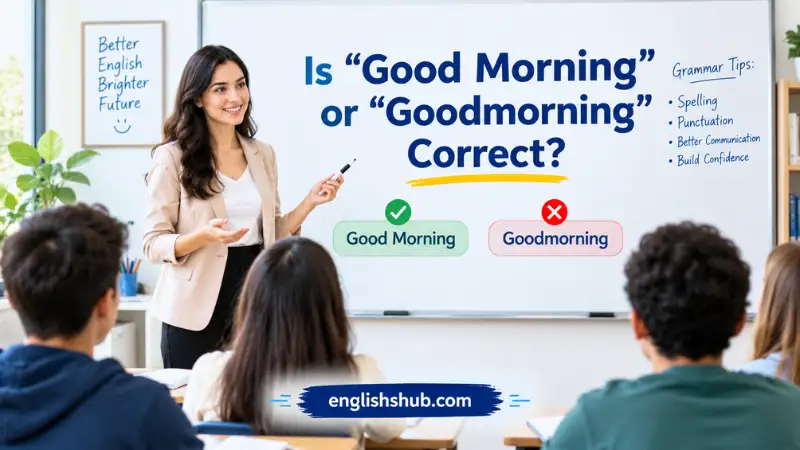
Good morning is the standard form.
When the expression functions as the familiar morning greeting, keep the space:
- Good morning, everyone! ✅
- Good morning, Sarah. ✅
- Goodmorning, everyone! ❌
- Goodmorning, Sarah. ❌
The same spelling applies whether you are speaking to a friend, teacher, customer, coworker, or stranger.
The form goodmorning may appear online because people type quickly, use usernames, create stylized captions, or make spelling mistakes. However, seeing a closed form online does not establish it as the standard spelling of the greeting.
The safest rule is simple:
When you mean the ordinary English greeting, write good morning with a space.
That rule works in school assignments, professional emails, text messages, articles, and everyday conversation.
Why Is “Good Morning” Two Words?
It is tempting to explain the spelling by saying that good is an adjective and morning is a noun, so they must always remain separate. That explanation is too broad.
English has many adjective-plus-noun combinations that have become closed compounds over time. For example:
- blackboard
- greenhouse
- newspaper
- bedroom
So the real point is that English establishes the spelling of individual expressions through usage and convention. Good morning is conventionally written as an open two-word expression.
The phrase can also appear in a normal grammatical noun phrase:
- I hope you have a good morning.
- We had a good morning at the park.
- She wished me a good morning before leaving.
Here, good modifies the noun morning. The same two words are also used as a conventional greeting:
- Good morning!
- Good morning, Professor Lee.
The spelling remains the same in both uses.
A useful memory rule
Think:
good + morning = good morning
Do not turn the expression into goodmorning simply because you see other English compounds written as one word.
What Does “Good Morning” Mean?
Good morning is a polite greeting used when people meet during the morning. Cambridge classifies it as an exclamation, while Oxford describes it as a polite way to say hello when people first see each other in the morning.
For example:
- Good morning! How are you?
- Good morning, class.
- Good morning, Mr. Davis.
- Good morning, everyone.
The phrase does not have to express a literal prediction that the other person’s morning will be good. In greeting use, it functions as a conventional way to acknowledge someone and wish them well.
However, context can make good morning an ordinary noun phrase:
- I hope you have a good morning.
Here, the speaker is wishing the person a pleasant morning rather than simply saying hello.
That distinction matters because it shows why the phrase is not just a fixed greeting in every sentence.
Capitalization Rules for “Good Morning”
Capitalization depends on the position and purpose of the phrase.
At the beginning of a sentence
Capitalize the first word:
Good morning! I hope you slept well.
Only Good needs capitalization because morning is an ordinary common noun.
In the middle of a sentence
Use lowercase unless another capitalization rule applies:
I said good morning to my neighbor.
She wished the entire team a good morning.
The phrase is not automatically capitalized just because it is a greeting.
As an email greeting
A common sentence-style form is:
Good morning, Alex,
If the greeting begins the message as a standalone salutation, capitalization conventions can vary by house style. The Editor’s Manual notes that standalone email salutations may use capitalization differently from greetings embedded in ordinary sentences.
For consistent modern professional writing, Good morning, Alex, is a clear choice.
In a title or heading
Title capitalization can produce:
Good Morning Messages
Good Morning Wishes
Here, capitalization comes from the title style, not because morning must normally be capitalized in the greeting.
Comma Rules: “Good Morning, Sarah”
When you directly address someone by name, a comma separates the greeting from the name in careful writing:
Good morning, Sarah.
Good morning, everyone.
Good morning, Professor Lee.
This is an example of a direct-address, or vocative, comma.
Compare the following:
Correct: Good morning, James.
Less careful: Good morning James.
The comma helps show that James is the person being addressed.
The same principle applies to other greetings:
- Hi, Maya.
- Hello, David.
- Good afternoon, everyone.
- Good evening, Dr. Chen.
However, punctuation practices can be more relaxed in casual digital communication. The standard form remains the better choice when you are writing carefully.
Good Morning in Emails, Texts, and Professional Writing
The spelling does not change with the communication channel.
Professional email
Good morning, Ms. Carter,
I am writing to confirm our meeting for Thursday.
The two-word form works naturally in professional communication.
Workplace message
Good morning, team. The meeting will begin at 9:00.
Text message
Good morning! Hope you slept well.
Classroom
Good morning, everyone. Please open your books.
Customer service
Good morning, Mr. Lee. How may I help you?
The tone may change according to the situation, but the spelling remains good morning.
That is an important distinction: register can change without changing the spelling.
Good Morning vs. Goodnight
Good morning sometimes causes confusion because goodnight can appear as one word.
The expressions do not need to follow identical spelling patterns.
Compare:
- Good morning! — morning greeting
- Good night! — common nighttime farewell
- a good morning — pleasant morning
- a goodnight kiss — established compound modifier
The existence of goodnight in particular compounds does not make goodmorning a standard word.
English contains many historical spelling conventions that cannot be predicted simply by looking at another expression. Therefore, memorize the established forms rather than assuming that parallel expressions must have parallel spelling.
Good Morning vs. Good Afternoon and Good Evening
The same open spelling pattern appears in the familiar expressions:
- Good morning
- Good afternoon
- Good evening
Examples:
Good morning, everyone.
Good afternoon, Professor.
Good evening, Mrs. Brown.
This comparison can make the spelling easier to remember. If you would normally write good afternoon with a space, use the same established two-word pattern for good morning.
Still, this is a memory aid rather than a universal spelling rule for every English word combination.
Pronunciation of “Good Morning”
In American English, Cambridge gives the pronunciation of good morning as /ˌɡʊd ˈmɔːr.nɪŋ/. The main stress falls on morning.
A simple approximation is:
good MOR-ning
The phrase contains two lexical words, so speakers normally hear both parts, even though connected speech can make them flow together naturally.
British English uses a closely related pronunciation, with Cambridge giving /ˌɡʊd ˈmɔː.nɪŋ/. The spelling does not change between standard American and British English.
Oxford also records morning as an informal shortened greeting:
Morning!
That is a different, shorter expression, not a reason to write goodmorning.
Is “Good Morning” Formal or Informal?
Good morning is flexible. It can be polite and professional, but it is not restricted to formal situations.
| Situation | Natural Example | Tone |
|---|---|---|
| Friend | Good morning! | Friendly |
| Teacher | Good morning, Ms. Patel. | Respectful |
| Coworker | Good morning, everyone. | Professional |
| Customer | Good morning, how may I help you? | Polite |
| Good morning, Daniel, | Professional | |
| Text | Good morning! ☀️ | Casual |
Therefore, calling good morning strictly “formal” would be misleading.
Its tone depends on the relationship, setting, delivery, and rest of the message.
For a very casual conversation, you may simply say morning! Oxford identifies this as an informal shortening of good morning.
Synonyms and Alternatives to “Good Morning”
There is no perfect one-word synonym for good morning because the expression performs a social function as a greeting.
Close alternatives
Morning!
An informal shortened version of good morning. It works best in familiar or relaxed situations.
Hello!
A general greeting that does not depend on the time of day.
Hi!
A friendly, informal greeting. EnglishShub’s guide to
explains that hi generally feels more casual, while hello has a broader and more neutral range.
Good day!
A greeting that can sound formal, old-fashioned, regional, or deliberately stylized depending on the context.
These alternatives are not perfectly interchangeable.
For example:
Good morning, Professor Lee. — specifically identifies the morning.
Hello, Professor Lee. — works at different times of day.
Hi, Professor Lee. — usually sounds more casual.
So if the time of day is relevant, good morning carries information that hello and hi do not.
Common Mistakes With “Good Morning”
Mistake 1: Writing “goodmorning”
Incorrect: Goodmorning, everyone.
Correct: Good morning, everyone.
The standard greeting contains a space.
Mistake 2: Adding a hyphen
Incorrect: Good-morning, everyone.
Correct: Good morning, everyone.
The ordinary greeting does not need a hyphen.
Mistake 3: Capitalizing both words in an ordinary sentence
Less appropriate in ordinary sentence style: I said Good Morning to my teacher.
Standard sentence style: I said good morning to my teacher.
Both words can be capitalized in a title such as Good Morning Messages, but title capitalization is a separate issue.
Mistake 4: Forgetting the direct-address comma
Careful: Good morning, Sarah.
The comma separates the greeting from the person being addressed.
Mistake 5: Assuming “goodmorning” is acceptable because it appears online
Online frequency does not automatically make a spelling standard. Usernames, hashtags, brand names, creative styling, and typos can all produce unusual closed forms.
For ordinary English writing, choose good morning.
A Simple Decision Rule
Use this three-step test:
Step 1: Are you using the expression as the morning greeting?
Write good morning.
Good morning, everyone.
Step 2: Are you describing or wishing someone a pleasant morning?
Still write good morning.
I hope you have a good morning.
Step 3: Are you putting the phrase inside a title?
Follow the title’s capitalization style.
Good Morning Messages
The spelling stays good morning. What changes is its grammatical role or capitalization.
FAQs
No. Goodmorning is not the standard one-word spelling of the ordinary English greeting. Write good morning as two words in standard English.
Yes. Good morning is a standard English greeting. Capitalize Good when the phrase begins a sentence or message. In a title, both words may be capitalized according to the title style.
In careful standard writing, use Good morning, John. The comma separates the greeting from the person being directly addressed.
Yes. Good morning is appropriate in professional emails, particularly when you are writing during the morning. The degree of formality comes from the entire message, not from the greeting alone.
You may encounter goodmorning in casual digital communication, but it is not the standard spelling. If you want standard English, use good morning, even in a text.
No. Standard British English also writes the expression as good morning. Cambridge gives British and American pronunciation information while retaining the same spelling.
It can perform the same basic greeting function, but morning! is an informal shortened form. Oxford specifically identifies morning as an informal short form of good morning.
Test Your Understanding
1. Which spelling is standard for the ordinary morning greeting?
A. Goodmorning
B. Good-morning
C. Good morning
D. Goodmorning!
2. Which sentence uses the greeting correctly with direct address?
A. Good morning Sarah.
B. Good morning, Sarah.
C. Goodmorning, Sarah.
D. Good-morning Sarah.
3. Which sentence uses “good morning” as an ordinary noun phrase rather than a standalone greeting?
A. Good morning, everyone!
B. Good morning, Professor Lee.
C. I hope you have a good morning.
D. Good morning!
4. Which capitalization is appropriate in an ordinary sentence?
A. I said Good Morning to Maya.
B. I said good morning to Maya.
C. I said good Morning to Maya.
D. I said GOOD Morning to Maya.
5. Which statement about “goodmorning” is most accurate?
A. It is the standard American spelling.
B. It is required in informal texting.
C. It is an accepted British spelling.
D. It is not the standard spelling of the ordinary greeting.
Answer Key
- C — The standard greeting is good morning, written as two separate words.
- B — A comma separates the greeting from the person being directly addressed.
- C — Here, a good morning refers to a pleasant morning rather than functioning as a standalone greeting.
- B — Inside an ordinary sentence, good morning is normally lowercase.
- D — Goodmorning may appear informally or stylistically online, but it is not the standard greeting spelling.
Conclusion
When choosing between goodmorning or good morning, use good morning in standard English. Keep the expression as two words whether you are greeting someone, writing an email, sending a text, or referring to a pleasant morning. Capitalization depends on its position, while a comma usually separates the greeting from a directly addressed name. Remember that goodnight follows different established spelling patterns, so it should not be used as a model for good morning. The simple rule is: write good morning with a space.